Math 5490 10/22/2014 Heat Imbalance Math 5490 October 22, 2014 - - PDF document

math 5490 10 22 2014
SMART_READER_LITE
LIVE PREVIEW

Math 5490 10/22/2014 Heat Imbalance Math 5490 October 22, 2014 - - PDF document

Math 5490 10/22/2014 Heat Imbalance Math 5490 October 22, 2014 Topics in Applied Mathematics: Introduction to the Mathematics of Climate Mondays mistakes corrected. Mondays and Wednesdays 2:30 3:45


slide-1
SLIDE 1

Math 5490 10/22/2014 Richard McGehee, University of Minnesota 1

Topics in Applied Mathematics: Introduction to the Mathematics of Climate

Mondays and Wednesdays 2:30 – 3:45

http://www.math.umn.edu/~mcgehee/teaching/Math5490-2014-2Fall/

Streaming video is available at

http://www.ima.umn.edu/videos/

Click on the link: "Live Streaming from 305 Lind Hall". Participation:

https://umconnect.umn.edu/mathclimate

Math 5490

October 22, 2014

Heat Imbalance

Math 5490 10/22/2014

Monday’s mistakes corrected.

James Hansen, et al, Earth’s Energy Imbalance: Confirmation and Implications, SCIENCE 308 (2005), p. 1431

Heat Imbalance

Math 5490 10/22/2014

Heat Imbalance

10 20 30 40 50 60 70 1 2 3 4 5 6 7 8 9 10 sea level rise (meters) centuries 0.1 0.85 1.7

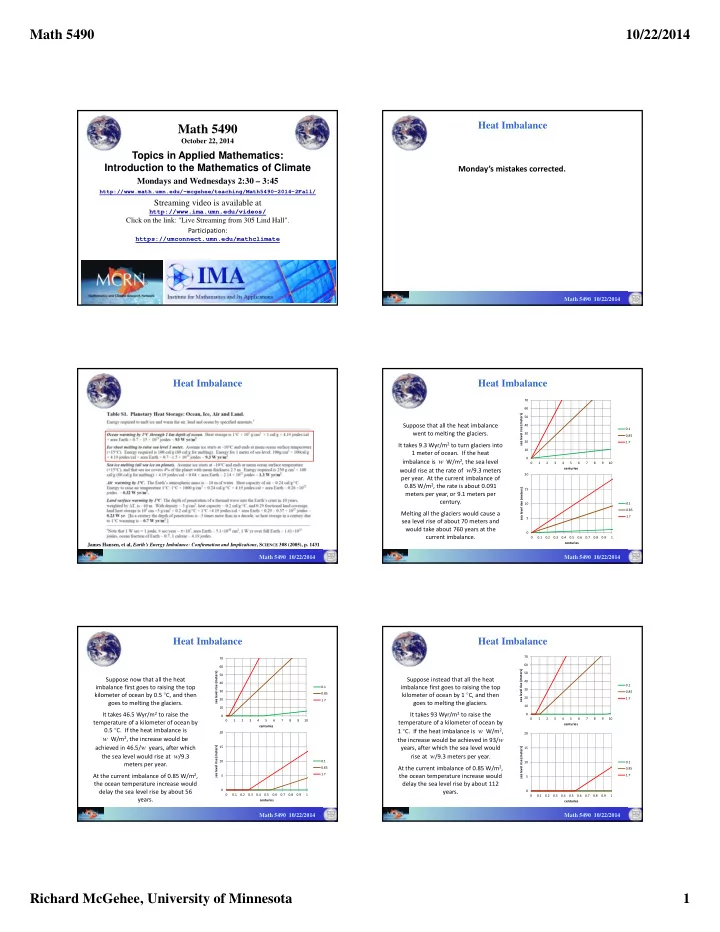
Suppose that all the heat imbalance went to melting the glaciers. It takes 9.3 Wyr/m2 to turn glaciers into 1 meter of ocean. If the heat imbalance is w W/m2, the sea level would rise at the rate of w/9.3 meters per year. At the current imbalance of 0.85 W/m2, the rate is about 0.091 meters per year, or 9.1 meters per century. Melting all the glaciers would cause a sea level rise of about 70 meters and would take about 760 years at the current imbalance.

5 10 15 20 0.1 0.2 0.3 0.4 0.5 0.6 0.7 0.8 0.9 1 sea level rise (meters) centuries 0.1 0.85 1.7

Math 5490 10/22/2014

Heat Imbalance

Suppose now that all the heat imbalance first goes to raising the top kilometer of ocean by 0.5 °C, and then goes to melting the glaciers. It takes 46.5 Wyr/m2 to raise the temperature of a kilometer of ocean by 0.5 °C. If the heat imbalance is

w W/m2, the increase would be

achieved in 46.5/w years, after which the sea level would rise at w/9.3 meters per year. At the current imbalance of 0.85 W/m2, the ocean temperature increase would delay the sea level rise by about 56 years.

10 20 30 40 50 60 70 1 2 3 4 5 6 7 8 9 10 sea level rise (meters) centuries 0.1 0.85 1.7 5 10 15 20 0.1 0.2 0.3 0.4 0.5 0.6 0.7 0.8 0.9 1 sea level rise (meters) centuries 0.1 0.85 1.7

Math 5490 10/22/2014

Heat Imbalance

Suppose instead that all the heat imbalance first goes to raising the top kilometer of ocean by 1 °C, and then goes to melting the glaciers. It takes 93 Wyr/m2 to raise the temperature of a kilometer of ocean by 1 °C. If the heat imbalance is w W/m2, the increase would be achieved in 93/w years, after which the sea level would rise at w/9.3 meters per year. At the current imbalance of 0.85 W/m2, the ocean temperature increase would delay the sea level rise by about 112 years.

10 20 30 40 50 60 70 1 2 3 4 5 6 7 8 9 10 sea level rise (meters) centuries 0.1 0.85 1.7 5 10 15 20 0.1 0.2 0.3 0.4 0.5 0.6 0.7 0.8 0.9 1 sea level rise (meters) centuries 0.1 0.85 1.7

Math 5490 10/22/2014

slide-2
SLIDE 2

Math 5490 10/22/2014 Richard McGehee, University of Minnesota 2

Heat Imbalance

Currently, it appears that the heat imbalance is mostly going to heating the ocean, not to melting ice. If this pattern continues, the danger for this century is more likely to come from weather changes than from sea level rise. The current heat imbalance has the potential to raise the sea level by almost a meter per decade, a major threat to coastal cities worldwide.

Summary

Math 5490 10/22/2014

What’s Happening Now?

Heat Imbalance

IPCC AR5 (2013) Figure 2.20 hiatus hiatus

Math 5490 10/22/2014

What’s Happening Now?

Heat Imbalance

Chou & Tung, Science 345 (2014) p 897

The heat imbalance is being absorbed by the ocean (at 1000 meters, not the surface).

Math 5490 10/22/2014

What’s Happening Now?

Heat Imbalance

The Good News The surface temperatures are remaining fairly constant, so the perceived warming is small. This hiatus gives us an opportunity to address the basic problem (mitigation). The Bad News The surface temperatures are remaining fairly constant, so the perceived warming is small. This hiatus could lull us into complacency so that we do not address the basic problem. There is evidence that hiatuses (hiati?) correspond to 60 year cycles of the AMOC. Will we experience another strong warming period in 30 years?

Chou & Tung, Science 345 (2014) p 897

Math 5490 10/22/2014

Ocean Circulation

Atlantic Meridional Overturning Circulation (AMOC) Cold salty water is dense, so it descends in the North Atlantic. The rate of circulation is a function of the temperature and salinity and can change over time.

Math 5490 10/22/2014

Ocean Circulation

Atmospheric Circulation Drives the Surface Ocean Circulation

Math 5490 10/22/2014

slide-3
SLIDE 3

Math 5490 10/22/2014 Richard McGehee, University of Minnesota 3

Ocean Circulation

Surface Ocean Circulation

Kaper & Engler

Math 5490 10/22/2014

Ocean Circulation

Overturning Ocean Circulation

Kaper & Engler

Math 5490 10/22/2014

Ocean Circulation

Simplified Overturning Ocean Circulation “Conveyer Belt”, “Thermohaline Circulation.

Kaper & Engler

Math 5490 10/22/2014

Ocean Circulation

Simplified Overturning Ocean Circulation View Looking Down on Antarctic

http://commons.wikimedia.org/wiki/File:Conveyor_belt.svg Math 5490 10/22/2014

Ocean Circulation

Atlantic Meridional Overturning Circulation (AMOC)

Part of the “thermohaline circulation”. thermo: heat haline: salt Cold salty water is dense, so it descends in the North Atlantic. The rate of circulation is a function of the temperature and salinity and can change over time.

Math 5490 10/22/2014

Ocean Box Models

Thermohaline Circulation

The circulation is driven by density differences, which are functions

  • f temperature and salinity.

Kaper & Engler

Math 5490 10/22/2014

slide-4
SLIDE 4

Math 5490 10/22/2014 Richard McGehee, University of Minnesota 4

Ocean Box Models

Stommel Model

Henry Stommel, Thermohaline Convection with Two Stable Regimes

  • f Flow, TELLUS XII (1961), 224-230.

Kaper & Engler

Math 5490 10/22/2014

Ocean Box Models

Math 5490 10/22/2014 ( ) ( ) dT c T T dt dS d S S dt

 

    Stommel, TELLUS XII (1961)

* * * *

Stommel Model

T: temperature S: salinity Stars indicate constant bath temperature and salinity.

Ocean Box Models

Math 5490 10/22/2014 ( ) ( ) dT c T T dt dS d S S dt

 

   

Dynamical Systems Approach

Both equation have the form: ( ), where and are constant. dx x x x dt  

 

  dx x dt    ( ) , where is an arbitrary constant.

t

x t ce c

 

 Consider first General solution Let (0) x x c   ( )

t

x t x e 

Ocean Box Models

Math 5490 10/22/2014

Dynamical Systems Approach

dx x dt   

t

 

t x x

 

x x

Ocean Box Models

Math 5490 10/22/2014

Dynamical Systems Approach

Back to: ( ), where and are constant. dx x x x dt  

 

  ( ) , where is an arbitrary constant.

t

x t x ce 

 

  General solution “Asymptotic stability”

  • f the equilibrium

solution ( ) ( )

t

x t x x x e 

  

   Equilibrium solution ( ), so ( ) (constant). dx x x x t x dt 

 

    (0) , so . x x x c c x x

 

     If 0, ( ) as . x t x t 

   

Ocean Box Models

Math 5490 10/22/2014

Dynamical Systems Approach

dx x dt   

t

 

x x

 

x x x* x* t x* x*

stable unstable

slide-5
SLIDE 5

Math 5490 10/22/2014 Richard McGehee, University of Minnesota 5

Ocean Box Models

Math 5490 10/22/2014 ( ) ( ) dT c T T dt dS d S S dt

 

   

Dynamical Systems Approach

Solve each separately: ( ) ( ) ( ) ( )

ct dt

T t T T T e S t S S S e

     

      ( , ) T S

 

d c  T S “Phase Portraits” T S d c  ( , ) T S

 

Ocean Box Models

Math 5490 10/22/2014 ( ) ( ) dT c T T dt dS d S S dt

 

   

Dynamical Systems Approach

“Non‐dimensionalize” We want to (1) take away as many units as possible, and (2) get rid of as many constants as possible. Let , T S y x T S

 

  1 ( ) 1 (1 ) 1 ( ) 1 (1 ) dy dT c T T T c c y dt T dt T T dx dS d S S S d d x dt S dt S S

       

                          (1 ) (1 ) dy c y dt dx d x dt     The new variables x and y are “dimensionless”.

Ocean Box Models

Math 5490 10/22/2014

Dynamical Systems Approach

“Time scaling” We are not wedded to seconds. Introduce a new time variable τ : d cdt   1 1 (1 ) 1 1 1 (1 ) (1 ) dy dy dy c y y d cdt c dt c dx dx dx d d x x d cdt c dt c c               (1 ) (1 ) dy c y dt dx d x dt     1 (1 ) dy y d dx d x d c      

Ocean Box Models

Math 5490 10/22/2014

Dynamical Systems Approach

Finally, introduce the ratio of the rates at which the temperature and salinity equilibrate. d c   1 (1 ) dy y d dx d x d c       1 (1 ) dy y d dx x d        By rescaling the temperature, salinity, and time, we have reduced the

  • riginal system with four parameters, to one with just one parameter.

( ) ( ) dT c T T dt dS d S S dt

 

   