Math 5490 9/29/2014 Glacial Cycles Math 5490 September 29, 2014 - - PDF document

math 5490 9 29 2014
SMART_READER_LITE
LIVE PREVIEW

Math 5490 9/29/2014 Glacial Cycles Math 5490 September 29, 2014 - - PDF document

Math 5490 9/29/2014 Glacial Cycles Math 5490 September 29, 2014 The Big Picture Topics in Applied Mathematics: Introduction to the Mathematics of Climate Mondays and Wednesdays 2:30 3:45


slide-1
SLIDE 1

Math 5490 9/29/2014 Richard McGehee, University of Minnesota 1

Topics in Applied Mathematics: Introduction to the Mathematics of Climate

Mondays and Wednesdays 2:30 – 3:45

http://www.math.umn.edu/~mcgehee/teaching/Math5490-2014-2Fall/

Streaming video is available at

http://www.ima.umn.edu/videos/

Click on the link: "Live Streaming from 305 Lind Hall". Participation:

https://umconnect.umn.edu/mathclimate

Math 5490

September 29, 2014

Glacial Cycles

http://www.snowballearth.org/when.html

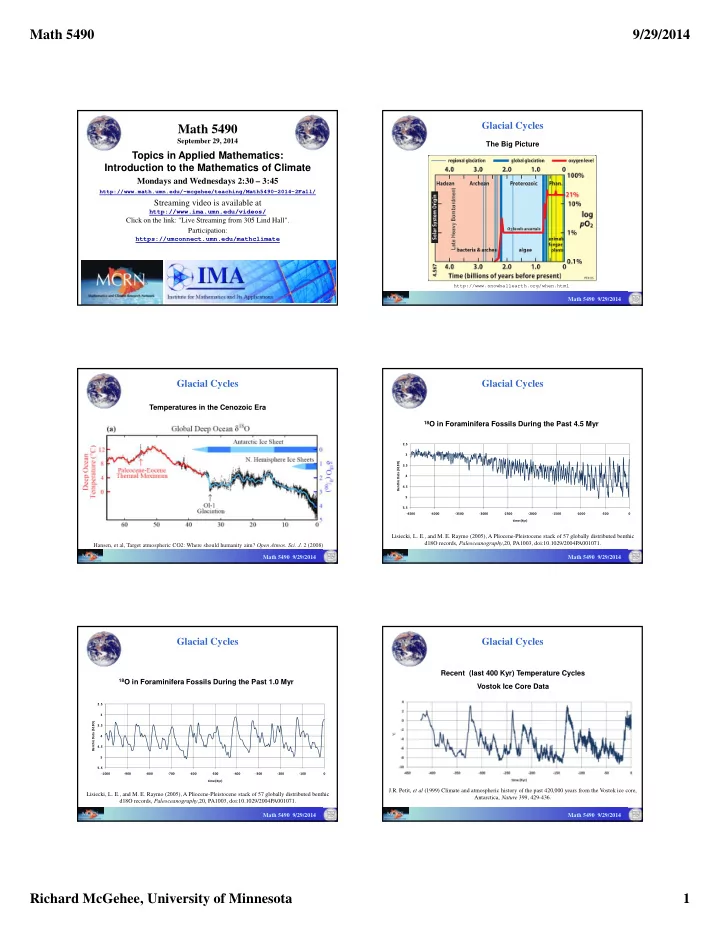
The Big Picture

Math 5490 9/29/2014

Glacial Cycles

Hansen, et al, Target atmospheric CO2: Where should humanity aim? Open Atmos. Sci. J. 2 (2008)

Temperatures in the Cenozoic Era

Math 5490 9/29/2014

18O in Foraminifera Fossils During the Past 4.5 Myr

Lisiecki, L. E., and M. E. Raymo (2005), A Pliocene-Pleistocene stack of 57 globally distributed benthic d18O records, Paleoceanography,20, PA1003, doi:10.1029/2004PA001071.

2.5 3 3.5 4 4.5 5 5.5 ‐4500 ‐4000 ‐3500 ‐3000 ‐2500 ‐2000 ‐1500 ‐1000 ‐500 Benthic Data (δ18O) time (Kyr)

Glacial Cycles

Math 5490 9/29/2014

2.5 3 3.5 4 4.5 5 5.5 ‐1000 ‐900 ‐800 ‐700 ‐600 ‐500 ‐400 ‐300 ‐200 ‐100 Benthic Data (δ18O) time (Kyr)

18O in Foraminifera Fossils During the Past 1.0 Myr

Glacial Cycles

Lisiecki, L. E., and M. E. Raymo (2005), A Pliocene-Pleistocene stack of 57 globally distributed benthic d18O records, Paleoceanography,20, PA1003, doi:10.1029/2004PA001071. Math 5490 9/29/2014

Recent (last 400 Kyr) Temperature Cycles Vostok Ice Core Data

J.R. Petit, et al (1999) Climate and atmospheric history of the past 420,000 years from the Vostok ice core, Antarctica, Nature 399, 429-436.

Glacial Cycles

Math 5490 9/29/2014

slide-2
SLIDE 2

Math 5490 9/29/2014 Richard McGehee, University of Minnesota 2

Eccentricity

John Imbrie & Katherine Palmer Imbrie, Ice Ages: Solving the Mystery, Harvard Univ. Press, 1979.

Glacial Cycles

Math 5490 9/29/2014

  • J. Laskar, et al (2004) A long-term numerical solution for the insolation quantities of the Earth, Astronomy &

Astrophysics 428, 261–285.

The effect due to eccentricity is more significant, but not that much: As e varies between 0 and 0.06, (1-e2)-1/2 varies between 1 and 1.0018, or about 0.2%. (Twenty times the effect due to a.)

Eccentricity

Note periods of about 100 kyr and 400 kyr.

0.00 0.01 0.02 0.03 0.04 0.05 0.06 ‐1000 ‐900 ‐800 ‐700 ‐600 ‐500 ‐400 ‐300 ‐200 ‐100 eccentricity time (Kyr)

Glacial Cycles

Math 5490 9/29/2014

Obliquity

http://upload.wikimedia.org/wikipedia/commons/6/61/AxialTiltObliquity.png

Glacial Cycles

Math 5490 9/29/2014

Note period of about 41 Kyr.

22.0 22.5 23.0 23.5 24.0 24.5 ‐1000 ‐900 ‐800 ‐700 ‐600 ‐500 ‐400 ‐300 ‐200 ‐100

  • bliquity (degrees)

time (Kyr)

Glacial Cycles

Obliquity

  • J. Laskar, et al (2004) A long-term numerical solution for the insolation quantities of the Earth, Astronomy &

Astrophysics 428, 261–285. Math 5490 9/29/2014

Precession

http://earthobservatory.nasa.gov/Library/Giants/Milankovitch/milankovitch_2.html

Glacial Cycles

Math 5490 9/30/2014

Precession Index

Note period of about 23 Kyr. index = e sinρ, where e = eccentricity and ρ = precession angle (measured from spring equinox)

‐0.06 ‐0.04 ‐0.02 0.00 0.02 0.04 0.06 ‐1000 ‐900 ‐800 ‐700 ‐600 ‐500 ‐400 ‐300 ‐200 ‐100 time (Kyr)

Glacial Cycles

  • J. Laskar, et al (2004) A long-term numerical solution for the insolation quantities of the Earth, Astronomy &

Astrophysics 428, 261–285. Math 5490 9/30/2014

slide-3
SLIDE 3

Math 5490 9/29/2014 Richard McGehee, University of Minnesota 3

Glacial Cycles

http://en.wikipedia.org/wiki/Zodiac

Precession

Math 5490 9/29/2014

Daily Average Insolation at Summer Solstice at 65° N

420 440 460 480 500 520 540 560 580 ‐1000 ‐900 ‐800 ‐700 ‐600 ‐500 ‐400 ‐300 ‐200 ‐100 W/m^2 Kyr

Glacial Cycles

Math 5490 9/29/2014 http://en.wikipedia.org/wiki/Milankovitch_cycles

Glacial Cycles

Math 5490 9/29/2014 Milutin Milankovitch 1879-1958

Milutin Milankovitch was a Serbian mathematician and professor at the University of Belgrade. In 1920 he published his seminal work on the relation between insolation and the Earth’s orbital parameters. In 1941 he published a book explaining his entire theory. His work was not fully accepted until 1976. Who was Milankovitch?

Glacial Cycles

Math 5490 9/29/2014

What happened in 1976? Hays, Imbrie, and Shackleton, “Variations in the Earth's Orbit: Pacemaker of the Ice Ages,” Science 194, 10 December 1976. “It is concluded that changes in the earth's

  • rbital geometry are the fundamental cause
  • f the succession of Quaternary ice ages.”

James D. Hays John Imbrie Nicholas Shackleton

Glacial Cycles

Math 5490 9/29/2014

Suggested Reading

John Imbrie & Katherine Palmer Imbrie, Ice Ages: Solving the Mystery, HARVARD UNIVERSITY PRESS, 1979

Glacial Cycles

Math 5490 9/29/2014

slide-4
SLIDE 4

Math 5490 9/29/2014 Richard McGehee, University of Minnesota 4

1800 1820 1840 1860 1880 1900 1920 1940 1960 1980 2000

Agassiz announces glacial theory

History of Discovery

Adhemar explains glacial cycles Humboldt debunks Adhemar Croll explains glacial cycles Evidence of multiple ice ages discovered in Illinois Magnetic reversals discovered Milankovitch explains glacial cycles

18O theory developed

climate fluctuations found in ocean cores paleomagnetic time scale developed Hays, et al

Glacial Cycles

Fourier Math 5490 9/29/2014

Glacial Cycles

Church of Saint Sulpice, Paris

Math 5490 9/29/2014

Glacial Cycles

Church of Saint Sulpice, Paris

Math 5490 9/29/2014

Glacial Cycles

Church of Saint Sulpice, Paris

Math 5490 9/29/2014

Glacial Cycles

Church of Saint Sulpice, Paris

Math 5490 9/29/2014

Glacial Cycles

Church of Saint Sulpice, Paris

Math 5490 9/29/2014

slide-5
SLIDE 5

Math 5490 9/29/2014 Richard McGehee, University of Minnesota 5

Suggested Reading

Dan Brown, The Da Vinci Code, ANCHOR BOOKS, 2003

Glacial Cycles

Math 5490 9/29/2014

Milankovitch Theory, verified by Hays, et al: The glacial cycles are driven by the variations in the Earth’s

  • rbit (Milankovitch Cycles), causing a variation in incoming

solar radiation (insolation). We see the evidence for the existence of glacial cycles in the climate record. We can compute the Milankovitch cycles from classical physics and evidence has been gathered for thousands of years. What is the evidence for the connection between glacial cycles and Milankovitch cycles?

Glacial Cycles

Math 5490 9/29/2014

Example: The ice ages occur about every 100,000 year, and the eccentricity of the Earth’s orbit cycles through changes every 100,000 years. Can we quantify this observation?

Glacial Cycles

Math 5490 9/29/2014

Example: The ice ages occur about every 100,000 year, and the eccentricity of the Earth’s orbit cycles through changes every 100,000 years. Can we quantify this observation?

Glacial Cycles

Fourier Transform (Power Spectrum) time series power spectrum

Math 5490 9/29/2014

Solar Forcing (Hays, et al) Hays, et al, Science 194 (1976), p. 1125

Glacial Cycles

Math 5490 9/29/2014

Climate Response, Hays, et al Three different temperature proxies from sea sediment data.

Glacial Cycles

Hays, et al, Science 194 (1976), p. 1125

Math 5490 9/29/2014

slide-6
SLIDE 6

Math 5490 9/29/2014 Richard McGehee, University of Minnesota 6

Eccentricity

Glacial Cycles

0.01 0.02 0.03 0.04 0.05 0.06 ‐5500 ‐5000 ‐4500 ‐4000 ‐3500 ‐3000 ‐2500 ‐2000 ‐1500 ‐1000 ‐500 eccentricity Kyr

Math 5490 9/29/2014

Obliquity

Glacial Cycles

22.0 22.5 23.0 23.5 24.0 24.5 ‐5500 ‐5000 ‐4500 ‐4000 ‐3500 ‐3000 ‐2500 ‐2000 ‐1500 ‐1000 ‐500

  • bliquity (degrees)

Kyr

Math 5490 9/29/2014

Precession Index

Glacial Cycles

‐0.06 ‐0.04 ‐0.02 0.02 0.04 0.06 ‐5500 ‐5000 ‐4500 ‐4000 ‐3500 ‐3000 ‐2500 ‐2000 ‐1500 ‐1000 ‐500 precession index Kyr

Math 5490 9/29/2014

Spectral Analysis of the Milankovitch cycles.

0.01 0.02 0.03 0.04 0.05 0.06 ‐5500 ‐5000 ‐4500 ‐4000 ‐3500 ‐3000 ‐2500 ‐2000 ‐1500 ‐1000 ‐500 eccentricity Kyr 22.0 22.5 23.0 23.5 24.0 24.5 ‐5500 ‐5000 ‐4500 ‐4000 ‐3500 ‐3000 ‐2500 ‐2000 ‐1500 ‐1000 ‐500

  • bliquity (degrees)

Kyr ‐0.06 ‐0.04 ‐0.02 0.02 0.04 0.06 ‐2000 ‐1800 ‐1600 ‐1400 ‐1200 ‐1000 ‐800 ‐600 ‐400 ‐200 precession index Kyr

Laskar’s computations Spectra

Eccentricity Obliquity Precession

Math 5490 9/29/2014

Glacial Cycles

Summer Solstice 65°N

Glacial Cycles

420 460 500 540 580 ‐5500 ‐5000 ‐4500 ‐4000 ‐3500 ‐3000 ‐2500 ‐2000 ‐1500 ‐1000 ‐500 W/m2 Kyr

eccentricity?

  • bliquity

precession

Math 5490 9/29/2014

Climate Response, Hays, et al Three different temperature proxies from sea sediment data.

Glacial Cycles

Hays, et al, Science 194 (1976), p. 1125

Math 5490 9/29/2014

slide-7
SLIDE 7

Math 5490 9/29/2014 Richard McGehee, University of Minnesota 7

2) ... climatic variance of these records is concentrated in three discrete spectral peaks at periods of 23,000, 42,000, and approximately 100,000 years. These peaks correspond to the dominant periods of the earth's solar orbit, and contain respectively about 10, 25, and 50 percent of the climatic variance. Hays, et al, Summary

Glacial Cycles

Hays, et al, Science 194 (1976), p. 1125

Math 5490 9/29/2014

Hays with Modern Data

Glacial Cycles

3 3.5 4 4.5 5 5.5 ‐500 ‐450 ‐400 ‐350 ‐300 ‐250 ‐200 ‐150 ‐100 ‐50 d18O Kyr

Math 5490 9/29/2014

Milankovitch vs. Climate

Glacial Cycles

eccentricity?

  • bliquity

precession

Math 5490 9/29/2014

Hays, et al, Science 194 (1976), p. 1127 Hays, et al, Summary Increasing contribution Forcing precession

  • bliquity

eccentricity eccentricity

  • bliquity

precession Response Hays’ explanation is that there are nonlinear feedbacks. Are there other explanations?

Glacial Cycles

Math 5490 9/29/2014

Zachos, et al, Science 292 (2001), p. 689 Cenozoic Era

Glacial Cycles

Math 5490 9/29/2014

Glacial Cycles

Temperatures in the Cenozoic Era

Hansen, et al, Target atmospheric CO2: Where should humanity aim? Open Atmos. Sci. J. 2 (2008) Math 5490 9/29/2014

slide-8
SLIDE 8

Math 5490 9/29/2014 Richard McGehee, University of Minnesota 8

Climate Response (Zachos, et al) Zachos, et al, Science 292 (2001), p. 689 Power spectrum of climate for the last 4.5

  • Myr. Note the peaks

at 41Kyr and 100 Kyr.

Glacial Cycles

Math 5490 9/29/2014

Zachos, et al, Summary Increasing contribution Nonlinear effects? Other explanations? Zachos, et al, Science 292 (2001), p. 689 Forcing precession

  • bliquity

eccentricity

  • bliquity

eccentricity precession Response

Glacial Cycles

Math 5490 9/29/2014

0.00 0.01 0.02 0.03 0.04 0.05 0.06 power frequency (1/Kyr) 100 Kyr 41 Kyr 23 Kyr

precession

  • bliquity

eccentricity

Spectral Analysis of the Climate Data

2.5 3.0 3.5 4.0 4.5 5.0 5.5 ‐5500 ‐5000 ‐4500 ‐4000 ‐3500 ‐3000 ‐2500 ‐2000 ‐1500 ‐1000 ‐500 δ18O Kyr

Glacial Cycles

Math 5490 9/29/2014

0.00 0.01 0.02 0.03 0.04 0.05 0.06 power frequency (1/Kyr) 100 Kyr 41 Kyr 23 Kyr

precession

  • bliquity

eccentricity

Spectral Analysis of the Climate Data

2.5 3.0 3.5 4.0 4.5 5.0 5.5 ‐5500 ‐5000 ‐4500 ‐4000 ‐3500 ‐3000 ‐2500 ‐2000 ‐1500 ‐1000 ‐500 δ18O Kyr

Conclusion Remains: The Milankovitch cycles “pace” the Earth’s climate. Exactly how is not so clear.

Glacial Cycles

Math 5490 9/29/2014

Incoming Solar Radiation (Insolation), averaged over the entire globe and over a full year, depends only on eccentricity e , not on either obliquity or precession.

 

2

1 Q Q e e  

   

2 2 2

2 , 1 cos sin cos sin cos cos s d

            

   

, I Q e s y   Insolation as a function of latitude, averaged over a full year, depends on eccentricity e and obliquity β , but not precession. where latitude  

Why such a small precession contribution?

Glacial Cycles

Math 5490 9/29/2014

Increasing contribution If we assume that glaciation depends on annual average insolation instead of insolation at summer solstice, then forcing and response are aligned. Forcing

  • bliquity

eccentricity

  • bliquity

eccentricity Response precession precession

Glacial Cycles

Zachos Summary (Revised)

Math 5490 9/29/2014

slide-9
SLIDE 9

Math 5490 9/29/2014 Richard McGehee, University of Minnesota 9

Something’s Missing

Glacial Cycles

22.0 22.5 23.0 23.5 24.0 24.5 ‐5500 ‐5000 ‐4500 ‐4000 ‐3500 ‐3000 ‐2500 ‐2000 ‐1500 ‐1000 ‐500

  • bliquity (degrees)

Kyr

2.5 3 3.5 4 4.5 5 5.5 ‐6000 ‐5000 ‐4000 ‐3000 ‐2000 ‐1000 d18O Kyr

Lisiecki‐Raymo Stack

  • bliquity

climate

Math 5490 9/29/2014 data power spectrum

Glacial Cycles

2.5 3 3.5 4 4.5 5 5.5 ‐6000 ‐5000 ‐4000 ‐3000 ‐2000 ‐1000 d18O Kyr

Lisiecki‐Raymo Stack 0.00 0.01 0.02 0.03 0.04 0.05 0.06 power frequency (1/Kyr) 100 Kyr 41 Kyr 23 Kyr

eccentricity?

  • bliquity

precession

Something’s Missing

Math 5490 9/29/2014 Last Million Years is Different

Glacial Cycles

  • 5 to -1 Myr

0.00 0.01 0.02 0.03 0.04 0.05 0.06 power frequency (1/Kyr) 100 Kyr 41 Kyr 23 Kyr

eccentricity?

  • bliquity

precession

  • 1 to 0 Myr
  • 5 to 0 Myr

A transition

  • ccurred about
  • ne million

years ago: the amplitude increased and the dominant period changed from 41 kyr to 100 kyr.

Math 5490 9/29/2014

What’s up with the Last Million Years?

Glacial Cycles

100,000 Year Problem: Why did the eccentricity signal become so dominant during the last million years? 400,000 Year Problem: If the last million years is dominated by eccentricity, what happened to the 400,000 year cycle?

eccentricity

0.00 0.01 0.02 0.03 0.04 0.05 0.06 power frequency (1/Kyr) 100 Kyr 41 Kyr 23 Kyr

eccentricity?

  • bliquity

precession

data

Math 5490 9/29/2014