Math 5490 11/17/2014 Dynamical Systems Math 5490 November 17, - - PDF document

math 5490 11 17 2014
SMART_READER_LITE
LIVE PREVIEW

Math 5490 11/17/2014 Dynamical Systems Math 5490 November 17, - - PDF document

Math 5490 11/17/2014 Dynamical Systems Math 5490 November 17, 2014 Topics in Applied Mathematics: Introduction to the Mathematics of Climate Mondays and Wednesdays 2:30 3:45 Bifurcation Theory


slide-1
SLIDE 1

Math 5490 11/17/2014 Richard McGehee, University of Minnesota 1

Topics in Applied Mathematics: Introduction to the Mathematics of Climate

Mondays and Wednesdays 2:30 – 3:45

http://www.math.umn.edu/~mcgehee/teaching/Math5490-2014-2Fall/

Streaming video is available at

http://www.ima.umn.edu/videos/

Click on the link: "Live Streaming from 305 Lind Hall". Participation:

https://umconnect.umn.edu/mathclimate

Math 5490

November 17, 2014

Dynamical Systems

Math 5490 11/17/2014

Bifurcation Theory

Dynamical Systems

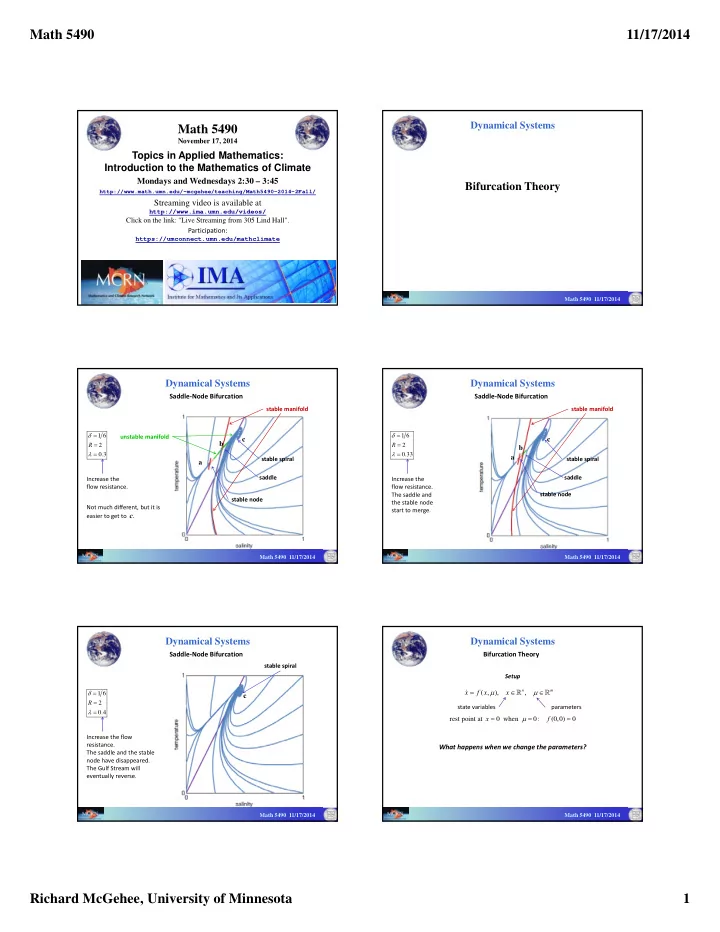
1 6 2 0.3 R     

a b c

stable manifold stable spiral saddle unstable manifold stable node Increase the flow resistance. Not much different, but it is easier to get to c.

Saddle‐Node Bifurcation

Math 5490 11/17/2014

Dynamical Systems

1 6 2 0.33 R     

a b c

stable manifold stable spiral saddle stable node Increase the flow resistance. The saddle and the stable node start to merge.

Saddle‐Node Bifurcation

Math 5490 11/17/2014

Saddle‐Node Bifurcation

Dynamical Systems

1 6 2 0.4 R     

c

stable spiral Increase the flow resistance. The saddle and the stable node have disappeared. The Gulf Stream will eventually reverse.

Math 5490 11/17/2014

Dynamical Systems

Math 5490 11/17/2014

Bifurcation Theory ( , ), ,

n m

x f x x        

parameters Setup state variables

What happens when we change the parameters? rest point at 0 when 0: (0,0) x f    

slide-2
SLIDE 2

Math 5490 11/17/2014 Richard McGehee, University of Minnesota 2

Dynamical Systems

Math 5490 11/17/2014

Bifurcation Theory ( , ), ,

n m

x f x x        

No Bifurcation (Poincaré Continuation) rest point at 0 when 0 : (0,0) x f    

1

The Jacobian matrix (0,0) is nonsingular, i.e., has no zero eigenvalues. D f Conclusion For small values of , there is a rest point ( ) satisfying (0) 0, ( ( ), ) 0. p p f p       The rest point “continues” for small parameter values.

Dynamical Systems

Math 5490 11/17/2014

Bifurcation Theory ( , ), ,

n m

x f x x        

Poincaré Continuation rest point at 0 when 0 : (0,0) x f    

2 1 1 2

We can write ( , ) O ( , ) 0, where (0,0) and is an matrix and solve for : ( ) O ( ). f x Ax B x A D f B n m x x p A B      

         Idea of Proof

1

If Jacobian matrix (0,0) is nonsingular, then, for small values of , there is a rest point ( ) satisfying (0) 0, ( ( ), ) 0. D f p p f p      

Dynamical Systems

Math 5490 11/17/2014

Bifurcation Theory ( , ), ,

n m

x f x x        

rest point at 0 when 0: (0,0) x f     There’s more!

1 1

If is continuously differentiable ( ), then the Jacobian matrix ( ( ), ) varies continuously with , as do the eigenvalues and eigenvectors. f C D f p    If the rest point at μ = 0 is hyperbolic (or a saddle, or a stable node,

  • r an unstable node, or a stable spiral, or an unstable spiral), then the

rest point p(μ ) inherits the property for small values of μ . Poincaré Continuation

1

If Jacobian matrix (0,0) is nonsingular, then, for small values of , there is a rest point ( ) satisfying (0) 0, ( ( ), ) 0. D f p p f p      

Dynamical Systems

Classification

determinant trace Math 5490 11/17/2014

Poincare continuation Poincare continuation fails when determinant = 0.

Kaper & Engler, 2013

Dynamical Systems

Math 5490 11/17/2014

Bifurcation Theory

Example

2

In this example, we can solve explicitly: 2 2 4 4 1 1 . 2 Since (0) 0 , we take the "+" sign: ( ) 1 1 . x x x p x p                      

2 1 1 2

( , ) 2 ( , ) 2 2 , so (0,0) 2 0, so there is a rest point ( ) satisfying (0) 0. ( ) O ( ). 2 x f x x x D f x x D f x p p x p                        For each value of μ close to 0, there is a unique rest point near x = 0.

Dynamical Systems

Bifurcation Theory

Example

1

Note that there is another rest point at 2 for 0. Its eigenvalue is ( 2,0) 2 2( 2) 2, so it is unstable. Futhermore, for small values of , there is a unique rest point ( ) near 2, x D f p x                and that rest point is unstable.

2 1 1

( , ) 2 ( , ) 2 2 , so (0,0) 2, so the rest point ( ) has an eigenvalue near 2 for small and hence is asymptotically stable. x f x x x D f x x D f x p                  2  small  Math 5490 11/17/2014

slide-3
SLIDE 3

Math 5490 11/17/2014 Richard McGehee, University of Minnesota 3

Dynamical Systems

Classification

determinant trace Math 5490 11/17/2014

Poincare continuation Poincare continuation fails when determinant = 0. What happens when it fails?

Kaper & Engler, 2013

Dynamical Systems

Bifurcation Theory

Example

2

( , ) 2 x f x x x        Math 5490 11/17/2014

2

Two rest points: 2 0, 1 1 x x x         

‐2 ‐1 1 2 3 4 ‐3 ‐2 ‐1 1

x  stable unstable saddle‐node

1 ( , )

2 2 D f x x    

1 2

rest point: 1 1 eigenvalue: 2 1 rest point: 1 1 eigenvalue: 2 1 p p                When μ = -1 , the rest points merge, and the eigenvalue becomes 0. The rest point becomes a “saddle‐node”.

‐2 ‐1 1 2 3 4 ‐3 ‐2 ‐1 1

x  stable unstable saddle‐node

Dynamical Systems

Bifurcation Theory

Example

2

( , ) 2 x f x x x        Math 5490 11/17/2014   1    2   

Dynamical Systems

Bifurcation Theory

Example

2

2 x x y y        Math 5490 11/17/2014

 

 

Rest Points: 0 : two rest points: ( , ) ,0 0 :

  • ne rest point:

( , ) 0,0 0 : no rest point x y x y           

 

1

2 Jacobian ( , ), 2 x D f x y          vector field

   

1 1

2 ( ,0), 2 2 ( ,0), 2 D f D f                             

μ < 0

saddle stable node

Dynamical Systems

Bifurcation Theory

Example

2

2 x x y y        Math 5490 11/17/2014

 

1

2 Jacobian ( , ), 2 x D f x y          vector field

 

1

(0,0), 2 D f         

μ = 0

determinant = 0 trace < 0 The local structure is not determined by the linearized equations.

 

 

Rest Points: 0 : two rest points: ( , ) ,0 0 :

  • ne rest point:

( , ) 0,0 0 : no rest point x y x y           

Dynamical Systems

Bifurcation Theory

Example

2

2 x x y y        Math 5490 11/17/2014

 

 

Rest Points: 0 : two rest points: ( , ) ,0 0 :

  • ne rest point:

( , ) 0,0 0 : no rest point x y x y            vector field

‐2 ‐1 1 2 ‐3 ‐2 ‐1 1

 x saddle stable node saddle‐node

slide-4
SLIDE 4

Math 5490 11/17/2014 Richard McGehee, University of Minnesota 4

Dynamical Systems

Bifurcation Theory

Example

2

2 x x y y        Math 5490 11/17/2014       saddle stable node saddle node

Dynamical Systems

1 6 2 0.3 R     

a b c

stable manifold stable spiral saddle unstable manifold stable node Increase the flow resistance. Not much different, but it is easier to get to c.

Stommel Model

Math 5490 11/17/2014

Dynamical Systems

1 6 2 0.33 R     

a b c

stable manifold stable spiral saddle stable node Increase the flow resistance. The saddle and the stable node start to merge.

Math 5490 11/17/2014

Stommel Model

Dynamical Systems

1 6 2 0.4 R     

c

stable spiral Increase the flow resistance. The saddle and the stable node have disappeared. The Gulf Stream will eventually reverse.

Math 5490 11/17/2014

Stommel Model

Dynamical Systems

Math 5490 11/17/2014

Example

Bifurcation Theory

3

3 x x x     

‐3 ‐2 ‐1 1 2 3 ‐3 ‐2 ‐1 1 2 3

μ

x 3 3

3 0, 3 x x x x        Rest Points

2 1 ( , )

3 3 D f x x   

1 1 1

stable: ( , ) 0, if 1 unstable: ( , ) 0, if 1 ( , ) 0, if 1 D f x x D f x x D f x x          

Dynamical Systems

Math 5490 11/17/2014

Example

Bifurcation Theory

3

3 x x x     

‐3 ‐2 ‐1 1 2 3 ‐3 ‐2 ‐1 1 2 3

μ

x 3 3

3 0, 3 x x x x        Rest Points

slide-5
SLIDE 5

Math 5490 11/17/2014 Richard McGehee, University of Minnesota 5

Dynamical Systems

Math 5490 11/17/2014

Example

Bifurcation Theory

3

3 x x x     

‐3 ‐2 ‐1 1 2 3 ‐3 ‐2 ‐1 1 2 3

x μ

desirable undesirable Hysteresis The system has a memory

  • f where it has been.

Returning parameters to the previous state might not return the system to the previous state Start here

Dynamical Systems

Math 5490 11/17/2014

Example

Bifurcation Theory

3

3 x x x     

‐3 ‐2 ‐1 1 2 3 ‐3 ‐2 ‐1 1 2 3

x μ

desirable undesirable Hysteresis Decrease the parameter to ‐2 (the tipping point).

Dynamical Systems

Math 5490 11/17/2014

Example

Bifurcation Theory

3

3 x x x     

‐3 ‐2 ‐1 1 2 3 ‐3 ‐2 ‐1 1 2 3

x μ

desirable undesirable Hysteresis Decrease to below the tipping point. The system flips to the other stable state.

Dynamical Systems

Math 5490 11/17/2014

Example

Bifurcation Theory

3

3 x x x     

‐3 ‐2 ‐1 1 2 3 ‐3 ‐2 ‐1 1 2 3

x μ

desirable undesirable Hysteresis We now increase the parameter back to its starting value, but the system stays in the new state.

Dynamical Systems

Math 5490 11/17/2014

Example

Bifurcation Theory

3

3 x x x     

‐3 ‐2 ‐1 1 2 3 ‐3 ‐2 ‐1 1 2 3

x μ

desirable undesirable Hysteresis We must increase the parameter back to the

  • ther tipping point (μ = 2)

before we can return to the previous state.

Dynamical Systems

Math 5490 11/17/2014

Example

Bifurcation Theory

3

3 x x x     

‐3 ‐2 ‐1 1 2 3 ‐3 ‐2 ‐1 1 2 3

x μ

desirable undesirable Hysteresis We must increase the parameter back to the

  • ther tipping point (μ = 2)

(and beyond) before we can return to the previous state.

slide-6
SLIDE 6

Math 5490 11/17/2014 Richard McGehee, University of Minnesota 6

Dynamical Systems

Math 5490 11/17/2014

Example

Bifurcation Theory

3

3 x x x     

‐3 ‐2 ‐1 1 2 3 ‐3 ‐2 ‐1 1 2 3

x μ

desirable undesirable Hysteresis Now we can decrease the parameter back to its

  • riginal value, returning the

system to its original state.

Dynamical Systems

Math 5490 11/17/2014

Cusp Catastrophe

Bifurcation Theory

3

x x x      

Guckenheimer via Kaper & Engler, 2013 3

rest points: x x     

2 1

saddle-nodes: D ( , , ) 3 f x x      

Dynamical Systems

Math 5490 11/17/2014

Cusp Catastrophe

Bifurcation Theory

3

x x x      

Kaper & Engler, 2013