Math 5490 10/20/2014 Good Science or Bad Science? Math 5490 - - PDF document

math 5490 10 20 2014
SMART_READER_LITE
LIVE PREVIEW

Math 5490 10/20/2014 Good Science or Bad Science? Math 5490 - - PDF document

Math 5490 10/20/2014 Good Science or Bad Science? Math 5490 October 20, 2014 Topics in Applied Mathematics: Introduction to the Mathematics of Climate Mondays and Wednesdays 2:30 3:45


slide-1
SLIDE 1

Math 5490 10/20/2014 Richard McGehee, University of Minnesota 1

Topics in Applied Mathematics: Introduction to the Mathematics of Climate

Mondays and Wednesdays 2:30 – 3:45

http://www.math.umn.edu/~mcgehee/teaching/Math5490-2014-2Fall/

Streaming video is available at

http://www.ima.umn.edu/videos/

Click on the link: "Live Streaming from 305 Lind Hall". Participation:

https://umconnect.umn.edu/mathclimate

Math 5490

October 20, 2014

Good Science or Bad Science?

Math 5490 10/20/2014 Math 5490 10/20/2014

Bad Science

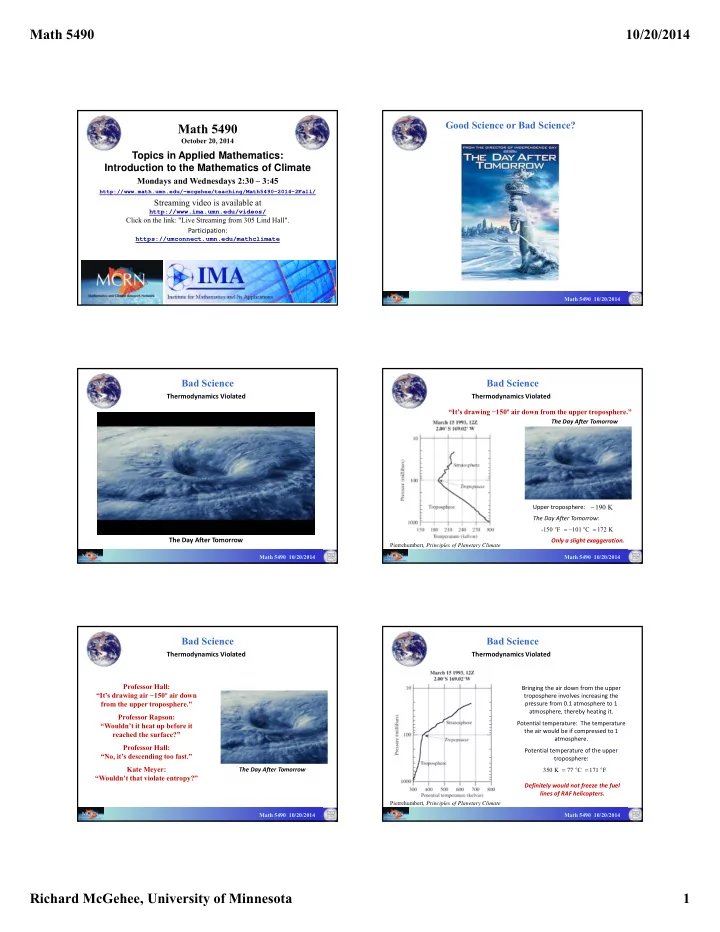
Thermodynamics Violated The Day After Tomorrow

Math 5490 10/20/2014

Bad Science

Thermodynamics Violated

The Day After Tomorrow

“It’s drawing −150º air down from the upper troposphere.”

Upper troposphere:

  • 150 F

101 C 172 K   

190 K  The Day After Tomorrow: Only a slight exaggeration.

Pierrehumbert, Principles of Planetary Climate Math 5490 10/20/2014

Bad Science

Thermodynamics Violated

The Day After Tomorrow

Professor Hall: “It’s drawing air −150º air down from the upper troposphere.” Professor Rapson: “Wouldn’t it heat up before it reached the surface?” Professor Hall: “No, it’s descending too fast.” Kate Meyer: “Wouldn’t that violate entropy?”

Math 5490 10/20/2014

Bad Science

Thermodynamics Violated

Pierrehumbert, Principles of Planetary Climate

Bringing the air down from the upper troposphere involves increasing the pressure from 0.1 atmosphere to 1 atmosphere, thereby heating it. Potential temperature: The temperature the air would be if compressed to 1 atmosphere. Potential temperature of the upper troposphere:

  • 350 K

77 C 171 F   Definitely would not freeze the fuel lines of RAF helicopters.

slide-2
SLIDE 2

Math 5490 10/20/2014 Richard McGehee, University of Minnesota 2

Math 5490 10/20/2014

Bad Science

Energy Balance Violated

Where did the energy go? Most of the northern hemisphere land covered with 30 feet of snow, converted to about 1 meter

  • f water.

Let’s say half of all the land,

  • r 15% of the Earth’s

surface. 70% of the surface is ocean, so about 15/70 or 0.2 meters of ocean evaporated and turned to snow in a few days.

Math 5490 10/20/2014

Bad Science

Energy Balance Violated

James Hansen, et al, Earth’s Energy Imbalance: Confirmation and Implications, SCIENCE 308 (2005), p. 1431

Math 5490 10/20/2014

Bad Science

Energy Balance Violated

About 0.2 meters of the ocean evaporated and turned to snow in a few days. It takes 9.3 Wyr/m2 to turn glaciers into 1 meter of ocean, so turning 0.1 meter

  • f ocean into snow (at −10°C) would dissipate 0.93 Wyr/m2. To accomplish

that in 3 days would have to dissipate more than 100 W/m2. Recall also that the North Atlantic Ocean temperature dropped by “13 degrees” during the same time. Let’s say that, averaged over the entire ocean, that amounted to one degree (Celsius) for the top 100 meters.

James Hansen, et al, SCIENCE 308 (2005), p. 1431

Cooling the ocean would take 9.3 Wyr/m2, which over 3 days would be a heat imbalance of ‐1000 W/m2. Recall that the current outgoing long wave radiation for the Earth is 235 W/m2.

Math 5490 10/20/2014

James Hansen, et al, Earth’s Energy Imbalance: Confirmation and Implications, SCIENCE 308 (2005), p. 1431

Heat Imbalance Heat Imbalance

Math 5490 10/20/2014

10 20 30 40 50 60 70 1 2 3 4 5 6 7 8 9 10 sea level rise (meters) centuries 0.1 0.85 1.7

Suppose that all the heat imbalance went to melting the glaciers. It takes 9.3 Wyr/m2 to turn glaciers into 1 meter of ocean. If the heat imbalance is w W/m2, the sea level would rise at the rate of w/9.3 meters per year. At the current imbalance of 0.85 W/m2, the rate is about 0.091 meters per year, or 9.1 meters per century. Melting all the glaciers would cause a sea level rise of about 70 meters and would take about 760 years at the current imbalance.

5 10 15 20 0.1 0.2 0.3 0.4 0.5 0.6 0.7 0.8 0.9 1 sea level rise (meters) centuries 0.1 0.85 1.7

Heat Imbalance

Math 5490 10/20/2014

Suppose now that all the heat imbalance first goes to raising the top kilometer of ocean by 0.5 °C, and then goes to melting the glaciers. It takes 46.5 Wyr/m2 to raise the temperature of a kilometer of ocean by 0.5 °C. If the heat imbalance is

w W/m2, the increase would be

achieved in 46.5/w years, after which the sea level would rise at w/9.3 meters per year. At the current imbalance of 0.85 W/m2, the ocean temperature increase would delay the sea level rise by about 56 years.

10 20 30 40 50 60 70 1 2 3 4 5 6 7 8 9 10 sea level rise (meters) centuries 0.1 0.85 1.7 5 10 15 20 0.1 0.2 0.3 0.4 0.5 0.6 0.7 0.8 0.9 1 sea level rise (meters) centuries 0.1 0.85 1.7

slide-3
SLIDE 3

Math 5490 10/20/2014 Richard McGehee, University of Minnesota 3

Heat Imbalance

Math 5490 10/20/2014

Suppose instead that all the heat imbalance first goes to raising the top kilometer of ocean by 1 °C, and then goes to melting the glaciers. It takes 93 Wyr/m2 to raise the temperature of a kilometer of ocean by 1 °C. If the heat imbalance is w W/m2, the increase would be achieved in 93/w years, after which the sea level would rise at w/9.3 meters per year. At the current imbalance of 0.85 W/m2, the ocean temperature increase would delay the sea level rise by about 112 years.

10 20 30 40 50 60 70 1 2 3 4 5 6 7 8 9 10 sea level rise (meters) centuries 0.1 0.85 1.7 5 10 15 20 0.1 0.2 0.3 0.4 0.5 0.6 0.7 0.8 0.9 1 sea level rise (meters) centuries 0.1 0.85 1.7

Heat Imbalance

Math 5490 10/20/2014

How will the heat imbalance be divided between heating the

  • cean and melting the glaciers?

How will the heat imbalance be affected by increasing atmospheric greenhouse gases? How will the heat imbalance be affected by increasing ocean temperatures? What happens to the weather as the ocean temperature rises and the ice caps melt? What should we do about coastal cities?

Questions for the Coming Centuries

Good Science

Math 5490 10/20/2014

Dansgaard‐Oeschger Events “Global warming” can cause the Northern Hemisphere to cool. Melting glaciers can lower the salinity

  • f the North Atlantic, causing a

decrease in the flow of the Atlantic Meridional Overturning Circulation (AMOC), slowing the heat transfer to the Northern Hemisphere. This phenomenon is believed to have caused the Younger Dryas.

http://www.pik‐potsdam.de/~stefan/sampleimages.html

Heat Imbalance

Heinrich and Dansgaard‐Oeschger events

Math 5490 10/20/2014 http://www.ncdc.noaa.gov/paleo/abrupt/data3.html

Heinrich and Dansgaard‐Oeschger events

Heat Imbalance

Math 5490 10/20/2014

The Younger Dryas

http://www.ncdc.noaa.gov/paleo/abrupt/data4.html

Heat Imbalance

Math 5490 10/20/2014

slide-4
SLIDE 4

Math 5490 10/20/2014 Richard McGehee, University of Minnesota 4

The Younger Dryas

http://www.ncdc.noaa.gov/paleo/abrupt/data4.html

Heat Imbalance

Math 5490 10/20/2014

3 3.5 4 4.5 5 5.5 ‐20 ‐15 ‐10 ‐5 δ18O kyr before present Benthic δ18O (Lisiecki & Raymo)

Only a minor impact on ice volume.

What’s Happening Now?

Heat Imbalance

Math 5490 10/20/2014

IPCC AR5 (2013) Figure 2.20 hiatus hiatus

What’s Happening Now?

Heat Imbalance

Math 5490 10/20/2014

Chou & Tung, Science 345 (2014) p 897

The heat imbalance is being absorbed by the ocean (at 1000 meters, not the surface). What’s Happening Now?

Heat Imbalance

Math 5490 10/20/2014

The Good News The surface temperatures are remaining fairly constant, so the perceived warming is small. The Bad News The heat is still there and will take a long time to dissipate and may have other effects, e.g. hurricanes, biological changes. If the surface temperature does not rise, the heat imbalance will remain high, leading eventually to more warming. There is evidence that hiatuses (hiati?) correspond to 60 year cycles of the AMOC. Will we experience another strong warming period in 30 years?

Chou & Tung, Science 345 (2014) p 897