
SLIDE 1
The DarkSide Program
Cristiano Galbiati Princeton University Presentation SLAC Snowmass CF Workshop March 7, 2013
The DarkSide Program Cristiano Galbiati Princeton University - - PowerPoint PPT Presentation
The DarkSide Program Cristiano Galbiati Princeton University Presentation SLAC Snowmass CF Workshop March 7, 2013 DarkSide Collaboration Augustana College, USA Black Hills State University, USA Fermilab, USA IHEP , China INFN
Cristiano Galbiati Princeton University Presentation SLAC Snowmass CF Workshop March 7, 2013
Augustana College, USA Black Hills State University, USA Fermilab, USA IHEP , China INFN Laboratori Nazionali del Gran Sasso, Italy INFN and Università degli Studi Genova, Italy INFN and Università degli Studi Milano, Italy INFN and Università degli Studi Napoli, Italy INFN and Università degli Studi Perugia, Italy INFN and Università degli Studi Roma 3, Italy Jagiellonian University, Poland Joint Institute for Nuclear Research, Russia Princeton University, USA RRC Kurchatov Institute, Russia
Temple University, USA University College London, UK University of Arkansas, USA University of California at Los Angeles, USA University of Chicago, USA University of Hawaii, USA University of Houston, USA University of Massachusetts at Amherst, USA
(rejects e/gamma) (unique to Argon - atomic physics of Argon dimer)
Argon)
phase)
Veto (identify neutrons with high efficiency in finite volume)
to cryostat, feedthroughs, and shield)
collection
reached required 36 kV and operated stably for over 8 months
F90 0.1 0.2 0.3 0.4 0.5 0.6 0.7 0.8 0.9 1
10
10 1 10
2
10
3
10
Mean 0.3463 RMS 0.07732 Mean 0.3458 RMS 0.06597
Mean 0.3445 RMS 0.0775
On the basis of date from DS-10, developed a detailed model to describe PSD curves for β/γ. Model applied to infer sensitivity quoted in the white paper. The model describes well the F90 broadening observed in DS-10 down to ~20 keVnr.
10 m (high) x 11 m (diameter) Water Tank
Energy/keV 200 400 600 800 1000 Rate/(Bq/keV)
10
10
10
10
10
Underground Argon Measurements
AAr, @KURF UAr, @Surface UAr, @Surface, Muon Vetoed UAr, @KURF
Assembled and
Fermilab PAB Special thanks to PAB staff!
Outer Shell Notes
Fused Silica Plate ector Cu Field Cage
Fused Silica Plate w/ Gas Pocket 279 ea. 3"PMTs provide 48% cathold coverage two places, top & bottom Inner Shell
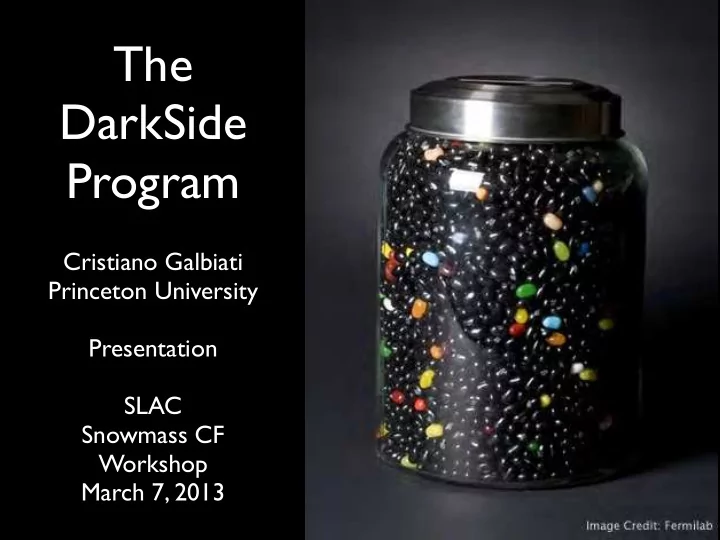
Like the jelly beans in this jar, the Universe is mostly dark: 96 percent consists
70%) and dark matter (about 26%). Only about four percent (the same proportion as the lightly colored jelly beans) of the Universe - including the stars, planets and us - is made of familiar atomic matter.
1
Snowmass 2013 Darkside Whitepaper
decommissioned in January 2013. If not, when do you expect to operate, and with what total target mass? The DarkSide-50 physics experiment is nearing completion. We expect begin commissioning the full detector system at the end of March 2013. The dark matter detector DarkSide-50 is a two-phase Time Projection Chamber (TPC) with a 150 kg total LAr mass, 50 kg active mass, 33 kg fiducial mass. The fill for the physics run will be done with underground argon depleted in the cosmogenic 39Ar. DarkSide-50 located inside a 1,000 ton water shield/ˇ Cerenkov muon veto and a 30 ton borated-liquid scintillator neutron veto. What total target mass do you expect to have operating 10 years from now? DarkSide-G2 (5 ton total LAr mass, 3.3 ton active, 3.0 ton fiducial) is next after Darkside-50 with start of
50 tons, may follow.
In Darkside-50 the ratio of fiducial to total active mass is 33 kg/50 kg=0.67, and the ratio of fiducial to total LAr mass is 33 kg/150 kg=0.22. How to you expect that ratio to scale in the future? In DarkSide-G2 the fiducial to active mass ratio scales to 3.0 ton/3.3 ton=0.91, and the ratio of fiducial to total LAr mass scales to 3.0 tons/5.0 tons=0.60. Describe briefly the basis for this scaling. In a TPC, the fiducial/active mass ratio and the fiducial/total LAr mass ratio improve with surface to volume ratio.
level, in both your total volume and in your fiducial volume, before detector discrimination is applied for each type of background (gamma, beta, alpha, radiogenic neutrons, cosmogenic neutrons)? Please quote in units of events/keV/kg/day and specify the energy range your are using (preferably 10–100 keV). Use either keVee (electron equivalent) or keVnr (nuclear recoil) as appropriate for the type of background. First, note that to answer using the requested units one would have to present an energy spectrum of the background, not an integral rate in a given range. Secondly, answering this depends on one’s interpretation of the term “demonstrated background level”. Since neither the Darkside-50 LAr-TPC nor the neutron and muon veto that complement it have yet been operated, we don’t have demonstrated background levels. The background levels expected from our simulations, based on assays of materials and actual performance
average rates over the energy range: 20 - 200 keVnr, equivalent to 8 - 160 keVee. Is your dominant background from the active target material, the experiment materials surround- ing the active target, or from the environment (including cosmic rays)? Source Rate in Active Mass Rate in Fiducial Mass events/(keV·kg·day) events/(keV·kg·day) γ [keVee] 1.7 0.9 β [keVee] 1.3 1.3 α [keVee] 4.5 × 10⁻³ <2.6 × 10⁻⁸ Radiogenic n [keVnr] 5.9 × 10⁻⁸ 5.4 × 10⁻⁸ Cosmogenic n [keVnr] 6.4 × 10⁻⁹ 6.4 × 10⁻⁹ TABLE I: Expected background levels for DarkSide-50 from simulations and radio-assay of materials.
2 Again, we have no demonstrated dominant background. However before discrimination (which is the subject of this section of questions) our dominant background is expected to be from 39Ar, followed closely by experiment materials surrounding the active target. By what factor do you need to reduce these backgrounds for future experiments? The expected background levels are satisfactory for DarkSide-G2. Describe briefly how you would achieve such reductions. Further reductions below the present expected levels are available. The expected 39Ar background level depends
limit for the radiopurity, the best results so far obtainable with a ∼1 kg sample counted underground at KURF. The actual level may be much lower. Work is continuing to improve the sensitivity of the 39Ar measurement. The PMTs are responsible for more than half the remaining background. We have developed with Hamamatsu a new variant of the R11065 (the R11065-20) with about 1/10 the background of the current variant available for the past two years. DarkSide-50 will be instrumented with the R11065-20 variants as they become available.
in both your total volume and in your fiducial volume, for each type of background (gamma, beta, alpha, radiogenic neutrons, cosmogenic neutrons)? Please quote these at 100 keVnr, and for 10 keVnr, or the lowest energy you have measured them. (See Table 2) Based on experience with the DarkSide-10 prototype, the DarkSide-50 β/γ discrimination cuts will be set in an energy-dependent manner so as to leave a leakage fraction which does not vary with energy. The constant leakage fraction is chosen to give an energy-integrated background of less than 0.1 events in a 0.1 ton·yr exposure. Neutron discrimination in the liquid argon TPC is based on a multiple-interaction cut and rejecting inelastic interactions that result in electron recoils. We note that the liquid argon TPC is surrounded by an active liquid scintillator detector and an instrumented water tank that greatly enhance our neutron discrimination
background from within the TPC by a factor of ∼100 and the combination of water tank and liquid scintillator will reduce the cosmogenic neutrons by a factor of ≫3000. These additional reductions, not included in the summary Table II, were taken into account when estimating the backgrounds in Table I. By what factor might these improve in the future? Describe briefly how you would achieve any
amplifier-cable drivers in the LAr, developed at LNGS. These will be tested in DarkSide-50. Combined with a change in the pulse-shape analysis from pulse integration to photon counting, this will practically eliminate the effects of electronic noise and single-photoelectron resolution on the PSD. At this time we do not have a quantitative estimate of the resulting improvement in sensitivity. Do you have “outlier” events that cannot be described by your simulations or calibrations? DarkSide-10 was operated with with atmospheric Argon (1 Bq/kg 39Ar), without a tight neutron shield, and has large sources of radioactive backgrounds very close to the fiducial volume (cryostat and its ceramic feedthroughs). As expected, the resulting background spectra do contain neutron-like events. However we cannot prove that every event in this region is a neutron event, or if some are “outliers” leaking from the millions of 39Ar beta events.
for electron recoils and nuclear recoils? Source Leakage Fraction Leakage Fraction Total Volume Fiducial Mass γ [keVee] 1 × 10⁻⁷ 1 × 10⁻⁷ β [keVee] 1 × 10⁻⁷ 1 × 10⁻⁷ Radiogenic n [keVnr] 0.72 0.72 Cosmogenic n [keVnr] 0.72 0.72 TABLE II: DarkSide-50 expected discrimination. For both β’s and γ’s, the event discrimination cuts are chosen so as to leave a constant (in energy) leakage fraction that integrates to a background of less than 0.1 events in 0.1 ton·yr exposure.
3
]
rec[keV
recE 20 40 60 80 100 120 140 160 180 200 Acceptance 0.2 0.4 0.6 0.8 1
discrimination applied. Dashed line: only PSD discrimination. Discrimination cuts are set as required for current upper limit of 39Ar activity; lower actual activity would allow cuts to be relaxed, further increasing the acceptance. Data from the Darkside-10 prototype demonstrated thresholds of 5 keVee, 9 keVnr for triggering, 9 keVee, 20 keVnr for analysis. Specify the nuclear recoil acceptance at your energy thresholds and describe briefly how you expect the thresholds and acceptance to evolve in the future. (See Figure 1) The event discrimination cuts are chosen so as to leave an energy-independent leakage fraction that integrates to a background of less than 0.1 events in 0.1 ton·yr exposure. The corresponding nuclear recoil acceptance (excluding dead time loss due to accidental coincidences in the neutron veto) is shown in Fig. 1. The solid line shows the acceptance for both PSD and S2/S1 discrimination, while the dashed line shows the acceptance when using PSD only. The cuts were chosen assuming an 39Ar activity in our underground Argon at its current upper limit of 6.5 mBq/kg. Should it turn out to be lower, the cuts could be relaxed and our acceptance at low energy would
function of WIMP mass, at least for 5, 10, 100, 1000 and 10000 GeV? What sensitivities do you project in the next 5, 10 and 15 years?
40Ar is spinless and has no SD sensitivity.There is no demonstrated sensitivity as the experiment is not yet running. The expected sensitivity for DarkSide-50 is shown in Figure 2. The expected sensitivity for DarkSide-G2 is shown in Figure 3.
face in getting your experiment to work?
4
10 100 1000
10
10
10
10
10
10
10 10 WIMP-Nucleon Cross Section [cm2]
DAMA/I DAMA/Na CoGeNT C D M S ( 2 1 / 1 1 ) EDELWEISS (2011/12) XENON100 (2011) COUPP (2012) SIMPLE (2012) ZEPLIN-III (2012) CRESST-II (2012) D a r k S i d e
XENON100 (2012)
WIMP mass [GeV/c2]
WArP (2008) DarkSide-50 PSD only
PMT stability at 86 K. Rate of purification of underground argon. What physics and engineering challenges do you expect to face for improving the sensitivity of the experiment? – Development of photosensors of larger sensitive area (possibly 5” diameter) and even lower radioactivity – Development of a DAQ architecture capable of handling the bit-rate generated by DarkSide-G2. – Collection and purification of underground argon at the ton scale Is there detector R&D needed to enable a future experiment?
What are the facility requirements (size, depth, ...) for your next generation experiment? The Darkside-50 and Darkside-G2 designs assume operation at LNGS inside a powerful passive/active shield/veto system which we have already built and are about to commission in Hall C. This system con- sists of a 30 ton borated-liquid scintillator neutron veto detector, located inside a 1,000 ton water ˇ Cerenkov detector.
annual modulation, and for what nuclear recoil energy energy threshold? If not, what are the main obstacles you face? We have not demonstrated this. PMT stability is a potential obstacle.
aside from the standard event by event discrimination and multiple scattering?
5
]
2[GeV/c
χM 10
210
310 ]
2[cm
nσ
10
10
10
10
10
10
10
inside a muon veto (1,000 ton water ˇ Cerenkov detector). This system gives DarkSide-50 the unique capability of tagging and rejecting with high efficiency events from radiogenic (>99.5%) and cosmogenic (>99.9%) neutrons masquerading as WIMP scatters. Does your technology allow different targets in the same experiment? If so, what changes are required to make use of these? In a manner of speaking – our DUSEL-G2 design MAX was a paired LAr and LXe experiment, with separate vessels, differential light reflectors, with a wavelength shifter for LAr and without for LXe, with PMTs optimized for each noble liquid, but with otherwise nearly identical technology and shared infrastructure. Does your experiment have sensitivity to dark matter interactions other than spin-independent
Yes in case of inelastic dark matter interactions.
formation does your experiment provide about WIMP properties (especially WIMP mass), and about dark matter distribution in the galaxy? The spectral shape of WIMP events contains information on WIMP mass and kinematics, as discussed in e.g. J.D. Lewin and P.F. Smith, Astroparticle Physics 6, 87 (1990). Detailed studies are underway and we will update this section prior to finalization of the document.