The Nature of Probability The Nature of Probability y - - PDF document

the nature of probability the nature of probability y
SMART_READER_LITE
LIVE PREVIEW

The Nature of Probability The Nature of Probability y - - PDF document

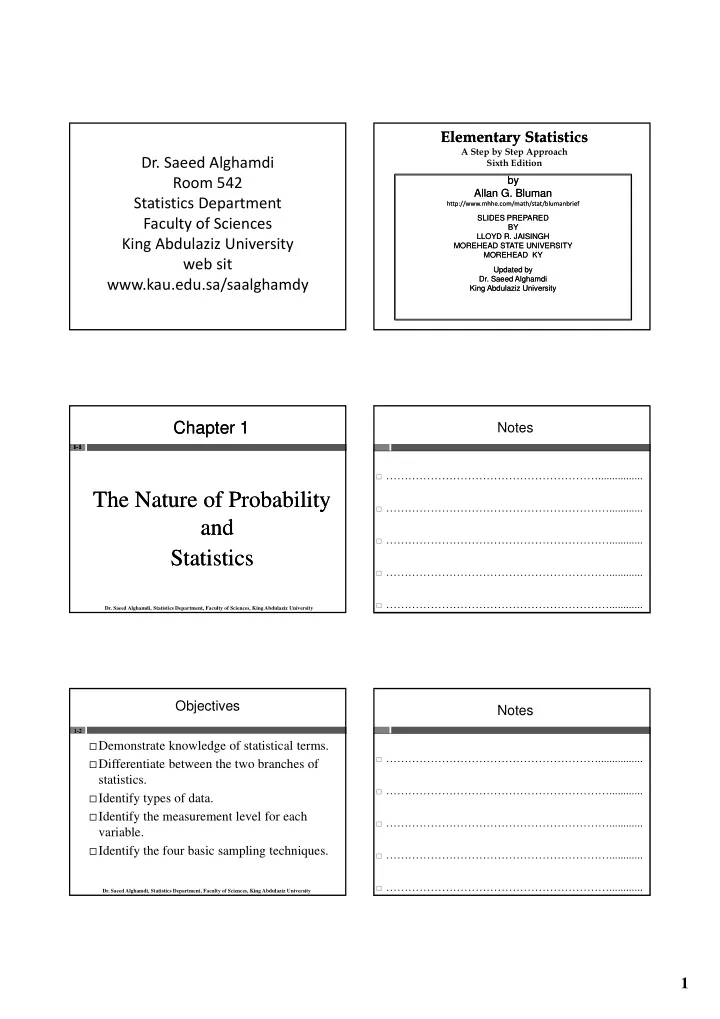
Elementary Statistics Elementary Statistics A Step by Step Approach Dr. Saeed Alghamdi Sixth Edition Room 542 by by Allan G. Allan G. Bluman Bluman Statistics Department http://www.mhhe.com/math/stat/blumanbrief


slide-1
SLIDE 1

1

  • Dr. Saeed Alghamdi

Room 542 Statistics Department Faculty of Sciences Faculty of Sciences King Abdulaziz University web sit www.kau.edu.sa/saalghamdy

by by Allan G. Allan G. Bluman Bluman

http://www.mhhe.com/math/stat/blumanbrief http://www.mhhe.com/math/stat/blumanbrief

SLIDES PREPARED SLIDES PREPARED BY BY

Elementary Statistics Elementary Statistics

A Step by Step Approach Sixth Edition

BY BY LLOYD R. JAISINGH LLOYD R. JAISINGH MOREHEAD STATE UNIVERSITY MOREHEAD STATE UNIVERSITY MOREHEAD KY MOREHEAD KY Updated by Updated by Dr.

  • Dr. Saeed

Saeed Alghamdi Alghamdi King King Abdulaziz Abdulaziz University University

1-

  • 1

1

Chapter Chapter 1 1

The Nature of Probability The Nature of Probability y and and Statistics Statistics

  • Dr. Saeed Alghamdi, Statistics Department, Faculty of Sciences, King Abdulaziz University

Notes

…………………………………………………................ ……………………………………………………............ ……………………………………………………............ ……………………………………………………............ ……………………………………………………............

Demonstrate knowledge of statistical terms. Differentiate between the two branches of

statistics.

1-2

Objectives

Identify types of data. Identify the measurement level for each

variable.

Identify the four basic sampling techniques.

  • Dr. Saeed Alghamdi, Statistics Department, Faculty of Sciences, King Abdulaziz University

Notes

…………………………………………………................ ……………………………………………………............ ……………………………………………………............ ……………………………………………………............ ……………………………………………………............

slide-2
SLIDE 2

2

1-3

Objectives

Explain the difference between an

  • bservational and an experimental study.

Explain how statistics can be used and

p misused.

Explain the importance of computers and

calculators in statistics.

  • Dr. Saeed Alghamdi, Statistics Department, Faculty of Sciences, King Abdulaziz University

Notes

…………………………………………………................ ……………………………………………………............ ……………………………………………………............ ……………………………………………………............ ……………………………………………………............

Statistics is the science of conducting

studies to collect, organize, summarize, analyze, and draw conclusions from data. P b bilit i th h f t

1-4

Introduction

Probability is the chance of an event

  • ccurring.

Probability deals more with creating models

deals more with creating models and theoretical data while and theoretical data while statistics statistics deals deals more with applying models and real data. more with applying models and real data.

  • Dr. Saeed Alghamdi, Statistics Department, Faculty of Sciences, King Abdulaziz University

Notes

…………………………………………………................ ……………………………………………………............ ……………………………………………………............ ……………………………………………………............ ……………………………………………………............

A population consists of all subjects that are

being studied.

A sample is a group of subjects selected from

a population

1-5

Introduction

a population.

Data are the values that variables can

assume.

Each value in the data set is called a data

value or a datum.

A data set is a collection of data values.

  • Dr. Saeed Alghamdi, Statistics Department, Faculty of Sciences, King Abdulaziz University

Notes

…………………………………………………................ ……………………………………………………............ ……………………………………………………............ ……………………………………………………............ ……………………………………………………............

slide-3
SLIDE 3

3

In order to gain knowledge about events,

statisticians collect information for variables that describe the events.

1-6

Introduction

A variable is a characteristic or attribute

that can assume different values.

Random variables have values that are

determined by chance.

  • Dr. Saeed Alghamdi, Statistics Department, Faculty of Sciences, King Abdulaziz University

Notes

…………………………………………………................ ……………………………………………………............ ……………………………………………………............ ……………………………………………………............ ……………………………………………………............

Descriptive statistics consists of the

collection, organization, summarization, and presentation of data. I f ti l t ti ti i t f li i

1-7

Descriptive and Inferential Statistics

Inferential statistics consists of generalizing

from samples to populations, performing estimations hypothesis testing, determining relationships among variables, and making predictions.

  • Dr. Saeed Alghamdi, Statistics Department, Faculty of Sciences, King Abdulaziz University

Notes

…………………………………………………................ ……………………………………………………............ ……………………………………………………............ ……………………………………………………............ ……………………………………………………............

Qualitative variables can be placed into

distinct categories according to some characteristic or attribute, e.g., flight classes,

1-8

Variables and Types of Data

departments, gender, ….

Quantitative or scale variables are numerical

in nature and can be ordered or ranked, e.g., number of passengers, cargo weights, age, ….

  • Dr. Saeed Alghamdi, Statistics Department, Faculty of Sciences, King Abdulaziz University

Notes

…………………………………………………................ ……………………………………………………............ ……………………………………………………............ ……………………………………………………............ ……………………………………………………............

slide-4
SLIDE 4

4

Variables and Types of Data (cont’d.)

Qualitative variables can be further classified into two groups.

Nominal—classifies data into categories that

b d d k d d

1-9

can not be ordered or ranked, e.g., gender, departments, eye color, ….

Ordinal—classifies data into categories that

can be ranked, e.g., flight classes, ranking, grade letters, ….

  • Dr. Saeed Alghamdi, Statistics Department, Faculty of Sciences, King Abdulaziz University

Notes

…………………………………………………................ ……………………………………………………............ ……………………………………………………............ ……………………………………………………............ ……………………………………………………............

Variables and Types of Data (cont’d.)

Quantitative or scale variables can be further classified into two groups.

Discrete variables assume values that can

b t d b f

1-10

be counted, e.g., number of passengers, number of students in Stat 110, ….

Continuous variables can assume all values

between any two specific values, e.g., heights, weights, ….

  • Dr. Saeed Alghamdi, Statistics Department, Faculty of Sciences, King Abdulaziz University

Notes

…………………………………………………................ ……………………………………………………............ ……………………………………………………............ ……………………………………………………............ ……………………………………………………............

Variables and Types of Data (cont’d.)

Also, Quantitative or scale variables can be further classified into two groups.

Interval—ranks data, and precise differences

b t it f d i t h

1-11

between units of measure do exist; however, there is no meaningful zero, e.g., IQ tests, temperature, ….

Ratio—possesses all the characteristics of

interval measurement, and there exists a true zero, e.g., time, heights, weights, ….

  • Dr. Saeed Alghamdi, Statistics Department, Faculty of Sciences, King Abdulaziz University

Notes

…………………………………………………................ ……………………………………………………............ ……………………………………………………............ ……………………………………………………............ ……………………………………………………............

slide-5
SLIDE 5

5

Surveys are the most common method of

collecting data. Three methods of surveying are

1-12

Data Collection

Telephone surveys Mailed questionnaire surveys Personal interviews

  • Dr. Saeed Alghamdi, Statistics Department, Faculty of Sciences, King Abdulaziz University

Notes

…………………………………………………................ ……………………………………………………............ ……………………………………………………............ ……………………………………………………............ ……………………………………………………............

Random samples are selected using chance

methods or random methods.

1-13

Sampling Techniques

Researchers obtain systematic samples by

numbering each subject of the populations and then selecting every number.

th

k

  • Dr. Saeed Alghamdi, Statistics Department, Faculty of Sciences, King Abdulaziz University

Notes

…………………………………………………................ ……………………………………………………............ ……………………………………………………............ ……………………………………………………............ ……………………………………………………............

Researchers select stratified samples by

dividing the population into groups called strata according to some characteristic that is important to the study then sampling from

1-14

Sampling Techniques

important to the study, then sampling from each group or strata.

Researchers select cluster samples by intact

groups called clusters. Thus, dividing the

population into groups and then taking samples of the groups.

  • Dr. Saeed Alghamdi, Statistics Department, Faculty of Sciences, King Abdulaziz University

Notes

…………………………………………………................ ……………………………………………………............ ……………………………………………………............ ……………………………………………………............ ……………………………………………………............

slide-6
SLIDE 6

6

1-15

Observational and Experimental Studies

In an observational study, the researcher

merely observes what is happening or what has happened in the past and tries to draw conclusions based on these observations

  • Dr. Saeed Alghamdi, Statistics Department, Faculty of Sciences, King Abdulaziz University

conclusions based on these observations.

In an experimental study, the researcher

manipulates one of the variables and tries to determine how the manipulation influences

  • ther variables.

Notes

…………………………………………………................ ……………………………………………………............ ……………………………………………………............ ……………………………………………………............ ……………………………………………………............ 1-16

Observational and Experimental Studies

In a true experimental study, the subjects

should be assigned to groups randomly. If this is not possible and a researcher uses intact groups then he is performing a quasi

  • Dr. Saeed Alghamdi, Statistics Department, Faculty of Sciences, King Abdulaziz University

intact groups, then he is performing a quasi- experimental study.

Notes

…………………………………………………................ ……………………………………………………............ ……………………………………………………............ ……………………………………………………............ ……………………………………………………............ 1-17

Observational and Experimental Studies

Statistical studies usually include one or more independent variables and one dependent variable. Th i d d t i bl l t

  • Dr. Saeed Alghamdi, Statistics Department, Faculty of Sciences, King Abdulaziz University

The independent variable or explanatory

variable is the one that is being manipulated is the one that is being manipulated by the researcher. by the researcher.

The

The dependent variable or outcome variable is the resultant variable. is the resultant variable.

Notes

…………………………………………………................ ……………………………………………………............ ……………………………………………………............ ……………………………………………………............ ……………………………………………………............

slide-7
SLIDE 7

7

1-18

Observational and Experimental Studies

A confounding variable is the variable that

is the variable that influences the dependent or outcome variable influences the dependent or outcome variable but cannot be separated from the independent but cannot be separated from the independent variable variable

  • Dr. Saeed Alghamdi, Statistics Department, Faculty of Sciences, King Abdulaziz University

variable. variable.

  • Example, subjects on exercise program may

Example, subjects on exercise program may improve their diet and perhaps that improve improve their diet and perhaps that improve their health in other ways not due to exercise their health in other ways not due to exercise

  • alone. Then diet becomes confounding
  • alone. Then diet becomes confounding

variable. variable.

Notes

…………………………………………………................ ……………………………………………………............ ……………………………………………………............ ……………………………………………………............ ……………………………………………………............ 1-19

Uses and Misuses of Statistics Uses and Misuses of Statistics

Suspect Samples: Sometimes researchers use

very small samples to obtain information or wrong way of selecting a sample such as bias sample selection or volunteer samples

  • Dr. Saeed Alghamdi, Statistics Department, Faculty of Sciences, King Abdulaziz University

sample selection or volunteer samples

Ambiguous Averages: measures that are

loosely called averages are the mean, median, mode and midrange. People can select the one that support their arguments.

Notes

…………………………………………………................ ……………………………………………………............ ……………………………………………………............ ……………………………………………………............ ……………………………………………………............ 1-20

Uses and Misuses of Statistics Uses and Misuses of Statistics

Changing the Subject: The choice of values

that represent the same data, as numbers and percentages. D t h d St ti ti it i th i hi h

  • Dr. Saeed Alghamdi, Statistics Department, Faculty of Sciences, King Abdulaziz University

Detached Statistics: it is the one in which no

comparison is made. For example, one may say that “Our cookies has one-third fewer calories” Here, fewer than what?

Notes

…………………………………………………................ ……………………………………………………............ ……………………………………………………............ ……………………………………………………............ ……………………………………………………............

slide-8
SLIDE 8

8

1-21

Uses and Misuses of Statistics Uses and Misuses of Statistics

Implied Connections: Usage of words such

as may, suggest or some that imply connections but there is no guarantee. So be careful when you draw conclusions

  • Dr. Saeed Alghamdi, Statistics Department, Faculty of Sciences, King Abdulaziz University

careful when you draw conclusions.

Misleading Graphs: if graphs are drawn

inappropriately, they can misrepresent the data and lead to false conclusions.

Notes

…………………………………………………................ ……………………………………………………............ ……………………………………………………............ ……………………………………………………............ ……………………………………………………............ 1-22

Uses and Misuses of Statistics Uses and Misuses of Statistics

Faulty Survey Questions: You should be sure

that the questions are properly written since the way questions are phrased can influence the way people answer them

  • Dr. Saeed Alghamdi, Statistics Department, Faculty of Sciences, King Abdulaziz University

the way people answer them.

Notes

…………………………………………………................ ……………………………………………………............ ……………………………………………………............ ……………………………………………………............ ……………………………………………………............

Excel, SPSS, MINITAB, SAS and the TI-83

graphing calculator can be used to perform statistical computations. S d h ld li h h

1-23

Statistical Packages

Students should realize that the computer

and calculator merely give numerical answers and save time and effort of doing calculations by hand.

  • Dr. Saeed Alghamdi, Statistics Department, Faculty of Sciences, King Abdulaziz University

Notes

…………………………………………………................ ……………………………………………………............ ……………………………………………………............ ……………………………………………………............ ……………………………………………………............