Teaching Statistical Literacy: Chapter 2 16 May 2019 V0 V1 V1 - - PDF document

teaching statistical literacy chapter 2 16 may 2019 v0
SMART_READER_LITE
LIVE PREVIEW

Teaching Statistical Literacy: Chapter 2 16 May 2019 V0 V1 V1 - - PDF document

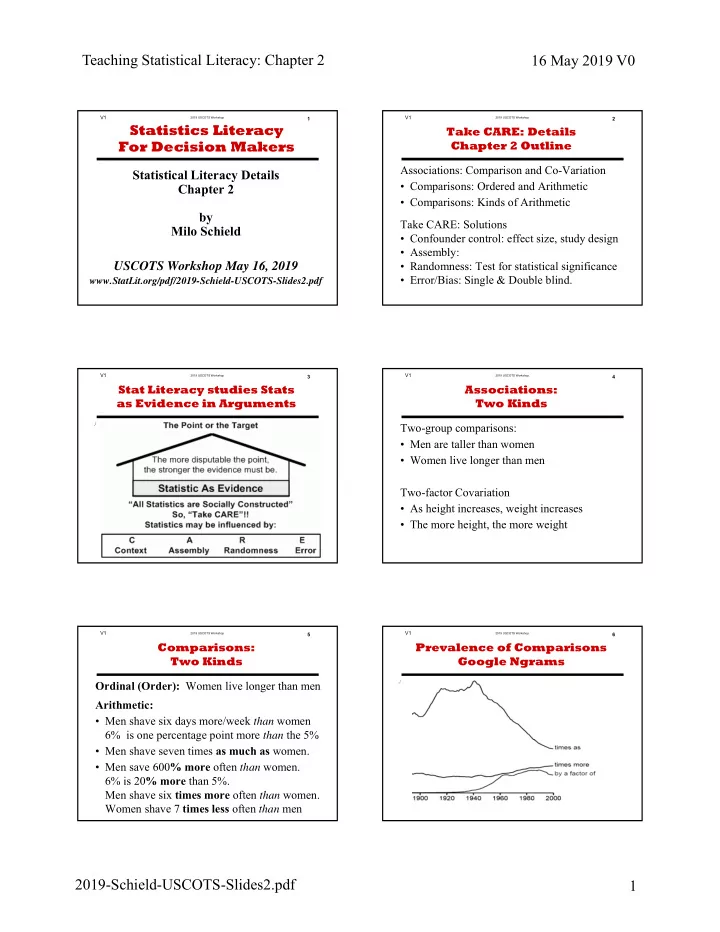
Teaching Statistical Literacy: Chapter 2 16 May 2019 V0 V1 V1 2019 USCOTS Workshop 1 2019 USCOTS Workshop 2 Statistics Literacy Take CARE: Details For Decision Makers Chapter 2 Outline Associations: Comparison and Co-Variation


slide-1
SLIDE 1

Teaching Statistical Literacy: Chapter 2 16 May 2019 V0 2019-Schield-USCOTS-Slides2.pdf 1

2019 USCOTS Workshop

V1 1

Statistical Literacy Details Chapter 2 by Milo Schield USCOTS Workshop May 16, 2019

www.StatLit.org/pdf/2019-Schield-USCOTS-Slides2.pdf

Statistics Literacy For Decision Makers

2019 USCOTS Workshop

V1

Associations: Comparison and Co-Variation

  • Comparisons: Ordered and Arithmetic
  • Comparisons: Kinds of Arithmetic

Take CARE: Solutions

  • Confounder control: effect size, study design
  • Assembly:
  • Randomness: Test for statistical significance
  • Error/Bias: Single & Double blind.

2

Take CARE: Details Chapter 2 Outline

2019 USCOTS Workshop

V1 ./ 3

Stat Literacy studies Stats as Evidence in Arguments

2019 USCOTS Workshop

V1

Two-group comparisons:

  • Men are taller than women
  • Women live longer than men

Two-factor Covariation

  • As height increases, weight increases
  • The more height, the more weight

4

Associations: Two Kinds

2019 USCOTS Workshop

V1

Ordinal (Order): Women live longer than men Arithmetic:

  • Men shave six days more/week than women

6% is one percentage point more than the 5%

  • Men shave seven times as much as women.
  • Men save 600% more often than women.

6% is 20% more than 5%. Men shave six times more often than women. Women shave 7 times less often than men

5

Comparisons: Two Kinds

2019 USCOTS Workshop

V1 ./ 6

Prevalence of Comparisons Google Ngrams

slide-2
SLIDE 2

Teaching Statistical Literacy: Chapter 2 16 May 2019 V0 2019-Schield-USCOTS-Slides2.pdf 2

2019 USCOTS Workshop

V1

What things block or negate confounders?

  • 1. Large effect size; large arithmetic comparison
  • 2. Study design
  • 3. Ratios
  • 4. Comparison of ratios.
  • 5. Selection and stratification
  • 6. Standardizing

7

Confounding

2019 USCOTS Workshop

V1

  • 1. Does the association involve an effect size?

If not, then no reason to think it is large

  • 2. Is the effect size material? For example,

a factor of 10 increase in 1 chance in 10,000.

  • 3. Is the effect size statistically significant?
  • 4. Is the effect size large enough to ward off

confounders? A: RR>4, B: RR > 3, C: RR>2, D: RR > 1.5. Schield (2018, ICOTS).

8

#1 Effect Size

2019 USCOTS Workshop

V1 ./ 9

Studies are the Primary Unit of Analysis

2019 USCOTS Workshop

V1

There are distinctions within these, but these six are enough to get started.

10

Six Basic Study Designs

2019 USCOTS Workshop

V1

.

11

Study Design Prevalences: Google Ngrams

2019 USCOTS Workshop

V1

Randomized controlled trials (RCT) are a major contribution of statistics to human knowledge. By doing the impossible—controlling for all variations (known and unknown) — randomized trials can be considered a “statistical miracle.” Experiments RCT Gold std. Silver std.

12

Random Assignment Nullifies Prior Confounding

Predictor Result Confounder Association

slide-3
SLIDE 3

Teaching Statistical Literacy: Chapter 2 16 May 2019 V0 2019-Schield-USCOTS-Slides2.pdf 3

2019 USCOTS Workshop

V1

  • 1747. Lind tests sailors with scurvy.
  • 1935 Fisher: The Lady Tasting Tea.
  • 1961 Perry Pre-School Project.
  • 1974 RAND Health Insurance Experiment
  • 1980s First AIDs trial video

13

Random Assignment Examples

2019 USCOTS Workshop

V1

Placebo Effect: Clinical trials where placebo group did as well as treatment group. See migraine prophylaxis, positive response: Placebo meds, 22%. placebo acupuncture 38%. placebo surgery, 58%. Note; Clinical studies, clinically proven, medical trials, medically proven, medical studies and controlled trials don't require randomization.

14

Placebo Effect

2019 USCOTS Workshop

V1 15

Study Designs

562 BC. Jews in Babylon test meat vs vegetarian diet. 1796 Jenner administers cowpox to patient with smallpox 1898 Lease of Hong Kong to the British for 99 years. 1919-1933: US prohibits production/consumption of alcohol.

2019 USCOTS Workshop

V1

1920 Watson's "Little Albert" study of social conditioning. 1945 Post-WWII division of Germany into East and West. 1945/48 Korea partition: North (USSR) and South (USA). 1951 Asch Conformity Exp. 74% agreed w peers' falsehood. 1954 Salk polio vaccine*. Biggest public health experiment. 1968 Bystander Effect. Less likely to act if in a group. 1987-2014: US states allow concealed carry of weapons (CCW)

* Salk: Second graders were treatment group; 1st and 3rd graders were control. www.medicine.mcgill.ca/epidemiology/hanley/c622/salk_trial.pdf

16

Quasi-Experiments: More Examples

2019 USCOTS Workshop

V1

Retrospective longitudinal studies : subjects recall past events. Cheap, quick. Prospective longitudinal studies: follow subjects through time. Expensive, time-consuming. Minimizes recall bias and sampling bias. Cross-sectional results are more reliable. Prospective studies:

  • 1921 Terman (Stanford) study of the gifted
  • 1948 Framingham Study: Follow all inhabitants of Framingham MA
  • 1951 British Doctors Survey
  • 1976 Harvard Nurses Study
  • 1979 Brouchard study of twins raised apart
  • 1979 National Longitudinal Study of Youth (NLSY)

17

Longitudinal Studies: Examples

2019 USCOTS Workshop

V1

  • 1948 Framingham Study: Cross-sectional data associated heart

attacks with high blood pressure, high cholesterol and smoking.

  • 1951 British Doctors Survey. Cross-sectional data strongly

associated lung-cancer deaths with smoking.

  • 1979 Brouchard study of twins raised apart. Similarities

between twins are due more to genes, less to environment.

  • 1979 National Longitudinal Study of Youth. Cross-sectional

data showed that social outcomes more strongly associated with individual IQ than with parents’ socio-economic status. See The Bell Curve (1994) by Herrnstein and Murray.

18

Cross Sectional Associations: Examples

slide-4
SLIDE 4

Teaching Statistical Literacy: Chapter 2 16 May 2019 V0 2019-Schield-USCOTS-Slides2.pdf 4

2019 USCOTS Workshop

V1

Which are cheapest? Which are most common in the media? Examples of uncontrolled quasi-experiments?

19

Evaluating Study Designs Grades are Starting Points

2019 USCOTS Workshop

V1

Association is not causation vs Association is often evidence of causation. Don’t cross in the middle of the block vs. look both ways before you do. Sex is not love (Danny Kaplan) vs. sex and love can be closely related.

20

From Association to Causation

2019 USCOTS Workshop

V1

The unlikely is almost certain given enough tries Math: Suppose there is one chance in N for a given rare event on the next try. The chance of having at least* one such event in N tries is over 50%—it is expected. * Chance of having just one event < 50%.

21

Chance: Law of Very Large Numbers

2019 USCOTS Workshop

V1

Consider matched statistics from two groups. If their 95% intervals don’t overlap, then their difference is statistically significant. Otherwise, the difference may be statistically insignificant.

22

Chance: Statistical Significance

Suppose 70% of gals dream in color (40% of guys) and the 95% margin of error is 10 points. The associated 95% confidence intervals are 60 to 80% for gals (30 to 50% for guys). The 30 point difference is statistically significant.

2019 USCOTS Workshop

V1

Before 1936, as many as one in three expectant moms died from puerperal fever following birth. Gerhard Domagk, a German doctor, developed Prontosil to fight against streptococcal infections. In 1936, Prontosil was administered to 38 newly delivered mothers, all suffering from puerperal

  • fever. Three died and thirty-five survived.

23

Case Study: The Prontosil Experiment

2019 USCOTS Workshop

V1

When Prontosil was administered earlier in the course of the infection, no mother died. In 1936, Prontosil was used to treat Franklin D. Roosevelt, Jr., the President’s son. This was the moment when the world realized that drugs were potent alternatives to surgery.

24

Case Study: The Prontosil Experiment

slide-5
SLIDE 5

Teaching Statistical Literacy: Chapter 2 16 May 2019 V0 2019-Schield-USCOTS-Slides2.pdf 5

2019 USCOTS Workshop

V1

Fifty subjects having pain associated with post-polio syndrome were randomly assigned. The treatment group received concentric magnets; the control group received inert placebo magnets. A major decrease in pain was reported by 75% in the treatment group 19% in the control group.

  • Natural Health, August, 1998. Page 52.

Effect size. Study design. Hypothetical thinking using Take CARE.

/ 25

Case Study Do Magnets Reduce Pain?

2019 USCOTS Workshop

V1

.

26

Bias or Ignorance?

2019 USCOTS Workshop

V1

.

27

Bias or Ignorance?

slide-6
SLIDE 6

2019 USCOTS Workshop

V1 1

Statistical Literacy Details Chapter 2 by Milo Schield USCOTS Workshop May 16, 2019

www.StatLit.org/pdf/2019-Schield-USCOTS-Slides2.pdf

Statistics Literacy For Decision Makers

slide-7
SLIDE 7

2019 USCOTS Workshop

V1

Associations: Comparison and Co-Variation

  • Comparisons: Ordered and Arithmetic
  • Comparisons: Kinds of Arithmetic

Take CARE: Solutions

  • Confounder control: effect size, study design
  • Assembly:
  • Randomness: Test for statistical significance
  • Error/Bias: Single & Double blind.

2

Take CARE: Details Chapter 2 Outline

slide-8
SLIDE 8

2019 USCOTS Workshop

V1 ./ 3

Stat Literacy studies Stats as Evidence in Arguments

slide-9
SLIDE 9

2019 USCOTS Workshop

V1

Two-group comparisons:

  • Men are taller than women
  • Women live longer than men

Two-factor Covariation

  • As height increases, weight increases
  • The more height, the more weight

4

Associations: Two Kinds

slide-10
SLIDE 10

2019 USCOTS Workshop

V1

Ordinal (Order): Women live longer than men Arithmetic:

  • Men shave six days more/week than women

6% is one percentage point more than the 5%

  • Men shave seven times as much as women.
  • Men save 600% more often than women.

6% is 20% more than 5%. Men shave six times more often than women. Women shave 7 times less often than men

5

Comparisons: Two Kinds

slide-11
SLIDE 11

2019 USCOTS Workshop

V1 ./ 6

Prevalence of Comparisons Google Ngrams

slide-12
SLIDE 12

2019 USCOTS Workshop

V1

What things block or negate confounders?

  • 1. Large effect size; large arithmetic comparison
  • 2. Study design
  • 3. Ratios
  • 4. Comparison of ratios.
  • 5. Selection and stratification
  • 6. Standardizing

7

Confounding

slide-13
SLIDE 13

2019 USCOTS Workshop

V1

  • 1. Does the association involve an effect size?

If not, then no reason to think it is large

  • 2. Is the effect size material? For example,

a factor of 10 increase in 1 chance in 10,000.

  • 3. Is the effect size statistically significant?
  • 4. Is the effect size large enough to ward off

confounders? A: RR>4, B: RR > 3, C: RR>2, D: RR > 1.5. Schield (2018, ICOTS).

8

#1 Effect Size

slide-14
SLIDE 14

2019 USCOTS Workshop

V1 ./ 9

Studies are the Primary Unit of Analysis

slide-15
SLIDE 15

2019 USCOTS Workshop

V1

There are distinctions within these, but these six are enough to get started.

10

Six Basic Study Designs

slide-16
SLIDE 16

2019 USCOTS Workshop

V1

.

11

Study Design Prevalences: Google Ngrams

slide-17
SLIDE 17

2019 USCOTS Workshop

V1

Randomized controlled trials (RCT) are a major contribution of statistics to human knowledge. By doing the impossible—controlling for all variations (known and unknown) — randomized trials can be considered a “statistical miracle.” Experiments RCT Gold std. Silver std.

12

Random Assignment Nullifies Prior Confounding

Predictor Result Confounder Association

slide-18
SLIDE 18

2019 USCOTS Workshop

V1

  • 1747. Lind tests sailors with scurvy.
  • 1935 Fisher: The Lady Tasting Tea.
  • 1961 Perry Pre-School Project.
  • 1974 RAND Health Insurance Experiment
  • 1980s First AIDs trial video

13

Random Assignment Examples

slide-19
SLIDE 19

2019 USCOTS Workshop

V1

Placebo Effect: Clinical trials where placebo group did as well as treatment group. See migraine prophylaxis, positive response: Placebo meds, 22%. placebo acupuncture 38%. placebo surgery, 58%. Note; Clinical studies, clinically proven, medical trials, medically proven, medical studies and controlled trials don't require randomization.

14

Placebo Effect

slide-20
SLIDE 20

2019 USCOTS Workshop

V1 15

Study Designs

562 BC. Jews in Babylon test meat vs vegetarian diet. 1796 Jenner administers cowpox to patient with smallpox 1898 Lease of Hong Kong to the British for 99 years. 1919-1933: US prohibits production/consumption of alcohol.

slide-21
SLIDE 21

2019 USCOTS Workshop

V1

1920 Watson's "Little Albert" study of social conditioning. 1945 Post-WWII division of Germany into East and West. 1945/48 Korea partition: North (USSR) and South (USA). 1951 Asch Conformity Exp. 74% agreed w peers' falsehood. 1954 Salk polio vaccine*. Biggest public health experiment. 1968 Bystander Effect. Less likely to act if in a group. 1987-2014: US states allow concealed carry of weapons (CCW)

* Salk: Second graders were treatment group; 1st and 3rd graders were control. www.medicine.mcgill.ca/epidemiology/hanley/c622/salk_trial.pdf

16

Quasi-Experiments: More Examples

slide-22
SLIDE 22

2019 USCOTS Workshop

V1

Retrospective longitudinal studies : subjects recall past events. Cheap, quick. Prospective longitudinal studies: follow subjects through time. Expensive, time-consuming. Minimizes recall bias and sampling bias. Cross-sectional results are more reliable. Prospective studies:

  • 1921 Terman (Stanford) study of the gifted
  • 1948 Framingham Study: Follow all inhabitants of Framingham MA
  • 1951 British Doctors Survey
  • 1976 Harvard Nurses Study
  • 1979 Brouchard study of twins raised apart
  • 1979 National Longitudinal Study of Youth (NLSY)

17

Longitudinal Studies: Examples

slide-23
SLIDE 23

2019 USCOTS Workshop

V1

  • 1948 Framingham Study: Cross-sectional data associated heart

attacks with high blood pressure, high cholesterol and smoking.

  • 1951 British Doctors Survey. Cross-sectional data strongly

associated lung-cancer deaths with smoking.

  • 1979 Brouchard study of twins raised apart. Similarities

between twins are due more to genes, less to environment.

  • 1979 National Longitudinal Study of Youth. Cross-sectional

data showed that social outcomes more strongly associated with individual IQ than with parents’ socio-economic status. See The Bell Curve (1994) by Herrnstein and Murray.

18

Cross Sectional Associations: Examples

slide-24
SLIDE 24

2019 USCOTS Workshop

V1

Which are cheapest? Which are most common in the media? Examples of uncontrolled quasi-experiments?

19

Evaluating Study Designs Grades are Starting Points

slide-25
SLIDE 25

2019 USCOTS Workshop

V1

Association is not causation vs Association is often evidence of causation. Don’t cross in the middle of the block vs. look both ways before you do. Sex is not love (Danny Kaplan) vs. sex and love can be closely related.

20

From Association to Causation

slide-26
SLIDE 26

2019 USCOTS Workshop

V1

The unlikely is almost certain given enough tries Math: Suppose there is one chance in N for a given rare event on the next try. The chance of having at least* one such event in N tries is over 50%—it is expected. * Chance of having just one event < 50%.

21

Chance: Law of Very Large Numbers

slide-27
SLIDE 27

2019 USCOTS Workshop

V1

Consider matched statistics from two groups. If their 95% intervals don’t overlap, then their difference is statistically significant. Otherwise, the difference may be statistically insignificant.

22

Chance: Statistical Significance

Suppose 70% of gals dream in color (40% of guys) and the 95% margin of error is 10 points. The associated 95% confidence intervals are 60 to 80% for gals (30 to 50% for guys). The 30 point difference is statistically significant.

slide-28
SLIDE 28

2019 USCOTS Workshop

V1

Before 1936, as many as one in three expectant moms died from puerperal fever following birth. Gerhard Domagk, a German doctor, developed Prontosil to fight against streptococcal infections. In 1936, Prontosil was administered to 38 newly delivered mothers, all suffering from puerperal

  • fever. Three died and thirty-five survived.

23

Case Study: The Prontosil Experiment

slide-29
SLIDE 29

2019 USCOTS Workshop

V1

When Prontosil was administered earlier in the course of the infection, no mother died. In 1936, Prontosil was used to treat Franklin D. Roosevelt, Jr., the President’s son. This was the moment when the world realized that drugs were potent alternatives to surgery.

24

Case Study: The Prontosil Experiment

slide-30
SLIDE 30

2019 USCOTS Workshop

V1

Fifty subjects having pain associated with post-polio syndrome were randomly assigned. The treatment group received concentric magnets; the control group received inert placebo magnets. A major decrease in pain was reported by 75% in the treatment group 19% in the control group.

  • Natural Health, August, 1998. Page 52.

Effect size. Study design. Hypothetical thinking using Take CARE.

/ 25

Case Study Do Magnets Reduce Pain?

slide-31
SLIDE 31

2019 USCOTS Workshop

V1

.

26

Bias or Ignorance?

slide-32
SLIDE 32

2019 USCOTS Workshop

V1

.

27

Bias or Ignorance?