Teaching Statistical Literacy: Chapter 3 16 May 2019 V1 Ch3: V1 - - PDF document

teaching statistical literacy chapter 3 16 may 2019 v1
SMART_READER_LITE
LIVE PREVIEW

Teaching Statistical Literacy: Chapter 3 16 May 2019 V1 Ch3: V1 - - PDF document

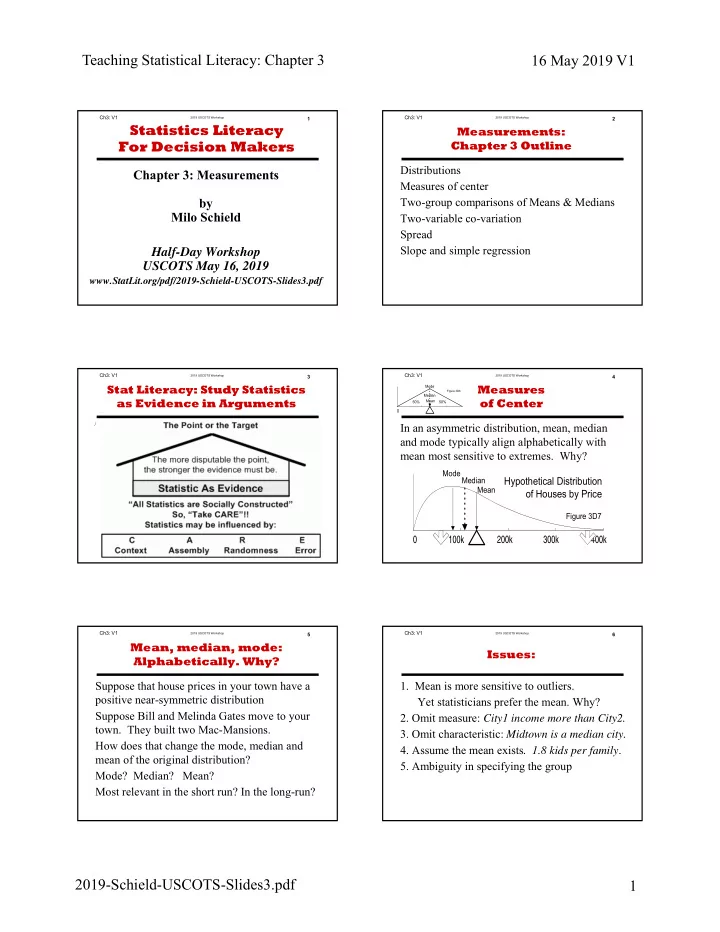
Teaching Statistical Literacy: Chapter 3 16 May 2019 V1 Ch3: V1 Ch3: V1 2019 USCOTS Workshop 1 2019 USCOTS Workshop 2 Statistics Literacy Measurements: For Decision Makers Chapter 3 Outline Distributions Chapter 3: Measurements


slide-1
SLIDE 1

Teaching Statistical Literacy: Chapter 3 16 May 2019 V1 2019-Schield-USCOTS-Slides3.pdf 1

2019 USCOTS Workshop

Ch3: V1 1

Chapter 3: Measurements by Milo Schield Half-Day Workshop USCOTS May 16, 2019

www.StatLit.org/pdf/2019-Schield-USCOTS-Slides3.pdf

Statistics Literacy For Decision Makers

2019 USCOTS Workshop

Ch3: V1

Distributions Measures of center Two-group comparisons of Means & Medians Two-variable co-variation Spread Slope and simple regression

2

Measurements: Chapter 3 Outline

2019 USCOTS Workshop

Ch3: V1 ./ 3

Stat Literacy: Study Statistics as Evidence in Arguments

2019 USCOTS Workshop

Ch3: V1

In an asymmetric distribution, mean, median and mode typically align alphabetically with mean most sensitive to extremes. Why?

4

Measures

  • f Center
Figure 3D6 Mean Mode Median 50% 50%

100k 200k 300k 400k

Figure 3D7

Hypothetical Distribution

  • f Houses by Price

Mean Mode Median

2019 USCOTS Workshop

Ch3: V1

Suppose that house prices in your town have a positive near-symmetric distribution Suppose Bill and Melinda Gates move to your

  • town. They built two Mac-Mansions.

How does that change the mode, median and mean of the original distribution? Mode? Median? Mean? Most relevant in the short run? In the long-run?

5

Mean, median, mode:

  • Alphabetically. Why?
2019 USCOTS Workshop

Ch3: V1

  • 1. Mean is more sensitive to outliers.

Yet statisticians prefer the mean. Why?

  • 2. Omit measure: City1 income more than City2.
  • 3. Omit characteristic: Midtown is a median city.
  • 4. Assume the mean exists. 1.8 kids per family.
  • 5. Ambiguity in specifying the group

6

Issues:

slide-2
SLIDE 2

Teaching Statistical Literacy: Chapter 3 16 May 2019 V1 2019-Schield-USCOTS-Slides3.pdf 2

2019 USCOTS Workshop

Ch3: V1

.

7

Controlling Confounding: Control Of

2019 USCOTS Workshop

Ch3: V1

.

8

Controlling Confounding: Control For

2019 USCOTS Workshop

Ch3: V1

.

9

Control Of/For Ngrams

2019 USCOTS Workshop

Ch3: V1

A crude association is an association in which nothing else has been taken into account. Less likely to get pregnant:

  • Short young adults than tall.
  • Adults that shave daily than those that don’t
  • Adults with long hair than those with short.

What one takes into account is an assumption. Teachers should say, “Check your assumptions.”

10

Crude Associations

2019 USCOTS Workshop

Ch3: V1

.zxc

11

Crude Association versus an Adjusted Association

US Income Distribution by Quintile Left Bar is Before Adjustment; Right Bar is After

4% 9% 23% 49% 12% 15% 15% 17% 20% 37% 0% 10% 20% 30% 40% 50% Bottom Second Middle Fourth Top Quintile of Families Share (%

  • f Total

www.Heritage.org

2019 USCOTS Workshop

Ch3: V1 12

Prison Expense: Crude vs Adjusted Associations

slide-3
SLIDE 3

Teaching Statistical Literacy: Chapter 3 16 May 2019 V1 2019-Schield-USCOTS-Slides3.pdf 3

2019 USCOTS Workshop

Ch3: V1

Ratio associations can be still be confounded. Averages are ratios.

13

Crude Ratio Associations It’s the Mix!!!

2019 USCOTS Workshop

Ch3: V1

SAT Verbal flat, but every group improved.

/ 14

Simpson’s Paradox: Time It’s the Mix!!

2019 USCOTS Workshop

Ch3: V1

After learning about Simpson’s Paradox, one student said, "I'll never trust another statistic." This is cynicism: not a good outcome.

15

Will an Association Reverse? The Cornfield Conditions Not all confounders can reverse an association. Jerome Cornfield proved that a confounder association must be "bigger" than the observed. Cornfield's conditions are one of the three biggest contributions of statistics to human knowledge.

2019 USCOTS Workshop

Ch3: V1

.

16

.

SEASON WINS vs. TOTAL PAYROLL

US Major League Baseball 52 62 72 82 92 102 10 20 30 40 50 60 Total Payroll ($Millions) 1995 Season W ins Yankees BlueJays Indians Twins Marlins Rangers Mets Padres Brav es Orioles Red Sox Reds Expos Pirates Tigers

2019 USCOTS Workshop

Ch3: V1

.

17

Regression Standardizes

House Prices (Average Acres = 1.6)

$50,000 $150,000 $250,000 $350,000 $450,000 1 2 3 4 5 6 Land Size (Acres)

2004AssessMTB

Best-Fit Line

2019 USCOTS Workshop

Ch3: V1

The data shows that house prices increase by $39,000 per bedroom. This is a crude association.

18

Regression Standardizes An Example: $16,000 per bedroom if land is controlled for, $9,000 per bedroom after accounting for land and house size, $5,000 after adjusting for land, house size, and number of bathrooms.

slide-4
SLIDE 4

Teaching Statistical Literacy: Chapter 3 16 May 2019 V1 2019-Schield-USCOTS-Slides3.pdf 4

2019 USCOTS Workshop

Ch3: V1

Children under two should not be allowed to watch television because it increases their chances

  • f suffering attention problems later in life, says

an American study. A study of 1,345 children found that each hour spent in front of the set every day increased the risks of attention deficit disorders by 10%.

U.S. journal, Pediatrics

19

TV for toddlers interferes with brain growth, says study:

2019 USCOTS Workshop

Ch3: V1

If a child’s risk of Attention Deficit Disorder increases by 10% for every extra hour of watching TV, how many hours do they have to watch to double their risk?

20

Time to Double given Growth Rate Rule of 72*: Time to double = 72 / Rate 72 divided by 10% per hour = 7.2 hours * Assuming compounding

2019 USCOTS Workshop

Ch3: V1

Don’t talk about confounding or effect size. Talk about assumptions.

  • What one controls for is an assumption.
  • What one fails to control for is an assumption.

AAU&C Quantitative Literacy VALUE rubric: Assumptions: Ability to make and evaluate important assumptions in estimation, modeling, and data analysis.

21

How to Relate this to Math Colleagues

2019 USCOTS Workshop

Ch3: V1

Interpretation, Representation, Calculation, Application, Assumptions, and Communication Assumptions: Ability to make and evaluate important assumptions in estimation, modeling, and data analysis.

www.statlit.org/pdf/2009QuantitativeLiteracyRubricAACU.pdf www.aacu.org/peerreivew/2014/summer/RealityCheck

22

AAC&U Quantitative Literacy VALUE Rubric

slide-5
SLIDE 5

2019 USCOTS Workshop

Ch3: V1 1

Chapter 3: Measurements by Milo Schield Half-Day Workshop USCOTS May 16, 2019

www.StatLit.org/pdf/2019-Schield-USCOTS-Slides3.pdf

Statistics Literacy For Decision Makers

slide-6
SLIDE 6

2019 USCOTS Workshop

Ch3: V1

Distributions Measures of center Two-group comparisons of Means & Medians Two-variable co-variation Spread Slope and simple regression

2

Measurements: Chapter 3 Outline

slide-7
SLIDE 7

2019 USCOTS Workshop

Ch3: V1 ./ 3

Stat Literacy: Study Statistics as Evidence in Arguments

slide-8
SLIDE 8

2019 USCOTS Workshop

Ch3: V1

In an asymmetric distribution, mean, median and mode typically align alphabetically with mean most sensitive to extremes. Why?

4

Measures

  • f Center

Figure 3D6

Mean Mode Median 50% 50%

100k 200k 300k 400k

Figure 3D7

Hypothetical Distribution

  • f Houses by Price

Mean Mode Median

slide-9
SLIDE 9

2019 USCOTS Workshop

Ch3: V1

Suppose that house prices in your town have a positive near-symmetric distribution Suppose Bill and Melinda Gates move to your

  • town. They built two Mac-Mansions.

How does that change the mode, median and mean of the original distribution? Mode? Median? Mean? Most relevant in the short run? In the long-run?

5

Mean, median, mode:

  • Alphabetically. Why?
slide-10
SLIDE 10

2019 USCOTS Workshop

Ch3: V1

  • 1. Mean is more sensitive to outliers.

Yet statisticians prefer the mean. Why?

  • 2. Omit measure: City1 income more than City2.
  • 3. Omit characteristic: Midtown is a median city.
  • 4. Assume the mean exists. 1.8 kids per family.
  • 5. Ambiguity in specifying the group

6

Issues:

slide-11
SLIDE 11

2019 USCOTS Workshop

Ch3: V1

.

7

Controlling Confounding: Control Of

slide-12
SLIDE 12

2019 USCOTS Workshop

Ch3: V1

.

8

Controlling Confounding: Control For

slide-13
SLIDE 13

2019 USCOTS Workshop

Ch3: V1

.

9

Control Of/For Ngrams

slide-14
SLIDE 14

2019 USCOTS Workshop

Ch3: V1

A crude association is an association in which nothing else has been taken into account. Less likely to get pregnant:

  • Short young adults than tall.
  • Adults that shave daily than those that don’t
  • Adults with long hair than those with short.

What one takes into account is an assumption. Teachers should say, “Check your assumptions.”

10

Crude Associations

slide-15
SLIDE 15

2019 USCOTS Workshop

Ch3: V1

.zxc

11

Crude Association versus an Adjusted Association

US Income Distribution by Quintile Left Bar is Before Adjustment; Right Bar is After

4% 9% 23% 49% 12% 15% 15% 17% 20% 37% 0% 10% 20% 30% 40% 50% Bottom Second Middle Fourth Top Quintile of Families Share (%

  • f Total

www.Heritage.org

slide-16
SLIDE 16

2019 USCOTS Workshop

Ch3: V1 12

Prison Expense: Crude vs Adjusted Associations

slide-17
SLIDE 17

2019 USCOTS Workshop

Ch3: V1

Ratio associations can be still be confounded. Averages are ratios.

13

Crude Ratio Associations It’s the Mix!!!

slide-18
SLIDE 18

2019 USCOTS Workshop

Ch3: V1

SAT Verbal flat, but every group improved.

/ 14

Simpson’s Paradox: Time It’s the Mix!!

slide-19
SLIDE 19

2019 USCOTS Workshop

Ch3: V1

After learning about Simpson’s Paradox, one student said, "I'll never trust another statistic." This is cynicism: not a good outcome.

15

Will an Association Reverse? The Cornfield Conditions Not all confounders can reverse an association. Jerome Cornfield proved that a confounder association must be "bigger" than the observed. Cornfield's conditions are one of the three biggest contributions of statistics to human knowledge.

slide-20
SLIDE 20

2019 USCOTS Workshop

Ch3: V1

.

16

.

SEASON WINS vs. TOTAL PAYROLL

US Major League Baseball 52 62 72 82 92 102 10 20 30 40 50 60 Total Payroll ($Millions) 1995 Season W ins Yankees BlueJays Indians Twins Marlins Rangers Mets Padres Brav es Orioles Red Sox Reds Expos Pirates Tigers

slide-21
SLIDE 21

2019 USCOTS Workshop

Ch3: V1

.

17

Regression Standardizes

House Prices (Average Acres = 1.6)

$50,000 $150,000 $250,000 $350,000 $450,000 1 2 3 4 5 6 Land Size (Acres)

2004AssessMTB

Best-Fit Line

slide-22
SLIDE 22

2019 USCOTS Workshop

Ch3: V1

The data shows that house prices increase by $39,000 per bedroom. This is a crude association.

18

Regression Standardizes An Example: $16,000 per bedroom if land is controlled for, $9,000 per bedroom after accounting for land and house size, $5,000 after adjusting for land, house size, and number of bathrooms.

slide-23
SLIDE 23

2019 USCOTS Workshop

Ch3: V1

Children under two should not be allowed to watch television because it increases their chances

  • f suffering attention problems later in life, says

an American study. A study of 1,345 children found that each hour spent in front of the set every day increased the risks of attention deficit disorders by 10%.

U.S. journal, Pediatrics

19

TV for toddlers interferes with brain growth, says study:

slide-24
SLIDE 24

2019 USCOTS Workshop

Ch3: V1

If a child’s risk of Attention Deficit Disorder increases by 10% for every extra hour of watching TV, how many hours do they have to watch to double their risk?

20

Time to Double given Growth Rate Rule of 72*: Time to double = 72 / Rate 72 divided by 10% per hour = 7.2 hours * Assuming compounding

slide-25
SLIDE 25

2019 USCOTS Workshop

Ch3: V1

Don’t talk about confounding or effect size. Talk about assumptions.

  • What one controls for is an assumption.
  • What one fails to control for is an assumption.

AAU&C Quantitative Literacy VALUE rubric: Assumptions: Ability to make and evaluate important assumptions in estimation, modeling, and data analysis.

21

How to Relate this to Math Colleagues

slide-26
SLIDE 26

2019 USCOTS Workshop

Ch3: V1

Interpretation, Representation, Calculation, Application, Assumptions, and Communication Assumptions: Ability to make and evaluate important assumptions in estimation, modeling, and data analysis.

www.statlit.org/pdf/2009QuantitativeLiteracyRubricAACU.pdf www.aacu.org/peerreivew/2014/summer/RealityCheck

22

AAC&U Quantitative Literacy VALUE Rubric