57% 2. Expose you to lots of new ideas 3. Present a coherent - - PDF document

57
SMART_READER_LITE
LIVE PREVIEW

57% 2. Expose you to lots of new ideas 3. Present a coherent - - PDF document

Statistical Literacy Workshop: Chapter 1 16 May 2019 V1 V1 V1 2019 USCOTS Workshop 1 2019 USCOTS Workshop 2 Teaching First Sharia math, Statistical Literacy then Sharia law!!! . Chapter 1 by Milo Schield Half-Day Workshop USCOTS May


slide-1
SLIDE 1

Statistical Literacy Workshop: Chapter 1 16 May 2019 V1 2019-Schield-USCOTS-Slides1.pdf 1

2019 USCOTS Workshop V1 1

Chapter 1 by Milo Schield Half-Day Workshop USCOTS May 16, 2019

www.StatLit.org/pdf/2019-Schield-USCOTS-slides1.pdf

Teaching Statistical Literacy

2019 USCOTS Workshop V1

.

2

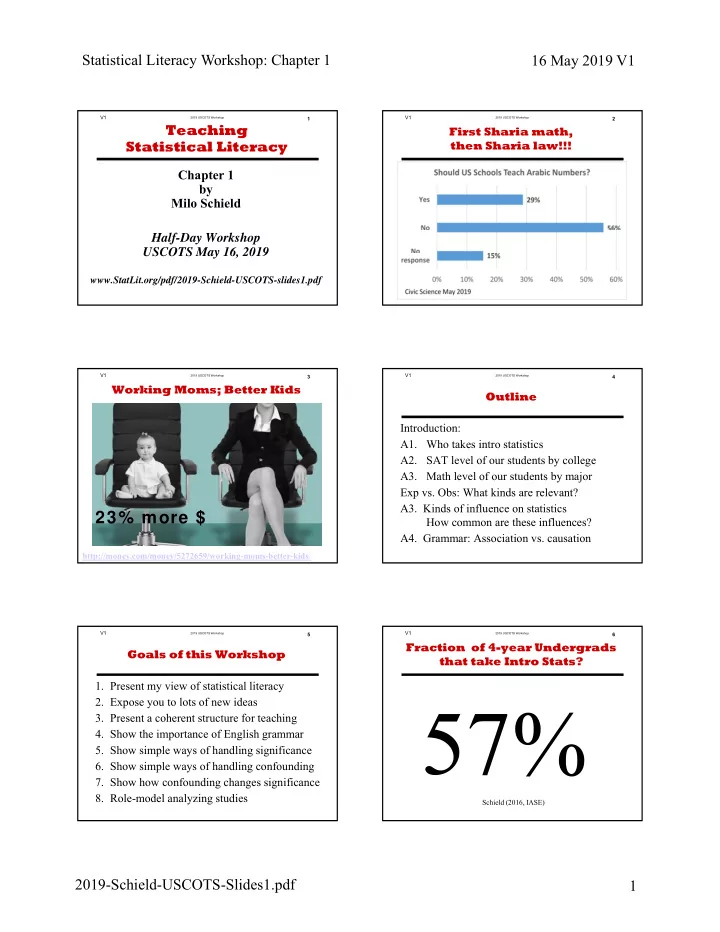
First Sharia math, then Sharia law!!!

2019 USCOTS Workshop V1

.

3

Working Moms; Better Kids

23% more $

http://money.com/money/5272659/working-moms-better-kids/ 2019 USCOTS Workshop V1

Introduction:

  • A1. Who takes intro statistics
  • A2. SAT level of our students by college
  • A3. Math level of our students by major

Exp vs. Obs: What kinds are relevant?

  • A3. Kinds of influence on statistics

How common are these influences?

  • A4. Grammar: Association vs. causation
4

Outline

2019 USCOTS Workshop V1
  • 1. Present my view of statistical literacy
  • 2. Expose you to lots of new ideas
  • 3. Present a coherent structure for teaching
  • 4. Show the importance of English grammar
  • 5. Show simple ways of handling significance
  • 6. Show simple ways of handling confounding
  • 7. Show how confounding changes significance
  • 8. Role-model analyzing studies
5

Goals of this Workshop

2019 USCOTS Workshop V1 Schield (2016, IASE) 6

Fraction of 4-year Undergrads that take Intro Stats?

57%

slide-2
SLIDE 2

Statistical Literacy Workshop: Chapter 1 16 May 2019 V1 2019-Schield-USCOTS-Slides1.pdf 2

2019 USCOTS Workshop V1 Tintle et al, 2013 7

Fraction of Course Gain that Stat Students Loose in 4 Months

50%

2019 USCOTS Workshop V1

Of those taking Stat I:

  • less than 1% take Stat II (10-yrs @ U. St. Thomas)
  • less than 0.2% major in statistics (nationwide).
  • most see less value in statistics after the course than

they did before. Schield and Schield (2008).

  • too many say “Worst course I ever took” [anecdotal]
www.amstat.org/misc/StatsBachelors2003-2013.pdf 1,135 stat majors in 2013 at 32 colleges www.StatLit.org/pdf/2015-Schield-UST-Enroll-in-Statistics.pdf 8

Student Attitudes Toward Stats

2019 USCOTS Workshop V1 Estimates by Schield (2015, Statchat) 9

What fraction of 4-Yr Intro Stat students are taught outside Math?

50%

2019 USCOTS Workshop V1 Schield (2016, IASE). Inferred from data in 2012 US Statistical Abstract. 10

Who takes Intro Statistics at Four-Year Colleges?

2019 USCOTS Workshop V1 Schield (2016, IASE) 11

Where are your students?

2019 USCOTS Workshop V1

SAT Math Scores: Average by Student Major Percentiles

  • f all those

taking the Math SAT

Schield (2016, IASE) 12

SAT Math Percentile by Major

slide-3
SLIDE 3

Statistical Literacy Workshop: Chapter 1 16 May 2019 V1 2019-Schield-USCOTS-Slides1.pdf 3

2019 USCOTS Workshop V1

The real world is complex and can't be described well by one or two variables. If students do not have exposure to simple tools for disentangling complex relationships, they may dismiss statistics as an old-school discipline only suitable for small sample inference of randomized studies.

13

GAISE 2016 Update

2019 USCOTS Workshop V1

Multivariable thinking is critical to make sense of the observational data around us

  • learn to identify observational studies
  • learn to consider potential confounding factors
  • use … stratification … to show confounding

This report recommends that students be introduced to multivariable thinking, preferably early in the introductory course and not as an afterthought at the end of the course.

14

GAISE 2016 Update

2019 USCOTS Workshop V1

.

Schield (2016, ASA) 15

Most Important Topics: Student Choices

2019 USCOTS Workshop V1 Statistical association is not the same as Basketball Assoc. Association words assert association explicitly or describe associations involving fixed conditions or unrepeatable events. Association: Height is associated with age in children Obesity is correlated with (related to) diabetes. Prediction: Graduating from high school predicts success in life.
  • *Comparisons: People with degrees earn more than those without
Whites have a higher risk of suicide than blacks. *Co-variation: As children get older, their weight increases. * Manipulation is impossible, or treatment or outcome cannot be repeated. Schield (2018, SL4DM) 16

A-B-C Words: A = Association

2019 USCOTS Workshop V1

Causation words assert causation, sufficiency

  • r contra-factual

Causation: A bomb caused the fire. Insomnia is a side effect. Lightning resulted in a fire. Spark results in a fire. Sufficient: The more X you do, the more Y you will get. Prevent, stop, end, start, kill, produce, cure, avoid, ban, quit, block, ward off, stave off, cancel, hinder, or eliminate.6 Contra-factual: Those who do X will get more Y than if they had not done X.

17

A-B-C Words: C = Causation

2019 USCOTS Workshop V1

Between words describe association but imply causation

Verbs: Red wine cuts cancer risk. TV ups kids’ risk of flunking. Gene X increases health risk. Smoking raises asthma risk. Connectors: Nuts linked to cancer. Trauma tied to heart disease. Contributor Diet contributes to diabetes. Age is factor in infertility Nouns: Spinach is asthma protector. Bad water is a killer. Logicals: Anxiety increases due to (because of) high stake testing
  • *Compare: People who take antidepressants have fewer migraines
Asthma attacks more likely for smokers than non-smokers. *Covariation: As teacher pay increases, student scores increase. The more hours worked, the more likely a promotion *Manipulation is possible, and treatment and outcome are repeatable. 18

A-B-C Words: B = Between

slide-4
SLIDE 4

Statistical Literacy Workshop: Chapter 1 16 May 2019 V1 2019-Schield-USCOTS-Slides1.pdf 4

2019 USCOTS Workshop V1

Of the 2,000 news headlines analyzed6, 71% involved A, B or C. Of those headlines involving A, B or C,

  • 86% were "between" claims,
  • 11% sufficiency, 3% causation, 3% association.
  • 6. Schield and Raymond (2009).
19

A-B-C Words: Distribution in Headlines

2019 USCOTS Workshop V1

This statement is ambiguous. It can mean: 1 Association is not sufficient to prove causation 2 Association provides no evidence for causation. Teachers may intend #1; students often hear #2. A better statement would be: Association is evidence of causation somewhere.

20

Association is not causation

2019 USCOTS Workshop V1

No idea has stifled the growth of statistical literacy as much as the endless repetition of the words "correlation is not causation". This phrase seems to be primarily used to suppress intellectual inquiry -- by encouraging the unspoken assumption that correlational knowledge is somehow an inferior form of knowledge.

John Myles White (2010): www.johnmyleswhite.com/notebook/2010/10/01/three-quarter-truths-correlation-is-not-causation/ 21

Association is not causation

2019 USCOTS Workshop V1 ./ 22

Studies are the Primary Unit of Analysis

2019 USCOTS Workshop V1 ./ 23

Harvard Case Studies: Title or Abstract

2019 USCOTS Workshop V1 ./ 24

Statistical Literacy : An Overview

slide-5
SLIDE 5

Statistical Literacy Workshop: Chapter 1 16 May 2019 V1 2019-Schield-USCOTS-Slides1.pdf 5

2019 USCOTS Workshop V1 ./ 25

Stat Literacy studies Stats as Evidence in Arguments

2019 USCOTS Workshop V1
  • Q1. Which group is largest?

Consolidate White (Non-Hispanic) with Hispanic.

  • Q2. Which group is largest?
26

Statistical Literacy : Assembly

2019 USCOTS Workshop V1

Five non-quantitative Topics:

  • 1. Regression to the Mean

Sport Illustrated Cover

  • 2. Statistically significant
  • 3. Chance-Related Mistakes:

Three Door problem; Birthday problem

  • Better than chance
  • Unlikely to be chance
27

Statistical Literacy : Randomness

2019 USCOTS Workshop V1

Three kinds of error

  • 1. Subject/respondent error:
  • 2. Researcher/measurement error:
  • 3. Sampling error:
28

Statistical Literacy : Error/Bias

2019 USCOTS Workshop V1 29

Statistical Literacy : Assembly

2019 USCOTS Workshop V1

More college students (over half) take intro statistics than any other course (except English). One-size fits all is no longer viable. Statistics education must support Stat 101 and 100/102. Statistics education should (1) support different flavors for different majors, and (2) agree on the contributions of statistics to human knowledge.

/ 30

Statistical Literacy : Recommendation

slide-6
SLIDE 6

Statistical Literacy Workshop: Chapter 1 16 May 2019 V1 2019-Schield-USCOTS-Slides1.pdf 6

2019 USCOTS Workshop V1

The past success of statistics has depended on vast, deliberate simplifications amounting to willful ignorance. This very success now threatens future advances in medicine, the social sciences, and other fields. Limitations of existing methods result in frequent reversals of scientific findings/recommendations, to the consternation of scientists and the public. Herbert I. Weisberg

31

Willful Ignorance

2019 USCOTS Workshop V1

The past success of statistics has depended on vast, deliberate simplifications amounting to willful ignorance.

32

Willful Ignorance Herbert Weisberg Limitations of existing methods result in frequent reversals of scientific findings and recommendations, to the consternation of scientists and the lay public.

slide-7
SLIDE 7

2019 USCOTS Workshop

V1 1

Chapter 1 by Milo Schield Half-Day Workshop USCOTS May 16, 2019

www.StatLit.org/pdf/2019-Schield-USCOTS-slides1.pdf

Teaching Statistical Literacy

slide-8
SLIDE 8

2019 USCOTS Workshop

V1

.

2

First Sharia math, then Sharia law!!!

slide-9
SLIDE 9

2019 USCOTS Workshop

V1

.

3

Working Moms; Better Kids

23% more $

http://money.com/money/5272659/working-moms-better-kids/

slide-10
SLIDE 10

2019 USCOTS Workshop

V1

Introduction:

  • A1. Who takes intro statistics
  • A2. SAT level of our students by college
  • A3. Math level of our students by major

Exp vs. Obs: What kinds are relevant?

  • A3. Kinds of influence on statistics

How common are these influences?

  • A4. Grammar: Association vs. causation

4

Outline

slide-11
SLIDE 11

2019 USCOTS Workshop

V1

  • 1. Present my view of statistical literacy
  • 2. Expose you to lots of new ideas
  • 3. Present a coherent structure for teaching
  • 4. Show the importance of English grammar
  • 5. Show simple ways of handling significance
  • 6. Show simple ways of handling confounding
  • 7. Show how confounding changes significance
  • 8. Role-model analyzing studies

5

Goals of this Workshop

slide-12
SLIDE 12

2019 USCOTS Workshop

V1

Schield (2016, IASE)

6

Fraction of 4-year Undergrads that take Intro Stats?

slide-13
SLIDE 13

2019 USCOTS Workshop

V1

Tintle et al, 2013

7

Fraction of Course Gain that Stat Students Loose in 4 Months

slide-14
SLIDE 14

2019 USCOTS Workshop

V1

Of those taking Stat I:

  • less than 1% take Stat II (10-yrs @ U. St. Thomas)
  • less than 0.2% major in statistics (nationwide).
  • most see less value in statistics after the course than

they did before. Schield and Schield (2008).

  • too many say “Worst course I ever took” [anecdotal]

www.amstat.org/misc/StatsBachelors2003-2013.pdf 1,135 stat majors in 2013 at 32 colleges www.StatLit.org/pdf/2015-Schield-UST-Enroll-in-Statistics.pdf

8

Student Attitudes Toward Stats

slide-15
SLIDE 15

2019 USCOTS Workshop

V1

Estimates by Schield (2015, Statchat)

9

What fraction of 4-Yr Intro Stat students are taught outside Math?

slide-16
SLIDE 16

2019 USCOTS Workshop

V1

Schield (2016, IASE). Inferred from data in 2012 US Statistical Abstract.

10

Who takes Intro Statistics at Four-Year Colleges?

slide-17
SLIDE 17

2019 USCOTS Workshop

V1

Schield (2016, IASE)

11

Where are your students?

slide-18
SLIDE 18

2019 USCOTS Workshop

V1

SAT Math Scores: Average by Student Major Percentiles

  • f all those

taking the Math SAT

Schield (2016, IASE)

12

SAT Math Percentile by Major

slide-19
SLIDE 19

2019 USCOTS Workshop

V1

The real world is complex and can't be described well by one or two variables. If students do not have exposure to simple tools for disentangling complex relationships, they may dismiss statistics as an old-school discipline only suitable for small sample inference of randomized studies.

13

GAISE 2016 Update

slide-20
SLIDE 20

2019 USCOTS Workshop

V1

Multivariable thinking is critical to make sense of the observational data around us

  • learn to identify observational studies
  • learn to consider potential confounding factors
  • use … stratification … to show confounding

This report recommends that students be introduced to multivariable thinking, preferably early in the introductory course and not as an afterthought at the end of the course.

14

GAISE 2016 Update

slide-21
SLIDE 21

2019 USCOTS Workshop

V1

.

Schield (2016, ASA)

15

Most Important Topics: Student Choices

slide-22
SLIDE 22

2019 USCOTS Workshop

V1

Statistical association is not the same as Basketball Assoc. Association words assert association explicitly or describe associations involving fixed conditions or unrepeatable events. Association: Height is associated with age in children Obesity is correlated with (related to) diabetes. Prediction: Graduating from high school predicts success in life.

  • *Comparisons: People with degrees earn more than those without

Whites have a higher risk of suicide than blacks. *Co-variation: As children get older, their weight increases.

* Manipulation is impossible, or treatment or outcome cannot be repeated. Schield (2018, SL4DM)

16

A-B-C Words: A = Association

slide-23
SLIDE 23

2019 USCOTS Workshop

V1

Causation words assert causation, sufficiency

  • r contra-factual

Causation: A bomb caused the fire. Insomnia is a side effect. Lightning resulted in a fire. Spark results in a fire. Sufficient: The more X you do, the more Y you will get. Prevent, stop, end, start, kill, produce, cure, avoid, ban, quit, block, ward off, stave off, cancel, hinder, or eliminate.6 Contra-factual: Those who do X will get more Y than if they had not done X.

17

A-B-C Words: C = Causation

slide-24
SLIDE 24

2019 USCOTS Workshop

V1

Between words describe association but imply causation

Verbs: Red wine cuts cancer risk. TV ups kids’ risk of flunking. Gene X increases health risk. Smoking raises asthma risk. Connectors: Nuts linked to cancer. Trauma tied to heart disease. Contributor Diet contributes to diabetes. Age is factor in infertility Nouns: Spinach is asthma protector. Bad water is a killer. Logicals: Anxiety increases due to (because of) high stake testing

  • *Compare: People who take antidepressants have fewer migraines

Asthma attacks more likely for smokers than non-smokers. *Covariation: As teacher pay increases, student scores increase. The more hours worked, the more likely a promotion

*Manipulation is possible, and treatment and outcome are repeatable.

18

A-B-C Words: B = Between

slide-25
SLIDE 25

2019 USCOTS Workshop

V1

Of the 2,000 news headlines analyzed6, 71% involved A, B or C. Of those headlines involving A, B or C,

  • 86% were "between" claims,
  • 11% sufficiency, 3% causation, 3% association.
  • 6. Schield and Raymond (2009).

19

A-B-C Words: Distribution in Headlines

slide-26
SLIDE 26

2019 USCOTS Workshop

V1

This statement is ambiguous. It can mean: 1 Association is not sufficient to prove causation 2 Association provides no evidence for causation. Teachers may intend #1; students often hear #2. A better statement would be: Association is evidence of causation somewhere.

20

Association is not causation

slide-27
SLIDE 27

2019 USCOTS Workshop

V1

No idea has stifled the growth of statistical literacy as much as the endless repetition of the words "correlation is not causation". This phrase seems to be primarily used to suppress intellectual inquiry -- by encouraging the unspoken assumption that correlational knowledge is somehow an inferior form of knowledge.

John Myles White (2010):

www.johnmyleswhite.com/notebook/2010/10/01/three-quarter-truths-correlation-is-not-causation/ 21

Association is not causation

slide-28
SLIDE 28

2019 USCOTS Workshop

V1 ./ 22

Studies are the Primary Unit of Analysis

slide-29
SLIDE 29

2019 USCOTS Workshop

V1 ./ 23

Harvard Case Studies: Title or Abstract

slide-30
SLIDE 30

2019 USCOTS Workshop

V1 ./ 24

Statistical Literacy : An Overview

slide-31
SLIDE 31

2019 USCOTS Workshop

V1 ./ 25

Stat Literacy studies Stats as Evidence in Arguments

slide-32
SLIDE 32

2019 USCOTS Workshop

V1

  • Q1. Which group is largest?

Consolidate White (Non-Hispanic) with Hispanic.

  • Q2. Which group is largest?

26

Statistical Literacy : Assembly

slide-33
SLIDE 33

2019 USCOTS Workshop

V1

Five non-quantitative Topics:

  • 1. Regression to the Mean

Sport Illustrated Cover

  • 2. Statistically significant
  • 3. Chance-Related Mistakes:

Three Door problem; Birthday problem

  • Better than chance
  • Unlikely to be chance

27

Statistical Literacy : Randomness

slide-34
SLIDE 34

2019 USCOTS Workshop

V1

Three kinds of error

  • 1. Subject/respondent error:
  • 2. Researcher/measurement error:
  • 3. Sampling error:

28

Statistical Literacy : Error/Bias

slide-35
SLIDE 35

2019 USCOTS Workshop

V1 29

Statistical Literacy : Assembly

slide-36
SLIDE 36

2019 USCOTS Workshop

V1

More college students (over half) take intro statistics than any other course (except English). One-size fits all is no longer viable. Statistics education must support Stat 101 and 100/102. Statistics education should (1) support different flavors for different majors, and (2) agree on the contributions of statistics to human knowledge.

/ 30

Statistical Literacy : Recommendation

slide-37
SLIDE 37

2019 USCOTS Workshop

V1

The past success of statistics has depended on vast, deliberate simplifications amounting to willful ignorance. This very success now threatens future advances in medicine, the social sciences, and other fields. Limitations of existing methods result in frequent reversals of scientific findings/recommendations, to the consternation of scientists and the public. Herbert I. Weisberg

31

Willful Ignorance

slide-38
SLIDE 38

2019 USCOTS Workshop

V1

The past success of statistics has depended on vast, deliberate simplifications amounting to willful ignorance.

32

Willful Ignorance Herbert Weisberg Limitations of existing methods result in frequent reversals of scientific findings and recommendations, to the consternation of scientists and the lay public.