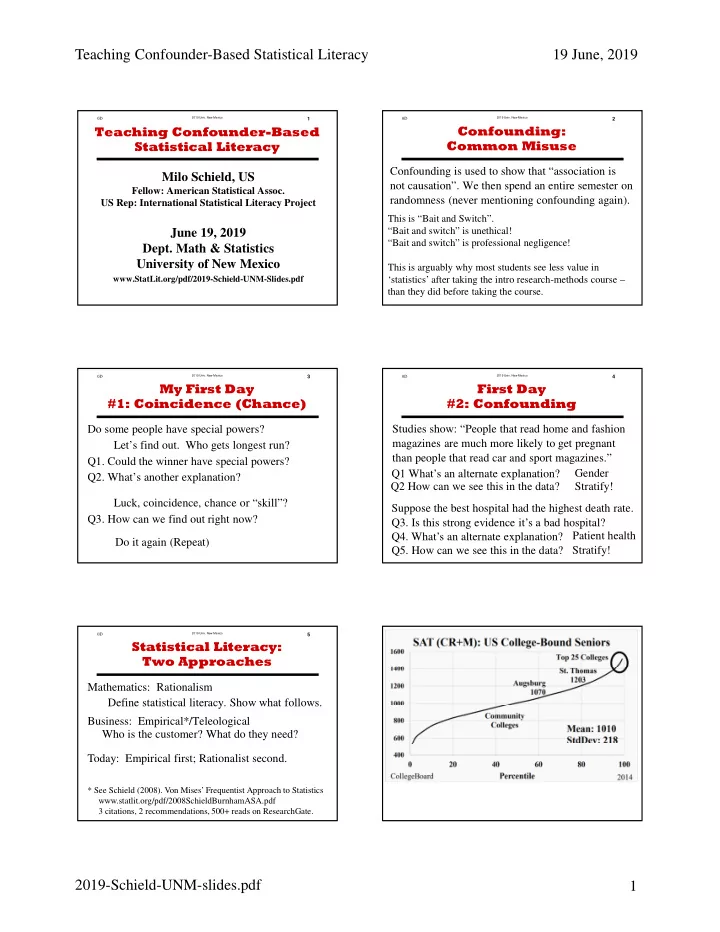
Teaching Confounder-Based Statistical Literacy 19 June, 2019 1 2 - - PDF document

teaching confounder based statistical literacy 19 june
SMART_READER_LITE
LIVE PREVIEW

Teaching Confounder-Based Statistical Literacy 19 June, 2019 1 2 - - PDF document

Teaching Confounder-Based Statistical Literacy 19 June, 2019 1 2 2019 Univ. New Mexico 2019 Univ. New Mexico 0D 0D Confounding: Teaching Confounder-Based Statistical Literacy Common Misuse Confounding is used to show that association


slide-1
SLIDE 1

Teaching Confounder-Based Statistical Literacy 19 June, 2019 2019-Schield-UNM-slides.pdf 1

2019 Univ. New Mexico 0D

1

Milo Schield, US

Fellow: American Statistical Assoc. US Rep: International Statistical Literacy Project

June 19, 2019

  • Dept. Math & Statistics

University of New Mexico

www.StatLit.org/pdf/2019-Schield-UNM-Slides.pdf

Teaching Confounder-Based Statistical Literacy

2019 Univ. New Mexico 0D

2

Confounding is used to show that “association is not causation”. We then spend an entire semester on randomness (never mentioning confounding again).

Confounding: Common Misuse

This is “Bait and Switch”. “Bait and switch” is unethical! “Bait and switch” is professional negligence! This is arguably why most students see less value in ‘statistics’ after taking the intro research-methods course – than they did before taking the course.

2019 Univ. New Mexico 0D

3

Do some people have special powers? Let’s find out. Who gets longest run?

  • Q1. Could the winner have special powers?
  • Q2. What’s another explanation?

My First Day #1: Coincidence (Chance)

Luck, coincidence, chance or “skill”?

  • Q3. How can we find out right now?

Do it again (Repeat)

2019 Univ. New Mexico 0D

4

Studies show: “People that read home and fashion magazines are much more likely to get pregnant than people that read car and sport magazines.”

First Day #2: Confounding

Suppose the best hospital had the highest death rate.

  • Q3. Is this strong evidence it’s a bad hospital?

Stratify! Q2 How can we see this in the data? Stratify! Q1 What’s an alternate explanation? Gender

  • Q4. What’s an alternate explanation?

Patient health

  • Q5. How can we see this in the data?
2019 Univ. New Mexico 0D

5

Mathematics: Rationalism Define statistical literacy. Show what follows. Business: Empirical*/Teleological Who is the customer? What do they need?

Statistical Literacy: Two Approaches

Today: Empirical first; Rationalist second.

* See Schield (2008). Von Mises’ Frequentist Approach to Statistics www.statlit.org/pdf/2008SchieldBurnhamASA.pdf 3 citations, 2 recommendations, 500+ reads on ResearchGate.

2019 Univ. New Mexico 0D

6

.

Our Students

slide-2
SLIDE 2

Teaching Confounder-Based Statistical Literacy 19 June, 2019 2019-Schield-UNM-slides.pdf 2

2019 Univ. New Mexico 0D

7

Math majors have highest Math SATs

Math-Stat Teachers

  • vs. Non-Math Students
2019 Univ. New Mexico 0D

8

.

Harvard Biz Review Cases 42K Word Prevalence: Abstract

2015

2019 Univ. New Mexico 0D

9

.

Most students take statistics. Our Audience/Customers

2019 Univ. New Mexico 0D

10

Reading numbers in the news. Not just pedagogy in traditional stats:

  • Including major projects in statistics
  • Using resampling to create confidence intervals
  • Use of resampling to run hypothesis tests
  • Analyzing results of clinical trials
  • Analyzing results of random surveys/polls

Statistical Literacy: NOT

2019 Univ. New Mexico 0D

11

Statistical literacy studies statistics as evidence in arguments.

Most statistical arguments involve observational

  • statistics. These are easily confounded.

Confounding is what connects statistical literacy to the humanities, the liberal arts, the social sciences, the professions and the soft physical sciences (geology, astronomy, epidemiology, etc.)

Statistical Literacy: An Overview

2019 Univ. New Mexico 0D

12

Statistical literacy studies statistics as evidence in arguments.

Statistical Literacy: Four Kinds of Arguments

GENERALIZATION From Some to All From Group to Subject SPECIFICATION From Present to Past. From Effect to Cause From Past to Future. From Act to Effect

OBSERVABLES

EXPLANATION PREDICTION

slide-3
SLIDE 3

Teaching Confounder-Based Statistical Literacy 19 June, 2019 2019-Schield-UNM-slides.pdf 3

2019 Univ. New Mexico 0D

13

In order to unpack this definition, we must be clear

  • n how we define “statistic”.

In traditional inference-based courses, a statistic is a property of a sample.

  • Typically random samples.
  • Typically small random samples.

Defining a “statistic” in Traditional Statistics

2019 Univ. New Mexico 0D

14

  • 1. Statistics are different from numbers.
  • 2. Statistics are between number and words.
  • 3. Statistics are numbers in context –

where the context matters.

  • 4. Statistics are counts and measures of real things

Consequence: Statistics can be influenced. StatLit studies ALL the influences on a statistic

Defining a “statistic” in Statistical Literacy

2019 Univ. New Mexico 0D

15

.

Statistical Literacy Studies ALL Influences

2019 Univ. New Mexico 0D

16

.

People that shave their face are taller…

2019 Univ. New Mexico 0D

17

Experiments vs. Observational Study

Study Design Can Ward Off Confounders

Experiment

Strength of Argument: Support given by the reasons (premises) -- assuming they are true Floor: truth of reasons

Observational Study

Walls: support of point if reasons are true Roof: point of dispute

2019 Univ. New Mexico 0D

18

.

Study Design Can Ward Off Confounders

slide-4
SLIDE 4

Teaching Confounder-Based Statistical Literacy 19 June, 2019 2019-Schield-UNM-slides.pdf 4

2019 Univ. New Mexico 0D

19

.

Ward off Confounders: Quasi-Experiments

2019 Univ. New Mexico 0D

20

.

Prevalence Ngrams

2019 Univ. New Mexico 0D

21

.

Prevalence Ngrams

2019 Univ. New Mexico 0D

22

.

Prevalence Ngrams

2019 Univ. New Mexico 0D

23

.

Prevalence Ngrams

2019 Univ. New Mexico 0D

24

  • 1. Association is not causation
  • 2. The Central Limit theorem; the formula for

Standard Error: statistical average error. Howard Wainer calls this “the most dangerous equation” (next to E=mc2)

  • 3. Fisher’s uses of random assignment to

control for pre-existing confounders

Three Big Contributions to Human Knowledge

slide-5
SLIDE 5

Teaching Confounder-Based Statistical Literacy 19 June, 2019 2019-Schield-UNM-slides.pdf 5

2019 Univ. New Mexico 0D

25

What are statistical educators biggest sins in teaching introductory statistics?

  • 1. Ignoring multivariate data, observational studies

and confounding.

  • 2. Failing to show that controlling for a confounder

can change statistical significance.

  • 3. Ignoring the Cornfield conditions.
  • 4. Ignoring how definitions can influence Stat. Sig.

Biggest Omissions relative to Human Knowledge

2019 Univ. New Mexico 0D

26

  • 1. Lack of focus on confounding
  • 2. Students
  • may become cynics about every statistic.
  • will have less respect for our discipline.
  • 3. Teachers:

Math/stat teachers: not trained to teach literacy. Math/stat teachers: don’t want to teach literacy.

  • 4. Textbook and teacher training materials

Statistical Literacy: Four Biggest Problems

2019 Univ. New Mexico 0D

27

Statistical literacy: the discipline that studies: * all the influences on a statistic. In observational studies, confounding is arguably the most common – most important – influence. The statistical literacy “debate” is ultimately between the ‘pro’ and the ‘anti’ confounders. Schield is – and has always been – pro-confounder. See Schield (1998) for “confounding factors”.

Statistical Literacy and Confounding

2019 Univ. New Mexico 0D

28

K-12 report: The first line: “The ultimate goal: statistical literacy”. Confounding is mentioned twice: once to define and once to note it may create patterns that are not a “reliable basis for statistical inference”. College report: Confounding is mentioned only

  • nce. It is not defined; it appears in a sample

problem in a list of words that may apply in analyzing data from an observational study.

Confounding Almost Absent in GAISE 2005

2019 Univ. New Mexico 0D

29

Plus: Confounding shown 18 times (big increase):

Twice up front: Goal 9: Ethics: “with large data sets, … under-standing confounding … becomes even more relevant.” p 11

  • Recommendation: Multivariable thinking. Examples

“show how confounding plays an important role…” p.15

Nine times in appendix B: 34, 38 (3), 40 (2), 41(3) Seven times later: Footnote 105; 113, 120, 122 (4). Minus: Not in any one-line recommendations/goals

Confounding mentioned in GAISE 2016 Update

2019 Univ. New Mexico 0D

30

Extremely important observational study. Smoking is a most-likely cause of cancer. MINUS:

  • Not in most statistics textbooks.
  • Not mentioned in GAISE 2005 College.

PLUS:

  • Discussed in detail in GAISE 2004 K-12.

But confounding was never used in the discussion

Silence on Smoking and Lung Cancer

slide-6
SLIDE 6

Teaching Confounder-Based Statistical Literacy 19 June, 2019 2019-Schield-UNM-slides.pdf 6

2019 Univ. New Mexico 0D

31

  • 1. Confounding is not an issue in predicting.
  • 2. There is no test for confounding. Judea Pearl
  • 3. Using association as evidence for causation is a

matter for subject-matter experts. Statisticians have no professional opinion on the subject.

  • 4. Discussing confounding would bring disrepute
  • n our discipline.

Why are we silent

  • n confounding?
2019 Univ. New Mexico 0D

32

We need to go back to the past. We need to revisit the Fisher-Cornfield dialogue on whether smoking caused lung cancer. We need to revisit Cornfield’s conditions for a confounder to nullify or reverse an association. We need to see how to change statistical education to include Cornfield’s criteria for confounding.

How can we change the present?

2019 Univ. New Mexico 0D

33

Back to 1958.

Back to the Future: Here we Go!

2019 Univ. New Mexico 0D

34

Jerome Cornfield got his BA and MA in history. He studied statistics at the US Dept of Agriculture. He worked for USDA on sampling and study design He created two common statistical measures: Relative risk (RR) and the Odds Ratio (OR). He carfully compared prospective (cohort) and retrospective (case control) studies. He was elected President of the ASA in 1974.

Back to the Future: Jerome Cornfield: 1912-1979

2019 Univ. New Mexico 0D

35

Statisticians are subdued in talking about Cornfield; they are silent on the Cornfield conditions.

  • 1. Not listed in RSS statistical timeline.

Not listed in Wikipedia Timeline of Statistics

  • 2. Wikipedia: Nothing on his work on confounding

in the Smoking-Cancer studies.

  • 3. Nothing in most of statisticians’ commentaries

about the Cornfield condition.

Back to the Future: Cornfield

2019 Univ. New Mexico 0D

36

Because we don’t know Cornfield’s conditions! Cornfield conditions: Minimum confounder size to nullify or reverse an observed association. Impact: Allowed statisticians to say that “Smoking causes cancer” using data from an observational study.

Why are We Silent

  • n Confounding?
slide-7
SLIDE 7

Teaching Confounder-Based Statistical Literacy 19 June, 2019 2019-Schield-UNM-slides.pdf 7

2019 Univ. New Mexico 0D

37

Confounders have no single analytical distribution. There is no way to say that a given effect size will resist X% of all relevant confounders. But we can postulate a standard distribution of confounders: say an exponential distribution of relative risks with a mean of 2 (median of 1.69). An RR of 4 will resist 95% of these standard

  • confounders. 1.5 resists 40%; 1.2 resists 20%.

Resist X% of Confounders

2019 Univ. New Mexico 0D

38

Confounder Resistance: Propose a Standard

Arbitrary, but simple and fits existing data.

2019 Univ. New Mexico 0D

39

With Cornfield conditions, we can

  • 1. Show that the larger the effect size, the

more resistance an association has to causation. (Schield and Burnham, 1998)

  • 2. Show how to use Cornfield’s conditions as

necessary conditions. Schield (2012).

  • 3. Show how to work problems controlling for a

binary confounder. Schield ().

Summary Need Cornfield Conditions

2019 Univ. New Mexico 0D

40

Conclusions

By featuring confounding in introductory statistics we can change our destiny. Statistical literacy can help untangle the confusion in many political debates. Distinguishing between a crude association and a standardized association would be a big step forward We are at a fork in the road. Which one will statistical educators take? Their choice will influence what most college graduates will study in decades to come.

slide-8
SLIDE 8

2019 Univ. New Mexico

0D

1

Milo Schield, US

Fellow: American Statistical Assoc. US Rep: International Statistical Literacy Project

June 19, 2019

  • Dept. Math & Statistics

University of New Mexico

www.StatLit.org/pdf/2019-Schield-UNM-Slides.pdf

Teaching Confounder-Based Statistical Literacy

slide-9
SLIDE 9

2019 Univ. New Mexico

0D

2

Confounding is used to show that “association is not causation”. We then spend an entire semester on randomness (never mentioning confounding again).

Confounding: Common Misuse

This is “Bait and Switch”. “Bait and switch” is unethical! “Bait and switch” is professional negligence! This is arguably why most students see less value in ‘statistics’ after taking the intro research-methods course – than they did before taking the course.

slide-10
SLIDE 10

2019 Univ. New Mexico

0D

3

Do some people have special powers? Let’s find out. Who gets longest run?

  • Q1. Could the winner have special powers?
  • Q2. What’s another explanation?

My First Day #1: Coincidence (Chance)

Luck, coincidence, chance or “skill”?

  • Q3. How can we find out right now?

Do it again (Repeat)

slide-11
SLIDE 11

2019 Univ. New Mexico

0D

4

Studies show: “People that read home and fashion magazines are much more likely to get pregnant than people that read car and sport magazines.”

First Day #2: Confounding

Suppose the best hospital had the highest death rate.

  • Q3. Is this strong evidence it’s a bad hospital?

Stratify! Q2 How can we see this in the data? Stratify! Q1 What’s an alternate explanation? Gender

  • Q4. What’s an alternate explanation?

Patient health

  • Q5. How can we see this in the data?
slide-12
SLIDE 12

2019 Univ. New Mexico

0D

5

Mathematics: Rationalism Define statistical literacy. Show what follows. Business: Empirical*/Teleological Who is the customer? What do they need?

Statistical Literacy: Two Approaches

Today: Empirical first; Rationalist second.

* See Schield (2008). Von Mises’ Frequentist Approach to Statistics www.statlit.org/pdf/2008SchieldBurnhamASA.pdf 3 citations, 2 recommendations, 500+ reads on ResearchGate.

slide-13
SLIDE 13

2019 Univ. New Mexico

0D

6

.

Our Students

slide-14
SLIDE 14

2019 Univ. New Mexico

0D

7

Math majors have highest Math SATs

Math-Stat Teachers

  • vs. Non-Math Students
slide-15
SLIDE 15

2019 Univ. New Mexico

0D

8

.

Harvard Biz Review Cases 42K Word Prevalence: Abstract

2015

slide-16
SLIDE 16

2019 Univ. New Mexico

0D

9

.

Most students take statistics. Our Audience/Customers

slide-17
SLIDE 17

2019 Univ. New Mexico

0D

10

Reading numbers in the news. Not just pedagogy in traditional stats:

  • Including major projects in statistics
  • Using resampling to create confidence intervals
  • Use of resampling to run hypothesis tests
  • Analyzing results of clinical trials
  • Analyzing results of random surveys/polls

Statistical Literacy: NOT

slide-18
SLIDE 18

2019 Univ. New Mexico

0D

11

Statistical literacy studies statistics as evidence in arguments.

Most statistical arguments involve observational

  • statistics. These are easily confounded.

Confounding is what connects statistical literacy to the humanities, the liberal arts, the social sciences, the professions and the soft physical sciences (geology, astronomy, epidemiology, etc.)

Statistical Literacy: An Overview

slide-19
SLIDE 19

2019 Univ. New Mexico

0D

12

Statistical literacy studies statistics as evidence in arguments.

Statistical Literacy: Four Kinds of Arguments

GENERALIZATION From Some to All From Group to Subject SPECIFICATION From Present to Past. From Effect to Cause From Past to Future. From Act to Effect

OBSERVABLES

EXPLANATION PREDICTION

slide-20
SLIDE 20

2019 Univ. New Mexico

0D

13

In order to unpack this definition, we must be clear

  • n how we define “statistic”.

In traditional inference-based courses, a statistic is a property of a sample.

  • Typically random samples.
  • Typically small random samples.

Defining a “statistic” in Traditional Statistics

slide-21
SLIDE 21

2019 Univ. New Mexico

0D

14

  • 1. Statistics are different from numbers.
  • 2. Statistics are between number and words.
  • 3. Statistics are numbers in context –

where the context matters.

  • 4. Statistics are counts and measures of real things

Consequence: Statistics can be influenced. StatLit studies ALL the influences on a statistic

Defining a “statistic” in Statistical Literacy

slide-22
SLIDE 22

2019 Univ. New Mexico

0D

15

.

Statistical Literacy Studies ALL Influences

slide-23
SLIDE 23

2019 Univ. New Mexico

0D

16

.

People that shave their face are taller…

slide-24
SLIDE 24

2019 Univ. New Mexico

0D

17

Experiments vs. Observational Study

Study Design Can Ward Off Confounders

Experiment

Strength of Argument: Support given by the reasons (premises) -- assuming they are true Floor: truth of reasons

Observational Study

Walls: support of point if reasons are true Roof: point of dispute

slide-25
SLIDE 25

2019 Univ. New Mexico

0D

18

.

Study Design Can Ward Off Confounders

slide-26
SLIDE 26

2019 Univ. New Mexico

0D

19

.

Ward off Confounders: Quasi-Experiments

slide-27
SLIDE 27

2019 Univ. New Mexico

0D

20

.

Prevalence Ngrams

slide-28
SLIDE 28

2019 Univ. New Mexico

0D

21

.

Prevalence Ngrams

slide-29
SLIDE 29

2019 Univ. New Mexico

0D

22

.

Prevalence Ngrams

slide-30
SLIDE 30

2019 Univ. New Mexico

0D

23

.

Prevalence Ngrams

slide-31
SLIDE 31

2019 Univ. New Mexico

0D

24

  • 1. Association is not causation
  • 2. The Central Limit theorem; the formula for

Standard Error: statistical average error. Howard Wainer calls this “the most dangerous equation” (next to E=mc2)

  • 3. Fisher’s uses of random assignment to

control for pre-existing confounders

Three Big Contributions to Human Knowledge

slide-32
SLIDE 32

2019 Univ. New Mexico

0D

25

What are statistical educators biggest sins in teaching introductory statistics?

  • 1. Ignoring multivariate data, observational studies

and confounding.

  • 2. Failing to show that controlling for a confounder

can change statistical significance.

  • 3. Ignoring the Cornfield conditions.
  • 4. Ignoring how definitions can influence Stat. Sig.

Biggest Omissions relative to Human Knowledge

slide-33
SLIDE 33

2019 Univ. New Mexico

0D

26

  • 1. Lack of focus on confounding
  • 2. Students
  • may become cynics about every statistic.
  • will have less respect for our discipline.
  • 3. Teachers:

Math/stat teachers: not trained to teach literacy. Math/stat teachers: don’t want to teach literacy.

  • 4. Textbook and teacher training materials

Statistical Literacy: Four Biggest Problems

slide-34
SLIDE 34

2019 Univ. New Mexico

0D

27

Statistical literacy: the discipline that studies: * all the influences on a statistic. In observational studies, confounding is arguably the most common – most important – influence. The statistical literacy “debate” is ultimately between the ‘pro’ and the ‘anti’ confounders. Schield is – and has always been – pro-confounder. See Schield (1998) for “confounding factors”.

Statistical Literacy and Confounding

slide-35
SLIDE 35

2019 Univ. New Mexico

0D

28

K-12 report: The first line: “The ultimate goal: statistical literacy”. Confounding is mentioned twice: once to define and once to note it may create patterns that are not a “reliable basis for statistical inference”. College report: Confounding is mentioned only

  • nce. It is not defined; it appears in a sample

problem in a list of words that may apply in analyzing data from an observational study.

Confounding Almost Absent in GAISE 2005

slide-36
SLIDE 36

2019 Univ. New Mexico

0D

29

Plus: Confounding shown 18 times (big increase):

Twice up front: Goal 9: Ethics: “with large data sets, … under-standing confounding … becomes even more relevant.” p 11

  • Recommendation: Multivariable thinking. Examples

“show how confounding plays an important role…” p.15

Nine times in appendix B: 34, 38 (3), 40 (2), 41(3) Seven times later: Footnote 105; 113, 120, 122 (4). Minus: Not in any one-line recommendations/goals

Confounding mentioned in GAISE 2016 Update

slide-37
SLIDE 37

2019 Univ. New Mexico

0D

30

Extremely important observational study. Smoking is a most-likely cause of cancer. MINUS:

  • Not in most statistics textbooks.
  • Not mentioned in GAISE 2005 College.

PLUS:

  • Discussed in detail in GAISE 2004 K-12.

But confounding was never used in the discussion

Silence on Smoking and Lung Cancer

slide-38
SLIDE 38

2019 Univ. New Mexico

0D

31

  • 1. Confounding is not an issue in predicting.
  • 2. There is no test for confounding. Judea Pearl
  • 3. Using association as evidence for causation is a

matter for subject-matter experts. Statisticians have no professional opinion on the subject.

  • 4. Discussing confounding would bring disrepute
  • n our discipline.

Why are we silent

  • n confounding?
slide-39
SLIDE 39

2019 Univ. New Mexico

0D

32

We need to go back to the past. We need to revisit the Fisher-Cornfield dialogue on whether smoking caused lung cancer. We need to revisit Cornfield’s conditions for a confounder to nullify or reverse an association. We need to see how to change statistical education to include Cornfield’s criteria for confounding.

How can we change the present?

slide-40
SLIDE 40

2019 Univ. New Mexico

0D

33

Back to 1958.

Back to the Future: Here we Go!

slide-41
SLIDE 41

2019 Univ. New Mexico

0D

34

Jerome Cornfield got his BA and MA in history. He studied statistics at the US Dept of Agriculture. He worked for USDA on sampling and study design He created two common statistical measures: Relative risk (RR) and the Odds Ratio (OR). He carfully compared prospective (cohort) and retrospective (case control) studies. He was elected President of the ASA in 1974.

Back to the Future: Jerome Cornfield: 1912-1979

slide-42
SLIDE 42

2019 Univ. New Mexico

0D

35

Statisticians are subdued in talking about Cornfield; they are silent on the Cornfield conditions.

  • 1. Not listed in RSS statistical timeline.

Not listed in Wikipedia Timeline of Statistics

  • 2. Wikipedia: Nothing on his work on confounding

in the Smoking-Cancer studies.

  • 3. Nothing in most of statisticians’ commentaries

about the Cornfield condition.

Back to the Future: Cornfield

slide-43
SLIDE 43

2019 Univ. New Mexico

0D

36

Because we don’t know Cornfield’s conditions! Cornfield conditions: Minimum confounder size to nullify or reverse an observed association. Impact: Allowed statisticians to say that “Smoking causes cancer” using data from an observational study.

Why are We Silent

  • n Confounding?
slide-44
SLIDE 44

2019 Univ. New Mexico

0D

37

Confounders have no single analytical distribution. There is no way to say that a given effect size will resist X% of all relevant confounders. But we can postulate a standard distribution of confounders: say an exponential distribution of relative risks with a mean of 2 (median of 1.69). An RR of 4 will resist 95% of these standard

  • confounders. 1.5 resists 40%; 1.2 resists 20%.

Resist X% of Confounders

slide-45
SLIDE 45

2019 Univ. New Mexico

0D

38

Confounder Resistance: Propose a Standard

Arbitrary, but simple and fits existing data.

slide-46
SLIDE 46

2019 Univ. New Mexico

0D

39

With Cornfield conditions, we can

  • 1. Show that the larger the effect size, the

more resistance an association has to causation. (Schield and Burnham, 1998)

  • 2. Show how to use Cornfield’s conditions as

necessary conditions. Schield (2012).

  • 3. Show how to work problems controlling for a

binary confounder. Schield ().

Summary Need Cornfield Conditions

slide-47
SLIDE 47

2019 Univ. New Mexico

0D

40

Conclusions

By featuring confounding in introductory statistics we can change our destiny. Statistical literacy can help untangle the confusion in many political debates. Distinguishing between a crude association and a standardized association would be a big step forward We are at a fork in the road. Which one will statistical educators take? Their choice will influence what most college graduates will study in decades to come.