July 17, 2014 Odyssey: A Journey to Lifelong Statistical Literacy - - PDF document

july 17 2014 odyssey a journey to lifelong statistical
SMART_READER_LITE
LIVE PREVIEW

July 17, 2014 Odyssey: A Journey to Lifelong Statistical Literacy - - PDF document

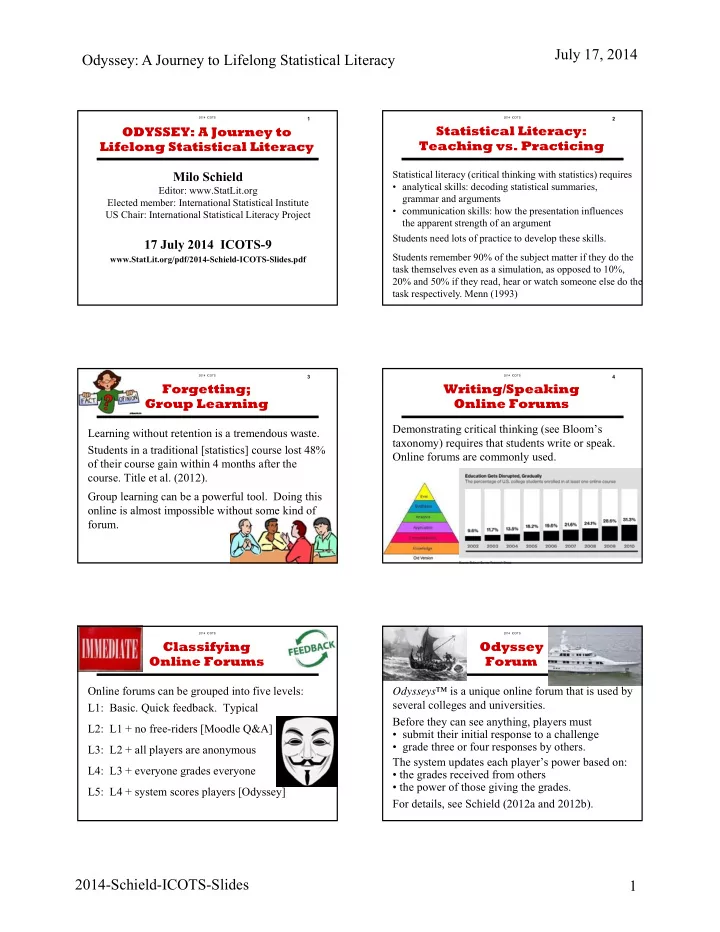
July 17, 2014 Odyssey: A Journey to Lifelong Statistical Literacy 2014 ICOTS 1 2014 ICOTS 2 Statistical Literacy: ODYSSEY: A Journey to Lifelong Statistical Literacy Teaching vs. Practicing Milo Schield Statistical literacy (critical


slide-1
SLIDE 1

Odyssey: A Journey to Lifelong Statistical Literacy July 17, 2014 2014-Schield-ICOTS-Slides 1

2014 ICOTS

1

Milo Schield

Editor: www.StatLit.org Elected member: International Statistical Institute US Chair: International Statistical Literacy Project

17 July 2014 ICOTS-9

www.StatLit.org/pdf/2014-Schield-ICOTS-Slides.pdf

ODYSSEY: A Journey to Lifelong Statistical Literacy

2014 ICOTS

2

Statistical literacy (critical thinking with statistics) requires

  • analytical skills: decoding statistical summaries,

grammar and arguments

  • communication skills: how the presentation influences

the apparent strength of an argument

Statistical Literacy: Teaching vs. Practicing

Students need lots of practice to develop these skills. Students remember 90% of the subject matter if they do the task themselves even as a simulation, as opposed to 10%, 20% and 50% if they read, hear or watch someone else do the task respectively. Menn (1993)

2014 ICOTS

3

Learning without retention is a tremendous waste. Students in a traditional [statistics] course lost 48%

  • f their course gain within 4 months after the
  • course. Title et al. (2012).

Forgetting; Group Learning

Group learning can be a powerful tool. Doing this

  • nline is almost impossible without some kind of

forum.

2014 ICOTS

Writing/Speaking Online Forums

4

Demonstrating critical thinking (see Bloom’s taxonomy) requires that students write or speak. Online forums are commonly used.

2014 ICOTS

5

Online forums can be grouped into five levels: L1: Basic. Quick feedback. Typical L2: L1 + no free-riders [Moodle Q&A] L3: L2 + all players are anonymous L4: L3 + everyone grades everyone L5: L4 + system scores players [Odyssey]

Classifying Online Forums

2014 ICOTS

6

Odysseys™ is a unique online forum that is used by several colleges and universities. Before they can see anything, players must

  • submit their initial response to a challenge
  • grade three or four responses by others.

The system updates each player’s power based on:

  • the grades received from others
  • the power of those giving the grades.

For details, see Schield (2012a and 2012b).

Odyssey Forum

slide-2
SLIDE 2

Odyssey: A Journey to Lifelong Statistical Literacy July 17, 2014 2014-Schield-ICOTS-Slides 2

2014 ICOTS

7

The key to good forums is the same as that for good discussions. The topics or challenges must:

  • be open-ended (as opposed to right-wrong)
  • encourage multiple approaches
  • encourage discussion and reflection.

The following challenges have been used in teaching statistical literacy face-to-face and online.

Good Forums

2014 ICOTS

8

Over 40 “Challenges” in the last three years.

Challenges have been grouped as follows:

  • Critical thinking exercises (7)
  • Reading and interpreting tables and graphs (6)
  • Reading and interpreting surveys (6)
  • Explaining data patterns (5)
  • Observational studies: Cross-sectional (7)
  • Observational studies: Longitudinal (6)
  • Evaluating randomized experiments (6)
2014 ICOTS

9

1) Critical Thinking

  • 1. All Statistics are Facts
  • 2. Can critical thinking be taught?
  • 3. Is Sylvia Browne a real psychic?
  • 4. How much math do we really need?
  • 5. Damned Lies and Statistics: Joel Best
  • 6. Gambler's Fallacy: Run at Monte Carlo
  • 7. Coincidence or not? Canadian Lottery winner.
2014 ICOTS

10

2) Reading Tables and Graphs

TABLES:

  • UK Bank-Raids data
  • Pioneer-Press Circulation Statistics
  • Per-Person Spending: Married vs. Single
  • US Dropout-Rates by race, income, ESL, etc.
  • AARP Insurance Savings: Mean, Median and Most

GRAPHS: Libertarian/Tea-Party/Christian-Right Overlaps

2014 ICOTS

11

3) Surveys

  • 1. 1 in 50 US Kids is homeless: study
  • 2. Halloween Consumer Survey (2012)
  • 3. Oregon has lowest rate of childhood obesity
  • 4. 1 in 10 Chinese adults are diabetics, study finds
  • 5. Students Consider Prostitution to Pay for Education
  • 6. Third of U.S. teens with phones text 100 times a day
  • 7. 95% Margin of Error
2014 ICOTS

12

4) Explaining Data

  • 1. Excess of Males in the SAT tails
  • 2. Are heights normally-distributed?
  • 3. Overweight Increases over Time
  • 4. Low Graduation Rates: Minnesota Schools
  • 5. 25,000 U.S. Deaths Linked to Sugary Drinks
slide-3
SLIDE 3

Odyssey: A Journey to Lifelong Statistical Literacy July 17, 2014 2014-Schield-ICOTS-Slides 3

2014 ICOTS

13

5) Evaluating Observational Studies: Cross-sectional

  • 1. Spanking Lowers IQ
  • 2. ADHD Leads to Weight Gain
  • 3. TV Ownership Linked to Well-Being
  • 4. College students: Later classes, lower grades
  • 5. Study: Women Who Drink Tend to Be Thinner
  • 6. Low-carb diet can increase bad cholesterol levels
  • 7. African Americans get fewer heart-protecting drugs
2014 ICOTS

14

6) Evaluating Observational Studies: Longitudinal

  • 1. Fewer Boys Following 9/11
  • 2. Women on the pill live longer: Study
  • 3. Interpreting a “Stream” Data Display
  • 4. High gas prices drive down traffic fatalities
  • 5. US Income Mobility Study: Ten Year Comparison
  • 6. Drinking Water Before Meals Helps Weight Loss
2014 ICOTS

15

7) Evaluating Randomized Experiments

  • 1. Comparing training programs
  • 2. "Booze + diet soda = bigger buzz?
  • 3. Bigger Tableware Helps Widen Waistlines
  • 4. Giving Criminals $$ after Release Cuts Recidivism?
  • 5. Not statistically significant = no difference?
2014 ICOTS

16

Student Responses

I like being anonymous to review others work. The best quality was the immediate feedback I received. I liked creating a response to the questions before having the opportunity to read what others had replied. I felt my initial response was independent. It helped me read and understand graphs and articles better using my critical reasoning skills. Odyssey helped me develop more confidence in my ability to critically evaluate articles and graphs and charts.

2014 ICOTS

17

.

Use Odyssey Again?

Best students like it most!

Q9: Odyssey should be used again 21 participants; 9 challenges

1 2 3 4 1000 1500 2000 2500 3000 3500 4000 4500 Odyssey Power 4=Strongly Agree

Median Power: 2462

BUS379 Spring, 2013 Augsburg College

Corr = 0.63 Statistically- significant

2014 ICOTS

18

.

Is Odyssey Enjoyable?

Best students agree more!

slide-4
SLIDE 4

Odyssey: A Journey to Lifelong Statistical Literacy July 17, 2014 2014-Schield-ICOTS-Slides 4

2014 ICOTS

19

Conclusion

Students need to practice in class what they should be doing after the class is finished. Most students will encounter statistics in their personal lives via the everyday media.

They need practice analyzing statistics in the media. Odyssey is one way of doing this online. See the associated paper for details.

2014 ICOTS

20

Bibliography

Menn, D. (1993, Oct). Multimedia in education. PC World, M52-M60. Schield, M. (2012a) Odysseys User Guide. Copy at www.statlit.org /pdf/2012-Odysseys-Guide-6up.pdf Schield, M. (2012b) Odysseys System Guide. Copy at www.statlit.org/pdf/2012-Odysseys-Guide2-6up.pdf Schield, M. (2014). Odyssey: A Journey to Lifelong Statistical Literacy. ICOTS. Copy at www.statlit.org/pdf/2014-Schield-ICOTS.pdf Title, Topliff, Vanderstoep, Holmes & Swanson (2012). Retention of Statistical Concepts in a Randomization-Based Introductory Statistics

  • Curriculum. SERJ May, 2012, p 21.
2014 ICOTS

Survey

How many of you are in or are connected with

  • 1. business or economics? 5/72
  • 2. epidemiology, sociology, education, history,

journalism or political-science? 13/72

21

How many cover ANY of these in Intro Stat? 18/72

  • confounding in problems or on exams,
  • coincidence in big data, effect size OR
  • effect of confounding on stat. significance
2014 ICOTS

Statistics Education Problem

When teaching Intro Stats, how many discuss:

  • different kinds of observational studies?
  • using observational associations to find causes?

22

Most teachers don’t teach these; most teach an abstinence-based course. [Only 1% of the 300+ ICOTS abstracts mention cause] Most college students will encounter causation repeatedly both professionally (social sciences, law, medicine) and personally (health/politics).

2014 ICOTS

New Course & Textbook: Statistical Literacy for Managers

First half: Traditional Descriptive & Inferential

  • 1. Tables & graphs in ordinary English
  • 2. Models and distributions
  • 3. Sampling, bias, confidence intervals & overlap

Second half: Big Data (Association/Causation)

  • 1. Coincidence & Law of Very Large Numbers
  • 2. Confounding: Influence on stat. significance
  • 3. Cross-sectional, longitudinal & random assign

23

2014 ICOTS

Need Focus/Support Group to Change Statistical Education

Need feedback/support from statistical educators

  • who deal with observational studies (business,

sociology, education, social work, law, health),

  • who focus on general education and the

humanities (political-science, history, journalism), OR

  • who want to see change in statistical education

If interested, e-mail Schield@Augsburg.edu

24

slide-5
SLIDE 5

2014 ICOTS

1

Milo Schield

Editor: www.StatLit.org Elected member: International Statistical Institute US Chair: International Statistical Literacy Project

17 July 2014 ICOTS-9

www.StatLit.org/pdf/2014-Schield-ICOTS-Slides.pdf

ODYSSEY: A Journey to Lifelong Statistical Literacy

slide-6
SLIDE 6

2014 ICOTS

2

Statistical literacy (critical thinking with statistics) requires

  • analytical skills: decoding statistical summaries,

grammar and arguments

  • communication skills: how the presentation influences

the apparent strength of an argument

Statistical Literacy: Teaching vs. Practicing

Students need lots of practice to develop these skills. Students remember 90% of the subject matter if they do the task themselves even as a simulation, as opposed to 10%, 20% and 50% if they read, hear or watch someone else do the task respectively. Menn (1993)

slide-7
SLIDE 7

2014 ICOTS

3

Learning without retention is a tremendous waste. Students in a traditional [statistics] course lost 48%

  • f their course gain within 4 months after the
  • course. Title et al. (2012).

Forgetting; Group Learning

Group learning can be a powerful tool. Doing this

  • nline is almost impossible without some kind of

forum.

slide-8
SLIDE 8

2014 ICOTS

Writing/Speaking Online Forums

4

Demonstrating critical thinking (see Bloom’s taxonomy) requires that students write or speak. Online forums are commonly used.

slide-9
SLIDE 9

2014 ICOTS

5

Online forums can be grouped into five levels: L1: Basic. Quick feedback. Typical L2: L1 + no free-riders [Moodle Q&A] L3: L2 + all players are anonymous L4: L3 + everyone grades everyone L5: L4 + system scores players [Odyssey]

Classifying Online Forums

slide-10
SLIDE 10

2014 ICOTS

6

Odysseys™ is a unique online forum that is used by several colleges and universities. Before they can see anything, players must

  • submit their initial response to a challenge
  • grade three or four responses by others.

The system updates each player’s power based on:

  • the grades received from others
  • the power of those giving the grades.

For details, see Schield (2012a and 2012b).

Odyssey Forum

slide-11
SLIDE 11

2014 ICOTS

7

The key to good forums is the same as that for good discussions. The topics or challenges must:

  • be open-ended (as opposed to right-wrong)
  • encourage multiple approaches
  • encourage discussion and reflection.

The following challenges have been used in teaching statistical literacy face-to-face and online.

Good Forums

slide-12
SLIDE 12

2014 ICOTS

8

Over 40 “Challenges” in the last three years.

Challenges have been grouped as follows:

  • Critical thinking exercises (7)
  • Reading and interpreting tables and graphs (6)
  • Reading and interpreting surveys (6)
  • Explaining data patterns (5)
  • Observational studies: Cross-sectional (7)
  • Observational studies: Longitudinal (6)
  • Evaluating randomized experiments (6)
slide-13
SLIDE 13

2014 ICOTS

9

1) Critical Thinking

  • 1. All Statistics are Facts
  • 2. Can critical thinking be taught?
  • 3. Is Sylvia Browne a real psychic?
  • 4. How much math do we really need?
  • 5. Damned Lies and Statistics: Joel Best
  • 6. Gambler's Fallacy: Run at Monte Carlo
  • 7. Coincidence or not? Canadian Lottery winner.
slide-14
SLIDE 14

2014 ICOTS

10

2) Reading Tables and Graphs

TABLES:

  • UK Bank-Raids data
  • Pioneer-Press Circulation Statistics
  • Per-Person Spending: Married vs. Single
  • US Dropout-Rates by race, income, ESL, etc.
  • AARP Insurance Savings: Mean, Median and Most

GRAPHS: Libertarian/Tea-Party/Christian-Right Overlaps

slide-15
SLIDE 15

2014 ICOTS

11

3) Surveys

  • 1. 1 in 50 US Kids is homeless: study
  • 2. Halloween Consumer Survey (2012)
  • 3. Oregon has lowest rate of childhood obesity
  • 4. 1 in 10 Chinese adults are diabetics, study finds
  • 5. Students Consider Prostitution to Pay for Education
  • 6. Third of U.S. teens with phones text 100 times a day
  • 7. 95% Margin of Error
slide-16
SLIDE 16

2014 ICOTS

12

4) Explaining Data

  • 1. Excess of Males in the SAT tails
  • 2. Are heights normally-distributed?
  • 3. Overweight Increases over Time
  • 4. Low Graduation Rates: Minnesota Schools
  • 5. 25,000 U.S. Deaths Linked to Sugary Drinks
slide-17
SLIDE 17

2014 ICOTS

13

5) Evaluating Observational Studies: Cross-sectional

  • 1. Spanking Lowers IQ
  • 2. ADHD Leads to Weight Gain
  • 3. TV Ownership Linked to Well-Being
  • 4. College students: Later classes, lower grades
  • 5. Study: Women Who Drink Tend to Be Thinner
  • 6. Low-carb diet can increase bad cholesterol levels
  • 7. African Americans get fewer heart-protecting drugs
slide-18
SLIDE 18

2014 ICOTS

14

6) Evaluating Observational Studies: Longitudinal

  • 1. Fewer Boys Following 9/11
  • 2. Women on the pill live longer: Study
  • 3. Interpreting a “Stream” Data Display
  • 4. High gas prices drive down traffic fatalities
  • 5. US Income Mobility Study: Ten Year Comparison
  • 6. Drinking Water Before Meals Helps Weight Loss
slide-19
SLIDE 19

2014 ICOTS

15

7) Evaluating Randomized Experiments

  • 1. Comparing training programs
  • 2. "Booze + diet soda = bigger buzz?
  • 3. Bigger Tableware Helps Widen Waistlines
  • 4. Giving Criminals $$ after Release Cuts Recidivism?
  • 5. Not statistically significant = no difference?
slide-20
SLIDE 20

2014 ICOTS

16

Student Responses

I like being anonymous to review others work. The best quality was the immediate feedback I received. I liked creating a response to the questions before having the opportunity to read what others had replied. I felt my initial response was independent. It helped me read and understand graphs and articles better using my critical reasoning skills. Odyssey helped me develop more confidence in my ability to critically evaluate articles and graphs and charts.

slide-21
SLIDE 21

2014 ICOTS

17

.

Use Odyssey Again?

Best students like it most!

Q9: Odyssey should be used again 21 participants; 9 challenges

1 2 3 4 1000 1500 2000 2500 3000 3500 4000 4500 Odyssey Power 4=Strongly Agree

Median Power: 2462

BUS379 Spring, 2013 Augsburg College

Corr = 0.63 Statistically- significant

slide-22
SLIDE 22

2014 ICOTS

18

.

Is Odyssey Enjoyable?

Best students agree more!

slide-23
SLIDE 23

2014 ICOTS

19

Conclusion

Students need to practice in class what they should be doing after the class is finished. Most students will encounter statistics in their personal lives via the everyday media.

They need practice analyzing statistics in the media. Odyssey is one way of doing this online. See the associated paper for details.

slide-24
SLIDE 24

2014 ICOTS

20

Bibliography

Menn, D. (1993, Oct). Multimedia in education. PC World, M52-M60. Schield, M. (2012a) Odysseys User Guide. Copy at www.statlit.org /pdf/2012-Odysseys-Guide-6up.pdf Schield, M. (2012b) Odysseys System Guide. Copy at www.statlit.org/pdf/2012-Odysseys-Guide2-6up.pdf Schield, M. (2014). Odyssey: A Journey to Lifelong Statistical Literacy. ICOTS. Copy at www.statlit.org/pdf/2014-Schield-ICOTS.pdf Title, Topliff, Vanderstoep, Holmes & Swanson (2012). Retention of Statistical Concepts in a Randomization-Based Introductory Statistics

  • Curriculum. SERJ May, 2012, p 21.
slide-25
SLIDE 25

2014 ICOTS

Survey

How many of you are in or are connected with

  • 1. business or economics? 5/72
  • 2. epidemiology, sociology, education, history,

journalism or political-science? 13/72

21

How many cover ANY of these in Intro Stat? 18/72

  • confounding in problems or on exams,
  • coincidence in big data, effect size OR
  • effect of confounding on stat. significance
slide-26
SLIDE 26

2014 ICOTS

Statistics Education Problem

When teaching Intro Stats, how many discuss:

  • different kinds of observational studies?
  • using observational associations to find causes?

22

Most teachers don’t teach these; most teach an abstinence-based course. [Only 1% of the 300+ ICOTS abstracts mention cause] Most college students will encounter causation repeatedly both professionally (social sciences, law, medicine) and personally (health/politics).

slide-27
SLIDE 27

2014 ICOTS

New Course & Textbook: Statistical Literacy for Managers

First half: Traditional Descriptive & Inferential

  • 1. Tables & graphs in ordinary English
  • 2. Models and distributions
  • 3. Sampling, bias, confidence intervals & overlap

Second half: Big Data (Association/Causation)

  • 1. Coincidence & Law of Very Large Numbers
  • 2. Confounding: Influence on stat. significance
  • 3. Cross-sectional, longitudinal & random assign

23

slide-28
SLIDE 28

2014 ICOTS

Need Focus/Support Group to Change Statistical Education

Need feedback/support from statistical educators

  • who deal with observational studies (business,

sociology, education, social work, law, health),

  • who focus on general education and the

humanities (political-science, history, journalism), OR

  • who want to see change in statistical education

If interested, e-mail Schield@Augsburg.edu

24