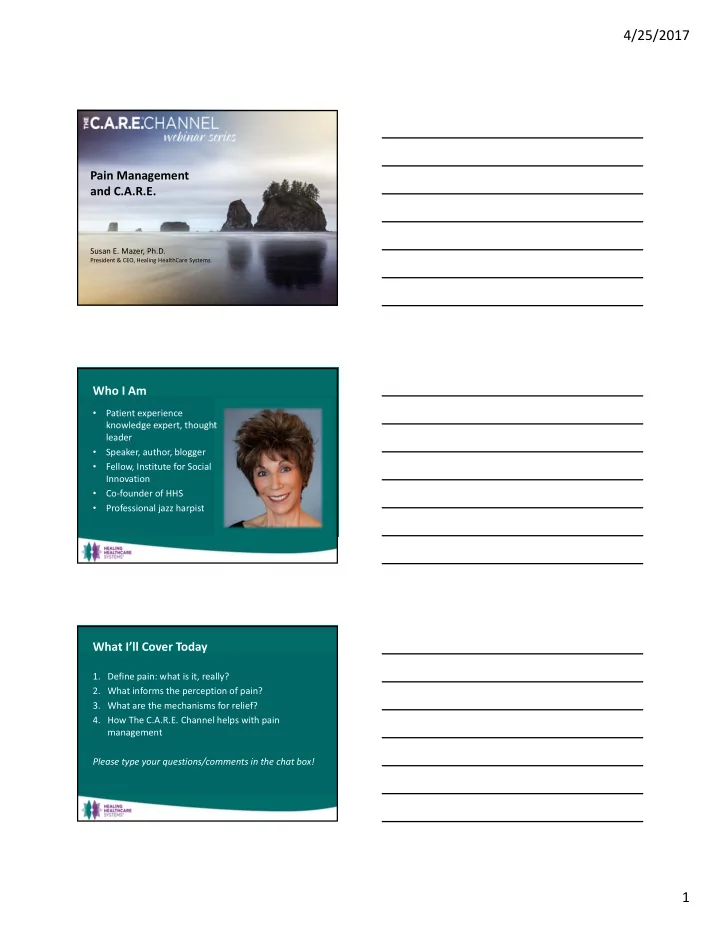
4/25/2017 Pain Management and C.A.R.E. Susan E. Mazer, Ph.D. - - PDF document

4 25 2017
SMART_READER_LITE
LIVE PREVIEW

4/25/2017 Pain Management and C.A.R.E. Susan E. Mazer, Ph.D. - - PDF document

4/25/2017 Pain Management and C.A.R.E. Susan E. Mazer, Ph.D. President & CEO, Healing HealthCare Systems Who I Am Patient experience knowledge expert, thought leader Speaker, author, blogger Fellow, Institute for Social


slide-1
SLIDE 1

4/25/2017 1

Susan E. Mazer, Ph.D.

President & CEO, Healing HealthCare Systems

Pain Management and C.A.R.E.

  • Patient experience

knowledge expert, thought leader

  • Speaker, author, blogger
  • Fellow, Institute for Social

Innovation

  • Co‐founder of HHS
  • Professional jazz harpist

Who I Am

  • 1. Define pain: what is it, really?
  • 2. What informs the perception of pain?
  • 3. What are the mechanisms for relief?
  • 4. How The C.A.R.E. Channel helps with pain

management Please type your questions/comments in the chat box!

What I’ll Cover Today

slide-2
SLIDE 2

4/25/2017 2

  • Pain is the #1 motivator for:

– Prescription requests and use – Stopping or changing dangerous behavior – Seeking medical help

  • Pain is what all patients fear
  • Pain relief is the dominant job of the hospital
  • Pain is not absolute

The Big “P”

  • Homer: “Arrow Shot

from God”

  • Aristotle: “Pain is a

Passion of the Soul”

  • Plato: Pain is not a

sensation, but an emotion

What Is Pain?

  • Descartes: The

Cartesian Divide

  • The stimulation

goes straight to the brain (“Pain Center”) . Has nothing to do with the mind.

What is Pain?

slide-3
SLIDE 3

4/25/2017 3

2017: What is Pain to the Patient?

Whatever the patient says it is!

Melzack/Wall: Gate Control Theory

  • Distraction theory: Focusing on non‐painful stimuli

can decrease perception of painful stimuli

  • Anxiety, obsessing about about pain, will increase

perception of pain

  • Pain management requires multi‐modal methods

that address the complexities involved

Pain Management: The Challenge

  • Agitation
  • Anxiety
  • Stress
  • Environmental stressors
  • Pain belief
  • Expectancy
  • Placebo/nocebo effects
  • Social/cultural values
slide-4
SLIDE 4

4/25/2017 4

Pain beliefs fully influence a patients pain threshold, participation in their care, and inform their success in self‐regulation. Suffering is silent, invisible, unexplainable, private. Opioid Epidemic: How Did We Get Here?

slide-5
SLIDE 5

4/25/2017 5

The identification and management of pain is an important component of [patient]‐centered care. [Patients] can expect that their health care providers will involve them in their assessment and management of pain. Both pharmacologic and nonpharmacologic strategies have a role in the management of pain. Acupuncture Chiropractic therapy Osteopathic manipulative treatment Massage therapy Physical therapy Relaxation therapy Cognitive behavioral therapy Acupuncture Chiropractic therapy Osteopathic manipulative treatment Massage therapy Physical therapy Relaxation therapy > C.A.R.E. Programming Cognitive behavioral therapy (CBT)

slide-6
SLIDE 6

4/25/2017 6

Continuous Ambient Relaxation Environment

Original Instrumental Music

  • Cross‐generational, cross‐cultural appeal
  • Intentionally selected to appeal to wide‐ranging

patient/family population

  • Listening to music reduces perception of pain
slide-7
SLIDE 7

4/25/2017 7

Nature Imagery

  • Provides coherent, interesting nature‐scapes
  • Slow transitions
  • Increases self‐regulation of pain

Nature Imagery and Music Music and nature are more effective in reducing pain than either one alone

slide-8
SLIDE 8

4/25/2017 8

Nature video + Relaxing music + Guided narration Engages mind and body to reduce anxiety, increase coping skills

  • Provides positive distraction
  • Provides respite from mental/emotional fatigue
  • Provides tool to use beyond the hospital

“I was in the Neuro‐ICU at UPMC Presbyterian in Pittsburgh and viewed your guided imagery programs. I found it so helpful in dealing with my medical

  • condition. It was the highlight of my stay at the hospital

and the one thing that got me through my recovery.”

www.healinghealth.com/patient_staff_stories

slide-9
SLIDE 9

4/25/2017 9

  • 29% reduction in pain

meds

  • Fewer side effects
  • 1.5 day average

reduced length of stay

Clinical Outcomes of Non‐Pharmaceutical Interventions Sales Team

Kelly Hunt

khunt@healinghealth.com

Amy Higgins

ahiggins@healinghealth.com

James Vinall

jvinall@healinghealth.com

slide-10
SLIDE 10

4/25/2017 10

  • 84 hours of non‐

repetitive content

  • Integrates with all TV

systems

  • Video broadcaster

resides onsite

  • HD and SD formats
  • Evidence‐based

content

  • Ongoing education

about research and practices

  • Implementation

support

Medical/dental offices, clinics DVDs, CDs, mobile app Live streaming for patient portals, mobile devices

slide-11
SLIDE 11

4/25/2017 11

Continuous Ambient Relaxation Environment

Susan E. Mazer, Ph.D.

President & CEO, Healing HealthCare Systems

Email: smazer@healinghealth.com Blog: www.healinghealth.com/susan‐mazer‐blog LinkedIn: www.linkedin.com/in/susanmazer

Thank You!