V1a 4/29/2017 Statistical Literacy: 2017 V1A 2017 CME 1 V1A - - PDF document

v1a 4 29 2017 statistical literacy 2017
SMART_READER_LITE
LIVE PREVIEW

V1a 4/29/2017 Statistical Literacy: 2017 V1A 2017 CME 1 V1A - - PDF document

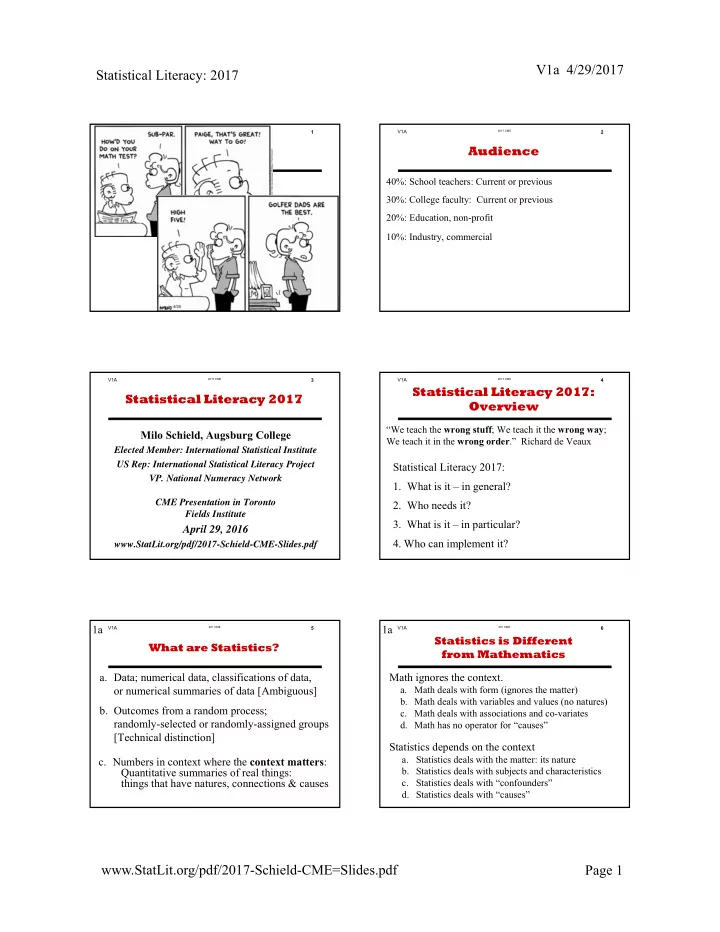
V1a 4/29/2017 Statistical Literacy: 2017 V1A 2017 CME 1 V1A 2017 CME 2 . Audience . 40%: School teachers: Current or previous 30%: College faculty: Current or previous 20%: Education, non-profit 10%: Industry, commercial V1A 2017


slide-1
SLIDE 1

Statistical Literacy: 2017 V1a 4/29/2017 www.StatLit.org/pdf/2017-Schield-CME=Slides.pdf Page 1

2017 CME V1A 1

.

.

2017 CME V1A 2

40%: School teachers: Current or previous 30%: College faculty: Current or previous 20%: Education, non-profit 10%: Industry, commercial

Audience

2017 CME V1A 3

Milo Schield, Augsburg College

Elected Member: International Statistical Institute US Rep: International Statistical Literacy Project

  • VP. National Numeracy Network

CME Presentation in Toronto Fields Institute

April 29, 2016

www.StatLit.org/pdf/2017-Schield-CME-Slides.pdf

Statistical Literacy 2017

2017 CME V1A 4

“We teach the wrong stuff; We teach it the wrong way; We teach it in the wrong order.” Richard de Veaux

Statistical Literacy 2017: Overview

Statistical Literacy 2017:

  • 1. What is it – in general?
  • 2. Who needs it?
  • 3. What is it – in particular?
  • 4. Who can implement it?
V1A 201 CME 5

What are Statistics?

  • a. Data; numerical data, classifications of data,
  • r numerical summaries of data [Ambiguous]
  • b. Outcomes from a random process;

randomly-selected or randomly-assigned groups [Technical distinction]

  • c. Numbers in context where the context matters:

Quantitative summaries of real things: things that have natures, connections & causes 1a

V1A 201 CME 6

Statistics is Different from Mathematics Math ignores the context.

  • a. Math deals with form (ignores the matter)
  • b. Math deals with variables and values (no natures)
  • c. Math deals with associations and co-variates
  • d. Math has no operator for “causes”

Statistics depends on the context

  • a. Statistics deals with the matter: its nature
  • b. Statistics deals with subjects and characteristics
  • c. Statistics deals with “confounders”
  • d. Statistics deals with “causes”

1a

slide-2
SLIDE 2

Statistical Literacy: 2017 V1a 4/29/2017 www.StatLit.org/pdf/2017-Schield-CME=Slides.pdf Page 2

V1A 201 CME 7

Mathematics: Patterns vs. Nature . 1a

2017 CME V1A

Saying “Statistics Come From Data” is like saying “Babies Come from Hospitals”

It’s true but it leaves out the interesting details Statistics are answers to questions or interests.

1a

V1A 201 CME 9

What is statistical literacy? In general terms

Statistical literacy is needed by citizens and social decision makers to enable them to understand and evaluate the statistics they encounter everyday. Everyday statistics are used as evidence in arguments. Legal:

  • Describe: 90% of a restaurant’s staff speaks Spanish
  • Compare: Most Mexican restaurant staff speak Spanish
  • Evaluate: Mexican restaurants discriminate in hiring .

1b

V1A 201 CME 10

What is statistical literacy? Examples:

Medical:

  • Describe: Japanese, who live long, eat low-fat diet
  • Compare: People with high-fat diets die sooner
  • Evaluate: High-fat diet causes shorter lifespan.

Social:

  • Describe: Average school class size is 24
  • Compare: Best performing classes are smaller
  • Evaluate: Smaller classes will improve outcomes

1b

V1A 201 CME 11

Who Needs Statistical Literacy? Three Audiences

.

2

V1A 201 CME 12

Three Audiences: More detail

  • 1. STEM majors and those who conduct surveys,

studies and research.

  • 2. Social decision-makers:

Politicians, bureaucrats, business leaders, doctors

  • Those who inform citizens and decision makers:

journalists, analysts, lawyers, economists, consultants, sociologists, political scientists, policy advocates, psychologists and educators.

  • 3. Citizen in a modern republic or democracy.

2

slide-3
SLIDE 3

Statistical Literacy: 2017 V1a 4/29/2017 www.StatLit.org/pdf/2017-Schield-CME=Slides.pdf Page 3

V1A 201 CME 13

College-Bound Students: Wide variation

.

400 600 800 1000 1200 1400 1600

20 40 60 80 100

Percentile

SAT (CR+M): US College-Bound Seniors

CollegeBoard

Mean: 1010 StdDev: 218

2014 Top 25 Colleges Community Colleges

  • St. Thomas

1203 Augsburg 1070

2a

V1A 201 CME 14

College-Bound US Students SAT Math Scores by Major

Business Insider (2014). 2014 SAT scores

2a

V1A 201 CME 15

US Stat 101 students by Major 2a

V1A 201 CME 16

Harvard Business Review: Website Search of 40K Items

  • .

2

V1A 201 CME 17

Statistical Literacy: More Detail

  • 3a. Association vs. Causation
  • 3b. Classify all the influences on a statistic
  • Context: Confounding and study design
  • Assembly/assumptions: How things are defined.
  • Randomness:

Unlikely is almost certain given enough trials.

  • Error/Bias:

3

2017 CME V1A

Association: Probably Not Causation . 3a

slide-4
SLIDE 4

Statistical Literacy: 2017 V1a 4/29/2017 www.StatLit.org/pdf/2017-Schield-CME=Slides.pdf Page 4

2017 CME V1A

Association: Probably Causation

Heart-Attack Survival Rate

0% 10% 20% 30% 40% 1 2 3 4 5 6 7 8

Minutes to Defibrillation

Survive

AP Story: 01/03/2008 Jolt delayed in third of cardiac arrests

3a

2017 CME V1A

Association: Possibly Causation . 3a

2017 CME V1A 21

Distinguish Causation from Association

Causation (8%): cause, effects, results, prevents Association (2%): associate, relate, correlate, Between (67%): Action verbs: ups, cuts, raises, boosts, increases

Other: due to, because of, attributed to Inappropriate use of “causes”:

  • Obesity causes later onset of puberty in boys
  • Junk food causes a third of heart attacks.

Schield and Raymond (2009) study 2,000 newspaper headlines involving quantity

3a

V1A 201 CME

“Research shows that the headgear reduces the concussion rate by more than 50 percent.” 8/2011 P. 41

22

Action-Verb Association

3a

V1A 201 CME 23

Association-Causation Baseball players whose names begin with the letter “D” are more likely to die young Drinking a full pot of coffee every morning will add years to your life, but one cup a day increases the risk of pancreatic cancer. Asian-Americans are most susceptible to heart attacks on the fourth day of the month

Source: Standard Deviations: Flawed Assumptions, Tortured Data,

and Other Ways to Lie with Statistics by Gary Smith (2015).

3a

V1A 201 CME 24

Pie Chart: Compare Protestants are twice as likely to be smokers as are Catholics ? 3a

SMOKERS

Other: 40% Catholics: 20% Protestants: 40%

NO: Smoker is whole. Student error rate: 62%

slide-5
SLIDE 5

Statistical Literacy: 2017 V1a 4/29/2017 www.StatLit.org/pdf/2017-Schield-CME=Slides.pdf Page 5

V1A 201 CME 25

Speculative [Spotty] Statistics Using Ordinary English Does a death certificate ever list air pollution as a cause of death? Does a coroner certify this? These are association-based statistics. These are speculative (spotty) statistics.

2017 CME V1A 26

Association vs. Causation 11 Headlines, Same Story

  • 1. Study: 45,000 Uninsured Die a Year (CBS News)
  • 2. 45,000 deaths attributable to uninsurance
  • 3. 45,000 US deaths associated with lack of insurance
  • 4. No health coverage tied to 45,000 deaths a year
  • 5. Lack of insurance linked to 45,000 deaths
  • 6. Study: 45,000 U.S. Deaths From Lack of Insurance
  • 7. One death every 12 minutes due to no health insurance
  • 8. 45,000 ... die because of lack of health insurance
  • 9. Lack of Health Insurance Kills 45,000 a Year
  • 10. Lack of Health Insurance cause 44,789 deaths
  • 11. Lack of insurance to blame for almost 45,000 deaths
V1A 201 CME 27

Stats = Premise: Crit. Thinking Stats = Conclusion: Stat Literacy .

V1A 201 CME 28

Statistical Literacy in detail: “Take CARE” Statistical literacy studies all influences on statistic:

  • Confounding:
  • what was – and was not – controlled for
  • what kind of study was involved
  • Assembly/Assumptions:
  • how statistics are collected, defined and grouped
  • how statistics are summarized, compared & presented
  • Randomness: small samples and big data
  • Error/bias

3b

V1A 201 CME 29

Confounding: Using Ordinary English 1) The percentage of women who are runners. 2) The percentage of women among runners. 3) The death rate of men is X per 100,000. 4) The men’s rate of death is X per 100,000 5) Toyota is the car most frequently stolen. 6) Toyota is the car most likely to be stolen. 7) Cadillac is the car most likely to be stolen. 3b

2017 CME V1A 30

Small Change in Syntax; Big Change in Semantics

.

Edison 2009/09/26
slide-6
SLIDE 6

Statistical Literacy: 2017 V1a 4/29/2017 www.StatLit.org/pdf/2017-Schield-CME=Slides.pdf Page 6

V1A 201 CME 31

Confounding: Mixed-Fruit vs. Apples-Apples Comparison

.

27# 14# 13#

2017 CME V1A 32

Size of a statistic depends

  • n what is “taken into account”

SEASON WINS vs. TOTAL PAYROLL

US Major League Baseball 52 62 72 82 92 102 10 20 30 40 50 60 Total Payroll ($Millions) 1995 Season Wins Yankees BlueJays Indians Twins Marlins Rangers Mets Padres Braves Orioles Red Sox Reds Expos Pirates Tigers

2017 CME V1A 33

US SAT-VERBAL SCORES

2017 CME V1A 34

Study design can inhibit certain kinds of confounders .

V1A 201 CME 35

Assembly: What to control for: United has Worst Pet Record Nine pets died while being transported by United while another 14 were injured last year. Most of any US airline… 3a

2017 CME V1A 36

Assembly:

Making small things big

7 nanograms per gram = 7 parts in a billion

4/2010 National Geographic
slide-7
SLIDE 7

Statistical Literacy: 2017 V1a 4/29/2017 www.StatLit.org/pdf/2017-Schield-CME=Slides.pdf Page 7

2017 CME V1A 37

Randomness: Coincidence?

.

2017 CME V1A 38

Error/Bias

A recent survey shows that most Republicans surveyed prefer Obama as President. Question: Who would you prefer as President?

  • Barack Obama
  • The captain of the Italian linear that crashed
  • Charlie Sheehan
  • Lady Gaga
V1A 201 CME 39

What is Impeding Statistical Literacy Math is the most privileged discipline in academia. Math and statistics have successfully resisted all attempts to support statistical literacy. This resistance is not a commission: a statement denying the need for statistical literacy. This resistance is an omission: a total silence on whether math is responsible for deciding what various groups of students need. 4a

V1A 201 CME 40

The Challenge "Quantitative Literacy (QL), the ability to use numbers and data analysis in everyday life, is everybody's orphan. Despite every person's need for QL, in the discipline-dominated K-16 education system in the United States, there is neither an academic home nor an administrative promoter for this critical competency." Quantitative Literacy: Why Numeracy Matters. p. 153 Bernard Madison 4b

V1A 201 CME 41

Statistical Literacy Support by NCTM Past President “Statistical literacy has risen to the top of my advocacy list, right alongside numeracy, and perhaps even ahead of “algebra for all.” By statistical literacy, I mean ... developing the ability to reason in the presence of, or under conditions of uncertainty. ... the facility to read and interpret statistical information and make informed inferences....“ J. Michael Shaughnessy

www.statlit.org/pdf/2010Shaughnessy-StatisticsForAll-NCTM.pdf

4b

V1A 201 CME 42

Tension: Statistics

  • vs. Stat Literacy

what most statisticians actually practice is typically more than the average person needs to be an informed citizen, intelligent consumer or skilled worker. What everyone needs is typically called statistical thinking or statistical literacy, a crucial component

  • f quantitative literacy."

Lynn Steen (2004). Achieving Quantitative Literacy p. 43

3a

slide-8
SLIDE 8

Statistical Literacy: 2017 V1a 4/29/2017 www.StatLit.org/pdf/2017-Schield-CME=Slides.pdf Page 8

V1A 201 CME 43

What Needs to be done? Support! Mathematics Canada has a unique opportunity to become a world leader in supporting statistical literacy in grades 10-18. The need is obvious, the tools are available. There is support from the American Statistical Association for multivariate thinking. Lynn Steen (MAA past president) and J. Michael Shaughnessy (NCTM past president) support it.

43

4c

V1A 201 CME 44

Mathematics is a highly privileged discipline Mathematics controls all of the quantitative courses taken in K-12. Mathematics decides whether to offer algebra in 8th grade or 9th grade. Mathematics decides what courses should be taken by students in non-quantitative majors. No discipline has as much power as Mathematics.

44 V1A 201 CME 45

Mathematics has great responsibility With great power comes great responsibility! Mathematics often polls other disciplines to see what they want for their students. Problem: Most other disciplines don’t know what mathematics their students should

45

Mathematics must take the lead. Mathematics must identify what students in all disciplines need.

V1A 201 CME 46

Mathematics opportunities Review the literature to see what students need to know about statistics. Identify the math needed by all college graduates Join with American statisticians (ASA) in supporting a multivariate focus on observational studies with a strong emphasis on confounding. Support the National Numeracy Network.

46 V1A 201 CME 47

References

Business Insider (2014). http://www.businessinsider.com/heres-the-average- sat-score-for-every-college-major-2014-10 De Veaux, D. (2015). Introductory Statistics in the 21st Century. USCOTS slides Schield, M. (2015). Statistical Inference for Managers. ASA www.statlit.org/pdf/2015-Schield-ASA.pdf Schield, M. (2014). Two Big Ideas for Teaching Big Data: ECOTS. www.statlit.org/pdf/2014-Schield-ECOTS.pdf Schield, M. (2013). Reinventing Business Statistics. MBAA. www.StatLit.org/pdf/2013-Schield-MBAA.pdf Tintle, Chance, Cobb, Rossman, Roy, Swanson & VanderStoep (2014) Challenging the state of the art in post-introductory statistics. http://2013.isiproceedings.org/Files/IPS032-P1-S.pdf

47
slide-9
SLIDE 9

2017 CME

V1A 1

.

.

slide-10
SLIDE 10

2017 CME

V1A 2

40%: School teachers: Current or previous 30%: College faculty: Current or previous 20%: Education, non-profit 10%: Industry, commercial

Audience

slide-11
SLIDE 11

2017 CME

V1A 3

Milo Schield, Augsburg College

Elected Member: International Statistical Institute US Rep: International Statistical Literacy Project

  • VP. National Numeracy Network

CME Presentation in Toronto Fields Institute

April 29, 2016

www.StatLit.org/pdf/2017-Schield-CME-Slides.pdf

Statistical Literacy 2017

slide-12
SLIDE 12

2017 CME

V1A 4

“We teach the wrong stuff; We teach it the wrong way; We teach it in the wrong order.” Richard de Veaux

Statistical Literacy 2017: Overview

Statistical Literacy 2017:

  • 1. What is it – in general?
  • 2. Who needs it?
  • 3. What is it – in particular?
  • 4. Who can implement it?
slide-13
SLIDE 13

V1A

201 CME

5

What are Statistics?

  • a. Data; numerical data, classifications of data,
  • r numerical summaries of data [Ambiguous]
  • b. Outcomes from a random process;

randomly-selected or randomly-assigned groups [Technical distinction]

  • c. Numbers in context where the context matters:

Quantitative summaries of real things: things that have natures, connections & causes 1a

slide-14
SLIDE 14

V1A

201 CME

6

Statistics is Different from Mathematics Math ignores the context.

  • a. Math deals with form (ignores the matter)
  • b. Math deals with variables and values (no natures)
  • c. Math deals with associations and co-variates
  • d. Math has no operator for “causes”

Statistics depends on the context

  • a. Statistics deals with the matter: its nature
  • b. Statistics deals with subjects and characteristics
  • c. Statistics deals with “confounders”
  • d. Statistics deals with “causes”

1a

slide-15
SLIDE 15

V1A

201 CME

7

Mathematics: Patterns vs. Nature . 1a

slide-16
SLIDE 16

2017 CME

V1A

Saying “Statistics Come From Data” is like saying “Babies Come from Hospitals”

It’s true but it leaves out the interesting details Statistics are answers to questions or interests.

1a

slide-17
SLIDE 17

V1A

201 CME

9

What is statistical literacy? In general terms

Statistical literacy is needed by citizens and social decision makers to enable them to understand and evaluate the statistics they encounter everyday. Everyday statistics are used as evidence in arguments. Legal:

  • Describe: 90% of a restaurant’s staff speaks Spanish
  • Compare: Most Mexican restaurant staff speak Spanish
  • Evaluate: Mexican restaurants discriminate in hiring .

1b

slide-18
SLIDE 18

V1A

201 CME

10

What is statistical literacy? Examples:

Medical:

  • Describe: Japanese, who live long, eat low-fat diet
  • Compare: People with high-fat diets die sooner
  • Evaluate: High-fat diet causes shorter lifespan.

Social:

  • Describe: Average school class size is 24
  • Compare: Best performing classes are smaller
  • Evaluate: Smaller classes will improve outcomes

1b

slide-19
SLIDE 19

V1A

201 CME

11

Who Needs Statistical Literacy? Three Audiences

.

2

slide-20
SLIDE 20

V1A

201 CME

12

Three Audiences: More detail

  • 1. STEM majors and those who conduct surveys,

studies and research.

  • 2. Social decision-makers:

Politicians, bureaucrats, business leaders, doctors

  • Those who inform citizens and decision makers:

journalists, analysts, lawyers, economists, consultants, sociologists, political scientists, policy advocates, psychologists and educators.

  • 3. Citizen in a modern republic or democracy.

2

slide-21
SLIDE 21

V1A

201 CME

13

College-Bound Students: Wide variation

.

400 600 800 1000 1200 1400 1600

20 40 60 80 100

Percentile

SAT (CR+M): US College-Bound Seniors

CollegeBoard

Mean: 1010 StdDev: 218

2014 Top 25 Colleges Community Colleges

  • St. Thomas

1203 Augsburg 1070

2a

slide-22
SLIDE 22

V1A

201 CME

14

College-Bound US Students SAT Math Scores by Major

Business Insider (2014). 2014 SAT scores

2a

slide-23
SLIDE 23

V1A

201 CME

15

US Stat 101 students by Major 2a

slide-24
SLIDE 24

V1A

201 CME

16

Harvard Business Review: Website Search of 40K Items

  • .

2

slide-25
SLIDE 25

V1A

201 CME

17

Statistical Literacy: More Detail

  • 3a. Association vs. Causation
  • 3b. Classify all the influences on a statistic
  • Context: Confounding and study design
  • Assembly/assumptions: How things are defined.
  • Randomness:

Unlikely is almost certain given enough trials.

  • Error/Bias:

3

slide-26
SLIDE 26

2017 CME

V1A

Association: Probably Not Causation . 3a

slide-27
SLIDE 27

2017 CME

V1A

Association: Probably Causation

Heart-Attack Survival Rate

0% 10% 20% 30% 40%

1 2 3 4 5 6 7 8

Minutes to Defibrillation

Survive

AP Story: 01/03/2008 Jolt delayed in third of cardiac arrests

3a

slide-28
SLIDE 28

2017 CME

V1A

Association: Possibly Causation . 3a

slide-29
SLIDE 29

2017 CME

V1A 21

Distinguish Causation from Association

Causation (8%): cause, effects, results, prevents Association (2%): associate, relate, correlate, Between (67%): Action verbs: ups, cuts, raises, boosts, increases

Other: due to, because of, attributed to Inappropriate use of “causes”:

  • Obesity causes later onset of puberty in boys
  • Junk food causes a third of heart attacks.

Schield and Raymond (2009) study 2,000 newspaper headlines involving quantity

3a

slide-30
SLIDE 30

V1A

201 CME

“Research shows that the headgear reduces the concussion rate by more than 50 percent.” 8/2011 P. 41

22

Action-Verb Association

3a

slide-31
SLIDE 31

V1A

201 CME

23

Association-Causation Baseball players whose names begin with the letter “D” are more likely to die young Drinking a full pot of coffee every morning will add years to your life, but one cup a day increases the risk of pancreatic cancer. Asian-Americans are most susceptible to heart attacks on the fourth day of the month

Source: Standard Deviations: Flawed Assumptions, Tortured Data,

and Other Ways to Lie with Statistics by Gary Smith (2015).

3a

slide-32
SLIDE 32

V1A

201 CME

24

Pie Chart: Compare Protestants are twice as likely to be smokers as are Catholics ? 3a

SMOKERS

Other: 40% Catholics: 20% Protestants: 40%

NO: Smoker is whole. Student error rate: 62%

slide-33
SLIDE 33

V1A

201 CME

25

Speculative [Spotty] Statistics Using Ordinary English Does a death certificate ever list air pollution as a cause of death? Does a coroner certify this? These are association-based statistics. These are speculative (spotty) statistics.

slide-34
SLIDE 34

2017 CME

V1A 26

Association vs. Causation 11 Headlines, Same Story

  • 1. Study: 45,000 Uninsured Die a Year (CBS News)
  • 2. 45,000 deaths attributable to uninsurance
  • 3. 45,000 US deaths associated with lack of insurance
  • 4. No health coverage tied to 45,000 deaths a year
  • 5. Lack of insurance linked to 45,000 deaths
  • 6. Study: 45,000 U.S. Deaths From Lack of Insurance
  • 7. One death every 12 minutes due to no health insurance
  • 8. 45,000 ... die because of lack of health insurance
  • 9. Lack of Health Insurance Kills 45,000 a Year
  • 10. Lack of Health Insurance cause 44,789 deaths
  • 11. Lack of insurance to blame for almost 45,000 deaths
slide-35
SLIDE 35

V1A

201 CME

27

Stats = Premise: Crit. Thinking Stats = Conclusion: Stat Literacy .

slide-36
SLIDE 36

V1A

201 CME

28

Statistical Literacy in detail: “Take CARE” Statistical literacy studies all influences on statistic:

  • Confounding:
  • what was – and was not – controlled for
  • what kind of study was involved
  • Assembly/Assumptions:
  • how statistics are collected, defined and grouped
  • how statistics are summarized, compared & presented
  • Randomness: small samples and big data
  • Error/bias

3b

slide-37
SLIDE 37

V1A

201 CME

29

Confounding: Using Ordinary English 1) The percentage of women who are runners. 2) The percentage of women among runners. 3) The death rate of men is X per 100,000. 4) The men’s rate of death is X per 100,000 5) Toyota is the car most frequently stolen. 6) Toyota is the car most likely to be stolen. 7) Cadillac is the car most likely to be stolen. 3b

slide-38
SLIDE 38

2017 CME

V1A 30

Small Change in Syntax; Big Change in Semantics

.

Edison 2009/09/26

slide-39
SLIDE 39

V1A

201 CME

31

Confounding: Mixed-Fruit vs. Apples-Apples Comparison

.

27# 14# 13#

slide-40
SLIDE 40

2017 CME

V1A 32

Size of a statistic depends

  • n what is “taken into account”

SEASON WINS vs. TOTAL PAYROLL

US Major League Baseball 52 62 72 82 92 102 10 20 30 40 50 60 Total Payroll ($Millions) 1995 Season Wins Yankees BlueJays Indians Twins Marlins Rangers Mets Padres Braves Orioles Red Sox Reds Expos Pirates Tigers

slide-41
SLIDE 41

2017 CME

V1A 33

US SAT-VERBAL SCORES

slide-42
SLIDE 42

2017 CME

V1A 34

Study design can inhibit certain kinds of confounders .

slide-43
SLIDE 43

V1A

201 CME

35

Assembly: What to control for: United has Worst Pet Record Nine pets died while being transported by United while another 14 were injured last year. Most of any US airline… 3a

slide-44
SLIDE 44

2017 CME

V1A 36

Assembly:

Making small things big

7 nanograms per gram = 7 parts in a billion

4/2010 National Geographic

slide-45
SLIDE 45

2017 CME

V1A 37

Randomness: Coincidence?

.

slide-46
SLIDE 46

2017 CME

V1A 38

Error/Bias

A recent survey shows that most Republicans surveyed prefer Obama as President. Question: Who would you prefer as President?

  • Barack Obama
  • The captain of the Italian linear that crashed
  • Charlie Sheehan
  • Lady Gaga
slide-47
SLIDE 47

V1A

201 CME

39

What is Impeding Statistical Literacy Math is the most privileged discipline in academia. Math and statistics have successfully resisted all attempts to support statistical literacy. This resistance is not a commission: a statement denying the need for statistical literacy. This resistance is an omission: a total silence on whether math is responsible for deciding what various groups of students need. 4a

slide-48
SLIDE 48

V1A

201 CME

40

The Challenge "Quantitative Literacy (QL), the ability to use numbers and data analysis in everyday life, is everybody's orphan. Despite every person's need for QL, in the discipline-dominated K-16 education system in the United States, there is neither an academic home nor an administrative promoter for this critical competency." Quantitative Literacy: Why Numeracy Matters. p. 153 Bernard Madison 4b

slide-49
SLIDE 49

V1A

201 CME

41

Statistical Literacy Support by NCTM Past President “Statistical literacy has risen to the top of my advocacy list, right alongside numeracy, and perhaps even ahead of “algebra for all.” By statistical literacy, I mean ... developing the ability to reason in the presence of, or under conditions of uncertainty. ... the facility to read and interpret statistical information and make informed inferences....“ J. Michael Shaughnessy

www.statlit.org/pdf/2010Shaughnessy-StatisticsForAll-NCTM.pdf

4b

slide-50
SLIDE 50

V1A

201 CME

42

Tension: Statistics

  • vs. Stat Literacy

what most statisticians actually practice is typically more than the average person needs to be an informed citizen, intelligent consumer or skilled worker. What everyone needs is typically called statistical thinking or statistical literacy, a crucial component

  • f quantitative literacy."

Lynn Steen (2004). Achieving Quantitative Literacy p. 43

3a

slide-51
SLIDE 51

V1A

201 CME

43

What Needs to be done? Support! Mathematics Canada has a unique opportunity to become a world leader in supporting statistical literacy in grades 10-18. The need is obvious, the tools are available. There is support from the American Statistical Association for multivariate thinking. Lynn Steen (MAA past president) and J. Michael Shaughnessy (NCTM past president) support it.

43

4c

slide-52
SLIDE 52

V1A

201 CME

44

Mathematics is a highly privileged discipline Mathematics controls all of the quantitative courses taken in K-12. Mathematics decides whether to offer algebra in 8th grade or 9th grade. Mathematics decides what courses should be taken by students in non-quantitative majors. No discipline has as much power as Mathematics.

44

slide-53
SLIDE 53

V1A

201 CME

45

Mathematics has great responsibility With great power comes great responsibility! Mathematics often polls other disciplines to see what they want for their students. Problem: Most other disciplines don’t know what mathematics their students should

45

Mathematics must take the lead. Mathematics must identify what students in all disciplines need.

slide-54
SLIDE 54

V1A

201 CME

46

Mathematics opportunities Review the literature to see what students need to know about statistics. Identify the math needed by all college graduates Join with American statisticians (ASA) in supporting a multivariate focus on observational studies with a strong emphasis on confounding. Support the National Numeracy Network.

46

slide-55
SLIDE 55

V1A

201 CME

47

References

Business Insider (2014). http://www.businessinsider.com/heres-the-average- sat-score-for-every-college-major-2014-10 De Veaux, D. (2015). Introductory Statistics in the 21st Century. USCOTS slides Schield, M. (2015). Statistical Inference for Managers. ASA www.statlit.org/pdf/2015-Schield-ASA.pdf Schield, M. (2014). Two Big Ideas for Teaching Big Data: ECOTS. www.statlit.org/pdf/2014-Schield-ECOTS.pdf Schield, M. (2013). Reinventing Business Statistics. MBAA. www.StatLit.org/pdf/2013-Schield-MBAA.pdf Tintle, Chance, Cobb, Rossman, Roy, Swanson & VanderStoep (2014) Challenging the state of the art in post-introductory statistics. http://2013.isiproceedings.org/Files/IPS032-P1-S.pdf

47