The Lognormal Distribution V1A July 20, 2018 1A 1A 2018 ASA 1 - - PDF document

the lognormal distribution v1a july 20 2018
SMART_READER_LITE
LIVE PREVIEW

The Lognormal Distribution V1A July 20, 2018 1A 1A 2018 ASA 1 - - PDF document

The Lognormal Distribution V1A July 20, 2018 1A 1A 2018 ASA 1 2018 ASA 2 Statistical Literacy: Best-selling statistics books The Lognormal Distribution 80 million: World Almanac (Since 1896) Milo Schield, Augsburg U. 5 million:


slide-1
SLIDE 1

The Lognormal Distribution V1A July 20, 2018 2018-Schield-ASA-Slides.pdf 1

2018 ASA

1A 1

Milo Schield, Augsburg U.

Editor: www.StatLit.org US Rep: International Statistical Literacy Project

  • Amer. Statistical Association JSM

July 30, 2018

www.StatLit.org/ pdf/2018-Schield-ASA-Slides.pdf XLS/Explore-LogNormal-Incomes-Excel2013.xlsx

Statistical Literacy: The Lognormal Distribution

2018 ASA

1A 2

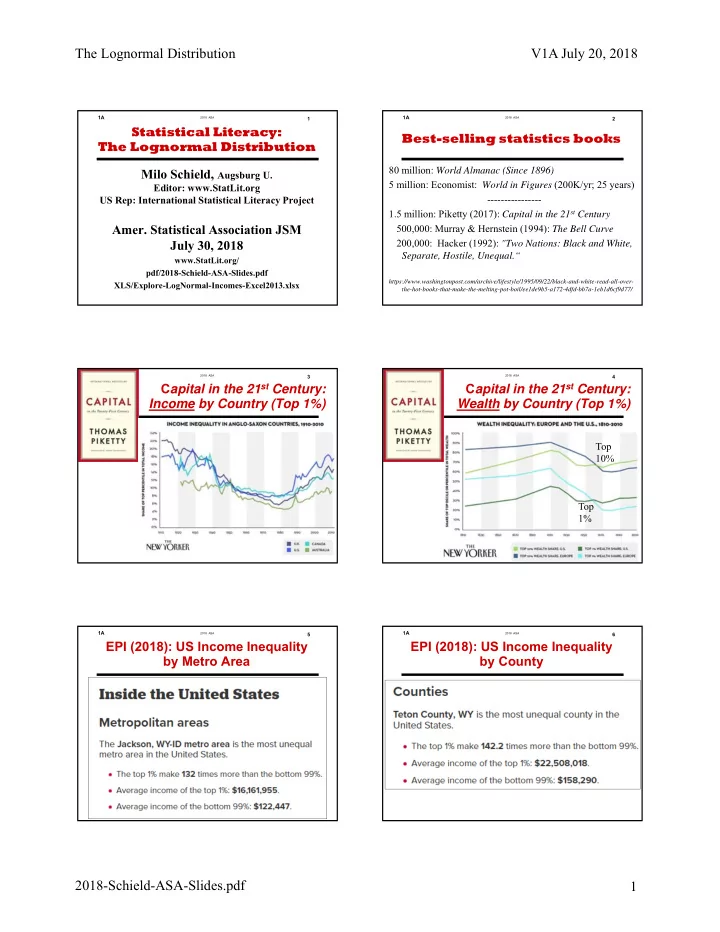
80 million: World Almanac (Since 1896) 5 million: Economist: World in Figures (200K/yr; 25 years)

  • 1.5 million: Piketty (2017): Capital in the 21st Century

500,000: Murray & Hernstein (1994): The Bell Curve 200,000: Hacker (1992): "Two Nations: Black and White, Separate, Hostile, Unequal.“

https://www.washingtonpost.com/archive/lifestyle/1995/09/22/black-and-white-read-all-over- the-hot-books-that-make-the-melting-pot-boil/ee1de9b5-a172-4dfd-bb7a-1eb1d6cf9d77/

Best-selling statistics books

2018 ASA

1A 3

.

Capital in the 21st Century: Income by Country (Top 1%)

2018 ASA

1A 4

.

Capital in the 21st Century: Wealth by Country (Top 1%)

Top 10% Top 1%

2018 ASA

1A 5

.

EPI (2018): US Income Inequality by Metro Area

2018 ASA

1A 6

.

EPI (2018): US Income Inequality by County

slide-2
SLIDE 2

The Lognormal Distribution V1A July 20, 2018 2018-Schield-ASA-Slides.pdf 2

2018 ASA

1A 7

Evaluate income share held by top 1% over time. Data source: Tax data Problem: Tax authorities censors high-income data. So, how did Piketty deduce the income share of top 1% Piketty used a model: the Pareto distribution. By fitting this model to uncensored incomes, he inferred the distribution of the censored incomes. Atkinson et al (2011). P 12-14.

Piketty: Censored Data Problem

2018 ASA

1A 8

The key property of Pareto distributions is this: the “ratio of ‘average income y*(y) of individuals with income above y’ to y does not depend on the income threshold y.” [Ave Income > y] / y = Beta “if β = 2, the average income of individuals with income above $100,000 is $200,000 and the average income of individuals with income above $1 million is $2 million.” Atkinson, Piketty, Suan (2011). P 12-14.

Piketty: Capital in the 21st Century

2018 ASA

1A 9

.

EPI (2018): Income Inequality Top 1% Since 1920 by Country

2018 ASA

1A 10

Bibliography

.

2018 ASA

1A 11

.

.

2018 ASA

1A 12

Log-Normal shape is common. Examples:

  • Incomes (bottom 97%), assets, size of cities
  • Weight and blood pressure of humans (by gender)
  • Stock and portfolio returns

Log-Normal is useful.

  • Function is easier to work with than a histogram
  • Understand what determines or explains shape
  • calculate the share of total income held by the top X%
  • calculate share of total income held by the ‘above-average’
  • explore effects of change in mean-median ratio.

Log-Normal Distribution

slide-3
SLIDE 3

The Lognormal Distribution V1A July 20, 2018 2018-Schield-ASA-Slides.pdf 3

2018 ASA

1A 13

“In many ways, it [the Log-Normal] has remained the Cinderella of distributions, the interest of writers in the learned journals being curiously sporadic and that of the authors of statistical text-books but faintly aroused.” “We … state our belief that the lognormal is as fundamental a distribution in statistics as is the normal, despite the stigma of the derivative nature of its name.” Shape is determined by the mean-median ratio.

Aitchison and Brown (1957). P 1.

Log-Normal Distribution: Atchison and Brown

2018 ASA

1A 14

.

Log-Normal Distribution of Units

0% 25% 50% 75% 100% 50 100 150 200 250 300 350 400 450 500 Incomes ($1,000)

Theoretical Distribution of Units by Income

Probability Distribution Function (PDF): as a percentage of the Modal PDF Cumulative Distribution Function (CDF): Percentage of Units with Incomes below price Mode: 20K LogNormal Dist of Units Median=50K; Mean=80K Units can be individuals, households or families

2018 ASA

1A 15

For anything that is distributed by X, there are always two distributions:

  • 1. Distribution of subjects by X
  • 2. Distribution of total X by X.

Sometime we ignore the 2nd: height or weight. Sometimes we care about the 2nd: income or assets. Surprise: If the 1st is lognormal, so is the 2nd.

Paired Distributions

2018 ASA

1A 16

If the distribution of households by income is log- normal with normal parameters mu# and sigma#, the distribution of total income by household income has a log-normal distribution where mu$ = mu# + sigma#^2; sigma$ = sigma#.

See Aitchison and Brown (1957), p. 158.

Special thanks to Mohammod Irfan (Denver University) for his help on this topic.

Distribution of Households and Total Income by Income

2018 ASA

1A 17

.

Distribution of Total Income

0% 25% 50% 75% 100% 50 100 150 200 250 300 350 400 450 500 Unit Incomes ($1,000)

Distribution of Total Income by Income per Household

Probability Distribution Function (PDF): as a percentage of the Modal PDF Cumulative Distribution Function (CDF): Percentage of Total Income below price Mode: 50K LogNormal Dist of Units by Income Median=50K; Mean=80K Median: 128K

2018 ASA

1A

Distribution of Households and Total Income

18 0% 25% 50% 75% 100% 50 100 150 200 Percentage of Maximum

Income ($1,000)

Distribution of Households by Income; Distribution of Total Income by Amount

Log Normal Distribution of Households by Income Income/House: Mean=80K; Median=50K

Households by Income Mode: $20K; Median: $50K Mean=$80K Distribution of Total Income by Amount of Income Mode: $50K Median: $128K Ave $205K
slide-4
SLIDE 4

The Lognormal Distribution V1A July 20, 2018 2018-Schield-ASA-Slides.pdf 4

2018 ASA

1A 19

.

Lorenz Curve and Gini Coefficient

0% 20% 40% 60% 80% 100% 0% 20% 40% 60% 80% 100% Percentage of Income Percentage of Households

Pctg of Income vs. Pctg. of Households

Top 50% (above $50k): 83% of total Income Top 10% (above $175k: 38% of total Income Top 1% (above $475k): 8.7% of total Income Top 0.1% (above $1M): 1.7% of total Income

Log Normal Distribution of Households by Income Income/House: Mean=80K; Median=50K

Gini Coefficient: 0.507 Bigger means more unequal

2018 ASA

1A 20

The Gini coefficient is determined by the Mean#/Median# ratio. The bigger this ratio the bigger the Gini coefficient and the greater the economic inequality.

Champagne-Glass Distribution

0% 20% 40% 60% 80% 100% 0% 20% 40% 60% 80% 100% Percentage of Households Percentage of Income

Pctg of Households vs. Pctg of Income

Top 50% (above $50k) have 83% of total Income Top 10% (above $175k) have 38% of total Income Top 1% (above $475k) have 8.7% of total Income Top 0.1% (above $1M) have 1.7% of total Income Log Normal Distribution of Households by Income Income/House: Mean=80K; Median=50K Gini = 0.507 Bottom‐Up 2018 ASA

1A 21

If the average household income is located at the Xth percentile, then it follows that;

  • X% of all HH have incomes below the average income

(1-X)% of all HH are located above this point

  • X% of all HH income is earned by Households above this point.
  • Above-average income households earn X/(1-X) times

their pro-rata share of total income

  • Below-average income households earn (1-X)/X times

their pro-rata share of income.

Atchison-Brown Balance Theorem

2018 ASA

1A 22

Log-normal distribution. Median HH income: $50K.

As Mean-Median Ratio  Rich get Richer (relatively)

Top 5% Top 1% Mean# Min$ %Income Min$ %Income Gini 55 103 11% 138 2.9% 0.24 60 135 15% 204 4.2% 0.33 65 165 18% 270 5.5% 0.39 70 193 20% 337 6.6% 0.44 75 220 23% 406 7.7% 0.48 80 246 25% 477 8.7% 0.51 85 272 27% 549 9.7% 0.53 90 298 29% 623 10.7% 0.56

2018 ASA

1A 23

What Causes an Increase in the Mean-Median Ratio?

Bad things: Crony capitalism, illegal gains. Good things: More people getting college degrees. Creating ways to do existing things better, cheaper or faster (Making pins, . Providing value or entertainment that people enjoy. Creating ways to do new things that were not doable before (telegraph, telephone, internet).

2018 ASA

1A 24

Conclusion

Using the LogNormal distribution provides a simple, principled way for students

  • to explore a plausible distribution of incomes
  • to understand the factors that influence the change

in income distributions

slide-5
SLIDE 5

2018 ASA

1A 1

Milo Schield, Augsburg U.

Editor: www.StatLit.org US Rep: International Statistical Literacy Project

  • Amer. Statistical Association JSM

July 30, 2018

www.StatLit.org/ pdf/2018-Schield-ASA-Slides.pdf XLS/Explore-LogNormal-Incomes-Excel2013.xlsx

Statistical Literacy: The Lognormal Distribution

slide-6
SLIDE 6

2018 ASA

1A 2

80 million: World Almanac (Since 1896) 5 million: Economist: World in Figures (200K/yr; 25 years)

  • 1.5 million: Piketty (2017): Capital in the 21st Century

500,000: Murray & Hernstein (1994): The Bell Curve 200,000: Hacker (1992): "Two Nations: Black and White, Separate, Hostile, Unequal.“

https://www.washingtonpost.com/archive/lifestyle/1995/09/22/black-and-white-read-all-over- the-hot-books-that-make-the-melting-pot-boil/ee1de9b5-a172-4dfd-bb7a-1eb1d6cf9d77/

Best-selling statistics books

slide-7
SLIDE 7

2018 ASA

1A 3

.

Capital in the 21st Century: Income by Country (Top 1%)

slide-8
SLIDE 8

2018 ASA

1A 4

.

Capital in the 21st Century: Wealth by Country (Top 1%)

Top 10% Top 1%

slide-9
SLIDE 9

2018 ASA

1A 5

.

EPI (2018): US Income Inequality by Metro Area

slide-10
SLIDE 10

2018 ASA

1A 6

.

EPI (2018): US Income Inequality by County

slide-11
SLIDE 11

2018 ASA

1A 7

Evaluate income share held by top 1% over time. Data source: Tax data Problem: Tax authorities censors high-income data. So, how did Piketty deduce the income share of top 1% Piketty used a model: the Pareto distribution. By fitting this model to uncensored incomes, he inferred the distribution of the censored incomes. Atkinson et al (2011). P 12-14.

Piketty: Censored Data Problem

slide-12
SLIDE 12

2018 ASA

1A 8

The key property of Pareto distributions is this: the “ratio of ‘average income y*(y) of individuals with income above y’ to y does not depend on the income threshold y.” [Ave Income > y] / y = Beta “if β = 2, the average income of individuals with income above $100,000 is $200,000 and the average income of individuals with income above $1 million is $2 million.” Atkinson, Piketty, Suan (2011). P 12-14.

Piketty: Capital in the 21st Century

slide-13
SLIDE 13

2018 ASA

1A 9

.

EPI (2018): Income Inequality Top 1% Since 1920 by Country

slide-14
SLIDE 14

2018 ASA

1A 10

Bibliography

.

slide-15
SLIDE 15

2018 ASA

1A 11

.

.

slide-16
SLIDE 16

2018 ASA

1A 12

Log-Normal shape is common. Examples:

  • Incomes (bottom 97%), assets, size of cities
  • Weight and blood pressure of humans (by gender)
  • Stock and portfolio returns

Log-Normal is useful.

  • Function is easier to work with than a histogram
  • Understand what determines or explains shape
  • calculate the share of total income held by the top X%
  • calculate share of total income held by the ‘above-average’
  • explore effects of change in mean-median ratio.

Log-Normal Distribution

slide-17
SLIDE 17

2018 ASA

1A 13

“In many ways, it [the Log-Normal] has remained the Cinderella of distributions, the interest of writers in the learned journals being curiously sporadic and that of the authors of statistical text-books but faintly aroused.” “We … state our belief that the lognormal is as fundamental a distribution in statistics as is the normal, despite the stigma of the derivative nature of its name.” Shape is determined by the mean-median ratio.

Aitchison and Brown (1957). P 1.

Log-Normal Distribution: Atchison and Brown

slide-18
SLIDE 18

2018 ASA

1A 14

.

Log-Normal Distribution of Units

0% 25% 50% 75% 100% 50 100 150 200 250 300 350 400 450 500 Incomes ($1,000)

Theoretical Distribution of Units by Income

Probability Distribution Function (PDF): as a percentage of the Modal PDF Cumulative Distribution Function (CDF): Percentage of Units with Incomes below price Mode: 20K LogNormal Dist of Units Median=50K; Mean=80K Units can be individuals, households or families

slide-19
SLIDE 19

2018 ASA

1A 15

For anything that is distributed by X, there are always two distributions:

  • 1. Distribution of subjects by X
  • 2. Distribution of total X by X.

Sometime we ignore the 2nd: height or weight. Sometimes we care about the 2nd: income or assets. Surprise: If the 1st is lognormal, so is the 2nd.

Paired Distributions

slide-20
SLIDE 20

2018 ASA

1A 16

If the distribution of households by income is log- normal with normal parameters mu# and sigma#, the distribution of total income by household income has a log-normal distribution where mu$ = mu# + sigma#^2; sigma$ = sigma#.

See Aitchison and Brown (1957), p. 158.

Special thanks to Mohammod Irfan (Denver University) for his help on this topic.

Distribution of Households and Total Income by Income

slide-21
SLIDE 21

2018 ASA

1A 17

.

Distribution of Total Income

0% 25% 50% 75% 100% 50 100 150 200 250 300 350 400 450 500 Unit Incomes ($1,000)

Distribution of Total Income by Income per Household

Probability Distribution Function (PDF): as a percentage of the Modal PDF Cumulative Distribution Function (CDF): Percentage of Total Income below price Mode: 50K

LogNormal Dist of Units by Income Median=50K; Mean=80K

Median: 128K

slide-22
SLIDE 22

2018 ASA

1A

Distribution of Households and Total Income

18 0% 25% 50% 75% 100% 50 100 150 200 Percentage of Maximum

Income ($1,000)

Distribution of Households by Income; Distribution of Total Income by Amount

Log Normal Distribution of Households by Income Income/House: Mean=80K; Median=50K

Households by Income Mode: $20K; Median: $50K Mean=$80K Distribution of Total Income by Amount of Income Mode: $50K Median: $128K Ave $205K

slide-23
SLIDE 23

2018 ASA

1A 19

.

Lorenz Curve and Gini Coefficient

0% 20% 40% 60% 80% 100% 0% 20% 40% 60% 80% 100% Percentage of Income Percentage of Households

Pctg of Income vs. Pctg. of Households

Top 50% (above $50k): 83% of total Income Top 10% (above $175k: 38% of total Income Top 1% (above $475k): 8.7% of total Income Top 0.1% (above $1M): 1.7% of total Income

Log Normal Distribution of Households by Income Income/House: Mean=80K; Median=50K

Gini Coefficient: 0.507 Bigger means more unequal

slide-24
SLIDE 24

2018 ASA

1A 20

The Gini coefficient is determined by the Mean#/Median# ratio. The bigger this ratio the bigger the Gini coefficient and the greater the economic inequality.

Champagne-Glass Distribution

0% 20% 40% 60% 80% 100% 0% 20% 40% 60% 80% 100% Percentage of Households Percentage of Income

Pctg of Households vs. Pctg of Income

Top 50% (above $50k) have 83% of total Income Top 10% (above $175k) have 38% of total Income Top 1% (above $475k) have 8.7% of total Income Top 0.1% (above $1M) have 1.7% of total Income

Log Normal Distribution of Households by Income Income/House: Mean=80K; Median=50K

Gini = 0.507 Bottom‐Up

slide-25
SLIDE 25

2018 ASA

1A 21

If the average household income is located at the Xth percentile, then it follows that;

  • X% of all HH have incomes below the average income

(1-X)% of all HH are located above this point

  • X% of all HH income is earned by Households above this point.
  • Above-average income households earn X/(1-X) times

their pro-rata share of total income

  • Below-average income households earn (1-X)/X times

their pro-rata share of income.

Atchison-Brown Balance Theorem

slide-26
SLIDE 26

2018 ASA

1A 22

Log-normal distribution. Median HH income: $50K.

As Mean-Median Ratio  Rich get Richer (relatively)

Top 5% Top 1% Mean# Min$ %Income Min$ %Income Gini 55 103 11% 138 2.9% 0.24 60 135 15% 204 4.2% 0.33 65 165 18% 270 5.5% 0.39 70 193 20% 337 6.6% 0.44 75 220 23% 406 7.7% 0.48 80 246 25% 477 8.7% 0.51 85 272 27% 549 9.7% 0.53 90 298 29% 623 10.7% 0.56

slide-27
SLIDE 27

2018 ASA

1A 23

What Causes an Increase in the Mean-Median Ratio?

Bad things: Crony capitalism, illegal gains. Good things: More people getting college degrees. Creating ways to do existing things better, cheaper or faster (Making pins, . Providing value or entertainment that people enjoy. Creating ways to do new things that were not doable before (telegraph, telephone, internet).

slide-28
SLIDE 28

2018 ASA

1A 24

Conclusion

Using the LogNormal distribution provides a simple, principled way for students

  • to explore a plausible distribution of incomes
  • to understand the factors that influence the change

in income distributions

slide-29
SLIDE 29

2018 ASA

1A 25

.

EPI (2018): US Income Inequality by State

slide-30
SLIDE 30

2018 ASA

1A 26

Bibliography

Aitchison J and JAC Brown (1957). The Log-normal Distribution. Cambridge (UK): Cambridge University Press. Searchable copy at Google Books: http://books.google.com/books?id=Kus8AAAAIAAJ Cassidy, John (2014). Piketty’s Inequality Story in 6 Graphs. The New Yorker

www.newyorker.com/news/john-cassidy/pikettys-inequality-story-in-six-charts

Cobham, Alex and Andy Sumner (2014). Is inequality all about the tails?: The Palma measure of income inequality. Significance. Volume 11 Issue 1. Limpert, E., W.A. Stahel and M. Abbt (2001). Log-normal Distributions across the Sciences: Keys and Clues. Bioscience 51, No 5, May 2001, 342-352. Copy at http://stat.ethz.ch/~stahel/lognormal/bioscience.pdf Schield, Milo (2013) Creating a Log-Normal Distribution using Excel 2013. www.statlit.org/pdf/Create-LogNormal-Excel2013-Demo-6up.pdf Stahel, Werner (2014). Website: http://stat.ethz.ch/~stahel

  • Univ. Denver (2014). Using the LogNormal Distribution. Copy at

http://www.du.edu/ifs/help/understand/economy/poverty/lognormal.html

  • Wikipedia. LogNormal Distribution.