Remote Sensing Applications in support of Coastal Zone Management - - PowerPoint PPT Presentation

remote sensing applications in support of coastal zone
SMART_READER_LITE
LIVE PREVIEW

Remote Sensing Applications in support of Coastal Zone Management - - PowerPoint PPT Presentation

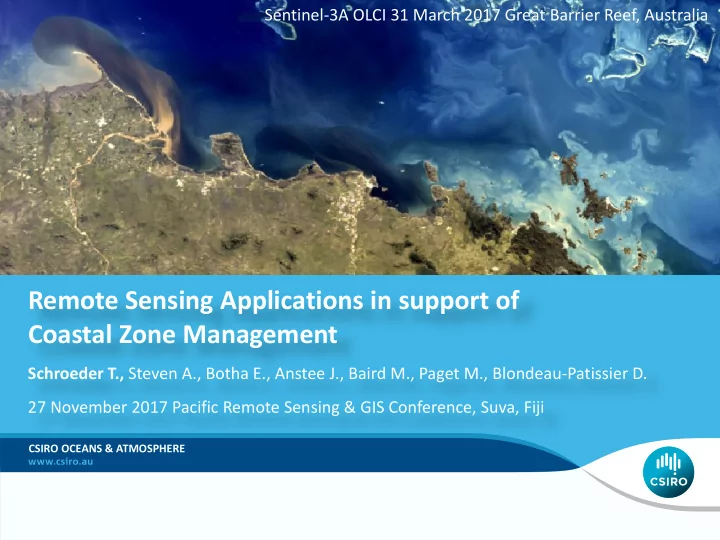
Sentinel-3A OLCI 31 March 2017 Great Barrier Reef, Australia Remote Sensing Applications in support of Coastal Zone Management Schroeder T., Steven A., Botha E., Anstee J., Baird M., Paget M., Blondeau-Patissier D. 27 November 2017 Pacific Remote


slide-1
SLIDE 1

CSIRO OCEANS & ATMOSPHERE

Remote Sensing Applications in support of Coastal Zone Management

Schroeder T., Steven A., Botha E., Anstee J., Baird M., Paget M., Blondeau-Patissier D. 27 November 2017 Pacific Remote Sensing & GIS Conference, Suva, Fiji Sentinel-3A OLCI 31 March 2017 Great Barrier Reef, Australia

slide-2
SLIDE 2

CSIRO – Coasts - Aquatic Remote Sensing Example applications in our region (Australia) International context – GEO, AO-GEOSS Open Data Cube Initiatives Opportunities & Conclusions

This presentation

This presentation

slide-3
SLIDE 3

Federal Government Agency for scientific research ~5000+ employees Oceans & Atmosphere Business Unit ~570 staff (4 Programs)

Capability covers physics, ecology, genetics, chemistry, mathematical modeling, observing systems, social sciences and marine engineering. (www.csiro.au/en/Research/OandA)

Coasts Program ~100+ staff Director Andy Steven

Supports the sustainable development of Australia’s coastal resources by providing decision-makers with integrated observational and modeling capabilities to assess and anticipate the dynamics and vulnerability of coastal assets.

This presentation

CSIRO

(Commonwealth Scientific Industrial Research Organization)

slide-4
SLIDE 4

Coasts - Aquatic Remote Sensing

Profile

  • We conduct research using coastal/inland Earth Observation

across a wide range of spatial and temporal scales

  • Our focus is on analytical methods

Radiative transfer analysis through atmosphere, water column & substrate cover in the optical (VIS), NIR, SWIR, thermal and the microwave spectral domains

  • Emphasis on remote sensing of spectral attributes relating to

physical processes, particularly those controlling the dynamics water quality

  • Emphasis on rigorous field and lab measurements and sensor

calibration/validation

  • Translation into management relevant applications
slide-5
SLIDE 5

Optically deep Optically shallow

  • Water quality monitoring (coastal & inland)
  • Guideline compliance monitoring
  • Flood/Freshwater plume extent mapping
  • Primary productivity – carbon fluxes
  • Light availability at seabed mapping
  • Algal bloom detection & dynamics
  • Oil pollution detection
  • Data assimilation products into BGCMs

Linking remote sensing & modelling

  • Habitat mapping – change detection
  • Spectral libraries
  • Bathymetry retrieval
  • Coral bleaching

Coasts - Aquatic Remote Sensing

Research, Algorithm Development & Applications

Measurements

slide-6
SLIDE 6

Why remote sensing?

  • Australia has the 3rd largest marine jurisdiction of any nation on Earth
  • 14 million km2 double the size of its land mass, coastline ~36.000 km
  • Biodiversity conservation & ecosystem health - Grand Challenge (Marine Nation 2025)

Prepared by the Oceans Policy Science Advisory Group

slide-7
SLIDE 7

Declining water quality Coastal developments Climate change Fishing

Biodiversity threats

Bleaching

Sea Surface Temperature

Cyclones Crown of Thorns Starfish

slide-8
SLIDE 8

In-water algorithm

Linear-Matrix-Inversion Artificial Neural Networks

In-water & Substratum

Semi-Analytical Model for Bathymetry Un-mixing and Concentration Assessment (SAMBUCA) A-prior knowledge of in-water optical properties and substratum reflectance required to constrain the solution

Remote Sensing Inversion

Optically deep/shallow waters

Atmospheric correction

Artificial Neural Networks

slide-9
SLIDE 9

Image credit: http://www.lib.utexas.edu

slide-10
SLIDE 10

Pronounced wet and dry season cycle Rainfall maximum between JAN-MAR River plumes are the major transport mechanism for dissolved nutrients, sediments and pollutants into the Great Barrier Reef Discharged material is proportional to the rainfall, and the extent and type of agricultural land in the catchment Frequency and intensity of tropical cyclones are expected to increase as a consequence of global warming

slide-11
SLIDE 11

River flood plumes – Great Barrier Reef – MODIS Jan 2007

30 km

Monitoring relevant for the management of coral and seagrass ecosystems. Low salinity runoff waters may discharge high loads of sediments, dissolved nutrients and anthropogenic contaminants into the sea and can directly stress marine ecosystems that are adapted to higher light and salinity levels. Reefs Reefs Plume boundary Clouds Clouds No salinity from optical remote sensing

slide-12
SLIDE 12

CDOM as surrogate for salinity

slide-13
SLIDE 13

MODIS-Aqua 02.02.2005 100 km

slide-14
SLIDE 14

S3A_OL_1_EFR____20160608T231306_20160608T231357_20160609T015217_0050_005_101_3420_MAR_O_NR _001

8 June 2016

25 50 km

N S3A_OL_1_EFR____20170331T233620_20170331T233920_20170401T013612_0179_016_087_3240_MAR_O_NR_002

31 March 2017

Burdekin River

slide-15
SLIDE 15

Assimilation of Satellite Ocean Colour (surface reflectance)

The eReefs Project

Bio-geochemical model Model Satellite Modeled Ocean Colour

(Courtesy: Dr Mark Baird & Team)

slide-16
SLIDE 16

Comparison GBR1 model vs satellite remote sensing

eReefs Whitsunday region http://research.csiro.au/ereefs/

Model Satellite CHL TSS Light CHL TSS Light

slide-17
SLIDE 17

Great Barrier Reef Report Card http://www.reefplan.qld.gov.au

Report cards measure progress towards the Reef Water Quality Protection Plan’s goal and targets. Water Quality scores derived from combined remote sensing and modeling framework. Report Card 2016

(Released Oct 2017)

eReefs: Integrated system of data, simulations and forecasting incl. visualization 1st step towards a National Coastal Information System

slide-18
SLIDE 18
  • GEO is a voluntary partnership of governments and
  • rganizations that is working to link Earth
  • bservation resources world-wide for the benefit of

society

  • GEO currently has 100+ member countries and 100+

participating organizations Group on Earth Observations (GEO)

slide-19
SLIDE 19
  • The GEO community seeks to build a Global Earth Observation

System of Systems (GEOSS).

  • To better integrate observing systems (in-situ and remote sensing)

and share data by connecting existing infrastructures using common standards.

  • GEOSS links these systems to strengthen the monitoring of the

state of the Earth.

Global Earth Observation Systems of Systems (GEOSS)

slide-20
SLIDE 20
  • GEOSS seeks to link Earth observation resources across

multiple societal benefit areas Global Earth Observation Systems of Systems (GEOSS)

slide-21
SLIDE 21

21

Improving regional

  • bserving

ability Data and information products processing Earth

  • bservation

data sharing service Technology cooperation network Regional applications

AO GEOSS

 Sustainable Agricultural  Cross-regional disaster mitigation  Ecology & environment  Infrastructure monitoring  Surveying and mapping  Ocean remote sensing monitoring  Water resources

Asia-Oceania GEOSS

Lead: Australia, China, Japan Members: Australia, Bangladesh, China, India, Japan, Mongolia, Myanmar, Nepal, Pakistan, South Korea

AO-GEOSS will enhance the observing capacity of the Asia-Oceania region

slide-22
SLIDE 22

Asia-Oceania GEOSS

Task 8: Ocean and Islands Observations for AO region

Foundational task are supporting applications and services.

slide-23
SLIDE 23

Presentation title | Presenter name 2 3 |

Goal

  • To advance and exploit synergies among the many
  • bservational programs devoted to island, coastal

and ocean, to improve engagement with a variety of users for enhancing the timeliness, quality and range

  • f services delivered;
  • to raise awareness of the societal benefits of ocean
  • bservations at the public and policy levels
  • Focus on coastal countries and small island states

Tasks

  • Identify and articulate user needs. Produce new

marine and coastal observation networks by supporting and linking partners.

  • Evaluate the sea level rise risk for the developing

states in the western and eastern Pacific.

  • Improve Modeling the Hydrodynamics and

Biogeochemistry of the ocean environment and Coastal Applications of the Data Cube.

Task 8 Oceans and Islands

slide-24
SLIDE 24

Task 11. Develop a Regional GEOSS Data Set

Asia-Oceania GEOSS

slide-25
SLIDE 25

Australia Regional Copernicus Hub

http://www.copernicus.gov.au

Sentinel-3A 22.08.2016

Provides free and open access to data from the European Sentinel 1, 2, and 3 satellite missions

slide-26
SLIDE 26

The big data challenge

(Lewis et al., RSE 2017)

Cumulative Level-0 data volumes (Petabytes)

For many applications lack of data is no longer the limiting factor … a lack of tools to exploit the data is.

slide-27
SLIDE 27

The Open Data Cube Initiative

www.opendatacube.org

(Lewis et al., RSE 2017)

Open = open source Data Cube = Aligned pixels ready for analysis Analysis ready data (Level-3) ... Reduce processing burden on users Analytics platform not just data storage Paradigm shift ... Pixels vs files and bring the science/user to the EO data Integration of multiple data sets supported Multiple platform ... Desktop, HPC, Cloud Community sharing/development of applications Prototypes: Columbia, Kenya, Vietnam ... Partners: GA, CSIRO, NASA, USGS Data pipelines: Landsat, MODIS, SAR (PALSAR 1/2, ALOS-2, Sentinel-1), Himawari-8, ...

slide-28
SLIDE 28

Applications – Open Data Cube Australia

www.opendatacube.org

  • Vegetation change (agricultural production)
  • Bushfire scar mapping and forestry inventory
  • Mining footprint and urban development
  • Carbon accounting
  • Wetland management and characterisation
  • Flood inundation mapping (farm, dam development)
  • Coastal change mangrove extent and water quality
  • Shallow water bathymetry
  • Seagrass and substratum mapping

AGDC - 30 years of Landsat data free and open for the entire Australian continent

slide-29
SLIDE 29

Conclusions & Opportunities

  • Remote sensing approaches complement in-situ water quality monitoring
  • However for remote regions remote sensing is often the only means of
  • btaining management relevant information for coastal zone management
  • Remote sensing methods developed in one area are applicable to other

regions (of Australia) as the physics-based approach is generic in nature

  • Methods can be applied to historical, current and future satellite images

and as such become a cost-effective monitoring tool to detect change

  • The Open Data Cube concept provides opportunities for collaboration and

development of applications specifically for the Asia-Oceanic region, inundation risk assessments or seagrass, mangrove mapping ...

  • Addressing the need to estimates of carbon stocks and sequestration rates

and better maps of blue carbon extent

slide-30
SLIDE 30

Thank you. Questions?

Dr Thomas Schroeder

Senior Research Scientist Coasts Brisbane Thomas.Schroeder@csiro.au

Dr Andy Steven

Research Director Coasts Brisbane Andy.Steven@csiro.au

slide-31
SLIDE 31

S C A T T E R I N G S C A T T E R I N G

Light interactions in an atmosphere-ocean system

Optically shallow Optically deep

slide-32
SLIDE 32

Presentation title | Presenter name | Page 32

Basics 3

Atmospheric correction Atmospheric correction

slide-33
SLIDE 33

Berkelmans et al. (2002, 2004); Hoegh-Guldberg (1999).

signal water signal land signal atmosphere measured

Most of the satellite signal at Top of Atmosphere is noise

> 90%

slide-34
SLIDE 34

T4: Ocean and Society

34

GEOSS-AP Ocean Data Networking System

slide-35
SLIDE 35

Examples applications optical shallow waters

slide-36
SLIDE 36

Bathymetry and substratum mapping

Georgina Cay (Lihou Reef National Nature Reserve)

MODIS Quickbird

Quickbird: ~2.6 m, 4 bands, ~3.5 days revist

slide-37
SLIDE 37

y = 0.8187x + 0.6458 R2 = 0.8066 5 10 15 20 25 30 5 10 15 20 25 30

retrieved depth (m) measured depth (m) Botha et al, 2010, doi: 10.13140/RG.2.1.1290.7288 Botha et al, 2013, RSE, doi: 10.1016/j.rse.2012.12.02

Bathymetry

Georgina Cay

slide-38
SLIDE 38

Substratum mapping

Georgina Cay