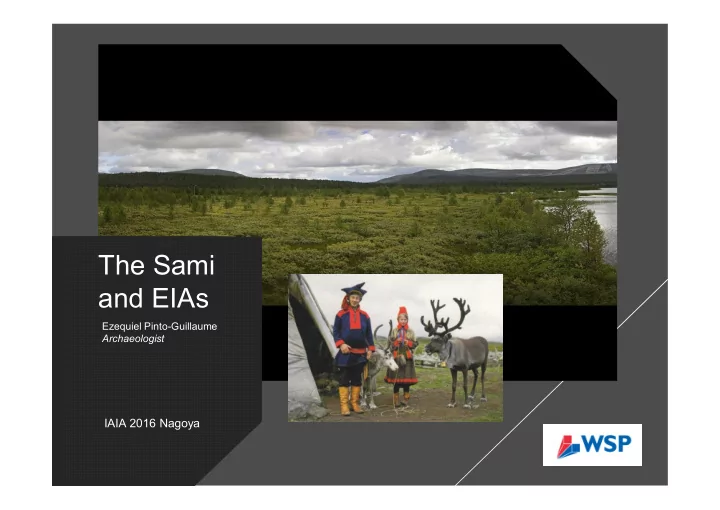
SLIDE 1 The Sami and EIAs
IAIA 2016 Nagoya
Ezequiel Pinto-Guillaume Archaeologist
SLIDE 2
The Sami people
SLIDE 3
Sápmi
SLIDE 4
The first EIAs for projects within Sápmi
Identified physical remains – Archaeological survey Ancient monument Other cultural-historical remains
SLIDE 5
The first EIAs for projects within Sápmi
Example: A Sami hearth Sami dwelling: Kåta
SLIDE 6
The first EIAs for projects within Sápmi
An abandoned physical object à Relevant as historic evidence
SLIDE 7
From a Sami point-of-view
Balance
SLIDE 8 2010 à Publication The Sami land use and EIA guidelines
Reccommendation Take into consideration:
- 1. Tangible cultural heritage
- 2. Intangible cultural heritage
- 3. Biological cultural heritage
SLIDE 9
2011 (SNHB Congress) à Ragnhild Svonni Siellu min siste (The Lanscape within us)
SLIDE 10
2011 (SNHB Congress) à Ragnhild Svonni Siellu min siste (The Lanscape within us)
Dialogue
From a Sami point-of-view: Physical remains Knowledge connected to the place
SLIDE 11
So what happened after that? EIAs after 2011:
Most EIAs have the same approach as before Only a few took up a certain dialogue with the local Sami people à But in this case cultural heritage was restricted to activities connected to reindeer herding
SLIDE 12
So what happened after that? EIAs after 2011:
Most EIAs have the same approach as before Only a few took up a certain dialogue with the local Sami people à But in this case cultural heritage was restricted to activities connected to reindeer herding
We are still on square one.
SLIDE 13 So what is the problem?
Myself Worldview based
European and American thought Logical, time oriented, and systematic The core of my thinking has a cause-and-effect relationship To understand the world is to understand the linear cause-and-effect relationships between events
SLIDE 14
So what is the problem?
Myself A linear person according to Members of a Canadian First Nation Canadian First Nations: Define... ”We are the landcape.”
SLIDE 15
The Sami challenge
Understanding the Relational Worldview It is intuitive, non-time oriented and fluid. The balance and harmony in relationships between multiple variables, including spiritual forces, make up the core of the thought system.
SLIDE 16
The Sami challenge
When we work with EIAs à Project to be insterted in the landscape à Disrupting the balance Possible solutions: à Dialogue with the local Sami, of course à Ask about Jojk and traditional knowledge in relation to the place à Take into consideration the three main aspects of cultural heritage pointed out by the Sami
SLIDE 17
Balance
Context Spirit Mind Body
SLIDE 18
Not this: Past Future Cause Effect
SLIDE 19
Scene from Áile ja áhkku (Áile and her Grandmother) a short firm by Siljá Somby
SLIDE 20
Thank you!