Environmental Impact Assessments How can EIAs/SEAs improve ocean - - PowerPoint PPT Presentation

environmental impact assessments
SMART_READER_LITE
LIVE PREVIEW

Environmental Impact Assessments How can EIAs/SEAs improve ocean - - PowerPoint PPT Presentation

Environmental Impact Assessments How can EIAs/SEAs improve ocean governance in ABNJ and how could they be incorporated under a new legally binding instrument ? Kristina M. Gjerde IUCN Senior High Seas Advisor Global Marine and Polar Programme


slide-1
SLIDE 1

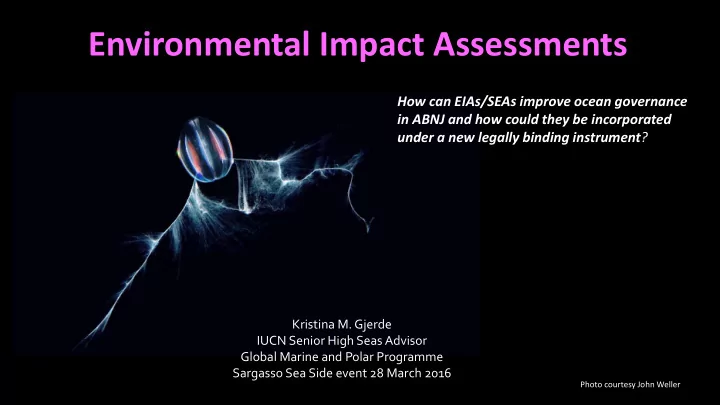
Photo courtesy John Weller

Environmental Impact Assessments

Kristina M. Gjerde IUCN Senior High Seas Advisor Global Marine and Polar Programme Sargasso Sea Side event 28 March 2016

How can EIAs/SEAs improve ocean governance in ABNJ and how could they be incorporated under a new legally binding instrument?

slide-2
SLIDE 2
  • Reaffirm existing obligations
  • Renew focus & impetus
  • Set out a clear & uniform process
  • Provide for cumulative assessment

and/or Strategic Environmental Assessment

  • Technical support & capacity

building to assist developing States

  • Global review, decision-making

process and accountability

text based on Glen Wright

slide-3
SLIDE 3

Ocean Fertization

Powdered chalk

Barney Balch

New and Emerging Activities

Bryce Groark Seaweed Energy Solutions AS

Ocean based Seaweed Carriers FADs Ocean Aquaculture Slide courtesy Duncan Currie

slide-4
SLIDE 4

Zenit lifts off with communications satellite. (Credit: Sea Launch)

slide-5
SLIDE 5
  • Warmer
  • More acidic
  • Less
  • xygenated

Levin & Lebris, The deep ocean under climate change, SCIENCE, December 2015

slide-6
SLIDE 6

Slide credit Lisa Levin, Scripps Institution of Oceanography

slide-7
SLIDE 7

Slide credit Lisa Levin, Scripps Institution of Oceanography

slide-8
SLIDE 8

And what about the fish?

slide-9
SLIDE 9
  • G. Ortuño Crespo, D. C. Dunn & P. N. Halpin (in prep)

Policy Brief available
Impacts of Fisheries on Open-Ocean Ecosystems

slide-10
SLIDE 10

Impacts of fisheries on open-ocean ecosystems

  • Much higher levels of overfishing and overfished stocks in ABNJ
  • Bycatch threatens non-target species
  • Documented declines in >80% Pacific loggerhead and >95% decline

in leatherback turtles (2000, 2003)

  • All 22 species of albatross & 19 of 21 oceanic elasmobranchs are

listed as at least Near Threatened by the IUCN with bycatch cited as the main threat.

  • Discards can alter foraging behavior and trophic relationships (2007)
  • Increased variability in biomass of exploited species (2012)
  • Increased extinction risk
  • 36% of migratory or potentially migratory chondrichthyan fishes

threatened with extinction (2014)

  • 99% declines for species like the Oceanic whitetip shark in parts of

their range. (2004)

  • Contraction ¡in ¡species’ ¡ranges ¡leads ¡to ¡change ¡in ¡community ¡structure ¡

(2011)

  • 9 of the 13 species of tuna and billfish assessed exhibited reduced

range with reduced abundances.

  • Decreases in body size can affect trophic relationships, decrease

reproductive potential and increase recovery time (2005+)

  • Loss of genetic diversity can increase extinction risk, increase recovery

time and decrease adaptability to changing climates

  • Removal of top predators leads to mesopredator release and changes in

community structure

  • Preliminary assessment in 2002; real evidence came only in 2013
  • There are also non-consumptive effects including changes in prey behavior,

growth or development

  • E.g., foraging relationship between seabirds and tuna in tropical regions,

where decreases in density or abundance of tuna may lead to decreases in foraging success for associated seabirds.

  • Reductions in biodiversity (species richness and density) reduces ecosystem

resilience… ¡(2005/2006)

  • … ¡and ¡can ¡lead ¡to ¡regime ¡shifts ¡in ¡open-ocean communities
  • Evidence from pelagic areas in large enclosed seas (2007).
  • Interactions between climate change and fisheries impacts (2010 review)
  • Abandoned, lost or discarded fishing gear (ALDFG)
  • G. Ortuño Crespo, D. C. Dunn & P. N. Halpin (in prep)

Policy Brief available

slide-11
SLIDE 11

http://www.un.org/depts/los/global_reporting/WOA_RegProcess.htm

slide-12
SLIDE 12

What is EIA?

  • “a process of evaluating

the likely environmental impacts, including cumulative impacts,

  • f a proposed project or development”

CBD (1992), art. 14

Slide credit Glen Wright, IDDRI

slide-13
SLIDE 13

Kiev Protocol to the ESPOO Convention

Also for new technologies!

slide-14
SLIDE 14

Relevant legal agreements for elements for EIAs/SEAs

  • UNCLOS
  • Convention on Biological Diversity
  • London Convention and Protocol
  • International Seabed Authority Mining Code
  • UNGA Resolutions on Deep Sea Bottom Fishing
  • Antarctic Protocol on Environmental Protection
  • UN Fish Stocks Agreement
  • CBD Guidelines on EIAs and SEAs
  • Espoo Convention on Transboundary Impact Assessments
  • Kiev Protocol on Strategic Environmental Assessments

Photo courtesy John Weller

slide-15
SLIDE 15

SDG 14.2

By 2020, sustainably manage and protect marine and coastal ecosystems to avoid significant adverse impacts, including by strengthening their resilience, and take action for their restoration in

  • rder to achieve healthy and

productive oceans

slide-16
SLIDE 16

With EIA procedures

  • Seabed mining
  • Deep sea fishing
  • Dumping of wastes + marine

geoengineering research

  • Anything more than minor or

transitory in Antarctic Treaty Area

Without EIA procedures

slide-17
SLIDE 17

17

INTERNATIONAL UNION FOR CONSERVATION OF NATURE

Part 3: Environmental Impact Assessment and Strategic Environmental Assessment

http://cmsdata.iucn.org/d

  • wnloads/iucn_bbnj_matr

ix_december_2015

slide-18
SLIDE 18
  • What activities trigger EIAs/SEAs?
  • Who will carry out the

assessment?

  • Who will make the final decision?
  • What will be the effect of final

decisions?

Credit: Lydia Slobodian

Photo courtesy John Weller

slide-19
SLIDE 19
  • Threshold: All activities, plans and programmes are

subject to EIA/SEA when they are likely to cause

  • Significant adverse effects
  • Substantial pollution or significant and harmful changes
  • More than a minor or transitory effect
  • List of Activities: Specify activities/plans/programmes

that always trigger EIA/SEA

  • List of Places: Specify areas that always trigger special

requirements for EIA/SEA, eg EBSAs, VMEs, MPAs

Credit: Lydia Slobodian

slide-20
SLIDE 20
  • Who gets consulted?

Credit: Lydia Slobodian

slide-21
SLIDE 21

Slide credit Glen Wright, IDDRI

slide-22
SLIDE 22
  • Who will make final decision on proposed activity?
  • Suggestion 1: State under whose jurisdiction/control

activity/plan/programme proposed

  • Suggestion 2: Regional or international organization

(existing or set up by the agreement)

  • Decision subject to review at request of State/stakeholder

Credit: Lydia Slobodian

slide-23
SLIDE 23

EIA and SEA: Effect of final decision

  • What will be the effect of the final

decision?

–Suggestion 1: Activity proceeds under control of State –Sugesttion 2: Activity does not proceed –Suggestion 3: Conditions placed on proposed activity

Credit: Lydia Slobodian

Photo courtesy David Freestone

slide-24
SLIDE 24
slide-25
SLIDE 25

Photo courtesy John Weller

slide-26
SLIDE 26
  • Reaffirm obligation; renew focus &

impetus

  • Set out a clear & uniform process
  • Cover activities outside sectoral

regimes

  • Best practice standards for inside

sectoral regimes

  • Provide for cumulative assessment

and/or Strategic Environmental Assessment

  • Technical support & capacity building to

assist developing States

  • Global review, decision-making process

and accountability

text based on Glen Wright

slide-27
SLIDE 27

27

INTERNATIONAL UNION FOR CONSERVATION OF NATURE

Thank you for your attention!

http://cmsdata.iucn.org/dow nloads/iucn_bbnj_matrix_dec ember_2015