SLIDE 1
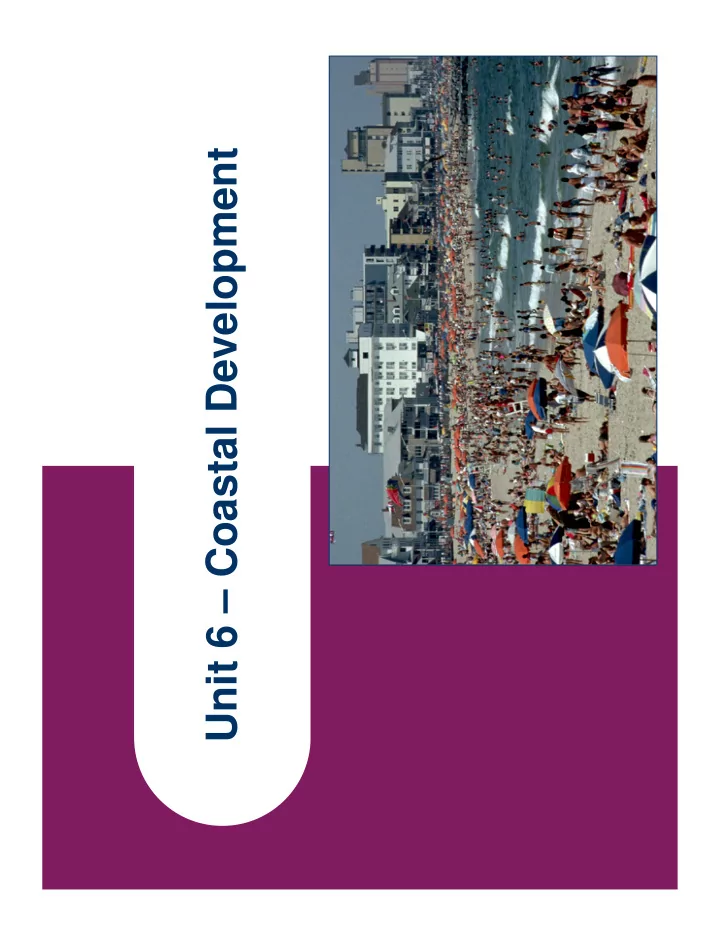
Unit 6 – Coastal Development
SLIDE 2
Coastal Population – UNEP 2002
SLIDE 3
U.S. Coastal Population Trends
Graphic Credit: Coastal Sprawl, Pew Oceans Commission (2002)
SLIDE 4
SLIDE 5
Coastal Management
How do we want our coasts to function, What do we want them to look like, and What uses do we want them to accommodate?
Complex interaction of laws, programs, and efforts to evaluate trade-offs and make decisions about how to use, conserve, and value the resources and opportunities of the coastal zone. Seeks to address three fundamental questions:
SLIDE 6
Coastal Zone Management Act
Established the following as national policy: “To preserve, protect, develop, and where possible, to restore and enhance, the resources of the Nation’s coastal zone for this and succeeding generations.”
SLIDE 7 Definition of Coastal Zone
Coastal waters and the adjacent shorelands, including islands, intertidal areas, salt marshes, and beaches.
- Seaward to the outer limits of state title.
- Inland “only to extent necessary to control
shorelands, the uses of which have a direct and significant impact on the coastal waters, and to control those geographical areas which are likely to be affected by or vulnerable to sea level rise.” Considerable variation between states.
SLIDE 8 Federal Consistency
“Each federal agency activity within or
- utside the coastal zone that affects any
land or water use or natural resource of the coastal zone shall be carried out in a manner which is consistent to the maximum extent practicable with the enforceable policies of approved State management programs.”
SLIDE 9
Interstate Consistency
Can a state review (comment on and
possibly object to) a federally licensed or permitted activity occurring totally within another state in order to determine if the activity has negative effects on the coastal environment of the reviewing state?
– Yes, if the activity affects the reviewing
state’s coastal zone.
SLIDE 10
Coastal Barrier Resources Act
Designated Coastal Barrier Resources
System in 1982
– After October 1983, a number of federal
subsidies would not longer be permitted in these designated areas including federal flood insurance and infrastructure assistance.
Effectiveness is debatable.
SLIDE 11
Case Study Dauphin Island, Alabama
July 2001 before Hurricane Lili (2002). September 17, 2004, immediately after the passage of Hurricane Ivan. August 31, 2005, two days after Hurricane Katrina.
SLIDE 12
Public Beach Access
SLIDE 13
Public Trust Doctrine
PTD provides that public trust lands, waters,
and living resources in a state are held by the state in trust for the benefit of all the people.
Establishes the right of the public to enjoy
fully public trust lands, waters, and living resources for a wide variety of public uses.
SLIDE 14
“Working Waterfronts”
Working Waterfront
Preservation Act of 2007
Florida’s Working
Waterfronts Legislation
Maine Working Waterfront
Access Pilot Program