Navigating the Environmental Compliance 10/22/2014 Process in - - PDF document

navigating the environmental compliance 10 22 2014
SMART_READER_LITE
LIVE PREVIEW

Navigating the Environmental Compliance 10/22/2014 Process in - - PDF document

Navigating the Environmental Compliance 10/22/2014 Process in Coastal California Instructors: Jim Robins April Zohn Coastal Laws & Governing Bodies Coastal Zone Management Act of 1972 Coastal Zone Management Act (1972) Federal act that


slide-1
SLIDE 1

Navigating the Environmental Compliance Process in Coastal California 10/22/2014 Elkhorn Slough Reserve Coastal Training Program 1

Instructors: Jim Robins April Zohn

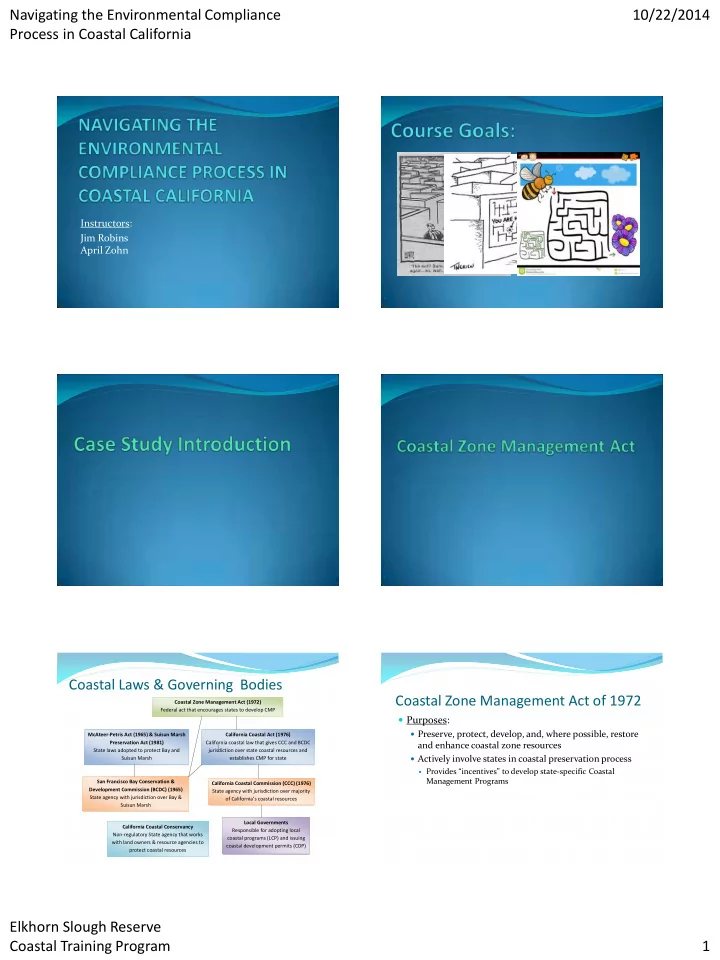
Coastal Laws & Governing Bodies

Coastal Zone Management Act (1972) Federal act that encourages states to develop CMP McAteer-Petris Act (1965) & Suisun Marsh Preservation Act (1981) State laws adopted to protect Bay and Suisun Marsh San Francisco Bay Conservation & Development Commission (BCDC) (1965) State agency with jurisdiction over Bay & Suisun Marsh California Coastal Act (1976) California coastal law that gives CCC and BCDC jurisdiction over state coastal resources and establishes CMP for state California Coastal Commission (CCC) (1976) State agency with jurisdiction over majority

  • f California’s coastal resources

Local Governments Responsible for adopting local coastal programs (LCP) and issuing coastal development permits (CDP) California Coastal Conservancy Non-regulatory State agency that works with land owners & resource agencies to protect coastal resources

Coastal Zone Management Act of 1972

 Purposes:

 Preserve, protect, develop, and, where possible, restore

and enhance coastal zone resources

 Actively involve states in coastal preservation process

 Provides “incentives” to develop state-specific Coastal

Management Programs

slide-2
SLIDE 2

Navigating the Environmental Compliance Process in Coastal California 10/22/2014 Elkhorn Slough Reserve Coastal Training Program 2 Coastal Zone Management Act (cont.)

 Responsible Agency:

 NOAA, Office of Ocean and Coastal Resource

Management (OCRM)

 State and local agencies with coastal zone oversight (i.e.,

CCC, BCDC, and local governments)  Trigger: Project modifies land or water use in the

coastal zone of state with an approved “coastal zone management program”

“Coastal Zone” Defined under CZMA

 Coastal waters (including the lands therein and thereunder)  Adjacent shorelands  Seaward to outer limit of State title  Inland from the shoreline  To a point that has “significant and direct impacts on coastal waters”

Federal Consistency

 CZMA mechanism that allows state agencies to ensure federal actions are consistent with CZMP  Triggered by:

 Federal action  Reasonably likely to affect land/water resources in the

coastal zone

What are Federal Actions?

 Federal activities, including development projects

 Requires Consistency Determination (or Negative

Determination)  Projects requiring Federal license, permit, or funding,

  • r OCS activity

 Requires Consistency Certification (or No Effects

Determination) Note: Restoration Projects with Federal Funding and/or a Federal Agency partner may be able to simplify Coastal Zone permitting through Federal Consistency: for details see: http://www.coastal.ca.gov/fedcd/guidecd.pdf

Federal Consistency Summary

Federal Activity Federal License, Permit, Funding, or OCS Activity

**Federal action that is reasonably likely to affect resources in coastal zone**

Consistency Determination Negative Determination Consistency Certification No Effects Determination

Activity consistent to the maximum extent practicable with CZMP Activity will have no effect on coastal zone Activity complies with and will be conducted in a manner consistent with CZMP Activity will have no effect on coastal zone Federal agency provides written documentation 90 days prior to federal approval Project applicant provides written documentation to state agency State agency reviews / comments within 60 days State agency reviews / comments within 6 months Federal agency may continue with a Federal Activity even if state agency disagrees Federal agency cannot approve / finance project without state agency agreement

slide-3
SLIDE 3

Navigating the Environmental Compliance Process in Coastal California 10/22/2014 Elkhorn Slough Reserve Coastal Training Program 3 Coastal Laws & Governing Bodies

Coastal Zone Management Act (1972) Federal act that encourages states to develop CMP McAteer-Petris Act (1965) & Suisun Marsh Preservation Act (1981) State laws adopted to protect Bay and Suisun Marsh San Francisco Bay Conservation & Development Commission (BCDC) (1965) State agency with jurisdiction over Bay & Suisun Marsh California Coastal Act (1976) California coastal law that gives CCC and BCDC jurisdiction over state coastal resources and establishes CMP for state California Coastal Commission (CCC) (1976) State agency with jurisdiction over majority

  • f California’s coastal resources

Local Governments Responsible for adopting local coastal programs (LCP) and issuing coastal development permits (CDP) California Coastal Conservancy Non-regulatory State agency that works with land owners & resource agencies to protect coastal resources

McAteer-Petris Act of 1965

 Purpose:

 Preserve San Francisco Bay from indiscriminate filling  Develop regional plan governing long-term use of the

Bay

 San Francisco Bay Plan

San Francisco Bay Plan

“The most important uses of the Bay are those providing

substantial public benefits and treating the Bay as a body of water, not as real estate.”  Key Objectives:

 Protect Bay as a natural resource

 Wildlife, fish, water quality, tidal marsh / flats etc.

 Develop Bay and shoreline to highest potential with

minimum fill

 Prevent unnecessary filling of the Bay  Increase public access to and along the Bay

Nejedly-Bagley-Z’berg Suisun Marsh Preservation Act of 1974

 Purpose:

 Protect Suisun Marsh from potential residential,

commercial and industrial development

 Develop regional plan to ‘preserve the integrity and

assure continued wildlife use’ of Suisun Marsh

 Suisun Marsh Protection Plan

slide-4
SLIDE 4

Navigating the Environmental Compliance Process in Coastal California 10/22/2014 Elkhorn Slough Reserve Coastal Training Program 4 California Coastal Act of 1976

 Purpose:

 Provide long-term protection to California’s coastline  Established California’s CZMP

 Established California Coastal Commission (CCC)  Made San Francisco Bay Conservation and Development

Commission (BCDC) responsible for coastal resources in Bay Area

 Partnered CCC and local governments

California Coastal Act Policies

 Used to make decisions on permit applications, federal consistency reviews, and LCP approvals

 Public access  Recreation  Marine environment  Land resources  Development

San Francisco Bay Conservation and Development Commission

 Responsible for implementing San Francisco Bay Plan and Suisun Marsh Protection Plan

 Render decisions on San Francisco Bay Development &

Suisun Marsh Development Permit Applications

 GOAL: prevent unnecessary filing of Bay and increase public access

 Responsible for enforcement of CCA and CZMA in Bay Area

 Federal consistency reviews

 GOAL: ensure federal actions occurring in the Bay are consistent

with CCA and CZMA

BCDC Jurisdiction

 San Francisco Bay  Certain waterways that flow into the Bay  Salt ponds and managed wetlands around the Bay  Shoreline band (100 feet inland from the Bay)  Primary management area of Suisun Marsh (i.e., below

10-foot contour line)

Activities Requiring BCDC Permit

Filling

Placing solid material, building pile-supported or cantilevered structures, disposing of material or permanently mooring vessels in the Bay or certain tributaries to the Bay

Dredging

Extracting material from the Bay bottom (in excess of $20)

Shoreline Projects

Nearly all work, including grading, within 100 feet of the Bay shoreline

Suisun Marsh Projects

Nearly all work in the portion of the Suisun Marsh below the 10- foot contour level, including land divisions

Other Projects

Any filling, new construction, major remodeling, substantial changes in use, and many land subdivisions in the Bay, along the shoreline, in salt ponds, duck hunting preserves, or other managed wetlands adjacent to the Bay

slide-5
SLIDE 5

Navigating the Environmental Compliance Process in Coastal California 10/22/2014 Elkhorn Slough Reserve Coastal Training Program 5 BCDC Permit Mechanisms

San Francisco Bay Permit Suisun Marsh Development Permit

Size Location Impacts

Regionwide Permit Administrative Permit Major Permit

BCDC Permit Application Process

 Application determined complete (30 days)  Pending Application notice posted at project site  Review by Commission staff

 Processes as Regionwide, Administrative or Major

 Commission Reviews (not for Regionwide)  Permit with conditions issued  “Appeal” period  Applicant signs and returns permit

BCDC Permit Comparison

REGIONWIDE PERMIT ADMINISTRATIVE PERMIT MAJOR PERMIT Routine maintenance that qualifies for approval under existing Regionwide Program Activity that qualifies as a minor repair or improvement Work that is more extensive than minor repair or improvement Staff determines if project is authorized under Regionwide Permit Staff distributes listing to Commission, State agencies, public Staff distributes summary to Commission, State agencies, public Placed on consent calendar  Reviewed by Commission Engineer / Design Review Reviewed by Commission No public hearing No public hearing Public hearing Authorized by Executive Director Permit with conditions issued by Commission Permit with conditions issued by Commission 45 Days 45-60 days 90 days++ Duration 1-2 years Duration 2-4 years Duration 2-10 years

California Coastal Commission

 Responsible for enforcing the provisions of the CCA and CZMA outside of BCDC’s jurisdiction

 Issue Coastal Development Permits (CDP)  Complete federal consistency determinations  Review and certify Local Coastal Program (LCP) and

amendments

 Hear coastal permit appeals

CCC Jurisdiction

 State’s coastal zone, excluding Bay area, where coastal zone is defined as:

 Land and water  Extending seaward (3 miles)  Including all offshore islands  Extending inland generally 1,000 yards (100 feet-5 miles)

 Delegated to local governments with approved LCP except shoreline activities

 Tidelands (i.e., below mean high / low tide lines)  Submerged lands (i.e., below mean low tide line)  Public trust lands (i.e., all lands subject to common law public

trust)

“Coastal Zone” Boundaries

 Inland extent can be confusing, so always check with the Coastal Commission or local planning agency

slide-6
SLIDE 6

Navigating the Environmental Compliance Process in Coastal California 10/22/2014 Elkhorn Slough Reserve Coastal Training Program 6 CDP Trigger

 Any activity that modifies land or water use in the coastal zone:

 Development  Restoration  Division of land  Change in intensity of use  Public access to state waters

CDP Comparison

Regular Permit Administrative Permit Emergency Permit

For all coastal development

  • utside scope of an

Administrative or Emergency Permit Can be used for:

  • Improvements to existing

structures

  • Single-family dwellings
  • Development of any four

dwelling units

  • Other development not in

excess of 100K Activity in the coastal zone that must occur immediately to prevent loss of life, health, property, or essential public services

Opportunity for Permit Exclusion

  • r Waiver?

Role of Local Government

 Majority of CDPs are issued by local government under LCPs certified by the CCC  Local Coastal Programs comprised of:

 Land use plan (i.e., general policies for development in

community)

 Implementation plan (i.e., how general policies applied)

 Zoning ordinances  Zoning maps  Other implementing requirements for sensitive coastal

resource areas

 Reviewed by CCC at least every 5 years

Local Government or CCC?

Does activity modify land or water use in the coastal zone? Coastal Development Permit NOT required Will activity impact tidelands, submerged lands, or public trust lands? Does activity occur in area with an approved Local Coastal Program? Complete CDP requirements as

  • utlined in LCP and submit for local

review Contact CCC to obtain Coastal Development Permit Contact CCC to obtain Coastal Development Permit

YES NO YES NO NO YES

General Process for CDP under LCP

 Varies between local governments  Generally processed by Planning and Development Department and approved by Planning Commission or Zoning Administrator  Typically has additional specific requirements to

address regional concerns (e.g., water availability)

Coastal Laws: Jurisdiction Summary

 Federal actions may use Federal Consistency Process  Majority of CDPs permitted by local jurisdiction where approved LCP in place  CCC issues CDP in areas where they have retained jurisdiction, or where multiple LCPs apply  BCDC issues permits for all projects in San Francisco Bay and Suisun Marsh

slide-7
SLIDE 7

Navigating the Environmental Compliance Process in Coastal California 10/22/2014 Elkhorn Slough Reserve Coastal Training Program 7 Coastal Permitting: Key Considerations

 Broad resource consideration (e.g., public access)  Coastal zone boundary determinations

 Made by CCC, NOT local governments  Overlapping jurisdictions?

 Wetland Definitions

 Two “prong” test (sometimes “one” prong test)  Extend 100 feet landward of upland limit  Differences between LCP and CCA definitions

Coastal Permitting: Key Considerations

 “Environmentally Sensitive Habitat Areas”

 CCA requires protection, enhancement, and restoration of

ESHAs

 i.e., intertidal and nearshore waters, wetlands, bays and estuaries,

riparian habitat, certain wood and grasslands, streams, lakes, and habitat for rare or endangered plants / animals  Specifically designated in LCP  Development in ESHA limited

 Cannot significantly disrupt habitat values  Only allows “use dependant” development  Development adjacent to ESHA must consider impacts on ESHA

Coastal Permitting: Key Considerations

 Sea Level Rise

 State of California Sea-Level Rise Guidance Document

(2013)

 Assist state agencies with approaches for incorporating sea

level rise into planning decisions

 Provides standardized range of SLR over time that reflects

most recent scientific data (i.e., Ntl Academy of Science [2012])

 Consider timeframe of project, adaptive capacity, and risk

tolerance when estimating sea level rise impacts

 Consider storms and other extreme events  Available at: http://www.opc.ca.gov/2013/04/update-to-the-

sea-level-rise-guidance-document/

Coastal Permitting: Options for Restoration Projects

IF project receives funding or technical assistance from the NOAA Restoration Center AND

 is in the Coastal Zone between Del Norte and SLO  Meets the condition of the NOAA RC’s Programmatic

BO (discussed later)

Applicants can utilize a PROGRAMMATIC Consistency Determination

 5 page Checklist submitted to NOAA RC staff for

approval

 Bypass project specific CDP

slide-8
SLIDE 8

Navigating the Environmental Compliance Process in Coastal California 10/22/2014 Elkhorn Slough Reserve Coastal Training Program 8 Clean Water Act, Section 404

 Purpose of CWA: Protect the nation’s waters  Responsible Agency:

 U.S. Army Corps of Engineers  EPA (Oversight)

 Trigger: Discharge of dredge or fill material into waters

  • f the U.S., including wetlands

Types of Permits

General Permits Standard Permits

Issued for a category or categories of activities causing only minimal adverse environmental effects Issued for activities not covered by a prior authorized General Permit  Nationwide General Permits  Regional General Permits  Programmatic General Permits  Individual Permits  Letters of Permission

  • Issued on a national, state, or regional

basis

  • Require minimal time for USACE

review

  • Require NEPA compliance and a

404(b)(1) Alternatives Analysis

  • Require a thorough review process

 Covers a wide range of projects designed to enhance and restore nature hydrology and ecology of streams, rivers, and wetlands  Key components:

 Cannot be used to convert one wetland type to another (i.e.

stream to wetland or vice versa)

 Changes in wetland plant communities that occur when

hydrology is more fully restored during rehabilitation activities are not considered a conversion

 Compensatory mitigation is not required for activities

authorized by this NWP since these activities must result in net increases in aquatic resource functions and services

NWP 27: Options for Restoration Projects

Rivers and Harbors Act, Section 10

 Purpose: Prevent unauthorized obstruction or alteration of any navigable water  Responsible Agency: USACE  Trigger: Work in, over, or under a navigable waterway

 Navigable waterways are those waters that are subject to

the ebb and flow of the tide and/or are presently used,

  • r have been used in the past, or may be susceptible to

use to transport interstate or foreign commerce

Process

 Generally processed with CWA Section 404 permit  If no CWA nexus, follow Department of the Army General / Standard Processes

slide-9
SLIDE 9

Navigating the Environmental Compliance Process in Coastal California 10/22/2014 Elkhorn Slough Reserve Coastal Training Program 9 Clean Water Act, Section 401

 Purpose: Ensure discharges requiring a federal license

  • r permit comply with state and federal water quality

standards

 Prohibits federal agency from issuing license or permit

for a project that would not comply with state or federal water quality standards  Responsible Agencies:

 RWQCB (delegated by SWRCB)  EPA (federal oversight)

 General Cert for Small Habitat Restoration Projects

 Must have a federal nexus for 404  Must meet basic criteria for small habitat restoration

(similar to CEQA 15333- will discuss later)

 Simplified Notice of Intent (vs certification) form and

reduced cost structure  Reduced Cost Structure for Large Restoration Project

CWA 401 : Options for Restoration Projects

Porter-Cologne Water Quality Control Act Waste Discharge Requirements

 Purpose: Protect waters of the state from discharge of pollutants

 Requires WDR to regulate activities that may affect

waters of the state (surface or groundwater) or that may discharge waste in a diffuse manner  Responsible Agencies:

 RWQCB (delegated by SWRCB)

Process

 WDRs:

 Applicant must submit a complete Report of Waste

Discharge at least 120 days prior to discharge  CWA 401 “Water Quality Certification” typically used

in place of WDR when the discharge has a federal nexus, and is a one-time or short-term discharge

 WDRs typically issued for on-going, long-term

discharges

Clean Water Act, Section 402

 Purpose: Maintain state water quality standards through regulation of point-source discharges to surface waters of the U.S.  Responsible Agency: SWRCB  Trigger: Action would result in new or continued point

source discharge of pollutants into surface waters of the U.S.

Construction General Permit

 General NPDES Permit  Applies to construction projects that encompass 1 or more acre of soil disturbance and result in discharge to waters of the U.S.

 File electronically “Permit Registration Documents”

with SWRCB

 Notice of Intent  SWPPP (prepared by ‘Qualified SWPPP Practitioner’)

 Typically submitted prior to construction by construction contractor / engineer

slide-10
SLIDE 10

Navigating the Environmental Compliance Process in Coastal California 10/22/2014 Elkhorn Slough Reserve Coastal Training Program 10 California Fish and Game Code, Section 1600-1616

 Purpose: Protect and conserve fish and wildlife resources associated with streams, rivers, and lakes  Responsible Agency: CDFW  Trigger: Project will:

 Divert or obstruct the natural flow; or  Substantially change the bed, channel or bank of any

river, stream, or lake; or

 Use material from a streambed

LSAA Jurisdiction

 Streams:

 Perennial, intermittent, or ephemeral (including desert

washes)

 From which fish or wildlife derive benefit  Vegetated or unvegetated  To top of bank, if no riparian vegetation  To edge of riparian vegetation

 Artificial drainages – if they provide fish and wildlife habitat  Lakes and ponds – natural or artificial; size is a consideration  Coho Help Act (2013)

 Goal to simplify LSAA and CESA compliance for coho

recovery projects

 https://www.dfg.ca.gov/fish/Resources/Coho/HELP/

 Habitat Restoration and Enhancement Act (2014)

 Goal to simplify LSAA and CESA compliance for small,

voluntary restoration projects if they provide fish and wildlife habitat

 http://www.suscon.org/watersheds/pdf/AB2193FactShe

et.pdf

LSAA: Options for Restoration Projects

Federal Endangered Species Act

 Purpose: Protect and recover imperiled species and the ecosystems upon which they depend  Responsible Agency:

 NMFS (marine & anadromous species)  USFWS (all other species)

slide-11
SLIDE 11

Navigating the Environmental Compliance Process in Coastal California 10/22/2014 Elkhorn Slough Reserve Coastal Training Program 11 Section 9: Prohibited Acts

 Prohibition: All persons are prohibited from importing, exporting, taking, transporting, or selling fish and wildlife species listed as endangered under the federal ESA

Section 9: Prohibited Acts (cont.)

TAKE

Hunt, harm, harass, pursue, shoot, would, kill, capture, trap, collect

HARASS

Act creating the likelihood

  • f injury by significantly

disrupting normal behavior patterns

HARM

Act that kills, injures, significantly modifies,

  • r degrades habitat

Section 9: Prohibited Acts (cont.)

 Listed plants: Take prohibition applies to fish and wildlife species only (limited protections for listed plants)  Threatened Species: Section 9 protections discretionary

 NMFS establishes “Section 4d Rule” prior to protections  USFWS has blanket policy that extends prohibitions to all

species, unless otherwise provided by special rule

Exceptions to Section 9

 Federal Agency Involvement (Section 7):

 No-Jeopardy Biological Opinion: As part of the federal

agency formal consultation requirement under Section 7, statement authorizing the incidental take of listed species  No Federal Agency Involvement (Section 10):

 Section 10 Permits: scientific take permits and

incidental take permits

ESA Section 7

 Trigger: Federal permit, authorization or funding that has the potential to affect federally-listed species or their habitat  Requirement: Federal agency must use their existing authorities to conserve threatened and endangered

species, and, in consultation with NFMS / USFWS, ensure their actions do not jeopardize listed species or destroy or adversely modify critical habitat.

Section 7: Consultation Processes

 Federal Agency prepares Biological Assessment

 Informal Consultation  Formal Consultation  Conference

slide-12
SLIDE 12

Navigating the Environmental Compliance Process in Coastal California 10/22/2014 Elkhorn Slough Reserve Coastal Training Program 12

 Programmatic Biological Opinions

 There are many different programmatic BO’s that could

help your project and many are not just for restoration projects (CRLF, coastal species, chaparral species, etc)

 Consider:

 NOAA RC and USACE for Salmonid Restoration Projects

(2006 & 2011) from Del Norte to SLO

 USFWS Partners Program internal BO (Sac office region only)

ESA Section 7: Options for Restoration Projects

California Endangered Species Act

 Purpose: Where feasible, the state should conserve species threatened or endangered with extinction

 State agency cannot cause jeopardy if reasonable and

prudent alternatives exist  Responsible Agency: CDFW

Prohibited Acts

 Endangered and Threatened Species (Section 2080): prohibition against commerce and taking

 Take: action or attempt to “hunt, pursue, catch, capture,

  • r kill’

 Must be proximate cause of death of a listed species; does not

include harm or harassment (see Attorney General’s opinion May 15, 1995)

Exceptions to Take Prohibition

 Section 2080.1: authorized take for joint federal / state- listed species with federal Section 7 or 10 authorization  Section 2081(a): take for scientific education, or management purposes  Section 2081(b): take incidental to otherwise lawful activities  Note - take not authorized for “fully protected species” (except for scientific research)

Comparison of CESA and ESA

CESA ESA

 Habitat not protected  Habitat protected (harm)  Take of individuals prohibited  Take of individuals prohibited  Same prohibitions for threatened and endangered species  4(d) rules allow reduced protections for threatened species  Section 2081 Incidental Take Permit  Section 7 Incidental Take Statement or Section 10 Incidental Take Permit  Plants somewhat protected  Plants protected only where federal action involved  CEQA trigger for 2081 permit  NEPA trigger for Section 10 permit

CESA: Options for Restoration Projects

 NOAA BO for Salmonid Restoration Projects contains a State Consistency Determination for species that are listed under ESA and CESA (i.e. coho salmon)  Coho Help Act and Habitat Restoration and Enhancement Act have provisions for providing CESA coverage for state listed species  Voluntary Local Program (VLP) is an innovative program specifically designed to help private landowners implement restoration activities, while continuing farming and ranching

  • practices. Alameda County RCD hold a VLP for 2 species.

Note: California Fully Protected Species are not technically CESA listed and “take” authorization is only possible for research projects and restoration project DIRECTLY benefiting the species that is fully protected.

slide-13
SLIDE 13

Navigating the Environmental Compliance Process in Coastal California 10/22/2014 Elkhorn Slough Reserve Coastal Training Program 13 Marine Mammal Protection Act

 Purpose: To conserve and protect marine mammals  Responsible Agency:

 USFWS – manatees, polar bears, sea otters, walruses and

dugongs

 NMFS – all other marine mammals

 Trigger: Incidental “take” of any marine mammal in U.S. waters

Marine Mammal Protection Act

 Permit Mechanisms: (non-fishing related)

 Letter of Authorization (LOA) –for incidental take of

marine mammals not listed as depleted and where take would result in a “negligible impact”

 Incidental Harassment Authorization (IHA) –

“expedited” process for incidental take associated with “harassment” (e.g., noise)

 No potential for serious injury or mortality or  Mitigation can minimize potential for serious injury or

mortality  Must comply with NEPA & ESA

National Historic Preservation Act, Section 106

 Purpose: Reduce effects of federal actions on historic and cultural properties  Responsible Agency:

 Advisory Council on Historic Preservation (ACHP)

(federal oversight)

 California State Historic Preservation Officer (SHPO)

 Requirement: Federal agency must consider possible effects of actions on properties listed or eligible for listing on National Register of Historic Places (NRHP)

Section 106 Compliance Process

 Conduct preliminary inventory

 Records search  Project site survey

 Evaluate eligibility for listing

 Broad pattern of history  Associated with historic figure  Distinctive work of significant architectural style  Potential to yield information on history / prehistory

 Determine effect of action on resource

 No effect  No adverse effect  Adverse effect

slide-14
SLIDE 14

Navigating the Environmental Compliance Process in Coastal California 10/22/2014 Elkhorn Slough Reserve Coastal Training Program 14 Section 106 Compliance Process (cont.)

 Consult with SHPO / ACHP

 Mitigation requirements  Memorandum of Agreement  Alternative approaches

Public Trust Lands

 Authority: California Constitution, various California statutes, and Public Trust Doctrine  Purpose: Ensure that “sovereign lands” are managed for the benefit of the public consistent with the provisions of Public Trust (e.g., commerce, navigation, fisheries, recreation)1  Responsible Agency:

 California State Lands Commission

 Land Management Division 1 SLC also has jurisdiction over 5.5 million acres of “school lands”

Public Trust Lands (cont.)

 Sovereign Lands Defined

 Tidelands

 Between ordinary low & ordinary high water on lands subject

to tidal action  Submerged lands

 Below ordinary low water in the beds of tidal and nontidal

navigable waters

 Includes beds of navigable rivers, streams, lakes, bays,

estuaries, inlets and straights

Surface Leasing Process

 Determine SLC jurisdiction

 Inquiry to Title Unit

 Determine if existing lease and proposed use are consistent  Apply for new or amended lease or permit

 Comprehensive effects analysis  Subject to CEQA review  Subject to Commission review / approval

National Environmental Policy Act

 Applies to “major federal actions that may significantly affect the quality of the human environment”  Types of federal actions subject to NEPA:

 New and continuing federal activities financed, assisted,

conducted, or approved by a federal agency

 New or revised agency rules, regulations, plans, policies,

procedures

 Legislative proposals

slide-15
SLIDE 15

Navigating the Environmental Compliance Process in Coastal California 10/22/2014 Elkhorn Slough Reserve Coastal Training Program 15

Types of NEPA Documents

 Environmental Assessment (EA)

 To determine significance of effects

 Finding of No Significant Impacts (FONSI)

 Decision document for an EA with no significant effects  “Mitigated FONSI”

 Environmental Impact Statement (EIS)

 Prepared when federal action has the potential to

significantly affect the quality of the human environment

 “Record of Decision”

California Environmental Quality Act

 Applies to state and local discretionary actions

 Activity directly undertaken by a public agency  Activity supported through public agency contracts,

grants, subsidies, loans, or other assistance

 Activity involving public agency issuance of a lease,

permit, license, certification, or other entitlement  Requires preparation of multi-disciplinary

environmental impact analysis to inform agency decision

CEQA exemption §15333 for Small Restoration Projects

(a) There would be no significant adverse impact on endangered, rare or threatened species

  • r their habitat pursuant to section 15065,

(d) Examples of small restoration projects may include, but are not limited to: (1) revegetation of disturbed areas with native plant species; (2) wetland restoration, the primary purpose of which is to improve conditions for waterfowl or other species that rely on wetland habitat; (3) stream or river bank revegetation, the primary purpose of which is to improve habitat for amphibians or native fish; (4) projects to restore or enhance habitat that are carried out principally with hand labor and not mechanized equipment. (5) stream or river bank stabilization with native vegetation or other bioengineering techniques, the primary purpose of which is to reduce or eliminate erosion and sedimentation; and (6) culvert replacement conducted in accordance with published guidelines of the Department of Fish and Game or NOAA Fisheries, the primary purpose of which is to improve habitat or reduce sedimentation.

CEQA: Options for Restoration Projects & Avoiding Semantic Snafus

slide-16
SLIDE 16

Navigating the Environmental Compliance Process in Coastal California 10/22/2014 Elkhorn Slough Reserve Coastal Training Program 16

Environmental Review & Permitting – Step-by-Step Process

 STEP 1: Baseline Surveys

 Wetland delineation  Cultural resources assessment  Water quality monitoring data  Hydrologic modeling  Species-specific data  Other? (e.g., sediment sampling)

Environmental Review & Permitting - Step-by-Step Process

 STEP 2: Develop Comprehensive Project Description

 Project components  Construction methodologies  Schedule and duration  Access & staging  Involve engineer and resource specialists

Environmental Review & Permitting - Step-by-Step Process

 STEP 3: Alternative Development

 Range of “reasonable alternatives” (CEQA / NEPA)  Other Permit Considerations

 “Least Environmentally Damaging Practicable Alternative” /

Minimum fill alternatives

 Avoidance of sensitive resources  Biological  Cultural  Public Access

Environmental Review & Permitting - Step-by-Step Process

 STEP 4: Environmental Review Documents

 CEQA / NEPA

 Type of document required  Internal review process and timelines  Final decision making authority

 Agency Coordination

 NEPA / CEQA lead agencies  Other responsible agencies

Environmental Review & Permitting - Step-by-Step Process

 STEP 5: Permitting

 Determine project to permit

 Environmental review considerations  Funding considerations  Permit “expiration” considerations  Include long-term maintenance and monitoring obligations?

 Identify necessary permits and authorizations

 Don’t forget local or site-specific authorizations

 Understand how permit authorizations relate and overlap

 Understand dependencies  Understand project-specific review process  sequence & timing  Allow adequate time for review / approval

Regulatory Process Responsible Agency California Environmental Quality Act DFG Section 106, National Historic Preservation Act SHPO * Section 404, Clean Water Act USACE Section 401, Clean Water Act RWQCB Section 1602, Fish and Game Code DFG DFG Right of Entry Permit DFG Coastal Development Permit CCC Monterey County Design Review MRY Co Section 7, Endangered Species Act (Strg./Otters); BO NMFS / USFWS Marine Mammal Protection Act (Otters/seals); IHA USFWS/ NMFS NEPA PEA Addendum NOAA ** Monterey Bay National Marine Sanctuary Permit MBNMS 30 AR Moss Landing Harbor District Permit MLHD USCG Buoy Permit USCG Union Pacific Railroad Permit UPRR Preliminary Approval based on 30% design Final Approval based on final design Legend Application Preparation Agency Review Agency Decision PR = Public Review Period AR = Agency Review period 30 AR Sep

94 AR (includes Commission Mtg)

135 AR 135 AR June Apr 60 AR 60 AR Mar

Project Milestone Chart for Parsons Slough Project

Oct 30 PR 30 PR 45 AR July Aug Jan Feb May

slide-17
SLIDE 17

Navigating the Environmental Compliance Process in Coastal California 10/22/2014 Elkhorn Slough Reserve Coastal Training Program 17

Environmental Review & Permitting - Step-by-Step Process

 STEP 5: Permitting (cont.)

 Prepare applications that best meet agency needs

 Format / content  “Complete” applications  Plan ahead – allow adequate time for review

 Facilitate coordinated review

 Troubleshoot “glitches”  Reconcile conflicting conditions (as necessary)  Be diligent and persistent!

Environmental Review & Permitting - Step-by-Step Process

 STEP 6: Project Approval

 Track permit conditions

 Consolidate into single location or table  Identify critical dates (e.g., in-water work windows)  Identify reporting requirements

 Understand amendment process

Opportunities to Smooth out the Bumps

HR side of the house…..

 Be familiar with the statues and regs so you can help your team AND help agency staff navigate the own process  If possible, get your local regulators in the field (together) to discuss specifics of the project and identify areas where agencies need to be on the same page  Solicit candid feedback from agencies early on in the process  Avoid being combative – it is easy to get frustrated, but this never helps.  Know when to push back and when to compromise  Develop realistic expectations for permit turn around time and staff assignments

Opportunities to Smooth out the Bumps

Technical Side of the House…..

 Clearly identify high priority resource concerns and integrate avoidance and minimization into the project plans (i.e work window, on-site mitigation, BMPs, post –project monitoring, etc.)  Look for ways to not just avoid and minimize, but for the project to provide resource benefits (if practicable)  Presume presence of listed species and/or wetlands (if reasonable)  Assume most conservative approach to determining impacts to rectify differences/overlapping requirements between agencies (e.g., state v. federal wetlands)  Look for the appropriate federal nexus for ESA compliance  Identify potential streamlined permit processes

Opportunities to Streamline Permitting for Restoration Projects

 NWP 27, Aquatic Habitat Restoration, Establishment, and Enhancement Activities  WQC for Small Habitat Restoration Projects  Programmatic BO between USACE and NOAA RC for fish restoration projects (2006 & 2011)  Federal Consistency Determination by CCC for NOAA RC habitat restoration projects (northern & central California) (2013)  CEQA Categorical Exemption 15333, Small Habitat Restoration Projects

Opportunities to Streamline Permitting for Restoration Projects

 Coho Help Act  AB 2193 – Habitat Restoration & Enhancement Act (Streamlined LSAA Process)  Funding through FRGP (Regional General Permit that includes programmatic CEQA/NEPA, ESA, CESA, 404,

and 401 coverage) or USFWS Partners in Wildlife (ESA)

 Collaboration with Resource Conservation Districts and utilizing Permit Coordination/Partners in Restoration Programs (Regional General Permits with CEQA/NEPA, ESA, CESA, 404, 401 and local permits)

slide-18
SLIDE 18

Navigating the Environmental Compliance Process in Coastal California 10/22/2014 Elkhorn Slough Reserve Coastal Training Program 18

Jim Robins jrobins@alnus-eco.com (510) 332-9895 April Zohn april@luxenvironmental.com (503) 774-3882