Managing NOLs in Federal and State Tax Compliance and State Tax - - PowerPoint PPT Presentation

managing nols in federal and state tax compliance and
SMART_READER_LITE
LIVE PREVIEW

Managing NOLs in Federal and State Tax Compliance and State Tax - - PowerPoint PPT Presentation

Presenting a live 110 minute teleconference with interactive Q&A Managing NOLs in Federal and State Tax Compliance and State Tax Compliance Navigating Federal Restrictions and State NOL Matches by a Multi State Company THURSDAY, JUNE 7,


slide-1
SLIDE 1

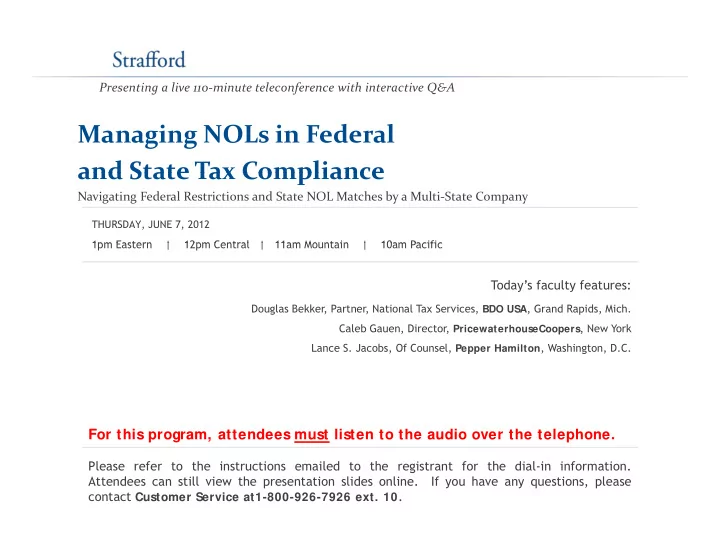
Presenting a live 110‐minute teleconference with interactive Q&A

Managing NOLs in Federal and State Tax Compliance and State Tax Compliance

Navigating Federal Restrictions and State NOL Matches by a Multi‐State Company

1pm Eastern | 12pm Central | 11am Mountain | 10am Pacific THURSDAY, JUNE 7, 2012

Today’s faculty features:

1pm Eastern | 12pm Central | 11am Mountain | 10am Pacific Douglas Bekker, Partner, National Tax Services, BDO USA, Grand Rapids, Mich. g , , , , p , Caleb Gauen, Director, PricewaterhouseCoopers, New York Lance S. Jacobs, Of Counsel, Pepper Hamilton, Washington, D.C.

For this program, attendees must listen to the audio over the telephone.

Please refer to the instructions emailed to the registrant for the dial-in information. Attendees can still view the presentation slides online. If you have any questions, please contact Customer Service at1-800-926-7926 ext. 10.

slide-2
SLIDE 2

Conference Materials

If you have not printed the conference materials for this program, please complete the following steps:

  • Click on the + sign next to “Conference Materials” in the middle of the left-

hand column on your screen hand column on your screen.

  • Click on the tab labeled “Handouts” that appears, and there you will see a

PDF of the slides for today's program.

  • Double click on the PDF and a separate page will open.

Double click on the PDF and a separate page will open.

  • Print the slides by clicking on the printer icon.
slide-3
SLIDE 3

Continuing Education Credits

FOR LIVE EVENT ONLY

Attendees must listen to the audio over the telephone. Attendees can still view

the presentation slides online but there is no online audio for this program.

Attendees must stay on the line for at least 100 minutes in order to qualify for

a full 2 credits of CPE. Attendance is monitored as required by NASBA. Please refer to the instructions emailed to the registrant for additional

  • information. If you have any questions, please contact Customer Service

at 1-800-926-7926 ext. 10. at 1 800 926 7926 ext. 10.

slide-4
SLIDE 4

Tips for Optimal Quality

S d Q lit S

  • und Qualit y

For this program, you must listen via the telephone by dialing 1-866-873-1442 and entering your PIN when prompted. There will be no sound over the web connection. co ect o . If you dialed in and have any difficulties during the call, press *0 for assistance. You may also send us a chat or e-mail sound@

straffordpub.com immediately so

we can address the problem.

Viewing Qualit y

To maximize your screen, press the F11 key on your keyboard. To exit full screen, press the F11 key again press the F11 key again.

slide-5
SLIDE 5

M i NOL i F d l d St t Managing NOLs in Federal and State Tax Compliance Seminar

June 7, 2012 Caleb Gauen, PricewaterhouseCoopers

caleb.gauen@ us.pwc.com

Douglas Bekker, BDO USA

dbekker@ bdo.com

Lance S. Jacobs, Pepper Hamilton

jacobsls@ pepperlaw.com

slide-6
SLIDE 6

Today’s Program

Federal NOL Treatment

[Douglas Bekker]

Slide 7 – Slide 24 State NOL Treatment

[Caleb Gauen]

Slide 25 – Slide 41 Special Situations At The State Level Involving NOLs

[Lance S . Jacobs]

Slide 42 – Slide 51

[Lance S . Jacobs]

slide-7
SLIDE 7

FEDERAL NOL TREATMENT

Douglas Bekker, BDO USA

FEDERAL NOL TREATMENT

slide-8
SLIDE 8

Agenda For This Section

Corporate/M&A Tax Training Series

Agenda For This Section

  • Computation of federal net operating loss
  • Computation of federal net operating loss
  • Limitations on carryforwards and carrybacks
  • Sect. 382
  • Latest developments

2012 Federal Net Operating Loss Update Page 8

slide-9
SLIDE 9

Federal Net Operating Loss (NOL)

Corporate/M&A Tax Training Series

Federal Net Operating Loss (NOL)

  • Corporate taxpayers – negative taxable income

­ Sect. 199 deduction cannot create or enlarge a NOL. ­ Charitable contributions cannot create an NOL.

  • Generally calculated on a consolidated basis, for consolidated

return filers

  • Separate computation must be done, for AMT purposes.

l h h h h h d d l

  • Flow-through entities: Loss passes through to the individual.

Individual NOL computation is more complex.

2012 Federal Net Operating Loss Update Page 9

slide-10
SLIDE 10

Federal NOL Carrybacks

Corporate/M&A Tax Training Series

And Carryforwards

  • NO’s must first be carried back 2 years.

­ Irrevocable election to forgo carryback period

  • Remaining NOL carried forward 20 years

Remaining NOL carried forward 20 years

  • Consolidated groups: Watch the SRLY rules

Separate return limitation year ­ Separate return limitation year ­ Can apply to limit ability to use loss carryforwards or carrybacks for entities joining or leaving the consolidated group

2012 Federal Net Operating Loss Update Page 10

slide-11
SLIDE 11

Federal NOL Carrybacks

Corporate/M&A Tax Training Series

And Carryforwards (Cont.)

  • AMT NOL follows the same carryback and carryforward rules.
  • Only 90% of current year AMTI can be offset by AMT NOL

carryforward or carryback

  • Special exception for any AMT NOL generated in Sect. 172(h)

election year election year

2012 Federal Net Operating Loss Update Page 11

slide-12
SLIDE 12

General Operation Of Sect 382

Corporate/M&A Tax Training Series

General Operation Of Sect. 382

  • Limitations apply following an “ownership change ”
  • Limitations apply following an ownership change.
  • Use of “pre-change” losses to offset “post-change” income subject to

l S t 382 li it ti annual Sect. 382 limitation

  • Limitations may also apply to recognized built-in losses.

2012 Federal Net Operating Loss Update Page 12

slide-13
SLIDE 13

General Policies Of Sect 382

Corporate/M&A Tax Training Series

General Policies Of Sect. 382

  • Anti trafficking rules
  • Anti-trafficking rules
  • Neutrality principle regarding use of capital
  • Purpose of acquisition is irrelevant.

2012 Federal Net Operating Loss Update Page 13

slide-14
SLIDE 14

Ownership Change Defined

Corporate/M&A Tax Training Series

Ownership Change Defined

  • An “ownership change” occurs on a testing date when the stock of the
  • An ownership change occurs on a testing date when the stock of the

loss corporation owned by one or more 5% shareholders increases by more than 50 percentage points during a testing period, when compared with the lowest ownership by each shareholder during that period.

2012 Federal Net Operating Loss Update Page 14

slide-15
SLIDE 15

5% Shareholders

Corporate/M&A Tax Training Series

5% Shareholders

  • An actual direct owner of at least 5% of loss corporation’s stock
  • An actual direct owner of at least 5% of loss corporation s stock
  • An indirect owner of at least 5% through higher-tier entities
  • Public group shareholders

­ Segregation rules can be complex. g g p ­ Cash issuance and small issuance exceptions

2012 Federal Net Operating Loss Update Page 15

slide-16
SLIDE 16

Testing Period

Corporate/M&A Tax Training Series

Testing Period

  • Generally consists of the three year period ending on a testing date
  • Generally consists of the three-year period ending on a testing date
  • Testing period does not begin before:

— Day after prior ownership change — First day of taxable year from which the corporation is carrying forward a net operating loss, net capital loss or other attribute

2012 Federal Net Operating Loss Update Page 16

slide-17
SLIDE 17

Testing Dates

Corporate/M&A Tax Training Series

Testing Dates

  • Acquisition or disposition of stock by a direct 5% owner
  • Acquisition or disposition of stock by a direct 5% owner
  • Acquisition or disposition of interests by an owner of higher-tier entity
  • Issuance of stock by a corporation
  • Redemption of stock
  • Recapitalization

2012 Federal Net Operating Loss Update Page 17

slide-18
SLIDE 18

Pre-Change Losses

Corporate/M&A Tax Training Series

Pre-Change Losses

  • Any net operating loss carried from a taxable year that ends before the
  • Any net operating loss carried from a taxable year that ends before the
  • wnership change

A ti f th t ti l f th t bl th t i l d

  • Any portion of the net operating loss for the taxable year that includes

the change date, to the extent attributable to the period preceding the change

2012 Federal Net Operating Loss Update Page 18

slide-19
SLIDE 19

Sect 382 Limitation

Corporate/M&A Tax Training Series

  • Sect. 382 Limitation
  • Value of the loss corporation’s stock immediately before the
  • Value of the loss corporation s stock, immediately before the
  • wnership change, multiplied by the long-term tax-exempt rate

L t t t t f J 2012 hi h i 3 26%

  • Long-term tax-exempt rate for June 2012 ownership changes is 3.26%.

2012 Federal Net Operating Loss Update Page 19

slide-20
SLIDE 20

Value Of Loss Corporation

Corporate/M&A Tax Training Series

Value Of Loss Corporation

  • Fair market value of all stock outstanding immediately before
  • Fair market value of all stock outstanding immediately before
  • wnership change

I l d ti l

  • Includes option value
  • May apply control premium to market capitalization
  • Capital contributions prior to change
  • Corporate contractions

2012 Federal Net Operating Loss Update Page 20

slide-21
SLIDE 21

Built-in Gains And Losses

Corporate/M&A Tax Training Series

Built-in Gains And Losses

  • Application of built-in gain and loss rules can be helpful or

harmful harmful. — If a loss corporation has a net unrealized built-in gain (NUBIG), a recognized built-in gain (RBIG) will enhance the annual Sect. 382 limitation 382 limitation. — If a loss corporation has a net unrealized built-in loss (NUBIL), a recognized built-in loss (RBIL) will be subject to the annual

  • Sect. 382 limitation.
  • Appraisal methodologies generally applied

2012 Federal Net Operating Loss Update Page 21

slide-22
SLIDE 22

Special Sect 382 Problems

Corporate/M&A Tax Training Series

Special Sect. 382 Problems

  • Multiple ownership changes
  • Multiple ownership changes
  • Foreign parent companies
  • Unclear or ambiguous SEC filings on schedules 13D and 13G

2012 Federal Net Operating Loss Update Page 22

slide-23
SLIDE 23

Recent Developments: Notice 2010-50

Corporate/M&A Tax Training Series

Recent Developments: Notice 2010-50

  • Sect 382 ownership measured by value
  • Sect. 382 ownership measured by value
  • Changes in percentage attributable to fluctuations in value are not

taken into account taken into account.

  • Difficult to measure
  • Notice 2010-50 is first guidance on this issue.

­ Full-value methodology Hold constant principal ­ Hold constant principal

2012 Federal Net Operating Loss Update Page 23

slide-24
SLIDE 24

Recent Developments: Sect 382

Corporate/M&A Tax Training Series

Recent Developments: Sect. 382 Proposed Regulations

  • Simplify, somewhat, the segregation rules for small shareholders
  • Sales by existing 5% shareholders to smaller shareholders
  • Redemptions
  • Look-through rules

2012 Federal Net Operating Loss Update Page 24

slide-25
SLIDE 25

STATE NOL TREATMENT

Caleb Gauen, PricewaterhouseCoopers

STATE NOL TREATMENT

slide-26
SLIDE 26

S NOL O li State NOLs: Outline

State NOL treatment varies from state to state – Issues that arise:

  • Nexus requirements to use net operating losses
  • Varying carryback and carryforward periods

a y g ca ybac a d ca y o a d pe ods

  • Statutory limitations on net operating loss deductions
  • NOL suspensions
  • Combined reporting

26

slide-27
SLIDE 27

N R i Nexus Requirements

  • Maryland
  • Taxpayer may only use a NOL if the NOL was

generated in a year that corporation was subject to MD i (R §03 04 03 07 A(5))

Some states require that a

MD income tax (Reg. §03.04.03.07.A(5)).

  • Arizona
  • Sesek & Associates, LTD v. Arizona Dept of Revenue

(2004): Taxpayer was not allowed to use an NOL d d ti b l i d

corporate taxpayer have nexus in the

carryover deduction, because losses were incurred prior to the taxpayer doing business in AZ .

  • New York
  • No deduction is allowed for a loss sustained in a

i hi h th ti t bj t t

nexus in the state the year the NOL

year in which the corporation was not subject to franchise tax (N.Y. Tax Law §208(9)(f)).

the NOL arises

27

slide-28
SLIDE 28

Carryback And Carryforward Periods

I. Carrybacks A. A majority of states do not allow carrybacks B. Federal legislation for enhanced carrybacks 1. Recovery and Reinvestment Act of 2009 (Pub. L. No. 111-5) a. Allows eligible small businesses to elect up to a 5-year carryback for an NOL sustained in tax year 2008; can elect 3-, 4- or 5-year carryback 2. Worker, Homeownership, and Business Assistance Act of 2009 (Pub. L.

  • No. 111-92)

a. Any taxpayer may elect to carry back an NOL arising in 2008 or 2009 but not both for 3 4 or 5 years 2009, but not both, for 3, 4 or 5 years. 3. Most states have decoupled from both of these federal provisions. II. Carryforwards A. Just over half of the states follow the federal 20-year carryforward. B. Carryforward periods range from 5 years to 7, 10, 12 or 15 years.

28

slide-29
SLIDE 29

More Carryback And Carryforward Issues

I. Short taxable years and carryback periods A. “Taxable year” means the period for which the return is made (IRC §441(b)(3)). B. A short year for which a return is made is treated as a taxable year, for y y , purposes of determining the carryback or carryover period for an NOL (Reg. §1.172-4(a)(2)). C. Example: Company Z files the following tax returns: TYE 12/31/2009 TYE 6/30/2010 TYE 6/30/2010 TYE 12/31/2010 In TYE 12/31/2011, Company Z generates a loss and carries it back for t t bl C Z ill b k t TYE 6/30/2010 d two taxable years. Company Z will carry back to TYE 6/30/2010 and 12/31/2010.

29

slide-30
SLIDE 30

Li i i NOL D ll C Limitations: NOL Dollar Caps

Illinois

  • For tax years ending

12/31/2012 and prior to Pennsylvania

  • Net loss deductions are

limited to the greater of $3 12/31/2012 and prior to 12/31/2014, C corporations are limited to a carryover deduction of $100,000 per limited to the greater of $3 million or 20% of Pennsylvania taxable income (72 PS § 7401(3)4(c)(1)). deduction of $100,000 per taxable year (35 ILCS 5/207(d)). (72 PS § 7401(3)4(c)(1)).

  • Pennsylvania net loss

carryover rules do not apply to capital losses, but rather p

  • nly to business and non‐

business losses arising from the operation of trade or b i business.

30

slide-31
SLIDE 31

Other Statutory Limitations O NOL D d i On NOL Deductions

I. Maryland – Net addit ion modificat ion (NAM) addback y

f ( )

A. The mechanics of the NAM addback (Admin. Release No. 18, Maryland Comptroller of the Treasury (Sept. 1, 2010); MD Code Sec. §10-205(e)) § ( )) 1. To arrive at MD taxable income, start with federal taxable income after NOL and make certain additions and subtractions. 2 When the addition modifications EXCEED subtraction 2. When the addition modifications EXCEED subtraction modifications in the year an NOL is generated, taxpayer must add back the NAM as the NOL is utilized. 3 Taxpayer only begins to add back the NAM as a modification on 3. Taxpayer only begins to add back the NAM as a modification on the MD return when the NAM + the cumulative associated NOL deductions already claimed in prior and current years EXCEED the total NOL. B. See example on next slide

31

slide-32
SLIDE 32

M l d NAM Addb k E l Maryland NAM Addback: Example

I Facts I. Facts A. In 1996, Corp. Z generated a federal NOL of ($1,000,000) and has MD NAM of $500,000 (i.e., additions exceed subtractions by $500,000) B In 1998 Z takes an NOL deduction of $800 000 B. In 1998, Z takes an NOL deduction of $800,000 II. Application A. 1996 and 1997: No modifications B. 1998: Begin to recapture the NAM – why? 1. NAM: $500,000 + 2. NOL deduction claimed: $800,000 = , 3. $1,300,000 > total NOL of $1,000,000 C. Then what? 1 Th $300 000 i dd d b k th 1998 MD t Li 1. The $300,000 excess is added back on the 1998 MD return on Line 2c, in order to arrive at MD taxable income.

32

slide-33
SLIDE 33

Other Statutory Limitations On NOL D d i (C ) NOL Deductions (Cont.)

I. New Jersey - NOL applied prior t o dividends-received deduct ion A. Rule: An NOL is generated in NJ when a taxpayer’s deductions exceed gross income – before the application of the dividends-received deduction (DRD) (NJ Stat. Ann. § 54:10A-4(k)(6)). B. Taxpayer receives the following deductions if it receives dividends from a subsidiary: 1. 100% dividend deduction if it owns 80% or more of the subsidiary 2. 50% dividend deduction if it owns more than 50% and less than 80% II. Example A. W Corp. has a federal loss of (R$100,000) and gets a dividend from a p ( $ , ) g wholly-owned subsidiary of $50,000. A. After application of the DRD, W Corp. has a federal NOL of ($100,000). B. NJ wrinkle: W Corp’s NOL is reduced to ($50,000), because the NOL is calculated before the dividend-received deduction.

33

slide-34
SLIDE 34

NOL S i NOL Suspensions

Illi i

  • For tax years ending 1/1/2011 and prior to 12/31/2012, C corporations are

suspended from using net loss deductions (35 ILCS 5/207(d)).

  • Relief
  • Years that are fully suspended or years in which the deduction would exceed

$100 000 are not counted as taxable years for purposes of the 12‐year

Illinois

$100,000 are not counted as taxable years, for purposes of the 12‐year carryover period.

  • Various suspensions: 2002‐2003 and 2008‐2011
  • 2008‐2011 suspension: Limited to corporate taxpayers with more than

$300,000 of pre‐apportioned income (Cal. Rev. & Tax Code §24416.21(e)(1)).

  • Relief

E d d f d i d f d d NOL d d i b d h

California

  • Extended carryforward period for suspended NOL deductions based on the

taxable year of the NOL (Cal. Rev. & Tax Code § 22416.21(b))

34

slide-35
SLIDE 35

C bi d R i Combined Reporting

I. Intra-stating mechanics II I ti / ti l t bi d

  • II. Importing/exporting losses to combined groups

III Separate return limitation year (SRLY)

  • III. Separate return limitation year (SRLY)
  • IV. Transition from separate to combined reporting regimes
  • IV. Transition from separate to combined reporting regimes

35

slide-36
SLIDE 36

Combined Reporting: Intra‐Stating ‐ CA

I. Intra-stating: Members of a unitary group may combine taxable income and losses, but must compute the NOL

carryforward on a separate basis using intrastate apportionment/ II. Year 1 A. A, B and C part of a combined group – taxable income (loss) as follows: 1. A – (100); B – 100; C – (50) = total loss (50) ( ); ; ( ) ( ) B. Year 1 apportionment % as follows: 1. A – 0%; B – 100%; C – 0% C. B is apportioned the (50) loss for Year 1 2 III. Year 2 A. Taxable income (loss) as follows: 1. A – (100); B – (100); C – 300 = total income $100 B. Year 2 apportionment % as follows: 1. A – 0%; B – 0%; C – 100% C. C is apportioned the income of $100 for Year 2. 1. C cannot use the (50) NOL from Year 1, because it was apportioned to B. 2 The (50) loss from Year 1 is trapped with B 2. The (50) loss from Year 1 is trapped with B. 3. If B leaves the group, then the NOL is lost to the group. 36

slide-37
SLIDE 37

Importing/Exporting Losses From A C bi d G NY A Combined Group ‐ NY

I. Combined group and nexus I. A combined group cannot deduct an NOL incurred by a member during a taxable year in which the corporation was not a member of the combined return group and was not subject to NY franchise tax (N.Y .

  • Reg. §3-8.2(b)).

II. Example I. X Corp., a NY taxpayer, incurred a $1 million NOL in 1996. II. Y Corp., a non-NY taxpayer, incurred a $1 million NOL in 1996.

  • III. In 1997, X & Y became part of a NY combined return.

III Issue

  • III. Issue

I. In 1997, combined group has $2 million NY taxable income but can only take $1 million of NOL (the loss generated by Y). II X C t f d it $1 illi f d l NOL t th g II. X Corp. cannot carryforward its $1 million federal NOL to the group, because X was not subject to NY tax when the NOL was incurred.

37

slide-38
SLIDE 38

E i i A C bi d G NY Exiting A Combined Group –NY

Aggregation method Aggregation method

  • In NY, a combined group’s net operating losses are allocated to members that generated losses based
  • n a ratio (NY Reg. §3‐8.7(b)).
  • Ratio = NOL generated by a particular member/NOL generated by all members with losses

Example

  • W Corp.: 7,500 income
  • X Corp.: (10,000) loss
  • Y Corp : (20 000) loss
  • Y Corp.: (20,000) loss
  • Combined loss = (22,500)
  • NOL allocated to X = 10,000/30,000 = (5,000)

The issue

  • If X leaves the group, it takes the (5,000) with it, and that portion of the NOL is lost to the group

forever.

38

slide-39
SLIDE 39

C bi d R i A d SRLY Combined Reporting And SRLY

I. IRC §382: Limits the utilization of the NOL in a ownership change II. SRLY rules: Limit use of an NOL by affiliated group generated by member in a separate return year A. A SRLY-NOL can only be used to the extent of that member’s taxable income in that group group.

III. Basic operat ion of t he S RLY rules (federal income taxation of corporations filing

consolidated returns, §42.02, separate return limitation year): A. P is the common parent of a consolidated group. At the close of Year 1, P buys all of A. P is the common parent of a consolidated group. At the close of Year 1, P buys all of the stock of S, and S joins the P consolidated group beginning in Year 2. S carries a $50 NOL from its separate return Year 1. The P group's consolidated taxable income for Year 2 is $200, before any consolidated NOL deduction. The consolidated taxable income would be $30 if determined solely by reference to S' items of $ y y income, gain, deduction and loss for Year 2. 1. If no SRLY limitation applied: All of S’ $50 NOL carryover would be included as part of the consolidated group NOL deduction for Year 2. 2. If SRLY limitation applies to the P group: Only $30 of S’ NOL carryover from Year 1 may be included in the deduction for Year 2.

39

slide-40
SLIDE 40

SRLY A d S C f i SRLY And State Conformity

I. States that allow combined reporting typically follow SRLY rules in limiting NOL deductions A. SRLY rules limit the NOL deductions of corporations that join a state consolidated return. 1. Losses carried over from a member’s separate return year may only be used to

  • ffset the portion of combined income attributable to the member that generated

that loss. II. States have adopted their own separate SRLY-type limitations A. New York 1. NY regulations provide that the portion of a combined NOL attributable to a ti th t fil d t t f di di t bl corporation that filed a separate return for a preceding or succeeding taxable year will be an amount bearing the same relation to the combined loss as the NOL of such corporation bears to the total NOL of all members of the group having such losses, to the extent that they are taken into account in computing the combined NOL (N.Y . Comp. Codes R. & Regs. tit. 20 §3-8.7(b)). NOL (N.Y . Comp. Codes R. & Regs. tit. 20 §3 8.7(b)). B. Arizona 1. NOLs incurred by a separate company may be carried forward and deducted against income reported on a combined return only to the extent that the combined income f th i l t d t th “b i it” th t i d th l (A i Ad i

  • f the group is related to the “business unit” that incurred the loss (Ariz. Admin.

Code R 15-2D-302(B)(3)(a)).

40

slide-41
SLIDE 41

Combined Reporting And Law Changes

I. District of Columbia A. Proposed regulations to implement mandatory unitary combined reporting for taxable years beginning on or after Jan. 1, 2011 (DC Office

  • f Tax and Revenue, Not ice of Proposed Rulemaking, Combined

Report ing: Net Operat ing Loss §165)

B. Proposed regulations and their effect on NOLs 1. NOLs are attributable to the taxable member rather than to the combined group. 2. Pre- and post-combination net operating losses a. Losses carried into the unitary group from before 2011 track y g p the entity that earned the loss b. Any apportioned net operating loss is an attribute of the separate corporation, rather than of the combined group. c. May only be utilized by the entity that generated the NOL on a separate entity basis

41

slide-42
SLIDE 42

SPECIAL SITUATIONS AT THE

Lance S. Jacobs, Pepper Hamilton

STATE LEVEL INVOLVING NOLs

slide-43
SLIDE 43

NOLs Post-Apportionment Vs. Pre Apportionment Pre-Apportionment

43

CONFIDENTIAL - FOR NEGOTIATION AND SETTLEMENT PURPOSES ONLY

slide-44
SLIDE 44

NOLs Post-Apportionment

  • Vs. Pre-Apportionment

P t A ti t Post-Apportionment

  • Some states require that an NOL be carried back or forward from the loss year, after allocation

and apportionment. These states also provide that the NOL deduction should be applied in the b k d f d ft ll ti d ti t carryback and carryforward year, after allocation and apportionment.

  • As a result, only the loss attributable from a post-apportionment state can be carried back or

forward against income from that post-apportionment state.

  • Example:
  • 2011
  • A company does 50% of its business in New Hampshire at all times in 2011.

Th l $500 000

  • The company loses $500,000.
  • $250,000 of the loss is apportioned to New Hampshire.
  • Thus, $250,000 is available for New Hampshire NOL purposes.
  • 2012

Th d 75% f it b i i N H hi t ll ti i 2012

  • The company does 75% of its business in New Hampshire at all times in 2012.
  • The company earns $1,000,000.
  • $750,000 is apportioned to New Hampshire.
  • The $250,000 NOL from 2011 reduces New Hampshire income.

Th th i $500 000 f N H hi i

44

CONFIDENTIAL - FOR NEGOTIATION AND SETTLEMENT PURPOSES ONLY

  • Thus, there is $500,000 of New Hampshire income.
slide-45
SLIDE 45

NOLs Post-Apportionment Vs. Pre-Apportionment (Cont.)

Pre-Apportionment

  • Some states allow the NOL computation to be made before apportionment and permit

the deduction to be applied in the carryback and carryforward year, before the deduction to be applied in the carryback and carryforward year, before apportionment.

  • As a result, there are more potential planning opportunities related to the utilization of

NOL i ti t t t NOLs in pre-apportionment states.

  • Example:
  • 2011
  • A company does 50% of its business in Virginia at all times in 2011.
  • The company loses $500,000.
  • Thus, $500,000 is available for NOL purposes.
  • 2012
  • 2012
  • The company does 75% of its business in Virginia at all times in 2012.
  • The company earns $1,000,000.
  • The $500,000 NOL from 2011 reduces the 2012 income to $500,000.

45

CONFIDENTIAL - FOR NEGOTIATION AND SETTLEMENT PURPOSES ONLY

  • $375,000 (i.e., 75% * $500,000) of the income is apportioned to Virginia.
slide-46
SLIDE 46

Issues Arising From Nexus Standards

46

CONFIDENTIAL - FOR NEGOTIATION AND SETTLEMENT PURPOSES ONLY

slide-47
SLIDE 47

Issues Arising From Nexus Standards

  • Nexus
  • Most states require a taxpayer to have nexus with a state in the year a loss is generated, in order to

carry over that loss to a subsequent year. y q y

  • For post-apportionment states, this requirement is implicit, because a loss cannot be apportioned to a

state unless the taxpayer has nexus with that state.

  • Same tax

Some states like New York require nexus and that the taxpayer be subject to the same state tax in both

  • Some states, like New York, require nexus and that the taxpayer be subject to the same state tax in both

the loss year and the carryover year, in order to claim an NOL.

  • Accordingly, if a corporation is subject to Article 32 (bank franchise tax based on income) in 2011 when it

has a loss but is only subject to Article 9-A (corporate franchise tax on income) in 2012 when it has gain, then the corporation cannot utilize the NOL from 2011 in 2012.

  • No nexus
  • Some states, like Virginia, do not have their own NOL provisions (they rely on the federal NOL

provisions) and have no nexus requirements for claiming an NOL. Accordingly, taxpayers in those states can “import” NOLs from non-nexus years can import NOLs from non-nexus years.

  • Va. Tax Comm’r Ruling P.D. 09-108 (June 24, 2009)
  • The Virginia tax commissioner permitted a taxpayer that incurred NOLs in separate return years

before the taxpayer became taxable in Virginia to carry forward and utilize those NOLs in subsequent consolidated return years, during which the taxpayer was taxable in Virginia. 47

CONFIDENTIAL - FOR NEGOTIATION AND SETTLEMENT PURPOSES ONLY

slide-48
SLIDE 48

State NOL Rights In Corporate Mergers And Acquisitions Mergers And Acquisitions

48

CONFIDENTIAL - FOR NEGOTIATION AND SETTLEMENT PURPOSES ONLY

slide-49
SLIDE 49

State NOL Rights In Corporate Mergers And Acquisitions

C f it T IRC S ti 381 A d 382 Conformity To IRC Sections 381 And 382 IRC Sect. 381

  • Generally, IRC Sect. 381 provides for the survival of NOL carryovers in connection with tax-free liquidations and

certain qualifying reorganizations.

  • Similar state rules

Many states allow an acquiring corporation to use pre-acquisition NOLs, in a manner similar to IRC Sect. 381.

  • Express and implied conformity

Several states either expressly adopt IRC Sect. 381 or implicitly adopt it because they do not provide an express variance from federal law. Thus, in these states, an acquiring corporation can only use pre-acquisition NOLs carried over to the extent permitted by IRC Sect. 381.

  • Silent
  • Several states permit a corporation to apply NOLs carried over against the income from another year, but they

do not provide a mechanism for the movement of the NOLs.

  • A literal interpretation of the statutes would deny an acquiring corporation from using the pre-acquisition NOLs

that are carried over. As a result, courts and tax administrators have struggled over how to interpret them.

  • Some of these states permit NOLs to be carried over after an acquisition, in certain circumstances:
  • A merger to reincorporate a corporation into another state (e.g., Massachusetts)
  • Where the surviving corporation is substantially the same as the pre-merger corporation (e.g., North

Carolina).

  • Some of these states (e.g., Connecticut, New Jersey, Utah, Tennessee) expressly prohibit NOLs from being

49

CONFIDENTIAL - FOR NEGOTIATION AND SETTLEMENT PURPOSES ONLY

carried over after an acquisition, because they require that an NOL be used only by the corporation that creates the NOL.

slide-50
SLIDE 50

State NOL Rights In Corporate Mergers And Acquisitions (Cont.)

C f it T IRC S ti 381 A d 382 (C t ) Conformity To IRC Sections 381 And 382 (Cont.) IRC Sect. 382

  • Generally, if a corporation has more than a 50-percentage=point change in ownership, then IRC Sect. 382

limits the amount of net operating losses that it may carry over to post-change years. p g y y p g y

  • Conformity
  • Most states that have adopted IRC Sect. 381 have also, either expressly or implicitly, adopted
  • Sect. 382.

A few states apply the IRC Sect 382 in a modified manner

  • A few states apply the IRC Sect. 382 in a modified manner.
  • Georgia and Pennsylvania: The IRC Sect. 382 limitation is applied on a separate company basis,

even when a consolidated federal income tax return is filed.

  • States that do not conform
  • Illinois: Illinois expressly states that no limitation under IRC Sect. 382 shall apply to an Illinois NOL or

credit.

  • New Jersey: Generally, an acquired corporation’s NOLs are lost if there is a 50% or more ownership

change, and the acquired corporation changes the business that gave rise to the loss.

  • Therefore so long as the acquired corporation maintains its business that generated the loss an

Therefore, so long as the acquired corporation maintains its business that generated the loss, an IRC Sect. 382-type limitation will not apply, regardless of the amount of the ownership change.

  • Difficulties applying IRC Sect. 382
  • The value of a consolidated group must be allocated to each subsidiary, in order to determine each

’ C S 382 50

CONFIDENTIAL - FOR NEGOTIATION AND SETTLEMENT PURPOSES ONLY

subsidiary’s separate IRC Sect. 382 limit.

  • Each member of a group must be examined to determine whether it has a NUBIL/NUBIG.
slide-51
SLIDE 51

State NOL Rights In Corporate Mergers And Acquisitions (Cont.)

SRLY R l SRLY Rules

  • Generally, for federal tax purposes, an NOL from a separate return loss year can only be used by a

consolidated group to the extent the loss-generating member has income.

  • Conformity
  • In states where the SRLY rules are adopted, an NOL from a separate return loss year may only be

p , p y y y utilized by a group filing a unitary or consolidated tax return to the extent the loss generating member has income.

  • Special cases
  • Some states have adopted SRLY type rules that are, in fact ,unique to the state.
  • Nebraska for example requires that NOL carry forwards not exceed the apportionable income of
  • Nebraska, for example, requires that NOL carry forwards not exceed the apportionable income of

the unitary group, multiplied by a fraction (the numerator of which is the Nebraska gross receipts of the corporation, and the denominator is the gross receipts of the unitary group).

  • Virginia (Virginia Public Document Ruling No. 09-126, 08/07/2009)
  • Virginia has implicitly adopted the SRLY rules. However, in 2009, the commissioner of the Virginia

Department of Taxation ruled that the post-acquisition NOL generated by an acquired company would not be subject to the SRLY limitation in determining the amounts available for carry forward to a Virginia consolidated return, because the acquired company satisfied the ownership requirements to be a member of the parent company's group, even though no other member of the group had Virginia nexus that year group had Virginia nexus that year.

  • In addition, the Virginia Department of Taxation ruled that the NOL generated by the parent

company during the acquisition year or prior would not be subject to the SRLY limitation in determining the amounts available for carry forward to a Virginia consolidated return, because the SRLY limitation only applies to a corporation that has had an ownership change. 51

CONFIDENTIAL - FOR NEGOTIATION AND SETTLEMENT PURPOSES ONLY