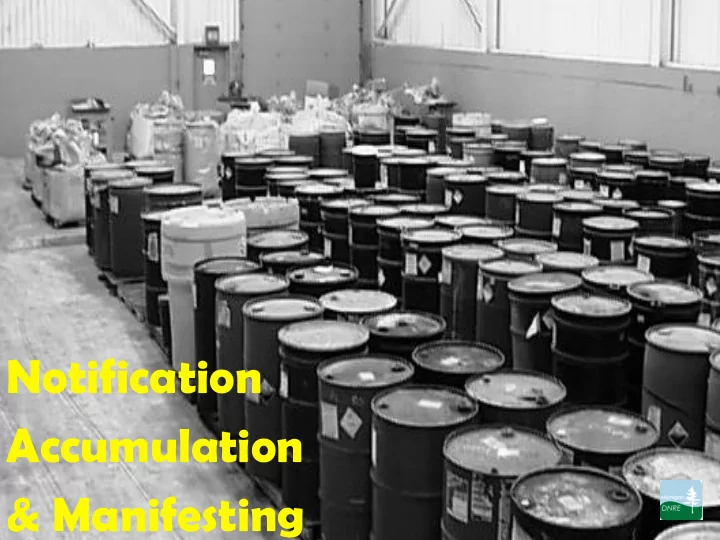
Notification Accumulation & Manifesting 1 Michigan - - PowerPoint PPT Presentation

notification accumulation manifesting
SMART_READER_LITE
LIVE PREVIEW

Notification Accumulation & Manifesting 1 Michigan - - PowerPoint PPT Presentation

Notification Accumulation & Manifesting 1 Michigan Environmental Michigan Environmental Compliance Conference Compliance Conference Christine Grossman Christine Grossman Compliance Assistance Specialist Compliance Assistance


slide-1
SLIDE 1

1

Notification Accumulation & Manifesting

slide-2
SLIDE 2

2

Michigan Environmental Michigan Environmental Compliance Conference Compliance Conference

Christine Grossman Christine Grossman Compliance Assistance Specialist Compliance Assistance Specialist Waste Regulations Waste Regulations grossmanc@michigan.gov grossmanc@michigan.gov 517-373-0590 517-373-0590

slide-3
SLIDE 3

3

Environmental Assistance Center Environmental Assistance Center

(EAC) (EAC)

Phone: Phone:

1-800-NO2-WASTE 1-800-NO2-WASTE

(1-800-662-9278) Hours: Hours: 8:00 a.m. to 5:00 p.m. Monday through Friday Technical Assistance Services Include: Technical Assistance Services Include: Air Shoreline Development Waste Brownfield Redevelopment Water Site Remediation Wetlands Storage Tanks

slide-4
SLIDE 4

4

Waste Session 2 Waste Session 2

Notification Accumulation Manifesting

Generator Requirements for:

slide-5
SLIDE 5

5

Notification Notification

Site (EPA) Site (EPA) Identification Number Identification Number

slide-6
SLIDE 6

6

Notification of Notification of Regulated Waste Activity Regulated Waste Activity

(Rule 303 and Section 12103) (Rule 303 and Section 12103)

Requires submittal of completed Site

Identification Form (EQP 5150)

slide-7
SLIDE 7

7

Requires payment of a $50 user charge for

new/initial or subsequent/updated

  • wner/operator notifications

Notifies DNRE & EPA of:

site owner/operator

site contact site waste activity

Notification of Notification of Regulated Waste Activity Regulated Waste Activity

(Rule 303 and Section 12103) (Rule 303 and Section 12103)

slide-8
SLIDE 8

8

Results in issuance of a Site (aka. EPA)

Site (aka. EPA) Identification Number Identification Number

Submittal of Site Identification Form

required for:

SQGs & LQGs

SQGs & LQGs

CESQGs manifesting LIW;

CESQGs manifesting LIW;

transportation of hazardous waste and/or LIW

transportation of hazardous waste and/or LIW

used oil collection & processing

used oil collection & processing

large quantity universal waste handlers

large quantity universal waste handlers

generators of

generators of ≥100 PPM PCB wastes 100 PPM PCB wastes

Notification of Notification of Regulated Waste Activity Regulated Waste Activity

(Rule 303 and Section 12103) (Rule 303 and Section 12103)

slide-9
SLIDE 9

9

Subsequent/updated notification filed for

changes in site waste activity (e.g. change is generator classification/status)

Request pre-populated Site Identification

Form for subsequent/updated notifications from Lansing Manifest Unit at 517-335-2690

Notification of Notification of Regulated Waste Activity Regulated Waste Activity

(Rule 303 and Section 12103) (Rule 303 and Section 12103)

slide-10
SLIDE 10

10

Expedite form processing by faxing

notification & paying on-line with credit card

Liquid industrial waste generators who

are not required to manifest wastes are not required to notify

Notification of Notification of Regulated Waste Activity Regulated Waste Activity

(Rule 303 and Section 12103) (Rule 303 and Section 12103)

slide-11
SLIDE 11

11

Accumulation Accumulation

slide-12
SLIDE 12

12

Characterize wastes and maintain records for

3 years from last off-site shipment or on-site treatment and/or disposal

Obtain and utilize Site ID Number if LQG, SQG,

  • r CESQG manifesting waste for disposal

Keep records of all hazardous waste generated,

treated and/or disposed on-site

Keep records of HW generated monthly to verify

generator status/classification

Accumulation Requirements Accumulation Requirements for All Generators for All Generators

(Satellite, CESQG, SQG, and LQG) (Satellite, CESQG, SQG, and LQG)

slide-13
SLIDE 13

13

Container or tank accumulation only Containers/tanks must be compatible with the

wastes, closed, and in good condition

Protect waste from weather, physical damage,

fire, and vandals

Accumulation conducted to prevent escape of

wastes/waste constituents to air, water, sewers

  • r the ground

Accumulation Requirements Accumulation Requirements for All Generators for All Generators

(Satellite, CESQG, SQG, and LQG) (Satellite, CESQG, SQG, and LQG)

slide-14
SLIDE 14

14

Containers must be in good condition and Containers must be in good condition and compatible with the waste compatible with the waste

slide-15
SLIDE 15

15

Drums must be Drums must be compatible with compatible with the waste! the waste! Excessive Excessive corrosion corrosion and rust and rust

Note Note corrosive corrosive label label

slide-16
SLIDE 16

16

Incompatible corrosives in leaking steel drums

Note Note corrosive corrosive label label

slide-17
SLIDE 17

17

Excessive rust Excessive rust

slide-18
SLIDE 18

18

Excessive Excessive pressure pressure

Danger!! Danger!!

slide-19
SLIDE 19

19

Dents, broken Dents, broken seams, etc. seams, etc.

slide-20
SLIDE 20

20

Containers cannot be exposed to Containers cannot be exposed to weather or vandals weather or vandals

slide-21
SLIDE 21

21

Compromised fencing provides access to Compromised fencing provides access to vandals vandals

slide-22
SLIDE 22

22

Containers cannot be exposed to Containers cannot be exposed to weather or vandals weather or vandals

Good labeling Good labeling Good containers Good containers Closed containers Closed containers No weather protection No weather protection Accessible to vandals Accessible to vandals No containment No containment

slide-23
SLIDE 23

23

Container must be stored to prevent physical damage

Unsafe pallets Unsafe pallets Stacked too high Stacked too high Inadequate aisle space Inadequate aisle space

slide-24
SLIDE 24

24

Drums must be stored closed! Drums must be stored closed! (solids and liquids) (solids and liquids)

slide-25
SLIDE 25

25

Best option is to close containers manually! Best option is to close containers manually!

slide-26
SLIDE 26

26

Drum bung in place Drum bung in place

slide-27
SLIDE 27

27

Funnels must allow for closure of the container Funnels must allow for closure of the container to prevent emissions and spillage to prevent emissions and spillage

Notice the Notice the splashing on splashing on wall wall

slide-28
SLIDE 28

28

Bung is Bung is replaced replaced Funnel is Funnel is removed removed

slide-29
SLIDE 29

29

Notice the Notice the valve? valve? If kept closed it If kept closed it would be OK would be OK

slide-30
SLIDE 30

30

Lidded funnel Lidded funnel Ball valve must Ball valve must be cl be closed

  • sed
slide-31
SLIDE 31

31

Accumulation must pre revent the escape of waste to the enviro ronment

slide-32
SLIDE 32

32

Records required to be maintained for 3 years to verify the CESQG exemption:

Waste characterizations Monthly waste volumes (show generate

< 220 lbs per month)

Manifests and/or disposal receipts/logs

showing proper disposal of CESQG wastes under Parts 31, 121, 115

CESQG Exemption Records CESQG Exemption Records

(Section 11138 & Rules 205, 302 & 307) (Section 11138 & Rules 205, 302 & 307)

See DNRE Publication Center CESQG G Guidance ce

slide-33
SLIDE 33

33

CESQG Exemption Requirements CESQG Exemption Requirements (0 - (0 - < 220 lbs/mo) 220 lbs/mo)

Must get Site/EPA ID number to manifest

liquids, solids exempt

Must generate < 220 lbs/mo No accumulation time limit Maximum volume < 2200 lbs CESQG’s ≥ 2200 lbs are SQG No user fees

DO O NOT OT EXCEED!!

slide-34
SLIDE 34

34

Licensed Hazardous Waste Facility Licensed Solid Waste Facility (solids

  • nly, no liquids)

Facility that will recycle or arrange for

recycling

Off-site or on-site WWTP if in

compliance with pre-treatment rules

CESQG Disposal Options CESQG Disposal Options (0 - (0 - < 220 lbs/mo) 220 lbs/mo)

slide-35
SLIDE 35

35

Additional SQG & LQG Additional SQG & LQG Accumulation Requirements Accumulation Requirements

Date and Label Containers 90/180 day accumulation limit (LQG/SQG) (LQG/SQG) Subpart AA, BB, CC (LQG) (LQG) Provide secondary containment (LQG/SQG > 2200 lbs) (LQG/SQG > 2200 lbs) Provide proper training Prepare emergency response plans Conduct frequent inspections Use licensed hazardous waste disposal sites Follow preparedness and prevention rules File a Biennial Report every 2 years (LQG) (LQG) See DNRE Publication See DNRE Publication Center SQG Center SQG Guidanc Guidance

slide-36
SLIDE 36

36

Hazardous Waste Hazardous Waste Accumulation Label Accumulation Label

slide-37
SLIDE 37

37

Date by day, not month (mm/dd/year)

slide-38
SLIDE 38

38

Hazardous Waste Hazardous Waste Shipping Label Shipping Label

slide-39
SLIDE 39

39

Hazardous Hazardous Waste Shipping Waste Shipping Labels Labels

slide-40
SLIDE 40

40

Satellite Satellite Containers

  • ntainers

(Rule 306(2)) (Rule 306(2))

Container must be at, or

near, point of generation and under operator control

Label at start of filling

with “HAZARDOUS WASTE” AND waste code number OR chemical name

Label when filled or total volume exceeds

55 gallons (1 quart for acute wastes) with accumulation date

slide-41
SLIDE 41

41

Move container

to accumulation area within 3 days of accumulation date

Satellite Satellite Containers

  • ntainers

(Rule 306(2)) (Rule 306(2))

Fill date = accumulation date See Op Memo 111-2 for more information

slide-42
SLIDE 42

42

Satellite Satellite Label Example abel Example

slide-43
SLIDE 43

43

Secondary Containment Secondary Containment

Containers:

Containers: 100% of the largest container OR 10% of the total volume stored, whichever is greater (free liquids)

Tanks:

Tanks: 100% of the largest tank PLUS an amount greater than or equal to a 25 year 24 hour rainfall event (if located outside)

See DNRE E Publication Center Guide to Secondary ry Containment

slide-44
SLIDE 44

44

Container Containment Construction:

Container Containment Construction: LIQUIDS - Base free of cracks, impervious coating, sealed joints, with base sloped or elevated containers and adequate squirt protection; SOLIDS - sloped area and elevated containers

Prevent run-on and remove spills/leaks/rain in

timely manner

Required of all LQGs Required of SQGs & CESQG storing > 2200

lbs

Secondary Containment Secondary Containment

slide-45
SLIDE 45

45

Lacking or Lacking or inadequate inadequate resistant coating resistant coating & cracked & cracked surfaces surfaces

= non-compliant non-compliant

slide-46
SLIDE 46

46

Poor joint seals or no Poor joint seals or no coatings can cause coatings can cause major problems! major problems!

slide-47
SLIDE 47

47

Non-functional containment containment

slide-48
SLIDE 48

48

Fabricated sides Fabricated sides

slide-49
SLIDE 49

49

Sloping ramp saves Sloping ramp saves backs and reduces backs and reduces spills when moving spills when moving materials in & out of materials in & out of containment area containment area Spill pallets OK for Spill pallets OK for solids or single solids or single containers, but do containers, but do NOT NOT provide squirt provide squirt protection for liquids protection for liquids

slide-50
SLIDE 50

50

Accumulation area must have adequate space

  • r aisle width to properly inspect containers and

for access by emergency personnel

All labels must be visible for inspections

Good Good aisle aisle space space

slide-51
SLIDE 51

51

Precipitation must be removed in a Precipitation must be removed in a timely manner from containment timely manner from containment areas areas

How can drums be checked for leaks if buried in snow? How can drums be checked for leaks if buried in snow?

slide-52
SLIDE 52

52

Don’t stack more than 2 drums high Don’t stack more than 2 drums high

Leaning drum is Leaning drum is a safety issue! a safety issue!

slide-53
SLIDE 53

53

Good containment and weather Good containment and weather protection rotection

Option for 1 – Option for 1 – 2 containers containers

slide-54
SLIDE 54

54

Locked Locked storage storage

slide-55
SLIDE 55

55

Good idea for more containers Good idea for more containers

slide-56
SLIDE 56

56

Defective tank Defective tank containment containment due to fracture in due to fracture in wall wall Metal building Metal building with built-in with built-in containment containment

slide-57
SLIDE 57

57

Note floor drain Note floor drain

slide-58
SLIDE 58

58

Tank Requirements Tank Requirements

Requirements depend when tank began

  • perating: “New” vs “Existing,” but all tanks

subject now

  • Aboveground vs Underground

Structural integrity testing required Labeled “Hazardous Waste” and meet fire

Code (NFPA 704)

slide-59
SLIDE 59

59

Containment and leak detection required New or repaired tanks must be certified by

an independent professional engineer

See inspection checklist available at

www.michigan.gov/dnre (select “Waste,”

“Hazardous and Liquid Industrial Waste,” “ Hazardous and Liquid Industrial Waste Management,” and “Hazardous Waste Program Inspection Forms”)

Tank Requirements Tank Requirements

slide-60
SLIDE 60

60

Inspection Requirements Inspection Requirements

Weekly for Container Accumulation Areas

(SQG and LQG)

Daily for Tank Systems (SQG and LQG) Logs required for all LQG Inspections No Log Required for SQG Inspections

See DNRE Publication Center We Weekly Maintenance Checklist

slide-61
SLIDE 61

61

CESQG CESQG

No specific requirements

No specific requirements

SQG SQG

Informal training

Informal training

Written training records not required

Written training records not required

No stipulated review period

No stipulated review period

Must have emergency coordinator

Must have emergency coordinator

Post CURRENT emergency information by phones

Post CURRENT emergency information by phones

Send facility diagram or discuss facility layout, road

Send facility diagram or discuss facility layout, road access, evacuation routes with response agencies access, evacuation routes with response agencies

Ensure emergency coordinator is on premises or on-call

Ensure emergency coordinator is on premises or on-call nearby nearby

Contingency Planning and Training Contingency Planning and Training

slide-62
SLIDE 62

62

See DNRE E Pu Publication Center SQG Emerg rgency Po Posting Form rm

slide-63
SLIDE 63

63

Not Acc cceptable e SQG Emergenc ency Post sting!!

slide-64
SLIDE 64

64

Annual training for employees Written training program Keep written training records for 3 years Must address potential emergencies & DNRE

notification of releases

Training should include

a review of contingency plan

LQG Contingency LQG Contingency Planning & Training Planning & Training

See DNRE E Publication Center LQG Contingency Guidance

slide-65
SLIDE 65

65

Must have site specific hazardous waste

component when given with other required training (Right-to-Know, DOT, etc.)

CURRENT & complete written contingency

plan on-site

Copies must be distributed to fire dept, police,

hospitals

Must be reviewed annually for needed changes

LQG Contingency LQG Contingency Planning & Training Planning & Training

slide-66
SLIDE 66

66

Proper emergency equipment must be

available:

Communication devices (phones, radios, PA) Communication devices (phones, radios, PA) Portable fire extinguishers/fire control equipment Portable fire extinguishers/fire control equipment Spill control equipment (absorbents, containers, spill Spill control equipment (absorbents, containers, spill kits) kits) Water for fire control in sufficient volumes Water for fire control in sufficient volumes Must be tested/maintained as necessary Must be tested/maintained as necessary

Personnel must have immediate access to

internal alarm system/communication device (seconds, not minutes)

SQGs & LQGs SQGs & LQGs Preparedness and Prevention Preparedness and Prevention

(40 CFR, Part 265, Subpart C) (40 CFR, Part 265, Subpart C)

:

slide-67
SLIDE 67

67

Must maintain sufficient aisle space in

hazardous waste handling areas to ensure access of emergency equipment & personnel

Make arrangements with local authorities in

case of emergency

Fire department tours and Fire department tours and tours by Local Emergency tours by Local Emergency Planning Committee Planning Committee Copies of contingency plan to police, hospitals, and Copies of contingency plan to police, hospitals, and fire department fire department Document visits, agreements, etc. Document visits, agreements, etc.

SQGs & LQGs SQGs & LQGs Preparedness and Prevention Preparedness and Prevention

(40 CFR, Part 265, Subpart C) (40 CFR, Part 265, Subpart C)

slide-68
SLIDE 68

68

Manifesting Manifesting

slide-69
SLIDE 69

69

Manifests Manifests

National Uniform Hazardous Waste Manifest must be used for:

Hazardous wastes from LQGs

Hazardous wastes from LQGs

Hazardous wastes from SQGs

Hazardous wastes from SQGs

Liquid hazardous waste from CESQGs

Liquid hazardous waste from CESQGs

Non-hazardous liquid wastes from all

Non-hazardous liquid wastes from all generators required to manifest for disposal generators required to manifest for disposal

Wastes with

Wastes with ≥ 50 PPM PCBs 50 PPM PCBs

Exceptions:

CESQG solid HW, CESQG solid HW, Non-hazardous solid waste Non-hazardous solid waste Consolidate manifest shipments (e.g. used oils, Consolidate manifest shipments (e.g. used oils, antifreeze, see Op Memo 121-3) antifreeze, see Op Memo 121-3)

slide-70
SLIDE 70

70

For information to order manifests or review on-line instructions to complete a manifest:

Go to www.michigan.gov/dnre,

select “Waste,” then “Uniform Manifest Information”

Manifests Manifests

slide-71
SLIDE 71

71

Generator

Manifest Manifest Sections Sections

International International Transporter Transporter Destination Facility Facility

slide-72
SLIDE 72

72

Generator Manifest Section

Gen Emergency Contact Gen Name & Mailing Address Gen Site ID Trans Site IDs Trans Names Destination Facility Site ID Destination Facility Name

slide-73
SLIDE 73

73

US DOT Description (inc. Proper Shipping Name, Hazard Class, ID Number and Packing Group Container Number Container Type Hazardous Material column Enter “X” if material in this row is a hazardous material Total Quantity Weight or Volume Hazardous Waste Codes

Generator Manifest Section Generator Manifest Section

slide-74
SLIDE 74

74

Special Handling (e.g. note if universal waste in Michigan) Generator Certification Printed Name Generator Certification Signature Transporter Signature Transporter Printed Name Destination Facility Printed Name Destination Facility Printed Name

Generator Manifest Section Generator Manifest Section

slide-75
SLIDE 75

75

Common Manifest Manifest Errors

#1 #1 –Failure to keep Failure to keep reliable filing system reliable filing system Wrong waste codes Wrong waste codes Failure to track Failure to track manifest time limits manifest time limits Wrong volumes Wrong volumes Failure to send copy Failure to send copy to DNRE to DNRE

slide-76
SLIDE 76

76

See DNRE E Publication Center Manifest Log

slide-77
SLIDE 77

77

Generator #

= page of manifest retained

Page

6

Manifest Procedure Manifest Procedure

slide-78
SLIDE 78

78 Copy

Manifest Procedure Manifest Procedure

Generator Transporter DNRE #

= page of manifest retained

Page

6

Page

5

Generator Generator sends sends DNRE copy DNRE copy by 10 by 10th

th day

day

  • f month
  • f month

following following shipment shipment

slide-79
SLIDE 79

79

Transporter Designated Facility #

= page of manifest retained

Page

5

Page

4

Manifest Procedure Manifest Procedure

slide-80
SLIDE 80

80 Page

2 Destination State

(if required)

Designated Facility #

= page of manifest retained

Page

4

Page

1

TSD sends DNRE TSD sends DNRE & Destination State & Destination State TSD signed copies TSD signed copies by 10 by 10th

th day of

day of month following month following waste delivery waste delivery

Manifest Procedure Procedure

DNRE

slide-81
SLIDE 81

81 Page

6 Generator Designated Facility #

= page of manifest retained

Page

3

Page

4

TSD sends Generator TSD sends Generator TSD signed copy within TSD signed copy within 30 days of waste 30 days of waste delivery delivery

Manifest Procedure Manifest Procedure

slide-82
SLIDE 82

82 Page

6 Generator Designated Facility #

= page of manifest retained

Page

3

Page

4

If LQG has not received TSD signed copy within 35 days of shipment, LQG must investigate and submit exception report to DNRE if not receiving TSD signed copy within 45 days

Manifest Procedure Manifest Procedure

slide-83
SLIDE 83

83 Page

6 Generator Designated Facility #

= page of manifest retained

Page

3

Page

4

If SQG has not received TSD signed copy within 60 days of shipment, SQG must submit to DNRE a copy of the manifest and an indication that the SQG has not received confirmation of delivery to the TSD

Manifest Procedure Manifest Procedure

slide-84
SLIDE 84

84 Page

6 Generator Designated Facility #

= page of manifest retained

Page

3

Page

4 If a liquid industrial waste generator has not received designated facility signed copy within 35 days of shipment, the generator must investigate and submit exception report to DNRE if not receiving designated facility signed copy within 45 days

Manifest Procedure Manifest Procedure

slide-85
SLIDE 85

85 Page

3 Generator keeps Page 6 copy for at least 3 years from date of off-site shipment

Following Generator receipt of Page 3 of the manifest with the TSD signature, Generator can recycle Page 3 if desired

Page

6

Manifest Procedure Manifest Procedure

slide-86
SLIDE 86

86

Need Help? Need Help?

Go to www.michigan.gov/dnrewaste Contact the DNRE EAC at 1-800-662-9278 Search the DNRE Publication Center Contact DNRE district waste inspection staff Contact hazardous waste vendors Contact waste consultants