FPGA What is a FPGA? How FPGAs work How do they work? - - PDF document

fpga
SMART_READER_LITE
LIVE PREVIEW

FPGA What is a FPGA? How FPGAs work How do they work? - - PDF document

2/21/2012 Content FPGA What is a FPGA? How FPGAs work How do they work? Manufacturers Distributed RAM History FPGA vs ASIC FPGA and Microprocessors Alternatives to FPGAs ETI135, Advanced Digital IC Design


slide-1
SLIDE 1

2/21/2012 1

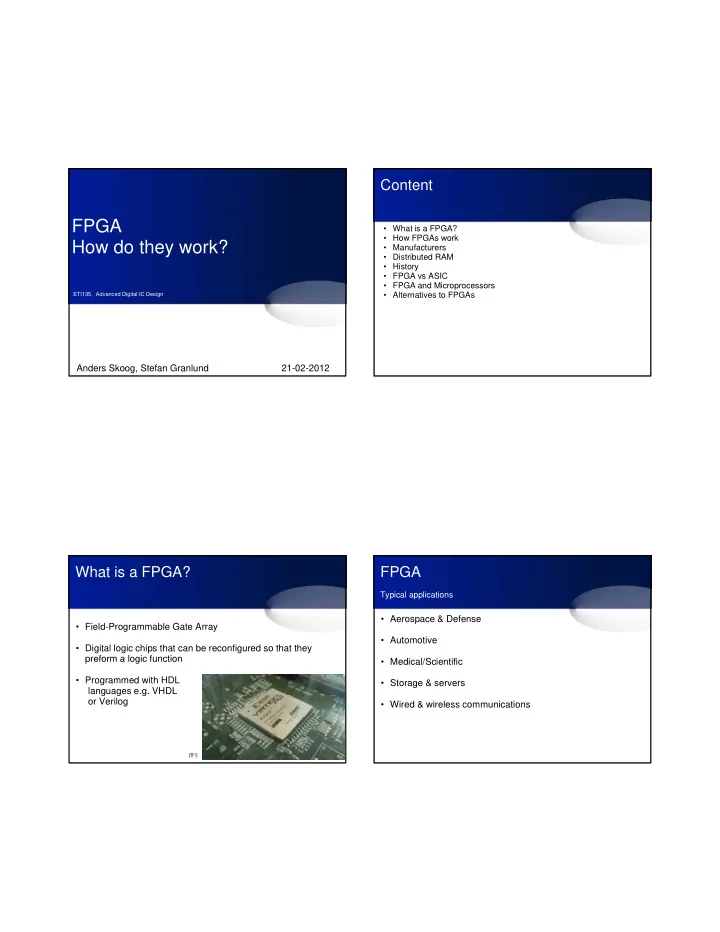
FPGA How do they work?

ETI135, Advanced Digital IC Design

Anders Skoog, Stefan Granlund 21-02-2012

Content

  • What is a FPGA?
  • How FPGAs work
  • Manufacturers
  • Distributed RAM
  • History
  • FPGA vs ASIC
  • FPGA and Microprocessors
  • Alternatives to FPGAs

What is a FPGA?

  • Field-Programmable Gate Array
  • Digital logic chips that can be reconfigured so that they

preform a logic function preform a logic function

  • Programmed with HDL

languages e.g. VHDL

  • r Verilog

[B1]

FPGA

Typical applications

  • Aerospace & Defense
  • Automotive

M di l/S i tifi

  • Medical/Scientific
  • Storage & servers
  • Wired & wireless communications
slide-2
SLIDE 2

2/21/2012 2

How FPGAs work

FPGA Design

  • Block structure
  • CLB (Configureable Logic Block)
  • RAM
  • IOB
  • DSP
  • Microprocessors
  • Multipliers

[B2]

How FPGAs work

Cont

[B2]

Logic-Cell Smallest part in FPGA Consists at least of

How FPGAs work

Cont

Consists at least of

  • Lookup Table (4-6 inputs)
  • D-flipflop
  • MUX

[B3]

Behaviour to duplicate 3-input AND & OR Lookup on FPGA

How FPGAs work

Cont

Input Output 0000 0001 0010 0011 0100 0101 0110 0111 1 1000 1 1001 1 1010 1 1011 1 1100 1 1101 1 1110 1 1111 1 [B3] [B4]

slide-3
SLIDE 3

2/21/2012 3

How FPGAs work

Cont

[B5] [B6]

How FPGAs work

Cont

Several Logic cells then gets interconnected

[B7]

How FPGAs work

Cont

Logic Cells can be connected to slices Several Slices form a CLB Several Slices form a CLB

[B10]

How FPGAs work

Cont

Interconnections between blocks is managed with Switch Matrices

[B9] [B8]

slide-4
SLIDE 4

2/21/2012 4

How FPGAs work

Cont

Interconnections between two adjacent CLB

[B17]

How FPGAs work

Cont

[B2]

How FPGAs work

Cont

IOB

[B14]

How FPGAs work

Cont

[B2]

slide-5
SLIDE 5

2/21/2012 5

How FPGAs work

Cont

[B18]

How FPGAs work

Cont

Configuration of FPGA

  • The FPGA clears (initializes) the internal

configuration memory

  • Configuration data is loaded into the internal memory
  • The user-application is activated by a start-up process

How FPGAs work

Cont

Configuration of FPGA

[B11]

How FPGAs work

Cont

Example of VHDL-code

[B4]

slide-6
SLIDE 6

2/21/2012 6

Design Flow

  • 1. Describe function in HDL or Schematic
  • 2. Simulate
  • 3. Synthesize and create netlist

4 Simulate with netlist

  • 4. Simulate with netlist
  • 5. Place and Route
  • 6. Simulate/verify Place and Route
  • 7. Generate binary files
  • 8. Upload to FPGA via JTAG interface or to a external memory

device

IP-Cores

  • IP-Cores are a reusable unit of logic, cell, or

chip layout design that is the intellectual property of one party. S ft HDL d N tli t

  • Soft cores: HDL code or as an Netlist
  • Hard cores: ASICs embedded on FPGA
  • FFT, AC97, ARM processors, MIPS, MP3

codec

  • Opencores.org

Manufacturers

Major manufacturers (80% of market):

  • Xilinx (over 50% of market)
  • Altera

Other manufacurers:

  • Lattice semiconductor
  • Actel
  • SiliconBlue
  • QuickLogic
  • ref. [1]

Xilinx vs Altera

Design philosophy

Xilinx: Tries to include as many features as possible, at the cost of increasing the complexity of the FPGA. Altera: Include the features most people use, to keep the complexity down.

slide-7
SLIDE 7

2/21/2012 7

Xilinx vs Altera

RAM-implementation

  • Xilinx and Altera use "big" RAM-blocks
  • Xilinx uses "Distributed RAM" for small RAMs
  • Altera mixes smaller and bigger blocks of RAM

[B12] [B16]

Distributed RAM

  • Xilinx patented technology
  • Turns a Logic-cell in to a

ll 16bit RAM ROM small 16bit RAM, ROM or FIFO shift register

[B3]

History

FPGA patent

  • Invented by Ross Freeman
  • Patent filed in in 1984 describing basic FPGA functions

“Patent No. 4,870,302 -- Each configurable logic element in the array is in itself capable of performing any one of a plurality of logic functions depending upon the control information placed in the configurable logic element. Each configurable logic element can have its function varied even after it is installed in a system by changing the control information placed in that element. “

  • Ref. [2]

History

First commercially viable FPGA

  • XC2064
  • 1985

B f d f Xili R F d B d

  • By co-founders of Xilinx Ross Freeman and Bernard

Vonderschmitt

  • 64 CLB with two 3-input lookup tables
  • Today: Virtex 7 ~150 000 CLB with four 6-input lookup

tables

  • Ref. [2] [3]
slide-8
SLIDE 8

2/21/2012 8

FPGA vs ASIC

FPGA advantages

  • Simpler design cycle
  • No "non recurring expenses"
  • More predictable project cycle
  • Reprogrammable
  • Shorter time to market, 9 months compared to 2 years
  • Ref. [5]

FPGA vs ASIC

ASIC advantages

  • Dynamic power: ASIC 12 x less than FPGA
  • Area: ASIC 40 x less than FPGA

Speed: ASIC 3 2 x faster than FPGA

  • Speed: ASIC 3.2 x faster than FPGA
  • Full custom capabillity
  • Lower unit cost
  • Ref. [4]

FPGA vs ASIC

What to choose?

ASIC

  • High volume products
  • Low power products
  • High speed

FPGA

  • Low to medium volume products
  • Needs to be flexible
  • Short development time

FPGAs and Microprocessors

  • Combining Serial and parallel processing
  • Reconfiguring FPGA at "run-time"
  • Loading firmware at Power on
  • Loading firmware at Power on

[B13]

slide-9
SLIDE 9

2/21/2012 9

FPGAs and Microprocessors

Hardware processor embedded in FPGA

  • PowerPC
  • ARM Cortex-M3
  • Atmel

Soft processor core

  • MicroBlaze
  • Nios II

CPLD

Alternative to FPGA

  • Macocells with logic-gates and

flip-flops

  • Non volatile configuration
  • Non-volatile configuration

memory

  • Constant signal delay
  • Not as flexible as FPGAs
  • Less number of gates than a

FPGA

[B15]

Thank you for listening

Questions?

References

Text

[1] "Altera and Xilinx Report: The Battle Continues", 17-06-2008 http://seekingalpha.com/article/85478-altera-and-xilinx-report-the-battle-continues [2] "Xilinx Co-Founder Ross Freeman Honored as 2009 National Inventors Hall of Fame Inductee for Invention of FPGA" , 11-02-2009 http://press.xilinx.com/phoenix.zhtml?c=212763&p=irol-newsArticle&ID=1255523&highlight [3] "FPGA Comparison Table", 17-02-2012, http://www.xilinx.com/products/silicon-devices/fpga/index.htm [4] Ian Kuon & Johnatan Rose "Measuring the Gap between FPGAs and ASICs" FPGA'06 February 2006 [4] Ian Kuon & Johnatan Rose, Measuring the Gap between FPGAs and ASICs , FPGA 06, February, 2006 http://www.eecg.toronto.edu/~jayar/pubs/kuon/kuonfpga06.pdf [5] Karthikeya "FPGA Vs ASIC Design: A Strategic Comparison" http://electronicsbus.com/fpga-vs-asic-design-verification-comparison/ [6] Spartan-3 Generation FPGA User Guide (v1.8), June 13, 2011 http://www.xilinx.com/support/documentation/user_guides/ug331.pdf [7] Spartan-3E FPGA Family Data Sheet (v3.8), August 26, 2009 http://www.xilinx.com/support/documentation/data_sheets/ds312.pdf

slide-10
SLIDE 10

2/21/2012 10

References

Pictures

[B1] Anders Skoog, 16-02-2012 [B2] http://www.xilinx.com/company/gettingstarted/, Retrieved 19-02-2012 [B3] http://www.fpga4fun.com/FPGAinfo2.html , Retrieved 19-02-2012 [B4] Stefan Granlund, 20-02-2012 [B5] http://en.wikipedia.org/wiki/File:FPGA_cell_example.png, Peter källström, may 2010 [B6] Spartan-3E FPGA Family Data Sheet (v3.8), August 26, 2009, page 29 [B7] http://www.fpga4fun.com/FPGAinfo2.html , Retrieved 19-02-2012 [B8] Spartan-3 Generation FPGA User Guide (v1.8), June 13, 2011, page 396 [B9] Spartan-3 Generation FPGA User Guide (v1.8), June 13, 2011, page 396 [B10] Spartan 3E FPGA Family Data Sheet (v3 8) August 26 2009 page 22 [B10] Spartan-3E FPGA Family Data Sheet (v3.8), August 26, 2009, page 22 [B12] Xilinx Spartan-II FPGA Family Data sheet, 06-2008, page 3 [B11] Spartan-3E FPGA Family Data Sheet (v3.8), August 26, 2009, page 104 [B13] http://en.wikipedia.org/wiki/File:Xilinx_S6-SP601_board.jpg , CC-by-sa-3.0 licens , 19-02-201 [B14] Spartan-3E FPGA Family Data Sheet (v3.8), August 26, 2009, page 11 [B15] http://www.xilinx.com/company/gettingstarted/ , Retrieved 19-02-2012 [B16] Altera ACCEX 1K Data sheet ver. 3.4, may 2003, page 8 [B17] Spartan-3 Generation FPGA User Guide (v1.8), June 13, 2011, page 397 [B18] Spartan-3E Generation FPGA User Guide (v1.8), June 13, 2011, page 47