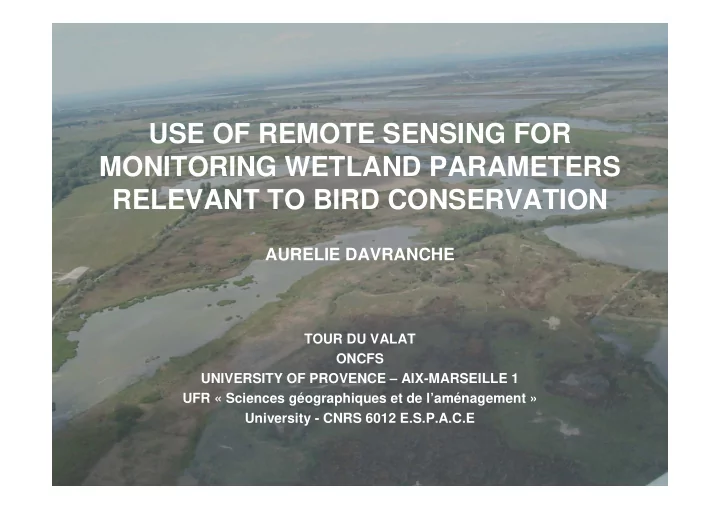
SLIDE 1 USE OF REMOTE SENSING FOR MONITORING WETLAND PARAMETERS RELEVANT TO BIRD CONSERVATION
AURELIE DAVRANCHE
TOUR DU VALAT ONCFS UNIVERSITY OF PROVENCE – AIX-MARSEILLE 1 UFR « Sciences géographiques et de l’aménagement » University - CNRS 6012 E.S.P.A.C.E
SLIDE 2
Camargue : Rhône river delta
90 000 ha of natural habitats mostly wetlands 2/3 on relatively small private estates Dynamic system: water and sediment inputs from the Rhône and the sea
2
SLIDE 3
Socio-economic activities and natural habitats
Rice growing Reed harvesting Cattle grazing Waterfowl hunting
Water management
input of freshwater in brackish marshes modification of the hydroperiod division of the marshes into smaller dyked units Influence on floristic composition and vegetation biomass Changes in bird habitat
3
SLIDE 4 Main objective
Necessity to monitore the management and the health state of these marshes Global loss of biodiversity Reserve managers and stakeholders are in needs
Proliferation of invasive species A fragmented configuration within a large geographical area: monitoring based on repeated ground measures difficult
Development of reliable and replicable remote sensing tools for wetland monitoring 4
Remote sensing: good potentialities for wetlands spatial analysis
SLIDE 5
Specific objectives
These tools will help to : ►map flooded areas irrespective of vegetation density to follow their spatial evolution monthly
5
►map the vegetation of Camargue marshes (common reed, club- rush, aquatic beds) to follow their spatial evolution over time ►map vegetation parameters that are associated with ecological requirements of vulnerable birds in reed marshes
SLIDE 6
Methodology
Image acquisition Image processing Data image extraction Statistical modellings: Classification trees Generalized Linear Models Sampling Vegetation characterisation (reedbeds, club- rush, aquatic beds) Estimation of water levels for each image Formulas = maps
6
Multispectral and multitemporal index Database GPS
SLIDE 7
Sampling
7
Fields campaigns : reedbeds, club-rush, aquatic beds, water levels, GPS Digitalizations : Others
SLIDE 8 Image processing: radiometric normalization
8
6S atmospheric model vs. pseudo-invariant features (PIF) Each PIF varies at least once
6S does not take into account this variation for the correction
Variation significatively lower with 6S Similarity index (Euclidian distance): Estimation of radiometric variation of PIF
Dec Mar May Jun Jul Sep
4 8 12 16
Dec Mar May Jun Jul Sep
0.04 0.08 0.12 0.16 4 8 12 16 0.04 0.08 0.12 0.16
Water Pine tree Roof Sand Radiometric variation (%)
Radiometric variation (%)
6S PI
1 2 3 4 5 6
Necessity of different types of PIF
SLIDE 9 Spectral variations
9 Influence of :
- phenology
- pluviometry
- water management
Natural and artificial phenomena characterizing Camargue wetlands require a multispectral and multitemporal imagery for their monitoring
0,05 0,1 0,15 0,2 0,25 0,3 B1 B2 B3 MIR B1 B2 B3 MIR B1 B2 B3 MIR B1 B2 B3 MIR B1 B2 B3 MIR B1 B2 B3 MIR December March May June July September Reflectance
Reedbeds Club-rush Aquatic beds
SLIDE 10 Statistical modelling : two approaches
10
1 - Qualitative approach : presence/absence
- Presence of reed, club-rush and aquatic beds
- Presence of water in differing conditions of vegetation density
2 - Quantitative approach : prediction of continuous variables
- Diagnostic parameters of reedbeds
- Quality for reed harvesting
- Suitability for vulnerable reed birds species (passerines, Purple
heron, Eurasian bitterns) Classification trees Generalized Linear Models
SLIDE 11 Classification tree algorithm
11
Rpart based on the algorithm CART (classification and regression tree) Breiman et al, 1984; implemented in R. Binary tree Recursive partioning based
Method Advantages
Prior parameter Cross-validation (k-fold) Optimal for presence/absence Hierarchical classification strategy: easy interpretation of results Small samples and reproducibility Unbalanced samples
SLIDE 12 Recursive partioning
12
0,1 0,2 0,3 0,4 0,5 0,6 0,7
0,05 0,1 0,15 0,2 0,25
c30603
aquatic beds reedbeds club-rush
Split at 0.2467 Split at 0.04897
A two-dimension example with two variables selected for reedbeds classification
SLIDE 13 Tree: example for reedbeds classification
13
| c30603< 0.04897
ndwif209>=-0.3834 2 672/46 1 544/0 2 128/46 1 80/0 2 48/46 1 39/0 2 9/46
Presence of reedbeds = c30603≥0.04897 & OSAVI12<0.2467 & NDWIF209<-0.3834
Formula Map
Reedbeds
SLIDE 14
Maps resulting from the formula
14
Combination of three maps: reedbeds, club-rush and aquatic beds in Camargue
SLIDE 15 Tree for flooded areas classification
15
| c4>=0.1436 ndwif2< -0.5475 dvw>=-0.5092 2 34/181 1 29/45 1 21/12 1 8/33 1 8/22 2 0/11 2 5/136
Flooded areas = c4 < 0.1436 or (c4 ≥ 0.1436 & NDWIF2 ≥ - 0.5475 et DWV < -0.5092)
Flooded areas Flooded areas Scattered vegetation and high water levels Dense vegetation and lower water levels
SLIDE 16
Classification accuracy and validation
16
84,9 88,3 Aquatic beds 93 Club-rush 92,6 91,9 Reedbeds 2006 2005
Classification accuracy (%) for the 3 types of marsh vegetation in Camargue:
Acquisition in October instead of September + extremely small class ? Aquatic beds in brackish marshes mixed with Club-rush + acquisition in October? 70 86 76 Flooded areas Vegetated marshes Open marshes All marshes
Classification accuracy (%) for flooded areas in 2006:
Best results: first half of the year and reed height<188 cm
SLIDE 17
Generalized Linear Models (GLM)
17
Y=a1x1+a2x2+…+aixi+…apxp+b Equation for p descriptives variables: Model selection : Coefficient of determination : R² ►R² = 1 → 100 % variance explained ►R² increases with the number of variables Best model : maximum R² with minimum number of variables Variable selection : Forward stepwise (FSW) ►Sequence of F-tests (Fischer statistic) : inclusion and exclusion of « statistically significant » descriptive variables ►End: when no additional variable contribute to increase significantly the variance explained Problem : the first variables selected have a big influence on the resulting model Pre-selection of descriptive variables necessary
SLIDE 18
Variables pre-selection
18
Criterions for pre-selection : stability ►Spectral response: correlation between two consecutive years ►Mean spectral response : no significant difference between two consecutive years 1 - What is the efficiency of these variables for modelling reedbed parameters ? 2 - What is the minimum number of images required for modelling reedbed parameters ? 20 of the 90 variables are pre-selected !
SLIDE 19 Percentage of explained variance
19 60 50
56
60 35
green reeds 47 38
number 61 59
reeds 66 54 44 Height of stems Best model = multidate Two dates One descriptive variable = one date Reedbed parameters
Best predicted parameter: height of stems
SLIDE 20 Best models : validation in 2006
20
17* 43*** 1 19* 30** 46*** 2006
60***
Percentage of
56***
Ratio dry/green
60***
Number of green reeds
47***
Panicles number
61***
Number of dry reeds
66***
Height of green reeds 2005 Purcentage of explained variance (*p=0.05, **p=0.01, ***p=0.001) : Number of panicles: binomial distribution → Rpart? Green reeds: bi-modal distribution → GAM? % of open areas: methodological imprecision
SLIDE 21
Application for monitoring: reedbeds evolution
21
Influence of water management, salinity…
SLIDE 22
Application for monitoring: reedbeds evolution
22
Influence of water management, salinity…
SLIDE 23
Application for monitoring: Birds habitats
23
Great Reed-Warbler reedbeds: height of stems >195 cm
SLIDE 24
Application for monitoring: flooding duration
24
Influence of water management on aquatic beds
SLIDE 25
Conclusion
25
► Remote sensing and statistical modelling for wetland monitoring : sustainability, precision, affordablility ► SPOT 5: multispectral and multitemporal modes optimal for wetland monitoring on large areas ► Roles reversed : field campaigns as a complementary tool for wetland monitoring with satellite remote sensing
SLIDE 26
Perspectives: improvements
26
► More descriptive variables : TC wetness, index differences ► Additional field campaigns to monitor reed harvesting ► Monitoring of water levels with the IME ► Number of panicles and green reeds : Rpart? GAM? ► Automatization of the methodology: simplicity for managers
SLIDE 27
Perspectives: other applications
27
► Rice cultivation:
SLIDE 28 Perspectives: other applications
28
► Rice cultivation:
PNRC: digitalization
SLIDE 29