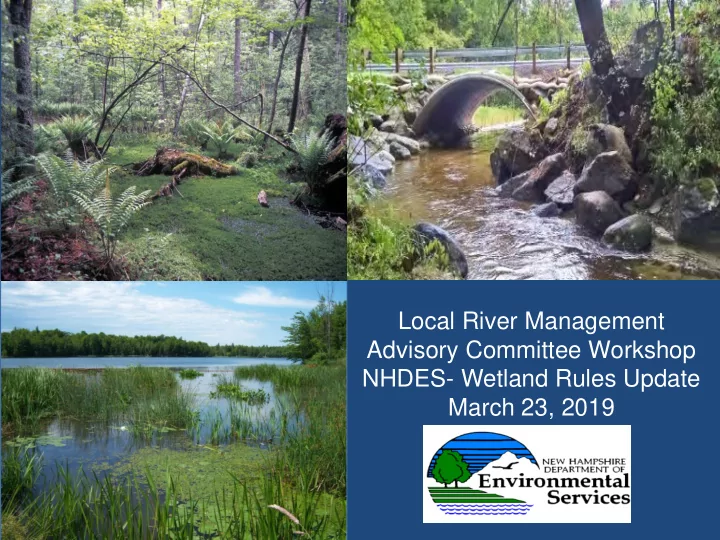
Local River Management Advisory Committee Workshop NHDES- Wetland Rules Update March 23, 2019
Advisory Committee Workshop NHDES- Wetland Rules Update March 23, - - PowerPoint PPT Presentation
Local River Management Advisory Committee Workshop NHDES- Wetland Rules Update March 23, 2019 Workgroup Sessions Date Type May 23 Wetland Rules Workgroup June 6 Wetland Rules Workgroup June 20 Wetland Rules Workgroup June 27 Top of
Workgroup Sessions
Date Type May 23
Wetland Rules Workgroup
June 6
Wetland Rules Workgroup
June 20
Wetland Rules Workgroup
June 27
Top of Bank Subcommittee
July 6
Top of Bank Subcommittee
July 11
Wetland Rules Workgroup
August 8
Wetland Rules Workgroup
August 17
Wildlife Ponds Subcommittee
August 22
Wetland Rules Workgroup
Sept 5
Wetland Rules Workgroup
Focus Input Sessions/ Outreach
Mar 21
NH Bar –Environmental Section
Mar 27
Wetlands Council update
April 24
DNCR, NHB, DES, Fish & Game Forestry
April 25
NHTOA Forestry Focus Group
May 15
BIA Rules update
May 15
Construction Focus
May 19
VLAP rules outreach
May 21
Utility Focus Group
May 29
Conservation Community Focus
May 31
BIA conference
July 20
Coastal & Aquaculture Focus sessions
August 10
Agriculture Focus Group
August 13
Utility BMP Focus
August 16
Beach-Deck Focus Group
August 23
NH Stream Crossing Steering Committee
August 28
Wetland Council update
August 30
Natural Resource Scientist Focus
Thank you!
- Special thanks to Michele Tremblay for her
participation in the Wetlands Rules Workgroup and subcommittee meetings! For your comments on the proposed rules: Upper Merrimack River LAC Ashuelot River LAC Lower Merrimack LAC Mt. Ascutney River Subcommitee Piscataquog River LACWarner River LAC
Wetlands Program Rulemaking Anticipated Schedule
Overall Schedule
Spring, 2019 Final Proposal filed 3/20/19 JLCAR review process File rules for adoption Jan 18, 2019
Public Comments Received
7 hearings & 80 letters Winter 2019 NHDES to review /consider public comments & Develop Final Proposal & Request FIS
We Are Here!
RSA 482-A
Public Purpose Wetland Function
Fish & Wildlife Habitat
Organization Changes
Env-Wt Current Proposed 100 Definitions Definitions 200 Practice & Procedure Hearings, Appeals & Waiver requests 300 Delineation, Evaluation, Project Classification, Permit Conditions Permit Types & Procedure, Standard Conditions, Criteria for Standard Permits 400 Shoreline Structures Delineation & Classification of jurisdictional areas & General Project Classification 500 Permit Procedure Project Specific Requirements (e.g. docks, utility, forestry, residential, commercial) 600 Tidal Wetlands Coastal Lands & Tidal Waters/ Wetlands 700 Prime Wetlands Prime Wetlands 800 Compensatory Mitigation Compensatory Mitigation 900 Stream Crossings Stream Crossings
Background
The wetland rules capture and address:
- The changes to RSA 482-A as it relates to the
LAC review process;
- Standard wetlands bureau practices & best
available science;
- Consistency with State sister and DES
programs;
- Consistency with the Army Corps of Engineers
Programmatic General permit;
LAC Workshop Agenda Questions
Q1- What is the impact of proposed rules on LAC review? Q2- What are the process changes resulting from the 2018 Wetlands legislation? Answer: NHDES reviewed statutory changes and incorporated these changes into the proposed rules processes.
“LAC jurisdiction” defined
- Env-Wt 103.27 “LAC jurisdiction” means the authority
conferred by RSA 483:8-a, III upon a local
- river management advisory committee relative to
activities within a designated river or river corridor,
- provided that for purpose of routine roadway
maintenance activities conducted under an SPN, registration, PBN, or EXP, LAC jurisdiction shall be limited to activities in or within 250 feet of a Tier 2 or Tier 3 designated river that have a direct surface water connection to the designated river.
LAC Right of Intervention established RSA 482-A:11
- [Paragraph III(a) effective January 1, 2019; see also paragraph III(a)
set out above.]
- (a) Upon written notification to the department by a municipal
conservation commission, a local river management
advisory committee, or the New Hampshire Rivers Council
that it intends to investigate any notice received by it pursuant to RSA 482-A:3, the department shall not make its decision on the application that is the subject of the notice until it has received and acknowledged receipt of a written report from such commission, local river management advisory committee, or the council, or until 40 days from the date of filing with the municipal clerk of such notice, whichever occurs earlier, subject to an extension of up to 40 days, as permitted by the commissioner, for good cause shown.
DES decision requires specific review
- f LAC recommendation
If a conservation commission, a local river management advisory committee, or the New Hampshire Rivers Council makes a recommendation to the department in its report, the department shall specifically consider such recommendation and shall make written findings with respect to each issue raised in such report which is contrary to the decision of the department.
14-day action from date filed with Town clerk
If notification by a local conservation commission, local river management advisory committee, or the New Hampshire Rivers Council pursuant to this paragraph is not received by the department within 14 days following the date the notice is filed with the municipal clerk, the department shall not suspend its normal action, but shall proceed as if no notification has been made. (b) Relative to any expedited permit under paragraph VI, the provisions
- f subparagraph (a) shall be modified as follows:
(1) The 40-day suspended action limit is reduced to 21 days; and (2) The notification by a municipal conservation commission of intended investigation shall be assumed unless the application filed under RSA 482-A:3 was signed by the conservation commission, or, if
- ne has not been established in the municipality, by the local
governing body, in which case the provisions of subparagraph (a) shall not apply.
Project Classification Clarified
Project Type Impact Size Resource Type
Project Classification Clarified Why does it matter?
3 tier classification system - Minimum, Minor, or Major Project Classification sets:
- Application Fee
- Eligibility for Notice, Registration vs.
Standard processes
- Whether mitigation is required?
- If Governor & Council approval is required
Current Major Impact Resources
Bog Tidal
Protected Species & Habitat
Primes
Tier 3 Streams
Proposed Major Impact Resources
Bog Tidal
Protected Species & Habitat
Primes
Flood plain Wetland /T3
Priority Resource Areas
Existing Project classification
Protected Species/ Habitat = major Major classification = Standard w/ maintenance exceptions
Proposed Project classification
Protected Species/habitat= Major w/ DataCheck Classification adjustment on NHB/F & Game recommendations =SPN, PBN or EXP w/ PTE exceptions
Current Minor Impact Resources
Marsh Perennial Stream
Proposed Minor Impact Resources
Marsh Perennial Stream as required by 900 Scrub-Shrub wetland adjacent to waterbody
Project Type Exceptions
- Classification based on size shall not apply to
SPN if it meet Env-Wt 308 & 307; See SPNs:
- Minimum Impact Utility
- Minimum Impact Forestry
- Minimum Impact Trails
- Routine Roadway & Railway Maintenance (See
900)
- Seasonal Dock Notice
Size Thresholds
Resource Type
Minimum Minor Major
Other than Watercourse
< 3,000 SF ≥3,000 SF – 10,000 SF ≥10,000 SF
Watercourse < 50 LF
≥ 50 LF – < 200 LF ≥200 LF
Process
Category
SPN
Statutory Notice
Routine Roadway
Registration
PBN
Permit by Notice
EXP
EXPEDITED
Standard
DES max Review time (days) N/A
5 5 30 50 /75
LAC
waiver of intervention required when project is…
w/in LAC jurisdiction except for Routine Roadway on lands used for Agriculture (& not Forestry
- r Trails)
w/in LAC jurisdiction w/in LAC jurisdiction w/in LAC jurisdiction w/in ¼ mile Designated River corridor
Minimum < 48” culvert Meets DOT BMPs YES YES X Minor X X X YES Major X X X
may require mitigation &
- r G & C
Statutory Permit by Notification (SPN)
SPN
- Temporary Seasonal Dock
- Timber Harvesting (minimum impact)
SPN
- Panning for gold or minerals
- Recreational Trails (minimum impact)
SPN
- Utility maintenance & repair (minimum)
- Culvert Repair/maintenance up to 48” culvert
Routine Roadway Registrations
Aligns with NHDOT Routine Roadway BMPs (Env-Wt 309.03)
- Routine Roadway Maintenance Registration
- RR-1: Culvert replacement or repair
- RR-2: Culvert extension
- RR-3: Culvert relocation
- RR-4: Embankment stabilization
- RR-5: In-kind headwall repair only; any size culvert
- RR-6: Headwall construction, repair, or replacement
- RR-7: Roadside ditch maintenance
- RR-8: Culvert inlet and outlet maintenance
- RR-9: Temporary scaffolding
PBN Change Require LAC sign-off
Current Permit by Notice (PBN) Future PBNs 14 projects -10 days
- Abutter notice
- Conservation
Commission (CC) approval 14 projects - 5 days
- No Abutter notice
- With CC &
- With LAC Review &
Waiver of Intervention
Existing PBN Projects (14 Projects) Now = 10 days/ w/ CC & LAC approval Proposed = 5 days
- 1. FW Seasonal Dock (513.24(a)
- 8. Culvert/ Bridge replacement
Replacement of Tier 1 (903.01(e)(4) 2. Wall Repair & Replacement (514.07(a)(4)
- 9. Beach replenishment (511.07(a))
3. Maintenance Dredge See 308 exemptions or see EXP
- 10. Dock anchoring pad (513.24(a)(3)
4. Temporary Coffer Dams (526.06(f))
- 11. Watercraft (513.24(a)(4))
- 5. Dock Structure In-kind Repair
(513.24(a))
- 12. Boatlift (513.24(a)(4))
- 6. Dry Hydrants (518.07(a))
- 13. Residential Utility (521.06(a)(7)
- 7. Non-docking structure
- 14. Utility Maintenance Notice 521.06(a)
Now covered under SPN
New PBN Projects Now = 30 days (EXP) or 50 days (STD) Proposed = 5 days New EXPEDITED (EXP) Projects Now = 50 days Proposed = 10 30 days
1. Aquatic Vegetation Removal
- 1. Exotic Weed Removal (510.08(a)(3)
- 1. Bioengineering (514)
- 2. Single Family Beach/ Deck/Patio
Repair (511.08)
- 2. Wildlife Pond (517)
- 3. Bank Stabilization (not as PBN)
- 3. Restoration projects (525)
- 4. Boathouse Repair/Maintenance
- 4. Coastal Living Shoreline (600)
- 5. Boardwalk Construction (not as PBN)
- 6. Agriculture + associated access
(522.06(a)
- 7. Residential Access Temporary
Tier 1 or Tier 2 access (903.01e(4)
- 8. Commercial Access T1 or T2
crossing repair 903.01(e)(2)
- 9. Developed TBZ work Tidal Dock
2 Shoreline & Shoreland processes
Shoreland (483-B) Application & Plan Shoreline (RSA 482-A) Application & Plan
New Consolidated Process Option
One Application One Plan
One DES POC One permit
Current Resource Majors
Tidal, Dunes, Protected species or habitat Bogs, Prime wetlands, Tier 3 streams
Proposed Resource Major = “Priority Resource Area”
Floodplain wetland
- n a Tier 3
watercourse Elevated to standard review (if not PTE or adjustment) & requires mitigation
New Avoidance & Minimization Techniques – Wetlands BMP
Table of Contents
- 1. Importance of Protecting Wetlands
- 2. Single Family Lots
- 3. Subdivisions
- 4. Commercial & Industrial Projects
- 5. Bike Paths, Trails & Boardwalks
- 6. Golf Courses
- 7. Stream & Wetland Crossings
- 8. Streambank & Shoreline Stabilization
- 9. Plantings
- 10. Construction & Maintenance
- 11. Tidal Projects
- 12. Non-Tidal Shoreline Structures
- 13. Utilities
Avoidance & Minimization
- Are there alternative layouts, designs or
technologies that would avoid detrimental wetlands impacts & still meet the project goal?
- Can crossings be narrowed or limited in #?
- Can work be scheduled to avoid deposition
in streams, or wetlands?
- Can in-stream work occur during low-flow
conditions & to avoid nesting or spawning periods?
Avoidance & Minimization Checklist
Functions & Values Evaluation Form
- New Functions &
Values Evaluation Form to be used
- with the Avoidance
& Minimization Checklist
Original Plan – Single Family Driveway
Revised Plan – Single Family Driveway
Original Subdivision plan
Chapter 7 Stream and Wetland Crossings
Chapter Env-Wt 900 updates Stream Crossings – New Definitions
- 902.16 “Longitudinal profile”
- 902.20 “Reference reach”
- 902.21 “Rehabilitation”
- 902.22 “Repair”
- 902.24 “Replacement”
- 902.25 “Self-mitigating”
- 902.26 “Sinuosity”
Stream Crossing changes (900)
- Any size tier can be “repaired” as a minimum
impact project
- Env-Wt 902.24 “Repair” as applied to a stream
crossing means work on an existing legal structure to allow the structure to remain in place where the necessary work does not include the installation of new
- structural components.
Rehabilitation Defined
Rehabilitation projects are minor or major Env-Wt 902.23 “Rehabilitation” as applied to a stream crossing means installation of new structural components in or on an existing legal structure to allow the structure to remain in place that does not qualify as repair or
- replacement. The term includes but is not
limited to slip-lining and installation of wing- walls or toe walls or any combination thereof.
New Definitions - Continued
- Env-Wt 902.13 “Geomorphic compatibility”
means the long-term ability of a stream crossing to:
- a) minimize potential for obstruction by
sediment, wood and debris;
- b) Preserve the natural alignment of the stream;
and
- c) Accommodate the entrenchment ratio, bank
full depth, and channel slope of the stream.
New Tier 3 Definition Change
Located on a watercourse where the contributing watershed is 640 acres or greater; Within a Designated River corridor, unless:
- The crossing is a Tier 1 on Watershed size
- The structure does not create a direct surface water
connection to the designated river as depicted on national hydrography dataset on GRANIT. Within a 100 year floodplain In a jurisdictional area having any protected species or habitat. In a prime wetland or duly established 100’ buffer.
Env-Wt 902.25 “Self- Mitigating”
- “Self-mitigating” as applied to stream crossings
means the design of the crossing incorporates measures or features to offset the loss of the affected resource’s functions and values in an area where the new functions and values are
- sustainable. Examples of self-mitigating
measures or features include, but are not limited to, eliminating a barrier to aquatic organism passage, improving the hydraulic capacity of an under-sized crossing, and improving geomorphic compatibility.
Repair, Rehabilitation, or Replacement of Existing legal Stream Crossings (904.08 & 904.09)
- Requires Professional engineer certifies:
No history of causing or contributing to flooding that damages the crossing, other human infrastructure, or protected species habitat; Proposed crossing meet or exceed general criteria; maintain or enhance hydraulic capacity; maintain or enhance the capacity of the crossing to accommodate aquatic organism passage or both; Maintain or enhance the connectivity of the stream reaches upstream or downstream of the crossing or both; and Not cause an increase in the frequency of flooding or overtopping
- f the banks upstream or downstream of the crossing.
NHDES new Stream Crossing Worksheet
NHDOT Routine Roadway BMPs updated
- BMPs for selection based on specific sites
- BMPs most effective to protect the
environment
- Goal to protect roadway infrastructure from
future storm events
- Goal to improve water quality within
watercourses
- Goal to protect water resources and improve
aquatic organism passage
Updates to the NHDOT Routine Roadway BMP
- Planning your project
- Planning annual maintenance
- P. 11 new section based on RMAC feedback:
- Aquatic Organism Passage and Connectivity
- RMAC recommendations included in BMP
New BMPs
- Agriculture – NH Agriculture (2019)
- Utility – DNCR – (2019)
- Routine Roadway – NHDOT (2019)
- Avoidance & Minimization (NEIWPCC) (2019)
Conclusion
The wetland rules capture and address:
- LAC’s new role based on statutory changes;
- When in LAC jurisdiction – streamlining as a 5
day Wetlands PBN, Routine Roadway Registration, or 30 day EXP is allowed only with CC & LAC waiver of intervention (sign-off on NHDES form);
- New Worksheets , new BMPs, and new tools can