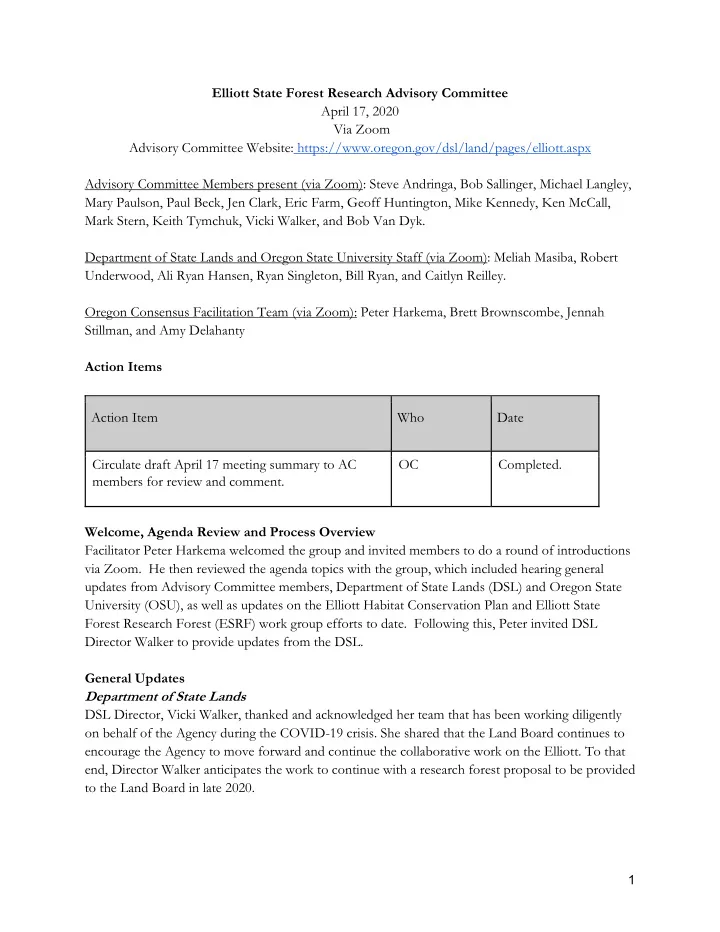
Elliott State Forest Research Advisory Committee April 17, 2020 Via - - PDF document

elliott state forest research advisory committee april 17
SMART_READER_LITE
LIVE PREVIEW

Elliott State Forest Research Advisory Committee April 17, 2020 Via - - PDF document

Elliott State Forest Research Advisory Committee April 17, 2020 Via Zoom Advisory Committee Website: https://www.oregon.gov/dsl/land/pages/elliott.aspx Advisory Committee Members present (via Zoom): Steve Andringa, Bob Sallinger, Michael


slide-1
SLIDE 1

1

Elliott State Forest Research Advisory Committee April 17, 2020 Via Zoom Advisory Committee Website: https://www.oregon.gov/dsl/land/pages/elliott.aspx Advisory Committee Members present (via Zoom): Steve Andringa, Bob Sallinger, Michael Langley, Mary Paulson, Paul Beck, Jen Clark, Eric Farm, Geoff Huntington, Mike Kennedy, Ken McCall, Mark Stern, Keith Tymchuk, Vicki Walker, and Bob Van Dyk. Department of State Lands and Oregon State University Staff (via Zoom): Meliah Masiba, Robert Underwood, Ali Ryan Hansen, Ryan Singleton, Bill Ryan, and Caitlyn Reilley. Oregon Consensus Facilitation Team (via Zoom): Peter Harkema, Brett Brownscombe, Jennah Stillman, and Amy Delahanty Action Items Action Item Who Date Circulate draft April 17 meeting summary to AC members for review and comment. OC Completed. Welcome, Agenda Review and Process Overview Facilitator Peter Harkema welcomed the group and invited members to do a round of introductions via Zoom. He then reviewed the agenda topics with the group, which included hearing general updates from Advisory Committee members, Department of State Lands (DSL) and Oregon State University (OSU), as well as updates on the Elliott Habitat Conservation Plan and Elliott State Forest Research Forest (ESRF) work group efforts to date. Following this, Peter invited DSL Director Walker to provide updates from the DSL. General Updates Department of State Lands DSL Director, Vicki Walker, thanked and acknowledged her team that has been working diligently

  • n behalf of the Agency during the COVID-19 crisis. She shared that the Land Board continues to

encourage the Agency to move forward and continue the collaborative work on the Elliott. To that end, Director Walker anticipates the work to continue with a research forest proposal to be provided to the Land Board in late 2020.

slide-2
SLIDE 2

2

Director Walker then highlighted the public engagement efforts that occurred in 2019. She noted the Agency has worked to keep the public informed about the Elliott State Research Forest process through open houses, presentations, and email updates. Many members of the public attended events and also spoke at Land Board meetings. Last week, DSL sent an email update reflecting back what was heard from those various engagement efforts throughout 2019. In 2020, Director Walker shared the Agency will continue to provide information and opportunities for public engagement, keeping social distancing restrictions in mind as necessary. Oregon State University Geoff Huntington (OSU) provided a brief update of the College of Forestry’s recreation stakeholder

  • utreach efforts. Geoff reminded the group that in 2019 the College held recreation focus group

sessions that helped inform the construction of the recreation portion of the Elliott State Research Forest Guiding Principles working draft document. (Information on the Advisory Committee and its work to-date, including the Guiding Principles, can be found here: Advisory Committee Website: https://www.oregon.gov/dsl/land/pages/elliott.aspx). Geoff noted that recreation was, and continues to be, an important topic to stakeholders if the Elliott becomes a research forest. To that end, the College plans to reconvene recreation stakeholders in the coming weeks to discuss what a future process for developing a recreation management plan might look like. Geoff noted that recreation planning won’t come until later in planning efforts for the Elliott, but there is significant interest in the topic and the College would like to continue those conversations and

  • engagement. Geoff shared there are 20-25 people that have expressed interest in this topic area at

past meetings with the bulk of people being local to the area, though there are also a few individuals from the Valley. Break Out Groups Advisory Committee members were then invited into small breakout groups to check-in for approximately five minutes. General Updates--Continued Advisory Committee members, DSL and OSU staff then provided brief updates on the recent activities related to the ESRF effort. They were as follows: Governance Work Group Meliah Masiba, Department of State Lands, reviewed the purpose of the governance work group and efforts to date. Meliah noted that the purpose of the Governance Work Group was for members to provide input on an ESRF governance framework that is consistent with the governance Guiding Principles agreed upon by the Advisory Committee and OSU in 2019. She shared that DSL and OSU are intending for the work on governance to continue to move forward, despite disruptions associated with the coronavirus pandemic. She noted that at the first meeting the group reviewed examples of various governance structures and engaged in a preliminary

slide-3
SLIDE 3

3

conversation about the desired attributes members would like to see in an ESRF governance model. At its upcoming meeting, the group will further discuss governance considerations as they relate to potential engagement with carbon markets and continue to discuss and identify mechanisms for

  • perationalizing governance principles that are aligned with the Guiding Principles outlined by

Advisory Committee members. Decoupling Conversations Meliah reminded the group that the Oregon Supreme Court’s decision in the Cascadia case raises potential considerations for both Elliott ownership and decoupling. Meliah shared that the Court’s decision means the Elliott must remain in state ownership and directs that common school lands must be managed to obtain the greatest benefit for Oregonians. While this decision will generate continued conversations around the implications for common school fund land management, she noted the Land Board’s vision for the Elliott has always included a desire to obtain a multitude of benefits for Oregon. Meliah also added OSU is considered an entity of the state, which should allow for a research forest scenario if title to the forest is transferred to them. The Cascadia decision generated interest and discussion by Advisory Committee members, and it was recognized that conversations regarding the decision should be informed by attorneys who were not present at the Advisory Committee meeting. Further discussion of decoupling awaits additional work within the Research Platform group (below) and will require engagement of additional stakeholders. Science Advisory Panel Peter then invited Portland State University faculty and chair of the Science Advisory Panel, Dr. Jennifer Allen, to provide a brief update of the Science Advisory Panel’s charge and work to date.

  • Dr. Allen noted the following (as articulated in an email previously forwarded by Oregon Consensus
  • n behalf of OSU’s Interim Dean of the College of Forestry to the Advisory Committee):

“The Science Advisory Panel, charged by the Dean of the College of Forestry, will work to ensure the vision and goals of the research charter, and associated research design, to position the Elliott State Research Forest as a world-leading source of scientific knowledge and discovery to advance the study and practice of forestry. The work will require the panel to offer direct feedback and input on OSU’s research design and its intersection with the values emphasized by the University, the Land Board stakeholder advisory committee, and

  • Oregonians. The panel will also advise on how to ensure the research charter and

governance structure, along with proposed conservation and research actions, emphasize scientific integrity while balancing multiple perspectives.”

  • Dr. Allen then shared the initial membership of the panel and the areas of expertise the panelists
  • represent. Dr. Allen clarified that this group is not intended to be representative of the various

interests around the Elliott, but rather, be able to offer perspectives from the areas of expertise in their research. Following this, AC members asked questions related to panelist representation; timeline; and how the Science Advisory Panel role in the long-term governance structure of the Elliott.

slide-4
SLIDE 4

4

Research Platform Geoff Huntington provided an overview of the current mapping and acreage allocation configuration and an update on ongoing research platform work. Research Platform Work Group members were invited to share their perspectives on the group’s discussions. Following this presentation and updates, Advisory Committee members asked questions related to Murrelet distribution, spatial and temporal distribution of early seral habitat over time, the definition of extensive, and how forest structure would shift over the life of the research forest. Habitat Conservation Plan Update Troy Rahmig, ICF, provided a brief update on efforts related to the Elliott HCP. Troy shared that a considerable amount of work has been happening in ESRF work groups around the research platform, designations across the landscape, and governance considerations. Troy shared the HCP work will ramp up further based on where the research forest platform workgroup effort lands, and that that output will direct the analysis that occurs in the HCP. ICF has been updating background information and is poised to start the analysis as the final pieces of the land allocation come

  • together. He noted work on the HCP will increase during the summer months and he anticipates a

draft HCP will be ready for the Land Board in late 2020. Troy shared that a component of the HCP will be to identify what monitoring will look like, including the type and level of intensity. Monitoring will help track achievement of HCP objectives and inform where the species are in the future relative to today. Troy shared it is important to remember that along with the HCP comes an incidental take permit. The permit holder is not penalized for growing habitat into the future. If species grow into habitat the permit holder has designated for harvest under the research platform, the HCP provides authorization and assurances that removal of such habitat is permitted so long as consistent with the conditions in the HCP. Troy then shared that proposed land allocations, habitat protections and expectations for harvest regimes will be documented and analyzed in the HCP and its future National Environmental Policy Act process. Next Steps Geoff then briefly reviewed the next steps on the research design and other estimated timelines. They were generally as follows: Research Design Draft Timeline:

  • Watershed-by-watershed mapping of Conservation Research Watersheds
  • Establish principles for what constitutes “intensive” and “extensive” harvest regimes
  • Provide a view of harvest and age distribution over time
  • Model harvest volume and revenue projections associated with draft allocation and

prescriptions

  • Involve new College of Forestry Dean, Tom DeLuca
slide-5
SLIDE 5

5

Other estimated timelines:

  • Additional mapping (April)
  • Harvest modeling (May)
  • Platform conversations (May-July)
  • Carbon protocol projection (June/July)
  • Advisory committee meeting (Mid July)
  • Platform committee concurrence on conceptual research resign (July/Aug)
  • Frame carbon protocol (TBD)
  • Governance framework (TBD)
  • Financial plan (TBD)
  • Extensive public engagement (TBD)

Following this, Peter invited final closing thoughts by committee members. The group shared general reflections and comments. Peter noted that committee members will continue to be consulted to advance the effort outside of formal Advisory Committee meetings. He invited committee members to continue to reach out to the facilitation, DSL and OSU teams at any point. Members of the public were encouraged to contact Ali Ryan Hansen (DSL) to stay informed on the Elliott process. There being no further questions, the meeting was adjourned.

slide-6
SLIDE 6

COLLEGE OF FORESTRY

Elliott State Research Forest Draft Allocations

DRAFT -- February 25, 2020

slide-7
SLIDE 7

Elliott State Research Forest

December Treatment Allocation

= fraction of watershed greater than 65 years old #.##

  • Single CRW block in western

watersheds

  • Minimize intensive harvest

acres in stands > 65 years

DRAFT -- February 27, 2020

slide-8
SLIDE 8

Elliott State Research Forest

January Treatment Allocation

  • Uses all watersheds
  • Minimize harvest acres in

stands > 65 years

  • Assigns partial watersheds to

adjacent full watershed allocation

= fraction of watershed greater than 65 years old #.## DRAFT -- February 27, 2020

slide-9
SLIDE 9

Elliott State Research Forest

February Treatment Allocation

= fraction of watershed greater than 65 years old #.## DRAFT -- February 27, 2020

  • Single CRW block in

western watersheds

  • Minimize intensive harvest

acres in stands > 65 years

  • Corrects errors in

December allocation

slide-10
SLIDE 10

December Allocation January Allocation

December Allocation January Allocation February Allocation Extensive 11,952 10,120 9,507 Triad-E 13,677 12,712 11,642 Triad-I 12,386 12,684 12,381 Intensive 10,915 13,269 11,972 CRW 33,593 33,735 37,018 Total 82,521 82,521 82,520

Allocation Summary

DRAFT -- February 27, 2020

February Allocation

slide-11
SLIDE 11

Elliott Forest Acre Allocation:

  • No Research Design
  • Comparable HCP Assumptions

Total Forest Acres 82,520 MMMA/NSO Designation 20,075 RMA (outside of MMMA/NSO) 6,395 Acres Available for Harvest 56,050

DRAFT -- February 27, 2020

slide-12
SLIDE 12

Forest Area MMMA/NSO Set Aside Acres Riparian Management Area Acres Acres in MRW Reserves Conservation Research Watersheds Total Protected Acres Total Potential Harvest Acres Research Forest TRIAD Concept 82,520 5,095 11,761 37,018 53,873 28,647* Non-Research Forest w/HCP 82,520 20,075 6,395 26,469 56,050**

Table 3. Comparison of February Allocation Research forest to a Non-Research Forest Alternative with Comparable HCP.

DRAFT -- February 27, 2020

* Approximately 11,761 acres available for intensive management ** Approximately 56,050 available for intensive management

slide-13
SLIDE 13

Elliott State Research Forest

Age-only Stand Allocation

Reserve Intensive Extensive RMA

Draft 3/12/2020

slide-14
SLIDE 14

Elliott State Research Forest

Age-only Stand Allocation Watershed Identification

Reserve Intensive Extensive RMA

Draft 3/12/2020

slide-15
SLIDE 15

1,000 2,000 3,000 4,000 5,000 6,000 7,000 8,000 9,000 10,000 11,000 12,000 13,000 14,000 15,000 10 20 30 40 50 60 70 80 90 100 110 120 130 140 150 160 170 180 190 200

Acres Age Class

Age Class Distribution by Allocation All Forest

Reserve RMA Intensive Extensive

Draft 3/18/2020

slide-16
SLIDE 16

1,000 2,000 3,000 4,000 5,000 6,000 7,000 8,000 9,000 10,000 11,000 12,000 13,000 14,000 15,000 10 20 30 40 50 60 70 80 90 100 110 120 130 140 150 160 170 180 190 200

Acres Age Class

Age Class Distribution by Allocation Management Research Watersheds Only

Reserve RMA Intensive Extensive

Draft 3/18/2020

slide-17
SLIDE 17

The following slides show draft stand-level allocations for Management Research Watersheds on the proposed Elliott State Research Forest (ESRF). Each set of eight slides is organized as follows: 1) Overview slide showing location of the subject watershed with respect to the entire ESRF 2) Orthophoto of subject watershed, showing watershed boundaries and perennial streams. The subject watershed is in normal color, and adjacent watersheds are partially obscured by a grey overlay. Adjacent lands that are not part of the ESRF are indicated with black diagonal lines 3) Orthophoto of subject watershed with overlay showing location of stands greater than 65 years of age 4) Orthophoto of subject watershed with overlay showing location of stands greater than 65 years of age, and the location of areas with MMMA and/or NSO designation 5) Draft stand allocations of subject watershed. RMAs are “generic”, and will be adjusted to achieve wood recruitment targets. Stand-level triad allocations (reserve, intensive, or extensive) are based on the prescribed triad mix of the watershed treatment category (Intensive, Triad-I, Triad-E, or Extensive) and on stand age, with the oldest stands within a subject watershed assigned to reserve, the youngest stands assigned to intensive, and the balance assigned to extensive 6) Draft stand allocations of subject watershed with overlay showing location of stands greater than 65 years

  • f age

7) Draft stand allocations of subject watershed with overlay showing location of stands greater than 65 years

  • f age, and the location of areas with MMMA and/or NSO designation

8) Stand table and bar chart showing stand age class distribution by allocation for the subject watershed

PLEASE NOTE: THIS IS A WORK IN PROGRESS!!! ALL SLIDES ARE “DRAFT” AND ARE SUBJECT TO CHANGE

slide-18
SLIDE 18

Watershed 94 Upper Fish Creek Intensive 1,359 acres Draft 3/18/2020

slide-19
SLIDE 19

Watershed 94 Upper Fish Creek Intensive 1,359 acres Draft 3/12/2020

slide-20
SLIDE 20

Stand age greater than 65

Watershed 94 Upper Fish Creek Intensive 1,359 acres Draft 3/12/2020

slide-21
SLIDE 21

Stand age greater than 65 MMMA/NSO Designation

Watershed 94 Upper Fish Creek Intensive 1,359 acres Draft 3/12/2020

slide-22
SLIDE 22

Reserve Intensive Extensive RMA

Upper Fish Creek 94 Acres Percent of Total Acres Percent Net

  • f RMA

Reserve 602 44% 50% Intensive 602 44% 50% Extensive 0% 0% RMA 156 11% 0% Total 1,359 100% 100%

Watershed 94 Upper Fish Creek Intensive 1,359 acres Draft 3/12/2020

slide-23
SLIDE 23

Reserve Intensive Extensive RMA

Upper Fish Creek 94 Acres Percent of Total Acres Percent Net

  • f RMA

Reserve 602 44% 50% Intensive 602 44% 50% Extensive 0% 0% RMA 156 11% 0% Total 1,359 100% 100%

Stand age greater than 65

Watershed 94 Upper Fish Creek Intensive 1,359 acres Draft 3/12/2020

slide-24
SLIDE 24

Watershed 94 Upper Fish Creek Intensive 1,359 acres

Reserve Intensive Extensive RMA

Upper Fish Creek 94 Acres Percent of Total Acres Percent Net

  • f RMA

Reserve 602 44% 50% Intensive 602 44% 50% Extensive 0% 0% RMA 156 11% 0% Total 1,359 100% 100%

Stand age greater than 65 MMMA/NSO Designation

Draft 3/12/2020

slide-25
SLIDE 25

50 100 150 200 250 300 350 400 450 10 20 30 40 50 60 70 80 90 100 110 120 130 140 150 160 170 180 190 200

Acres Age Class

Age Class Distribution by Allocation Upper Fish Creek (WS94)

Reserve RMA Intensive Extensive Acres by Age Class Age Class 10 20 30 40 50 60 70 80 90 100 110 120 130 140 150 160 170 180 190 200 210 220 230 240 250 Total Reserve 1 27 181 11 6 34 209 47 83 600 Intensive 85 154 68 198 90 596 Extensive 1 RMA 3 8 4 16 14 42 7 8 46 3 9 161 Total 88 162 74 214 131 223 11 14 43 255 51 92 1,357

Draft 3/18/2020

slide-26
SLIDE 26

Watershed 72 Nameless Creek Triad-E 727 acres Draft 3/18/2020

slide-27
SLIDE 27

Watershed 72 Nameless Creek Triad-E 727 acres Draft 3/12/2020

slide-28
SLIDE 28

Watershed 72 Nameless Creek Triad-E 727 acres

Stand age greater than 65

Draft 3/12/2020

slide-29
SLIDE 29

Watershed 72 Nameless Creek Triad-E 727 acres

Stand age greater than 65 MMMA/NSO Designation

Draft 3/12/2020

slide-30
SLIDE 30

Watershed 72 Nameless Creek Triad-E 727 acres

Reserve Intensive Extensive RMA

Nameless Creek 72 Acres Percent of Total Acres Percent Net

  • f RMA

Reserve 125 17% 20% Intensive 125 17% 20% Extensive 374 51% 60% RMA 103 14% 0% Total 727 100% 100%

Draft 3/12/2020

slide-31
SLIDE 31

Watershed 72 Nameless Creek Triad-E 727 acres

Reserve Intensive Extensive RMA

Nameless Creek 72 Acres Percent of Total Acres Percent Net

  • f RMA

Reserve 125 17% 20% Intensive 125 17% 20% Extensive 374 51% 60% RMA 103 14% 0% Total 727 100% 100%

Stand age greater than 65

Draft 3/12/2020

slide-32
SLIDE 32

Watershed 72 Nameless Creek Triad-E 727 acres

Reserve Intensive Extensive RMA Stand age greater than 65 MMMA/NSO Designation

Nameless Creek 72 Acres Percent of Total Acres Percent Net

  • f RMA

Reserve 125 17% 20% Intensive 125 17% 20% Extensive 374 51% 60% RMA 103 14% 0% Total 727 100% 100%

Draft 3/12/2020

slide-33
SLIDE 33

50 100 150 200 250 300 350 400 450 10 20 30 40 50 60 70 80 90 100 110 120 130 140 150 160 170 180 190 200

Acres Age Class

Age Class Distribution by Allocation Nameless Creek (WS72)

Reserve RMA Intensive Extensive Acres by Age Class Age Class 10 20 30 40 50 60 70 80 90 100 110 120 130 140 150 160 170 180 190 200 210 220 230 240 250 Total Reserve 1 123 125 Intensive 3 62 36 24 125 Extensive 77 87 4 8 27 125 7 34 370 RMA 13 5 3 1 1 35 44 101 Total 3 62 36 114 92 4 11 1 29 160 7 201 720

Draft 3/18/2020

slide-34
SLIDE 34

Ack Acknowledgeme ments:

  • Collaboration
  • Geoff Huntington, Director of Strategic Initiatives
  • Oregon Consensus
  • Riparian strategy
  • Gordie Reeves
  • Deanne Carlson
  • Spatial Analysis
  • Deanne Carlson
  • Exploratory committee
  • Katy Kavanagh – Associate Dean of Research
  • Matt Betts – Landscape ecologist (emphasis on biodiversity)
  • Ashley D’Antonio – Recreational ecologist (managing environmental consequences of nature-based recreation)
  • Shannon Murray – College of Forestry (Continuing Education Program Coordinator)
  • Klaus Peuttmann- Silviculture managing for complexity (focus on forest ecology)
  • Meg Krawchuk – Landscape ecologist (fire & conservation science)
  • John Sessions –Forest Engineer (Forest Operations Planning & Management)
  • Ben Leshchinsky – Geotechnical engineer with a focus on forest road design, hydrologic process, landslides, slope stability
  • Jenniffer Bakke – Wildlife Biologist (Environmental services manager with Hancock Natural Resource Group)
  • Clark Binkley – Institute for Working Landscapes Board Chair and Managing Director