The Spartan 3e FPGA The Spartan 3e FPGA Whats inside the chip? How - - PDF document

the spartan 3e fpga
SMART_READER_LITE
LIVE PREVIEW

The Spartan 3e FPGA The Spartan 3e FPGA Whats inside the chip? How - - PDF document

The Spartan 3e FPGA The Spartan 3e FPGA Whats inside the chip? How does it implement random logic? What other features can you use? What do all these things mean? LUT, Slice, BRAM, DCM, IOB, CLB... Two important documents


slide-1
SLIDE 1

1

The Spartan 3e FPGA

CS/EE 3710

The Spartan 3e FPGA

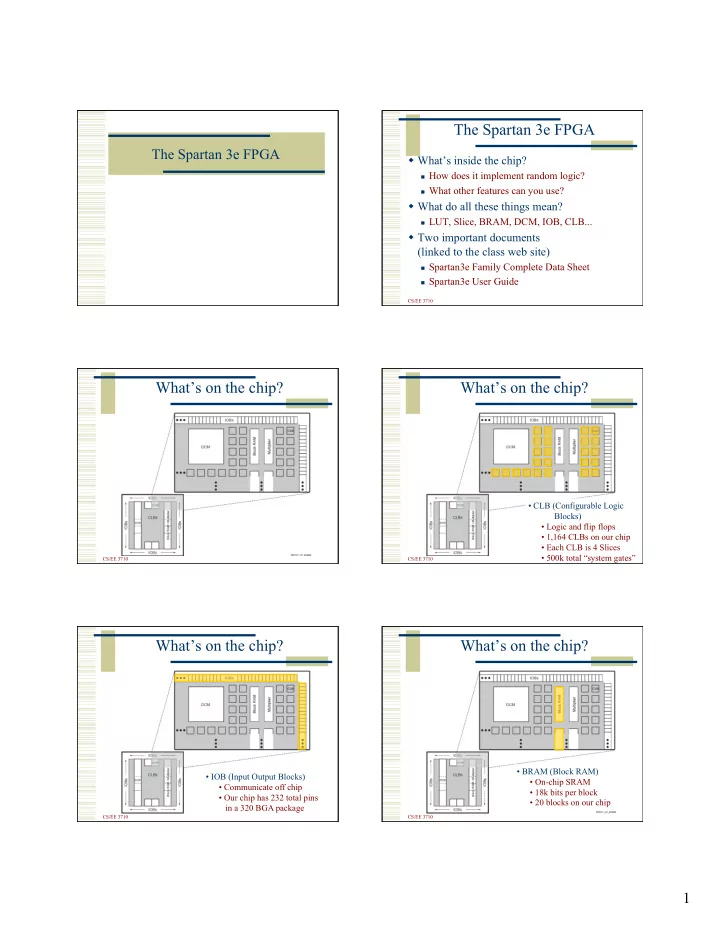
 What’s inside the chip?

 How does it implement random logic?  What other features can you use?

 What do all these things mean?

 LUT, Slice, BRAM, DCM, IOB, CLB...

 Two important documents (linked to the class web site)

 Spartan3e Family Complete Data Sheet  Spartan3e User Guide CS/EE 3710

What’s on the chip?

CS/EE 3710

What’s on the chip?

  • CLB (Configurable Logic

Blocks)

  • Logic and flip flops
  • 1,164 CLBs on our chip
  • Each CLB is 4 Slices
  • 500k total “system gates”

CS/EE 3710

What’s on the chip?

  • IOB (Input Output Blocks)
  • Communicate off chip
  • Our chip has 232 total pins

in a 320 BGA package

CS/EE 3710

What’s on the chip?

  • BRAM (Block RAM)
  • On-chip SRAM
  • 18k bits per block
  • 20 blocks on our chip
slide-2
SLIDE 2

2

CS/EE 3710

What’s on the chip?

  • Multiplier
  • Custom 18x18 multiplier
  • One per RAM block...

CS/EE 3710

What’s on the chip?

  • DCM (Digital Clock Manager
  • Clock generation and

distribution

  • Four on our chip

CS/EE 3710

What’s on the chip?

  • Programmable Interconnect
  • Connect everything together
  • Perhaps the most critical

part of the chip!

CS/EE 3710

CLB: Configurable Logic Block

 4 “Slices” per CLB

 The slices work together to make logic, flip flops,

distributed RAM, or shift registers

 Connected to other CLBs through Switch Matrix CS/EE 3710

Left and Right Slices

 SRL16 = 16-bit shift register  RAM16 = 16-bit RAM (16x1 bit memory)  LUT4 = four-bit lookup table (16x1 bit memory)  SLICEM = slice that can be memory or logic  SLICEL = slice that can only be logic

CS/EE 3710

What’s Really in a Slice?

slide-3
SLIDE 3

3

CS/EE 3710

LUT 4 – Basic Building Block

CS/EE 3710

LUT 4 – Basic Building Block

CS/EE 3710

Slice Muxes extend LUT4

CS/EE 3710

Once CLB – up to LUT7

CS/EE 3710

Top Half of a SliceM (left)

CS/EE 3710

Top Half of a SliceM (left)

slide-4
SLIDE 4

4

CS/EE 3710

Logic-only (combinational)

CS/EE 3710

Logic + register (sequential)

CS/EE 3710

Just register

CS/EE 3710

Fast Carry Path (arithmetic)

CS/EE 3710

Fast Carry Path (arithmetic)

CS/EE 3710

Fast Carry Path (arithmetic)

slide-5
SLIDE 5

5

CS/EE 3710

Mapping to CLBs

 Each LUT can go through a flip flop

 So, these circuits map to the same number of Slices CS/EE 3710

Mapping to CLBs

 How about these?

CS/EE 3710

Mapping to CLBs

 How about these?

CS/EE 3710

CLB Summary

 Each CLB = 4 slices  Each slice contains

 2 LUT-4  LUT can be random logic, or 16x1bit RAM or SR  2 flip flop  MUXs  Carry logic

 ISE reports how many slices you use

 among lots of other things... CS/EE 3710

IO Blocks

 Connections to the

  • utside world

 Each pin can be

configured a large number of ways

 Different signaling

voltages and drive currents

CS/EE 3710

IO Blocks

 Connections to the

  • utside world

 Each pin can be

configured a large number of ways

 Different signaling

voltages and drive currents

NOTE! No 5v!

slide-6
SLIDE 6

6

CS/EE 3710

Inside an IOB

CS/EE 3710

Interconnect

 Actually the most important part of the FPGA!

 Consumes the most area on the die  Consumes the most power on the die  In most cases, wires limit the performance

 But, hardly mentioned in the datasheet

 People are more impressed with logic CS/EE 3710

Interconnect

 RAM-programmable switches

 2,270,208 bits of configuration RAM!  Compare to 368,640 total bits of Block RAM  or 74,752 total bits of Distributed RAM (LUTs)

 Hierarchical organization

 Many fast, short wires with small drive  Fewer longer wires with high drive  LOTS of work goes into picking just the right

mix!

CS/EE 3710

Interconnect

CS/EE 3710

Interconnect

Four types

  • f wires

CS/EE 3710

Clock Routing

 Routed on a separate dedicated network

 Another reason to avoid gated clocks

 Recursive “Fish bone” network that minimizes clock skew  Clocks come from

  • ff-chip, or from

a DCM

slide-7
SLIDE 7

7

CS/EE 3710

Spartan XC3E500S

CS/EE 3710

Block RAM

We’ve seen details of these already…

CS/EE 3710

Behavioral Template

Dual-port 1 R/W 1 R

CS/EE 3710

Structural Template

CS/EE 3710

Structural Template

CS/EE 3710

Distributed RAM

slide-8
SLIDE 8

8

CS/EE 3710

Distributed RAM

CS/EE 3710

Distributed RAM

Dual-Port Distributed RAM

CS/EE 3710

Distributed RAM

Dual-Port Distributed RAM

CS/EE 3710

Digital Clock Manager (DCM)

CS/EE 3710

Digital Clock Manager (DCM)

CS/EE 3710

Digital Clock Manager (DCM)

slide-9
SLIDE 9

9

CS/EE 3710

Clock Skew

CS/EE 3710

Clock Skew

CS/EE 3710

Multipliers

CS/EE 3710

Multipliers

CS/EE 3710

Synthesis Output (mips example)

CS/EE 3710

Synthesis Output (mips example)

slide-10
SLIDE 10

10

CS/EE 3710

Synthesis Output (mips example)

CS/EE 3710

Synthesis Output (mips example)

CS/EE 3710

Synthesis Output (mips example)

CS/EE 3710

Implement Output (mips example)

CS/EE 3710

Implement Output (mips example)

CS/EE 3710

Implement Output (mips example)

slide-11
SLIDE 11

11

CS/EE 3710

Implement Output (mips example)

CS/EE 3710

Implement Output (mips example)

CS/EE 3710

Implement Output (mips example)

CS/EE 3710

Implement Output (mips example)

CS/EE 3710

Conclusion

 FPGAs are complex beasts!

 Made to be very general and flexible

 ASIC vs. FPGA?

 Rule of thumb, FPGA about 5 times slower

clock than ASIC

 FPGAs consume more power  FPGAs are bigger for the same function  ASICs are much more expensive to develop  NRE – Non-Recurring Engineering CS/EE 3710

ASIC vs. FPGA