NANOELECTRONICS AND ITS APPLICATION IN FUTURE INFORMATION PROCESSING - - PDF document

nanoelectronics and its application in future information
SMART_READER_LITE
LIVE PREVIEW

NANOELECTRONICS AND ITS APPLICATION IN FUTURE INFORMATION PROCESSING - - PDF document

NANOELECTRONICS AND ITS APPLICATION IN FUTURE INFORMATION PROCESSING D. K. Ferry, Arizona State University, Tempe, AZ 1 st Korean-US NanoForum October 14, 2003 Nanostructures Research Group CENTER FOR SOLID STATE ELECTRONICS RESEARCH As is


slide-1
SLIDE 1

Nanostructures Research Group

CENTER FOR SOLID STATE ELECTRONICS RESEARCH

NANOELECTRONICS AND ITS APPLICATION IN FUTURE INFORMATION PROCESSING

  • D. K. Ferry, Arizona State University, Tempe, AZ

1st Korean-US NanoForum October 14, 2003 Nanostructures Research Group

CENTER FOR SOLID STATE ELECTRONICS RESEARCH

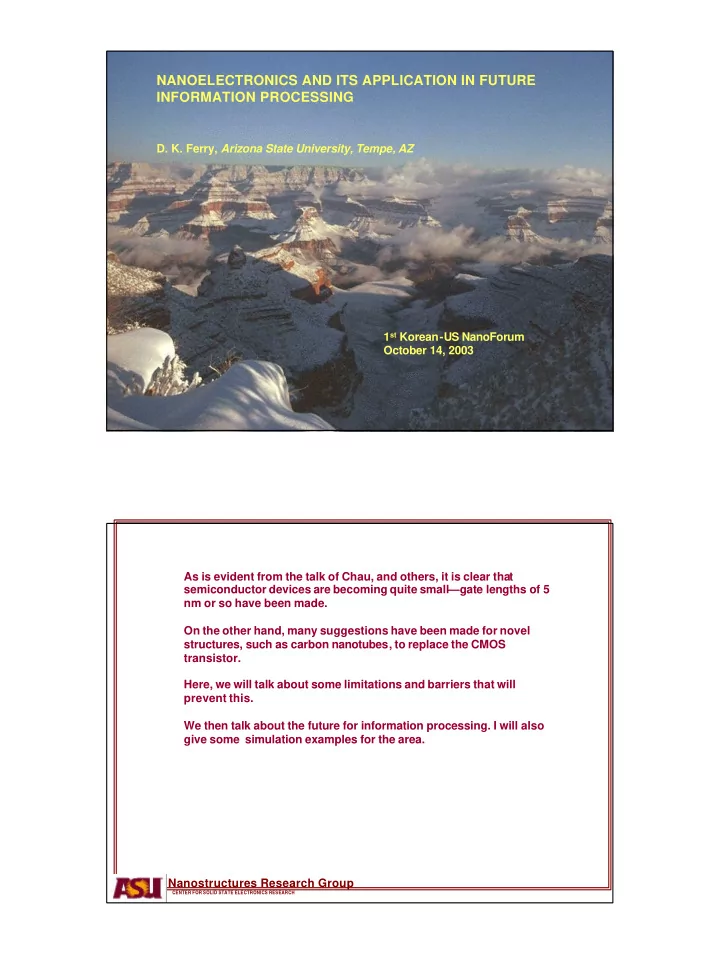
As is evident from the talk of Chau, and others, it is clear that semiconductor devices are becoming quite small—gate lengths of 5 nm or so have been made. On the other hand, many suggestions have been made for novel structures, such as carbon nanotubes, to replace the CMOS transistor. Here, we will talk about some limitations and barriers that will prevent this. We then talk about the future for information processing. I will also give some simulation examples for the area.

slide-2
SLIDE 2

Nanostructures Research Group

CENTER FOR SOLID STATE ELECTRONICS RESEARCH

The Microworld

0.1 nm 1 nanometer (nm) 0.01 µm 10 nm 0.1 µm 100 nm 1 micrometer ( µm) 0.01 mm 10 µm 0.1 mm 100 µm 1 millimeter (mm) 0.01 m 1 cm 10 mm 0.1 m 100 mm 1 meter (m) 100 m 10-1 m 10-2 m 10-3 m 10-4 m 10-5 m 10-6 m 10-7 m 10-8 m 10-9 m 10-10 m

Visible spectrum

The Nanoworld

The “Realm” of Nano-Electronics

DNA ~2 nm wide Ultrasmall MOSFET Lg ~ 20 nm

2001 TODAY Nanostructures Research Group

CENTER FOR SOLID STATE ELECTRONICS RESEARCH

(Chau, Intel) 20 nm critical sizes means that there are only about 80 atoms of the gate in the source-drain direction! If Silicon is going to continue to this size scale, what limitations are there? What options are there for novel new devices and/or quantum devices? I will address this in the remainder of this talk.

slide-3
SLIDE 3

Nanostructures Research Group

CENTER FOR SOLID STATE ELECTRONICS RESEARCH

What about some limitations?

There is a power limitation, in that Si can only dissipate on the order

  • f 10 W/cm2. If N is the number of devices per sq. cm., E is the energy

required to switch, f is the frequency of the clock, and P is the probability that a switch occurs in each clock cycle, then

The “quantum” limit, which also arises for SETs, comes from the

Nyquist criteria

Thermal limit of E > kBT

10 ≤ ENfP

h f E 100 / ≥

Nanostructures Research Group

CENTER FOR SOLID STATE ELECTRONICS RESEARCH

10-15 10-14 10-13 10-12 10-11 10-10 10-9 10-23 10-21 10-19 10-17 10-15 Time (s) Energy (J)

106 1010 108 Devices/cm2 Duty factor = 1% kBTat room temperature MPUs DRAM

35 nm “node ”

“Quantum”

While the SET promises great speed, this speed cannot be used at 300 K due to packing

  • limitations. It will not replace

current approaches on this basis. Cannot go below the packing density line due to power dissipation limitations
slide-4
SLIDE 4

Nanostructures Research Group

CENTER FOR SOLID STATE ELECTRONICS RESEARCH

It is widely claimed that new, novel structures will replace Si transistors by doing the job of silicon better! One such is the carbon nanotube (CNT). Consider one of the better versions, coming from a front-line research laboratory: 300 nm (S-D) tube 60 nm (S-D) tube Barely one

  • rder of

magnitude

  • n/off ratio
  • M. Radosavljevi?et al., APL 83, 2435 (2003)

Nanostructures Research Group

CENTER FOR SOLID STATE ELECTRONICS RESEARCH

0.6 eV gap will lead to breakdown as well.

  • M. Radosavljevi?et al., APL 83, 2435 (2003)
slide-5
SLIDE 5

Nanostructures Research Group

CENTER FOR SOLID STATE ELECTRONICS RESEARCH

Experiment V nA V nA g

peak m

/ 150 2 . 30 ~

,

= A typical CNT has a diameter (or circumference) of say ~3nm: mm mS nm nS g

peak m

/ 50 / 50 ~

,

=

  • M. Radosavljevi?et al., APL 83, 2435 (2003)

Nanostructures Research Group

CENTER FOR SOLID STATE ELECTRONICS RESEARCH

mm mS m S V m A g

peak m

/ 800 / 800 1 . / 80 ~

,

= = µ µ µ µ

slide-6
SLIDE 6

Nanostructures Research Group

CENTER FOR SOLID STATE ELECTRONICS RESEARCH

One does not give away transconductance! The ability to drive other gates is directly dependent upon the transconductance. The MOSFET has more ~50 years of work in optimizing its performance. It performs excellently in its job, and is not likely to be replaced for this job!

Nanostructures Research Group

CENTER FOR SOLID STATE ELECTRONICS RESEARCH

10-15 10-14 10-13 10-12 10-11 10-10 10-9 10-23 10-21 10-19 10-17 10-15 Time (s) Energy (J)

106 1010 108 Devices/cm2 Duty factor = 1% kBTat room temperature MPUs DRAM

“Quantum”

NEW DEVICE TYPES MUST PRODUCE ENHANCED FUNCTIONALITY: Same function with fewer devices. SCALING

slide-7
SLIDE 7

Nanostructures Research Group

CENTER FOR SOLID STATE ELECTRONICS RESEARCH

SOI MOSFET Structure

TBOX=30 nm Gate 2nm SiO2 Drain Source Buried SiO2 Substrate Contact n+ n+ p TSi 50 nm 40 nm 50 nm

Nanostructures Research Group

CENTER FOR SOLID STATE ELECTRONICS RESEARCH

slide-8
SLIDE 8

Nanostructures Research Group

CENTER FOR SOLID STATE ELECTRONICS RESEARCH

The discreteness of charge is now observable in these small devices: We cannot use average densities any more, but must account for the exact position of impurities and individual atoms. The inter-particle Coulomb interaction becomes extremely important in device operation and particle motion. Nanostructures Research Group

CENTER FOR SOLID STATE ELECTRONICS RESEARCH

slide-9
SLIDE 9

Nanostructures Research Group

CENTER FOR SOLID STATE ELECTRONICS RESEARCH

While it is not likely that MOSFETs will be replaced, for their applications, there nevertheless are many applications for which new structures, such as molecules, may provide new applications. One such is for organic LEDs, since the molecules are good at emitting in the blue end of the spectrum. Here, we are studying transport through a metal-molecule -metal structure, using the techniques developed for semiconductor devices. The question we ask is how the conductance changes with stress on the molecule. The experiments are done by Tao et al. (ASU). Force Nanostructures Research Group

CENTER FOR SOLID STATE ELECTRONICS RESEARCH

Force

slide-10
SLIDE 10

Nanostructures Research Group

CENTER FOR SOLID STATE ELECTRONICS RESEARCH

Conclusions:

It is unlikely that Si-based MOSFETs will be replaced in VLSI. Novel transistors (CNTs, molecules, etc.) need to find new applications, for which the Si MOSFET is not a competitor. While we have been focusing on trying to use simple molecules to make FETs, this is the wrong approach. We need to enhance the functionality

  • f each device.

We need to use the molecules to bridge the electronics —biology gap to make sensors for biological applications or for biological control. Nanostructures Research Group

CENTER FOR SOLID STATE ELECTRONICS RESEARCH

HOMO Level

slide-11
SLIDE 11

Nanostructures Research Group

CENTER FOR SOLID STATE ELECTRONICS RESEARCH

LUMO Level