
SLIDE 1
NIRCam: The JWST Near-IR Camera and Slitless Spectrograph Thomas - - PowerPoint PPT Presentation
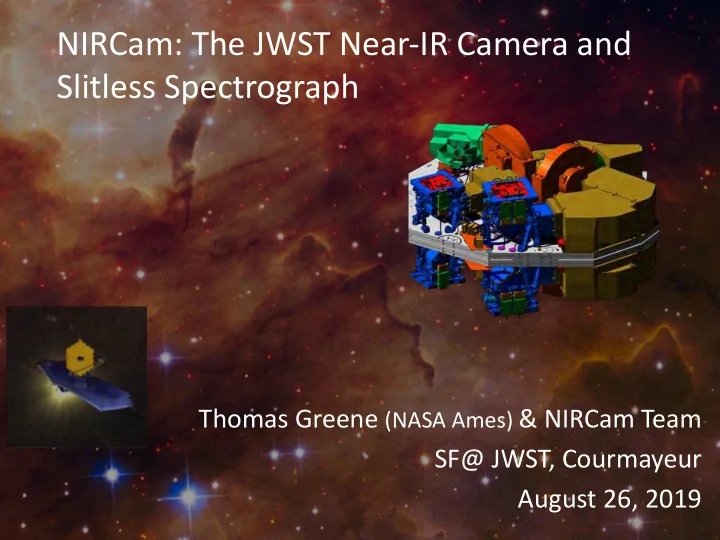
NIRCam: The JWST Near-IR Camera and Slitless Spectrograph Thomas Greene (NASA Ames) & NIRCam Team SF@ JWST, Courmayeur August 26, 2019 Contents NIRCam overview NIRCam modes Detectors and Subarrays Imaging
26 August 2019 NIRCam: The JWST Near-IR Camera 2
for JWST
– Two nearly identical modules (A & B) with refractive designs to minimize mass and volume – Dichroic used to split range into short (0.6– 2.3µm) and long (2.4–5µm) channels – Nyquist sampling at 2 and 4µm – 2.2 arc min x 4.4 arc min total field of view seen in two colors (40 MPixels) – Coronagraphic capability for both short and long wavelengths – Dispersive components in short and long channels allow slitless spectroscopy – Led by the University of Arizona (PI M. Rieke) and fabricated by Lockheed Martin
sensor
3 26 August 2019 NIRCam: The JWST Near-IR Camera
4
26 August 2019 NIRCam: The JWST Near-IR Camera 4
26 August 2019 5 NIRCam: The JWST Near-IR Camera
26 August 2019 NIRCam: The JWST Near-IR Camera 6
26 August 2019 NIRCam: The JWST Near-IR Camera 7
26 August 2019 NIRCam: The JWST Near-IR Camera 8
Blue and red correspond to the short and long wavelength channels,
each module. The coronagraphy field of view, located above the detectors on this plot, is projected onto the detectors when in use (from Jdox).
26 August 2019 NIRCam: The JWST Near-IR Camera 9
(LW)
From OTE
0.6 – 2.4 µm 2,4 – 5 µm
No Short Wavelength Spectroscopic Capabilities in Cycle 1 2 LW grisms in each module provide R~1500 slitless spectroscopy: Chose dispersion orientation and filters to suit your science
Simultaneous SW & LW
are possible
26 August 2019 10 NIRCam: The JWST Near-IR Camera
26 August 2019 11 NIRCam: The JWST Near-IR Camera
26 August 2019 NIRCam: The JWST Near-IR Camera 12
S/N = 10 detection limits for point sources in a 10 ks image (comprised of 10 exposures, 1 ks each). The sources are assumed to have flat spectra in nJy (and AB magnitudes). Zodiacal light is assumed to be 1.2 times the minimum. Filter widths are shown as horizontal bars.
26 August 2019 NIRCam: The JWST Near-IR Camera 13
26 August 2019 NIRCam: The JWST Near-IR Camera 14
26 August 2019 NIRCam: The JWST Near-IR Camera 15
Krist+ 2007 SPIE
26 August 2019 NIRCam: The JWST Near-IR Camera 16
Jdox / Beichman+ 2010 PASP Roll subtraction (+5° and -5°) for speckle suppression. 10 mas position error, 10 nm wavefront error between rolls (Jdox / Beichman+ 2010 PASP) Approx ground-based limit M band (4.7 µm) for M0V @ 4pc (Krist+ 2007 SPIE)
26 June 2016 SPIE: NIRCam Spectroscopy 17
NIRCam Si grism
26 June 2016 SPIE: NIRCam Spectroscopy 18
Grism undeviated wavelength is 4.0 µm Increasing l 2.’2 * NIRCam FOV is 2.’2 x 2.’2 with dispersion of 10 Å per 0.”065 x 0.”065 pixel *
26 August 2019 NIRCam: The JWST Near-IR Camera
19
Greene+ (2018 JATIS 035001-3)
26 August 2019 NIRCam: The JWST Near-IR Camera 20
26 August 2019 NIRCam: The JWST Near-IR Camera 21
Greene+ 2017 JATIS
26 August 2019 NIRCam: The JWST Near-IR Camera 22
Strong scientific synergy with the NIRISS (planets in formation and star clusters), MIRI (extinction mapping, protostars, disks, and star formation in local group), NIRSPEC, IDS (star clusters near and far) Teams.
26 August 2019 NIRCam: The JWST Near-IR Camera 23
infrared-camera
http://www.stsci.edu/hst/proposing/apt
26 August 2019 NIRCam: The JWST Near-IR Camera 24