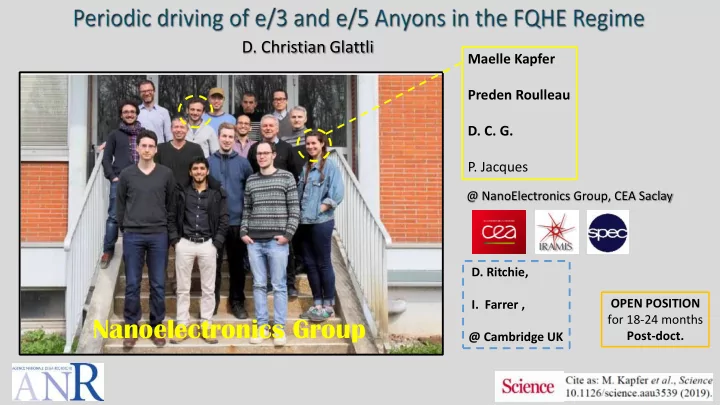
Nanoelectronics Group
@ NanoElectronics Group, CEA Saclay
Maelle Kapfer Preden Roulleau
- D. C. G.
- P. Jacques
- D. Ritchie,
- I. Farrer ,
@ Cambridge UK OPEN POSITION for 18-24 months Post-doct.
- D. Christian Glattli
Nanoelectronics Group Post-doct. @ Cambridge UK PERIODIC DRIVING - - PowerPoint PPT Presentation
D. Christian Glattli Maelle Kapfer Preden Roulleau D. C. G. P. Jacques @ NanoElectronics Group, CEA Saclay D. Ritchie, OPEN POSITION I. Farrer , for 18-24 months Nanoelectronics Group Post-doct. @ Cambridge UK PERIODIC DRIVING of a
@ NanoElectronics Group, CEA Saclay
@ Cambridge UK OPEN POSITION for 18-24 months Post-doct.
quantum inductance ~ (h/e2)τ, quantum capacitance ~ (e2/h)τ , charge relaxation (or Büttiker’s) resistance h/2e2
For voltage pulses on a contact V(t)=Vdc +Vac(t):
→ single-electron transport
) (t V
Energy
) (t I
F
E
h h 2
F
E
(D)
eVdc= hν V(t) 𝜁 − ℎ𝑤 𝜁 − 2ℎ𝑤
Current Heat current
2
) ( ) ( t v t I
F
) ( * ) ( Im ) ( t dt t d v t I
F Q
M.F. Ludovico, J. S. Lim, M. Moskalets, L. Arrachea, D. Sanchez (2014)
.... ) / 2 ( ) / ( ) / ( ) ( ) (
. . 2 . . 1 . . 1 . . .
q h V O P q h V O P q h V O P V O P V O
dc C D dc C D dc C D dc C D dc A P
O : current, heat, current noise, heat noise, ….
t l i t i T l
2 ) (
EF
t
quantum capacitor electron source
t
e t
) (
2 2 2
) ( 1 ) (
t iw t t 1 ) (
) (t V
EF
w
e
. 2
) (
voltage pulse source:
leviton
Levitov, Lee,Lesovik, J. Math. Phys.(1996) Keeling, Klich and Levitov PRL 97, 116403 (2006) Dashti, Misiorny, Kheradsoud, Samuelsson, and Splettstoesser, PRB 100, 035405 (2019)
Energy
) (t I
F
E
h h 2
F
E
) ( ~ f
(D)
eVdc= hν electrons (no) hole V(t)
time 1e- … 1e- (periodic Levitons) Sine Pulses
electrons
) ( ~ f
holes
Energy
) (t I
F
E
h h 2
F
E
(D)
eVdc= hν V(t) 𝜁 − ℎ𝑤 𝜁 − 2ℎ𝑤
Lorentzian Pulses
) ( ) ( t V V t V
ac dc
time 1e- 1e- …
) (t V
l and l l
t l i t i T l
2 ) (
t ac
dt t V h e t ' ) ' ( ) (
0,00 0,25 0,50 0,75 1,00 0,0 0,2 0,4 0,6 0,8 1,0 1,2 1,4 1,6 Time delay (period unit) /T SI
coll./SI
Lorentzian Wave =2 ( 2e
Lorentzian Wave =1 ( 1e
VG
V(t)
VG V(t+τ) 2 1 1
HOM I
2 2 2 2 1 1
HOM I
(many particle HOM experiments open a new field of quantum investigations)
DOI 10.1002/pssb.201600650
659–663 (2013)
1054–1057 (2013)
WDF WDF
(quasi-probability) NEGATIVE PARTS (blue) reflect Quantum Coherence)
(X. G. Wen (1991) )
S
i
(Leynaas+Mirrheim 1977, Wilczek 1982 ) expected for Fractional Quantum Hall effect (FQHE) quasiparticles (Arovas, Schrieffer, Wilczek 1984)
C
l e
2
a
z
b
z
) , ( 3 exp ) , (
2 2 a b holes b a holes
z z i z z
Berry phase
Example: for filling factor ν = 1/3 ( = 1 electron/3 quantum states) a quasi-hole particle has a charge e*=-e/3 (Laughlin 1983)
ν = 1/3;1/5,2/5,3/7, …
, ,
a b b a
ν = 5/2, 7/2, … Majorana a b c a c b
a
z
b
z e*=e/4 a b
S
i
ν = 5/2 (Moore, Read 1991, Wen 1991) Non-abelian anyons should allow topological quantum computation (Freedman, Kitaev 2002)
Photon 1 Photon 2 Anyon 1 Anyon 2 1 2(1) in
X coincidence recording 1(2) 2 Bosons: θS =0 Fermions: θS =π beam- splitter
2 2
S
i
ir t t ir S
S B . .
Hong, Ou, & Mandel (1987)
Photon 1 Photon 2 Anyon 1 Anyon 2 X coincidence recording Bosons: θS =0 Fermions: θS =π beam- splitter
2 2
S
i
1 2(1) in
1(2) 1
ir t t ir S
S B . .
Photon 1 Photon 2 Anyon 1 Anyon 2 X coincidence recording Bosons: θS =0 Fermions: θS =π beam- splitter
2 2
S
i
ir t t ir S
S B . .
1 2(1) in
1(2) 1
Statistical measurements: Current noise SI = 2 (e*)2 ν (1 – P(1,2))= (e*)2 ν (1 + g2(τ)cos θS )
III-V semi-conductor heterojunction GaAs/GaAlAs 2D electrons density of state
h eB n
c
2 1
c
2 3
c
2 5 energy
c
m A e p m H 2 2 1
2 2
eB y Y eB x X
x y
) , ( y x
) , ( Y X
eB /
cyclotron motion
eB i Y X eB i
y x
, , 2 1 n E
c n
e h Y X B .
cyclotron motion is frozen 1D dynamics
Integer Quantum Hall Effect (IQHE) Rhall=(h/e2)1/ =1,2,3, …
) ( 1
2
k e h n e B R
s Hall
density of state
h eB n
c
2 1
c
2 3
c
2 5 energy
c
III-V semi-conductor heterojunction GaAs/GaAlAs 2D electrons
cyclotron motion drift chiral 1D EDGE CHANNELS
( no current in the bulk ) ( edge current )
x
c
2 1
c
2 3
c
2 5
energy
n=0 n=1 n=2
z B E v
conf drift
ˆ
.
drift
. conf
ν = 2
Integer Quantum Hall Effect (IQHE) Fractional Quantum Hall Effect (FQHE) Rhall=(h/e2)1/ =1,2,3, … Rhall=(h/e2)1/ =1/3,2/5,3/7, …2/3, 3/5, 4/7, … 1/3 2/5
a
z
b
z
e*=e/3
2D-electrons Anyons Ѱ(a,b)=eiθ Ѱ(b,a) =π/3
FQHE → C-F. IQHE ν = 1/3 → ν=1 ν = 2/5 → ν=2 ν = 3/7 → ν=3 …. → …. e*=e/5 e*=e/3 B: WB in 2/5 Plateau 1/3 A: WB in 1/3 while 2/5 reflected
A B
νB=2/5 νB=2/5 νB=2/5
ν = 1/3
μR μL e*Vdc Vdc e* μR –μL = e*Vdc IB(Vdc) SI
DC =2e* |IB| (Schottky)
DC Shot Noise DC Transport
e* e*
dc B B dc B DC I
weak coupling limit
μR μL e*Vdc V(t)
e* μL+hf μL-hf
P0 SI
DC
P-1 SI
DC(Vdc-hf/e*)
P1 SI
DC(Vdc+hf/e*)
DC Shot Noise
hf/e* Pl : probability to absorb (emit) l >0 (<0) Photons V(t)=Vdc + Vaccos(2πft)
Lesovik and Levitov (1994)
PASN = P0 SI DC(Vdc) + P1 SI DC(Vdc+hf/e*) + P-1 SI DC(Vdc-hf/e*)+…
μR μL e*Vdc V(t)
e*
V(t)=Vdc + Vaccos(2πft) μL+hf μL-hf
hf/e* PASN DC Shot noise
PASN = P0 SI DC(Vdc) + P1 SI DC(Vdc+hf/e*) + P-1 SI DC(Vdc-hf/e*)+…
Pl : probability to absorb (emit) l >0 (<0) Photons V(t)=Vdc + Vaccos(2πft)
Lesovik and Levitov (1994)
2/5 1/3 A B e/5 e/3 case A: case B: =2/5 =2/5 =2/5 =2/5 1/3
V It IB Samples: ns =1.07 1011 cm-2 μ=3 106 cm2V-1s-1 (from I. Farrer, D. Ritchie, Cambridge UK) S.E.M. view Nanolithography at SPEC (M. Kapfer) =Vdc+Vac(t)
14 Tesla Dry Magnet 13mK base temperature 2.2 MHz Δf=~150kHz Home-made Cryo-amp. (0.22nV)2/Hz CROSS-SPECTRUM 0-26GHz It IB V1 V2
e/3 B=2/5 B=2/5
1/3
2/5 1/3 A B
dc B B dc B DC I
e*= e/3 ! confirms ’97-’98 experiments
(Saclay PRL 97, Weizmann Nat. 97 and 99)
e/3 Vdc It+It(t) IB+IB(t)
e/3 B=2/5 B=2/5
1/3
2/5 1/3 A B
ac dc
Vac 100 μV for -67dBm Vdc+Vaccos(2πft) f=22GHz
e/3 B=2/5 B=2/5
1/3
2/5 1/3 A B
ac dc
Vac 200 μV for -61dBm f=22GHz
Vdc+Vaccos(2πft)
e/3 B=2/5 B=2/5
1/3
2/5 1/3 A B
ac dc
Vac 200 μV for -61dBm
1
dc DC I dc DC I dc DC I dc PASN I
2 1 1 1 2
* *
hf V e J P P hf V e J P
ac ac
f=22GHz
1
dc DC I dc DC I dc DC I dc PASN I I
Excess PASN: Finding a flat variation for the low |Vdc| range provides a determination of P0
WHY a FLAT VARIATION?
P0 SI
DC
P-1 SI
DC(Vdc-hf/e*)
P1 SI
DC(Vdc+hf/e*)
DC Shot Noise
hf/e*
hf/e* Excess PASN
SI = SI
PASN (Vdc) –
P0 SI
DC (Vdc)
= P1 [SI
DC (Vdc – hf / e*) + SI DC (Vdc + hf / e*) ]
Finding a flat variation for the low |Vdc| range provides a determination of |p0|2 as: P0 +2 P1 1 , this gives P1
1
dc DC I dc DC I dc DC I dc PASN I I
Excess PASN:
Finding a flat variation for the low |Vdc| range provides a determination of |p0|2 as: P0 +2 P1 1 , this gives P1 comparison using fJosephson=e*Vdc/h with e*=e/3
1
dc DC I dc DC I dc DC I dc PASN I I
Excess PASN:
MEASURING e* from Excess PASN: threshold voltage : VJ=hf/e* scales with frequency! Best fit of data with e* free parameter e*=1/(3.07±0.05)
1
dc DC I dc DC I dc DC I dc PASN I I
2/5 1/3 A B
dc B B dc B DC I
e*= e/5 ! Vdc It+It(t) IB+IB(t) - <IBIt> e/5 B=2/5 B=2/5 e*=e/5 confirms Weizmann results (Reznikov 1999) on 2/5
MEASURING e* from Excess PASN: threshold voltage : VJ=hf/e* scales with frequency! Best fit of data with e* free parameter
e*=e/(5.17±0.31)
1
dc DC I dc DC I dc DC I dc PASN I I
time 1e- 1e- …
) (t V
See: theory prediction for photo-assisted current noise at ν=1/3
and T. Martin, . Phys. Rev. Lett. 118, 076801 (2017) Also heat noise at at ν=1/3
e/3 (e) (e) e/3
state
state H.O.M. Beam Splitter ANYON SOURCE ANYON SOURCE
. 2 stat d u
A DC version can be find in: ``Current Correlations from a Mesoscopic Anyon Collider ‘’ B. Rosenow, I. P. Levkivskyi, B. I. Halperin, (2016)
OLD METHOD NEW METHOD e/3 and e/5: M. Kapfer et al. SCIENCE, Vol. 363 pp. 846-849 (2019) e/3 finite frequency noise, R. Bisognin et al. Nature Communications (2019)
The Josephson Frequency of fractionally charge anyons
pfer er, P. Roulleau, I. Farrer, D. A. Ritchie, and D. C. Glattli,
SCIENCE, Vol. 363 pp. 846-849 (2019)
Levitons :
ure e 502, 659 (2013)
re 514, 603 (2014)
I Safi
All members of Nanoelectronics Group at Saclay ANR FullyQuantum AAP CE30 UltraFastNano FET Open H2020.
SPEC CEA-Saclay
OPEN POSITION for 18-24 months Post-doct. soon coming !
time 1e- 1e- …
) (t V
See: also: Jérome Rech’s Talk, Wednesday Session 3-C, and
and T. Martin, . Phys. Rev. Lett. 118, 076801 (2017)
e dt t I t V h e e t I dt t V e ) ( ) ( * ) ( 2 ) ( * 1
Why only charge e levitons in FQHE.
e e
strong barrier :
= 1 = 1
V
2 0
2 0
1 2 D eI SI 1 2 D eI S
B I
) 1 ( 2 D D I e S I
B
I I I h V e I
2
/
transmitted (D) reflected (1-D) (rarely transmitted electrons) (incoming electrons)
e e
(rarely transmitted holes) weak barrier :
Poisson’s statistics
JETP Letters49, 594 (1989) Schottky (1918)
h/eV
e e/3
strong barrier :
= 1/3 = 1/3
V
h V e I 3 /
2 0
h V e I 3 /
2 0
1 2 D eI SI
1 3 2 D I e S
B I B
I I I h V e I
2
3 /
transmitted (D) reflected (1-D) (rarely transmitted electrons) (incoming electrons)
e e
(rarely transmitted holes) weak barrier :
e e e/3 e/3
derived from chiral-Luttinger liquid approach ( X.G. Wen 1995, C. Kane + M. Fisher 1994; Fendley, Ludwig + Saleur (1995)) First observation: CEA Saclay 1997 Weizmann 1997
h/3eV =1/3 =1/3
JOSEPHSON RELATION
qV (L) conductor (R) conductor q micro-wave photon hf
CEA Saclay
2e JOSEPHSON RELATION
qV
V I
energy
2e JOSEPHSON RELATION
qV
V I hf/q
hf
e JOSEPHSON RELATION
qV
V SI Lesovik + Levitov (1994)
e JOSEPHSON RELATION
qV
V SI hf/q
Lesovik + Levitov (1994)
hf micro-wave photon
e* JOSEPHSON RELATION
qV
e* V =1/m =1/m q=e* = e/m hf Lesovik + Levitov (1994) X.G. Wen (1995) V SI hf/e*
energy
F
t ac
dt t V e t ' ) ' ( ) (
/ ) (
t i t i
) (t Vac
``single side band spectrum’’
) ( / t i t i x k i
EF ) ( ~ f
) (t V el. hole
requires :
energy
F
t ac
dt t V e t ' ) ' ( ) (
/ ) (
t i t i
) (t Vac
``single side band spectrum’’
) ( / t i t i x k i
EF ) ( ~ f
) (t V el. hole
t i
) (
t ' t i iw
energy
F
t ac
dt t V e t ' ) ' ( ) (
/ ) (
t i t i
) (t Vac
``single side band spectrum’’
) ( / t i t i x k i
EF ) ( ~ f
) (t V el. hole
t i
) (
) /( 2 /
2 2
w t w dt d
t ' t i iw
energy
F
t ac
dt t V e t ' ) ' ( ) (
/ ) (
t i t i
) (t Vac
``single side band spectrum’’
) ( / t i t i x k i
EF ) ( ~ f
) (t V el. hole
2 ) (
t i
) /( 4 /
2 2
w t w dt d
t ' t i iw
energy
F
t ac
dt t V e t ' ) ' ( ) (
/ ) (
t i t i
) (t Vac
``double side band spectrum’’ for non-integer charge
) ( / t i t i x k i
) (t V hole
e q t i
/ ) (
) /( 2 /
2 2
w t w e q dt d
EF ) ( ~ f
el.
fractional q
« Dynamical orthogonality catastrophe » Levitov 1995
) (t V
fractional q
energy
F
t ac
dt t V e t ' ) ' ( ) (
/ ) (
t i t i
) (t Vac
``double side band spectrum’’ for non-integer charge
) ( / t i t i x k i
hole
e q t i
/ ) (
) /( 2 /
2 2
w t w e q dt d
EF ) ( ~ f
el.
minimal excitation states (levitons) for integer charge only