How do we charge a capacitor? Battery Device that generates and - - PDF document

how do we charge a capacitor battery
SMART_READER_LITE
LIVE PREVIEW

How do we charge a capacitor? Battery Device that generates and - - PDF document

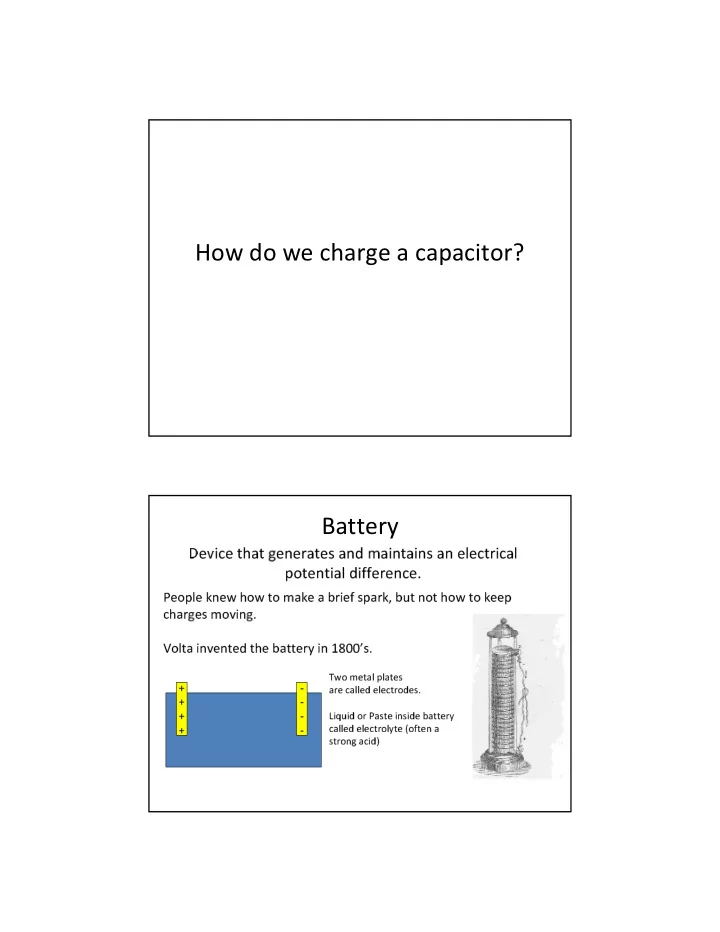
How do we charge a capacitor? Battery Device that generates and maintains an electrical potential difference. People knew how to make a brief spark, but not how to keep charges moving. Volta invented the battery in 1800s. Two metal plates


slide-1
SLIDE 1

How do we charge a capacitor?

People knew how to make a brief spark, but not how to keep charges moving. Volta invented the battery in 1800’s.

  • +

+ + +

Liquid or Paste inside battery called electrolyte (often a strong acid) Two metal plates are called electrodes.

Battery

Device that generates and maintains an electrical potential difference.

slide-2
SLIDE 2

By using two different metals for the electrodes, we can have two different chemical reactions. The reactions build up charges creating the electrical potential difference between the metal electrodes. One unit is called a “cell”. Many cells put together is called a battery. Example: Car battery is six 2 V cells = 12 V battery

Battery

Each cell consists of a lead (Pb) electrode and a lead oxide (PbO2) electrode immerse in a solution

  • f water and sulfuric acid (H2SO4).

The “Mac Gyver” Battery

slide-3
SLIDE 3

EMF

When the battery is not connected, the charges have nowhere to go: they feel a potential, but they stay in the electrodes When we “close” the circuit, charges can move, can circulate, producing a “current” http://www.youtube.com/watch?v=F1p3fgbDnkY&NR=1 Analog between a battery and an escalator.

  • +++++++++++++

+ + + ∆Vbat

Electro motive force (EMF)

slide-4
SLIDE 4

Charging a capacitor

The electrons will flow through the wires. However, they cannot jump through the empty space between the plates. Charges will accumulate in the plates until the potential difference or voltage equals the one in the battery.

Electric current

8

= = ∆ ∆ ≡ dt dQ t Q I

Rate of flow of charge Units [I] = Coulombs/second = Ampere (A) or “Amp”

slide-5
SLIDE 5

Electrons flow in metals, not the protons, so the negative electric charges are moving.

  • e

E

E e E q F v v v − = =

Electrons go “upstream” against the electric field vector.

What or “who” is carrying the current?

Flow of negative charge in one direction is equivalent to flow of positive charge in the opposite direction.

Current direction

By convention, we define the direction of current “I ” as the direction of flow of (imaginary) positive charges. In reality, of course, it is often negative charges flowing the other way. Whose fault is this?

I

  • e
  • e
slide-6
SLIDE 6

Microscopic description

d d d d

nqv A I J JA nqAv dt dQ I dt nqAv dt nAv q dN q dQ = = = = = → = = = ) ( ) (

Current density

How many electrons are flowing by when I = 1.0 A? C e

19

10 6 . 1

× = t N e t Q I

e

∆ ∆ = ∆ ∆ = sec / 10 6 . 5

18elec

e I t Ne × = = ∆ ∆

Example

I = 10 mA = 0.01 Amps is lethal ! Yet, I could grab a wire carrying 1000 Amps and be safe. Why? My body has a much higher electrical resistance than metal. Thus, the electrons prefer to mostly flow through the wire – not my body!

slide-7
SLIDE 7

Most materials are Ohmic. In Ohmic materials, the current (I) is proportional to the electric field

  • r the electrical potential difference (V).

High V Low V E

d

d E V V | | v = ∆ = V I ∝

(Ohmic material)

constant = I V

Electric resistance

Resistance R of a piece of wire (or other material)

constant = ≡ I V R

“Ohm’s Law”

IR V =

This is not really a physical law. It is true for perfectly Ohmic materials. Resistance has units of Ohms = Ω = Volts/Amp

Ohm’s Law

slide-8
SLIDE 8

CPS question

A light bulb is attached to a battery with constant voltage V. The light filament has resistance R. When the light bulb is first turned on by attaching to the battery, the filament heats up rapidly, and as it heats, its resistance R increases (due to increased scattering of electrons by thermal vibrations). As the light bulb filament heats up, the current i in the filament A) Increases B) Decreases C) Remains the same.

V stays constant, R increases, so I = V/R decreases

CPS question An ideal battery produces a fixed? A)Current Output B)Electric Potential Energy Output C)Power Output D)Electric Potential Difference E) None of the Above

slide-9
SLIDE 9

Ohmic behavior

Silicon chip characteristic. Where is the Ohmic and non Ohmic behavior?

Resistors

R V=5V I

Ideal wire Rwire = 0.

= = ∆

wire wire

IR V

Ideal battery Rbattery = 0. Non-ideal Battery

slide-10
SLIDE 10

Flow of electrons in wire or resistor is like flow of water in a full pipe (no bubbles or leaks).

A C B

IA = 2 gallons/min IC = 2 gal/min IB = 2 gal/min High Pressure Low Pressure High Voltage Low Voltage I I I

Resistors (cont.)

Resistance R of a piece of conductor depends on 1) Composition or Material 2) Shape and Dimensions

A = Area L = Length

A L R ρ =

Where ρ is resistivity – measure of internal friction; dependent on material composition.

Resistivity

slide-11
SLIDE 11

What is the source of resistivity?

Resistivity originates from “internal friction” or interaction between the electrons carrying the current and other degrees of freedom inside the solid, mainly atoms vibrating (phonons)

Resistivity and temperature

)] ( 1 [ ) ( T T T − + = α ρ ρ

Temperature dependence over a small interval in T (Taylor expansion) α is called “temperature coefficient of resistivity”

slide-12
SLIDE 12

CPS question

1 2

Two cylindrical resistors are made of the same material (same resistivity ρ). Resistor 2 is twice as long and has twice the diameter of resistor 1. What is the ratio R2/R1? A) 2 B) 4 C) 1/2 D) 1/4 E) 1

Answer:

2 2 1 1 1 2

R L A 1 1 2 R L A 4 2 = = × = (the resistivities cancel)

Microscopic version of Ohm’s Law

EL V L J A L JA IR V = = ⎟ ⎠ ⎞ ⎜ ⎝ ⎛ = = ρ ρ ) (

J E ρ =

They are equivalent.

area current A I J = =

Current density

J E IR V ρ = ↔ =

http://www.youtube.com/watch?v=5laTkjINHrg&feature=related

slide-13
SLIDE 13

E E J σ ρ = = 1

Conductivity is the inverse of Resistivity.

Conductivity

Same as resistivity, depends only on the composition or material A copper cylinder is machined to have the following shape. The ends are connected to a battery so that a current flows through the copper.

A C B

Which region A, B, or C has the greatest magnitude current I? A B C D) all three have the same I

CPS question

slide-14
SLIDE 14

A copper cylinder is machined to have the following shape. The ends are connected to a battery so that a current flows through the copper.

A C B

Which region A, B, or C has the greatest magnitude current density J? A B C D) all three have the same J.

CPS Question

Region B has the largest current density J = I/A. All 3 regions have the same current I, so the region with the smallest A has the largest J.

CPS question

A copper cylinder is machined to have the following shape. The ends are connected to a battery so that a current flows through the copper.

A C B

Which region A, B, or C has the greater conductivity? A B C D) all three have the same σ. All three regions have the same conductivity σ. Conductivity σ is a property of the material type, not of the shape of the sample.

slide-15
SLIDE 15

CPS question

A copper cylinder is machined to have the following shape. The ends are connected to a battery so that a current flows through the copper.

A C B

Which region A, B, or C has the greatest magnitude electric field? A B C D) all three have the same |Ε|. Region B has the largest E-field. J = σ E, J is largest is region B (from the 1st part of this question), σ is constant for all regions, so E must be max where J is max, in region B.

Potential changes around a circuit

slide-16
SLIDE 16

Energy and Power in circuits

What happens to the resistor (light bulb) when we turn it on? It emits light. It also gets hot ! Heat is a form of energy. Power P = Energy/Time = [Joules/second] = [Watts] Inside a current carrying resistor, electrostatic potential energy is converted into thermal energy (heat).

Energy and Power in circuits

The moving charges (for example electrons) are shifting down in potential energy. In an interval of time ∆t , the amount of charge passing through a circuit element is:

V t I V Q U ) ( ) ( ∆ = ∆ = ∆ IV t V t I t U P = ∆ ∆ = ∆ ∆ = ) ( t I Q ∆ = ∆

The potential energy change for this amount of charge is The power delivered or extracted from the circuit element is:

slide-17
SLIDE 17

Power delivered to a resistor

I V or ∆V

IV P =

R V R I IV P

2 2

= = =

If the resistor is Ohmic, then V=IR and thus Where did the energy go? Energy goes into heat. Heat is in fact random (thermal) motion of particles, which is microscopic kinetic energy. However, these velocities are random and do not change the overall drift velocity. “100 Watt” light bulb For all household appliances, they have:

V V 120 = ∆

Clicker Question

In fact, 95% is heat, and only 5%

  • f energy is in the light.

What is the approximate resistance of the filament (at

  • perating temperature)?

A) R = 100 Ohms B) R = 144 Ohms C) R = 1250 Ohms D) None of the Above