Working principles of LEEM-PEEM Lucia Aballe Michael Foerster - - PowerPoint PPT Presentation

working principles of leem peem
SMART_READER_LITE
LIVE PREVIEW

Working principles of LEEM-PEEM Lucia Aballe Michael Foerster - - PowerPoint PPT Presentation

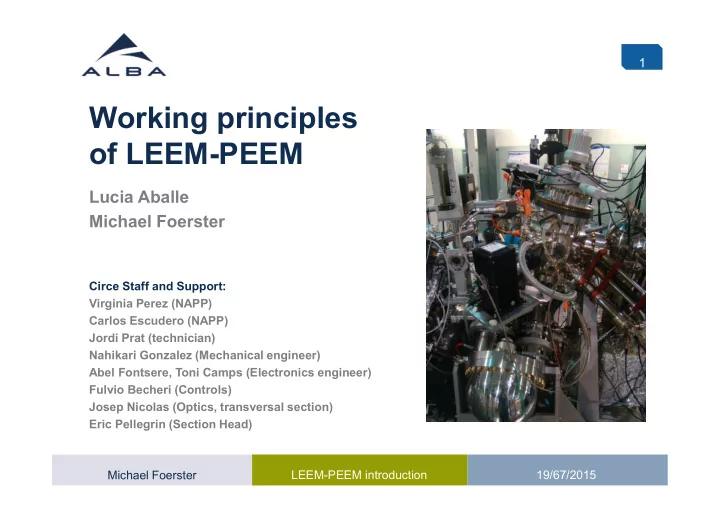
1 Working principles of LEEM-PEEM Lucia Aballe Michael Foerster Circe Staff and Support: Virginia Perez (NAPP) Carlos Escudero (NAPP) Jordi Prat (technician) Nahikari Gonzalez (Mechanical engineer) Abel Fontsere, Toni Camps (Electronics


slide-1
SLIDE 1

Michael Foerster LEEM-PEEM introduction 19/67/2015

Lucia Aballe Michael Foerster

Working principles

  • f LEEM-PEEM

Circe Staff and Support: Virginia Perez (NAPP) Carlos Escudero (NAPP) Jordi Prat (technician) Nahikari Gonzalez (Mechanical engineer) Abel Fontsere, Toni Camps (Electronics engineer) Fulvio Becheri (Controls) Josep Nicolas (Optics, transversal section) Eric Pellegrin (Section Head)

1

slide-2
SLIDE 2

Michael Foerster LEEM-PEEM introduction 19/67/2015

BL24 - PEEM

2

… it is connected to the synchrotron … it is a LEEM … it uses high Voltage

slide-3
SLIDE 3

Michael Foerster LEEM-PEEM introduction 19/67/2015

Low energy electron microscope (LEEM) (Bauer, 1962, 1985)

3

  • 20 kV + STV

Slow electrons Fast electrons

  • 20 kV

Sample Electron gun Screen Cathode lense or immersion microscopy: electrons are accelerated by electric field between sample and the first lense (Objective). It combines (full field) electron imaging (i.e. high voltage) with a low „interaction“ voltage.

slide-4
SLIDE 4

Michael Foerster LEEM-PEEM introduction 19/67/2015

Start voltage STV

4

  • 20 kV + V

LEEM  The voltage offset STV between the e-gun and the sample is called Start Voltage. It defines the kinetic energy of the electrons arriving at the sample.  Varying the start voltage between -5 until +100 V, different contrast mechanisms are accesible (work function, quantum confinement).  For negative STV, the electrons do not reach the sample. The sample is acting as electrostatic mirror (mirror electron microscopy (MEM)).

  • 20 kV - V

MEM

slide-5
SLIDE 5

Michael Foerster LEEM-PEEM introduction 19/67/2015

Quantum confinement

IV- LEEM: counting atomic layers in graphene

  • P. Merino & J.A. Martin-Gago (ICMM)
slide-6
SLIDE 6

Michael Foerster LEEM-PEEM introduction 19/67/2015

Aberrations and resolution

6

 The spatial resolution is limited by several effects to typically < 10nm in LEEM. (approaching 1 nm in new aberration corrected type)  Spherical aberration: electron far off center of the optical axis are deviating (Contrast Aperture)  Chromatic aberration (in XPEEM): electrons with different energy are deviating (Energy Analyzer)  Diffraction limit

slide-7
SLIDE 7

Michael Foerster LEEM-PEEM introduction 19/67/2015

Contrast aperture and dark field

7

sample image plane backfocal plane

  • bjective

lens

  • R. Tromp, IBM

 To reduce the spherical aberration, the Contrast Aperture (CA) is introduced into a backfocal (diffraction) plane  Darkfield imaging: using diffracted electron beam for the image

  • L. Martin, M. Monti, J. Marco, J. Figuera

(IQFR-CSIC, Instituto de Química Física "Rocasolano")

slide-8
SLIDE 8

Michael Foerster LEEM-PEEM introduction 19/67/2015

LEED

  • 20 kV + STV
  • 20 kV

Sample Electron gun Screen  We can also image a diffraction plane, i.e. LEED (energy defined by the start voltage) Illumination aperture

slide-9
SLIDE 9

Michael Foerster LEEM-PEEM introduction 19/67/2015

Illumination aperture

9

 In LEED mode we can define the area of which the diffraction pattern is taken (down to 0.5um) by the Illumination aperture

(J.I. Flege, et al University of Bremen)

slide-10
SLIDE 10

Michael Foerster LEEM-PEEM introduction 19/67/2015

LEEM modes and sensitivity

10

LEEM MEM LEED u-LEED DF-LEEM STV Projector settings Contrast aperture Illumination aperture Topography Workfunction Quantum confinement  Structure

Mode Parameter/ tool Contrast/ sensitivity

slide-11
SLIDE 11

Michael Foerster LEEM-PEEM introduction 19/67/2015

From LEEM to PEEM

11

 Technically „easy“: just replace e-gun by photons (UV lamp, laser or Synchrotron)  Photo Emission Electron Microscope (PEEM or XPEEM with X-rays)

  • 20 kV + STV
  • 20 kV

Sample Electron gun Screen X-ray beam  Slow photoelectrons are accelerated by the HV of the objective lense

slide-12
SLIDE 12

Michael Foerster LEEM-PEEM introduction 19/67/2015

From LEEM to XPEEM

12

x 100

Kinetic Energy (eV)

CL VB

hv-f

EF SE

 Under synchrotron X-ray illumination, all kind of electrons come

  • ut of the sample, but mainly low energy secondaries
slide-13
SLIDE 13

Michael Foerster LEEM-PEEM introduction 19/67/2015

From LEEM to XPEEM

13

 Adding an electron analyzer and energy slit: spectroscopic LEEM/PEEM (note that STV is sample offset)

  • 20 kV + STV

Slow electrons Fast electrons

  • 20 kV

Analyzer Screen

X-ray beam Energy Slit

slide-14
SLIDE 14

Michael Foerster LEEM-PEEM introduction 19/67/2015

How to select the electrons we want?

14

x 100

Kinetic Energy (eV)

CL VB

hv-f

EF SE

Changing STV moves the electron spectrum through the fixed acceptance window (energy slit): STV = kinetic energy of accepted electrons (XPS)

slide-15
SLIDE 15

Michael Foerster LEEM-PEEM introduction 19/67/2015

Benefits of X+PEEM

scanning hn : XAS, EXAFS scanning STV (const. hn) : XPS  diffraction mode: ARPES  Photon energy  Polarization  Kinetic Energy (STV)

 Elemental

 Chemical  Magnetic: XMCD/XMLD  Directional (orbitals) nXLD

slide-16
SLIDE 16

Michael Foerster LEEM-PEEM introduction 19/67/2015

Spectromicroscopy

“spectroscopy with spatial resolution” (pixel by pixel)

“images with spectral contrast”

  • L. Martin, M. Monti, J. Marco, J. Figuera

(IQFR-CSIC, Instituto de Química Física "Rocasolano")

slide-17
SLIDE 17

Michael Foerster LEEM-PEEM introduction 19/67/2015

Dispersive plane

 Microscope works best with low kinetic energy, at high STV, transmission is much lower  For XPS, we get better statistics and energy resolution when we image the Dispersive Plane of the analyzer and obtain spatial resolution by an aperture in an image plane (Selected Area)

SA in image Dispersive image on detector

slide-18
SLIDE 18

Michael Foerster LEEM-PEEM introduction 19/67/2015

ARPES with selected area

 Microscope in diffraction mode for angle resolved Photoemission spectroscopy (ARPES)  Image kx-ky at constant energy (ΔE ca. 200meV)  Spatial resolution by selected area aperture

  • 20 kV + STV
  • 20 kV

Screen

X-ray beam

slide-19
SLIDE 19

Michael Foerster LEEM-PEEM introduction 19/67/2015

  • Th. Schmidt et al,
  • Surf. Rev. and Lett. 5 (1998)

A more complete picture

slide-20
SLIDE 20

Michael Foerster LEEM-PEEM introduction 19/67/2015

Surface sensitive

Electron Kinetic Energy (eV) Mean Free Path (nm)

10 5 1 0.5 0.3 2 5 10 50 100 500 1000 2000

Au Au Au Au Au Au Au Al Ag Ag Ag Ag Ag Ag Ag Ag Ag Ag Mo Mo Mo W Be C C Be C W P Be Be Ni Be Fe Be

Electron Mean Free Path

Electron Kinetic Energy (eV) Mean Free Path (nm)

10 5 1 0.5 0.3 2 5 10 50 100 500 1000 2000

Au Au Au Au Au Au Au Al Ag Ag Ag Ag Ag Ag Ag Ag Ag Ag Mo Mo Mo W Be C C Be C W P Be Be Ni Be Fe Be

Electron Mean Free Path

secondary electrons photo electrons

X ray penetration depth Electron escape depth >>

slide-21
SLIDE 21

Michael Foerster LEEM-PEEM introduction 19/67/2015

Sample environment

21

Requirements: UHV compatible, reasonable large, flat and not too insulating Standard options: sputter cleaning, heating (>1500 K), cooling (>150K), low pressure gas exposure, in situ metal evaporation All electronics connected to the sample must float

  • n HV
slide-22
SLIDE 22

Michael Foerster LEEM-PEEM introduction 19/67/2015

Customized environment @ALBA

22

In situ magnetic fields: OOP, IP, biaxial IP (small) In situ electrical poling: OOP or in-plane electrodes

Based on design from BESSY (F. Kronast) Based on design from SLS

slide-23
SLIDE 23

Michael Foerster LEEM-PEEM introduction 19/67/2015

Keep in mind

 UHV system with sample transfers, many pumps and valves  High voltage between sample and lense (20 kV in ca. 2mm), risk of discharges, clean, flat samples, sufficient degassing (the day before)  Detector overexposure and damage (there is an automatic protection, but it works only when camera is run in the proper way)  Take normalization image

slide-24
SLIDE 24

Michael Foerster LEEM-PEEM introduction 19/67/2015

The control panel

Magnification (FOV), Diffraction mode, Dispersive mode Sample movement Sample rotation Start voltage Focus (Objective) Stigmastism e-gun intensity

slide-25
SLIDE 25

Michael Foerster LEEM-PEEM introduction 19/67/2015

Thank you‘s

Laura Campos User office Sergi Puso, Sergio Vicente, Gemma Rosas (Systems) Salvador Ferrer Alba Staff

The speakers: Juan de la Figuera Florian Kronast

You!