RC circuits Initially one has +Q 0 and Q 0 on the Capacitor plates. - - PDF document

rc circuits
SMART_READER_LITE
LIVE PREVIEW

RC circuits Initially one has +Q 0 and Q 0 on the Capacitor plates. - - PDF document

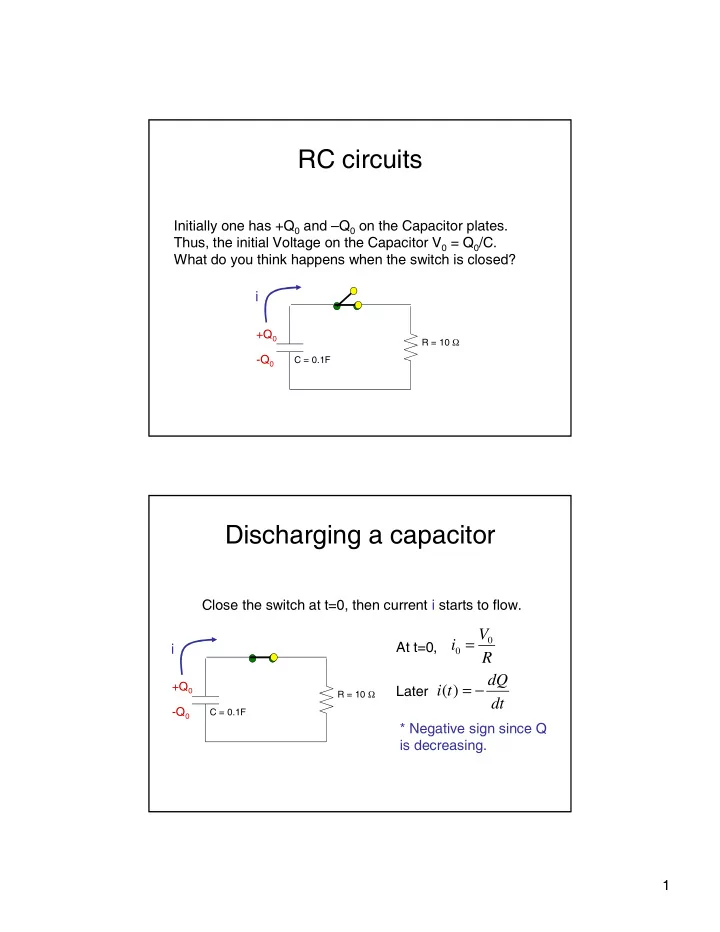
RC circuits Initially one has +Q 0 and Q 0 on the Capacitor plates. Thus, the initial Voltage on the Capacitor V 0 = Q 0 /C. What do you think happens when the switch is closed? i +Q 0 R = 10 -Q 0 C = 0.1F Discharging a capacitor Close


slide-1
SLIDE 1

1

RC circuits

C = 0.1F R = 10 Ω

Initially one has +Q0 and –Q0 on the Capacitor plates. Thus, the initial Voltage on the Capacitor V0 = Q0/C. What do you think happens when the switch is closed?

+Q0

  • Q0

i

C = 0.1F R = 10 Ω

+Q0

  • Q0

Close the switch at t=0, then current i starts to flow. i At t=0,

R V i

0 =

Later

dt dQ t i − = ) (

* Negative sign since Q is decreasing.

Discharging a capacitor

slide-2
SLIDE 2

2

C = 0.1F

+Q0

  • Q0

i Voltage across C = Voltage across R

R c

V V = R dt dQ iR C Q − = = Q RC dt dQ 1 − =

We now need to solve this differential equation.

Discharging a capactiror

Solving the differential equation:

Q RC dt dQ 1 − =

RC t

e Q t Q

/

) (

=

Check solution by taking the derivative...

Q RC e RC Q dt dQ

RC t

1 1

/

− = ⎟ ⎠ ⎞ ⎜ ⎝ ⎛− =

− /

) ( Q e Q t Q

RC =

= =

Also Q(t) = Q0 at t=0.

Discharging a capacitor

slide-3
SLIDE 3

3 Exponential Decay time Q(t)

RC t

e Q t Q

/

) (

=

After a time τ = RC, Q has dropped by e-1 = 1/e. After a time t = 2RC, Q has dropped by e-2 = 1/e2 Thus τ=RC is often called the time constant and has units [seconds].

Q0 Q0/e τ

Discharging a capacitor

RC t RC t

e i e RC Q dt dQ t i

/ /

| | | ) ( |

− −

= ⎟ ⎠ ⎞ ⎜ ⎝ ⎛ = = Q RC e RC Q dt dQ

RC t

1 1

/

− = ⎟ ⎠ ⎞ ⎜ ⎝ ⎛− =

Thus, the current also falls with the same exponential function.

Discharging a capacitor

slide-4
SLIDE 4

4

Clicker Question

A capacitor with capacitance 0.1F in an RC circuit is initially charged up to an initial voltage of Vo = 10V and is then discharged through an R=10Ω resistor as shown. The switch is closed at time t=0. Immediately after the switch is closed, the initial current is Io =Vo /R=10V/10Ω. What is the current I through the resistor at time t=2.0 s? A)1A B) 0.5A C) 1/e A = 0.37A D) 1/e2 A = 0.14A E) None of these.

Answer: 1/e2 A = 0.14A. The time constant for this circuit is RC=(10Ω)(0.10F) = 1.0 sec. So at time t=2.0 sec, two time constants have

  • passed. After one time constant, the voltage, charge, and current have all

decreased by a factor of e. After two time constants, everything has fallen by e2. The initial current is 1A. So after two time constants, the current is 1/e2 A = 0.135A.

C=0.1F R=10Ω

More complex RC circuit: Charging C with a battery.

C=0.0010 F R = 10 Ω V=10V

Before switch closed i=0, and charge on capacitor Q=0. Close switch at t=0. Try Voltage loop rule.

= + + +

C R b

V V V / = − − + C Q iR Vb

Charging a capacitor
slide-5
SLIDE 5

5

/ = − − + C Q iR Vb / = − − + C Q R dt dQ Vb

( )

RC t b

e CV t Q

/

1 ) (

− = RC Q R V dt dQ

b −

+ =

Charging a capacitor

C=0.0010 F R = 10 Ω V=10V

time time Q

dt dQ i =

( )

RC t b

e CV t Q

/

1 ) (

− =

RC t b e

R V t dt dQ t i

/

) ( ) (

= =

Charging a capacitor

  • Although no charge actually passes between the capacitor plates, it acts just like

a current is flowing through it.

  • Uncharged capacitors act like a “short”: VC=Q/C=0
  • Fully charged capacitors act like an “open circuit”. Must have iC = 0 eventually,
  • therwise Q infinity.
slide-6
SLIDE 6

6 An RC circuit is shown below. Initially the switch is open and the capacitor has no charge. At time t=0, the switch is

  • closed. What is the voltage across the capacitor

immediately after the switch is closed (time = 0)?

C=0.0010 F R = 10 Ω V=10V

A) Zero B) 10 V C) 5V D) None of these.

Clicker Question