Capacitor Any two pieces of metal (conductor) brought near each - - PDF document

capacitor
SMART_READER_LITE
LIVE PREVIEW

Capacitor Any two pieces of metal (conductor) brought near each - - PDF document

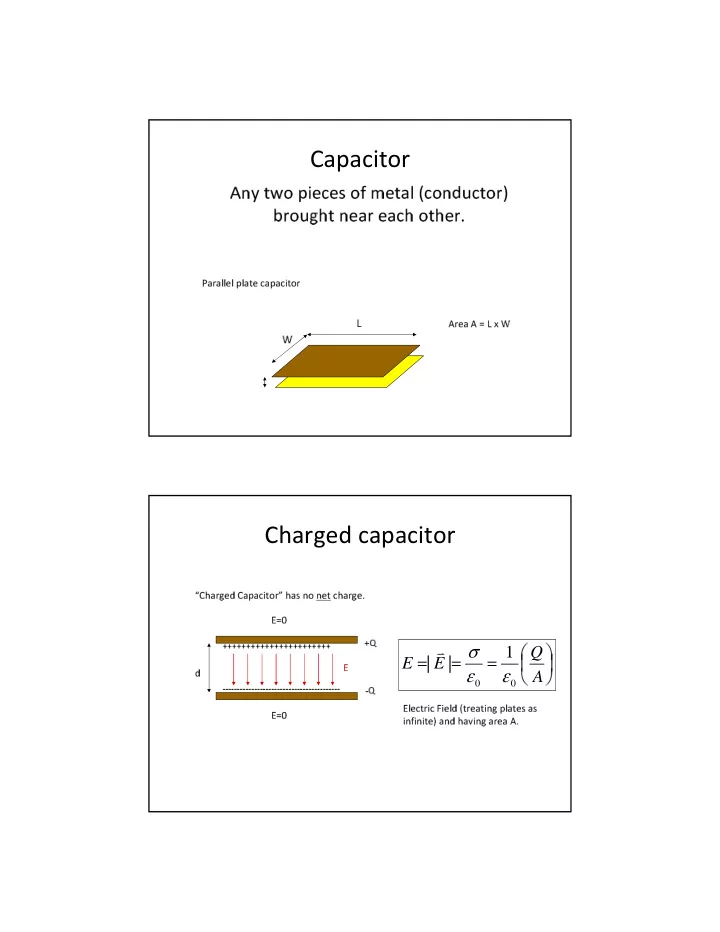
Capacitor Any two pieces of metal (conductor) brought near each other. Parallel plate capacitor L Area A = L x W W Charged capacitor Charged Capacitor has no net charge. E=0 +Q 1 Q +++++++++++++++++++++++ = = = E


slide-1
SLIDE 1

Capacitor

Any two pieces of metal (conductor) brought near each other.

Parallel plate capacitor

L W

Area A = L x W

Charged capacitor

“Charged Capacitor” has no net charge.

+++++++++++++++++++++++

  • +Q
  • Q

E=0 E=0 E Electric Field (treating plates as infinite) and having area A.

⎟ ⎠ ⎞ ⎜ ⎝ ⎛ = = = A Q E E 1 | | ε ε σ v

d

slide-2
SLIDE 2

Capacitance

+++++++++++++++++++++++++++

  • +Q
  • Q

⎟ ⎠ ⎞ ⎜ ⎝ ⎛ = = A Q E 1 ε ε σ

Ed r d E V V = ⋅ = ∆ =

v v ) ( d A Q V ε = →

We define “capacitance”

V Q C ≡

For parallel plate capacitor

d A C ε ≡

d

Capacitance

V Q C ≡

Can think of capacitor as a device for storing charge (and also energy). Units [Capacitance] = [Coulomb/Volt] = [Farad]

slide-3
SLIDE 3

L L d

A parallel-plate capacitor has square plates of edge length L, separated by a distance d. If we doubled the dimension L and halve the dimension d, by what factor have we changed the capacitance?

A) 1.0 B) 2.0 C) 4.0 D) 8.0 E) 16.0

( )

2 2 2

  • 2L

A L L C 8 d d d / 2 d ε ε ε ε = = → =

CPS Question

How big is a one Farad Capacitor?

CPS question

Assume you have two parallel plates that are separated by 1 mm. If you estimate ε0 ~ 10-11, what is the area of the plates to have a 1.0 Farad capacitance? A) 100,000,000 square meters B) 1,000 square meters C) 1 square meters D) 0.1 square meters E) 0.001 square meters

d A C ε ≡

slide-4
SLIDE 4

Commercial capacitors

Micro-farad capacitors in small packages are made by making d very small ~ atomic dimensions.

Energy Storage

Capacitor stores both charge and energy. Suppose the capacitor is not fully charged. How much work is required to move a little bit +dq across?

+++++++++++++++++++++++++++

  • +Q
  • Q

dq

Vdq dU dW Work = = = dq C q dU ⎟ ⎠ ⎞ ⎜ ⎝ ⎛ = C Q q d C q dU U

Q

2

2

= ⎟ ⎠ ⎞ ⎜ ⎝ ⎛ = =

∫ ∫

Each next piece +dq gets harder and harder.

QV CV C Q U 2 1 2 1 2 1

2 2

= = =

Potential Energy stored in the capacitor.

slide-5
SLIDE 5

CPS Question

A parallel plate capacitor is charge up (+Q on one plate and –Q on the other). The plates are isolated so the charge Q cannot change. The plates are then pulled apart so that the plate separation d increases. The total electrostatic energy stored in the capacitor? A) Increases B) Decreases C) Remains constant

+++++++++++++++++++++++

  • +Q
  • Q

E d

QV CV C Q U 2 1 2 1 2 1

2 2

= = =

Where is this energy U? Answer = the electric field has energy. Energy density of E-field =

u Vol U volume energy = = .

( )

d A Ed d A Vol CV ⋅ ⎟ ⎠ ⎞ ⎜ ⎝ ⎛ = =

2 2

2 1 . 2 1 ε

2

2 1 E ε = Turns out work to charge capacitor is equal to energy stored.

Electric Field energy

This is valid for any electric field configuration in vacuum: “empty” space contains energy!!!

slide-6
SLIDE 6

Spring analogy

+++++++++++++++++++++++++++

  • +Q
  • Q

2

1 2 1 Q C U ⎟ ⎠ ⎞ ⎜ ⎝ ⎛ =

2

2 1 kx U =

Electric field energy Elastic energy What is this device?

Applications

slide-7
SLIDE 7

Applications (cont)

Capacitors are good for storing large amounts of energy, which can then be accessed quickly (e.g. camera flash). Capacitors are also ideal transducers. Devices that covert physical quantities into electrical signals (e.g. computer keyboard, elevator buttons).

A d

d A C ε ≡

Circuits with capacitors

Circuit symbol for a capacitor

More than one capacitor?...

slide-8
SLIDE 8

Capacitors in parallel

( )

2 1 2 1 2 1 2 1 2 2 1 1 2 1

; C C C C C V Q V C C Q Q Q V C Q V C Q V V V V

eq total ab

+ = → + = → + = + = = = → = = =

Capacitors in parallel (cont)

Think of two capacitors in parallel as adding the area of the two capacitors

...

3 2 1

+ + + = C C C Ceq

Many capacitors in parallel:

slide-9
SLIDE 9

Capacitors in series

2 1 2 1 2 1 2 2 1 1 2 1

1 1 1 1 1 ; C C C Q V C C Q V V V V C Q V V C Q V V Q Q

eq ab cb ac

+ = = → ⎟ ⎟ ⎠ ⎞ ⎜ ⎜ ⎝ ⎛ + = + = = = = = = → =

Capacitors in series (cont)

2 1 2 1

1 1 1

  • r

1 1 1 C C C C C C

eq eq

+ = + =

... 1 1 1 1

3 2 1

+ + + = C C C Ceq

Many capacitors in series:

slide-10
SLIDE 10

19

CPS question

A bank of three capacitors (C1, C2, C3) is connected as follows.

C1=2 F C3=1 F C2=1 F

What is the effective total capacitance of the bank? A) C = 0 Farad B) C = 1 Farad C) C = 1.5 Farad D) C = 2.0 Farad E) C = 0.5 Farad

Dielectrics

What if the gap between the capacitor plates is not empty?

slide-11
SLIDE 11

Dielectrics (cont)

/V Q Cwithout =

without

C C V V V Q C > → < = but /

Without dielectric: With dielectric:

Increases the capacitance!!!

Dielectric constant

Dielectric constant:

V V C C K = = K V V =

With the dielectric present, the potential difference for a given charge Q is reduced by a factor K

slide-12
SLIDE 12

Dielectric constants for some materials

Induced charge and polarization

slide-13
SLIDE 13

Polarization

We assume that the induced surface charge density is directly proportional to the electric field magnitude in the material Without dielectric: ε σ = E ε σ σ

induced

K E E − = = With dielectric: ⎟ ⎠ ⎞ ⎜ ⎝ ⎛ − = K

induced

1 1 σ σ From these we

  • btain:

Permittivity ε ε K =

We have found:

ε σ = E

ε σ K K E E = =

Defining: We obtain: permittivity and

2 2

2 1 2 1 E E K u d A d A K KC C ε ε ε ε = = = = =

Capacitance Energy density

Easy rule of thumb: replace ε by ε0 in all the equations