Hardware Description Language (HDL) and Logic Synthesis Alireza - - PDF document

hardware description language hdl and logic synthesis
SMART_READER_LITE
LIVE PREVIEW

Hardware Description Language (HDL) and Logic Synthesis Alireza - - PDF document

EE M216A .:. Fall 2011 Hardware Description Language (HDL) and Logic Synthesis Alireza Tarighat (ee216a@gmail.com) Slides are Courtesy of Prof. Dejan Markovi . Design Challenges: An Industrial View TIMING POWER AREA DESIGNER RUNTIME


slide-1
SLIDE 1

1

Hardware Description Language (HDL) and Logic Synthesis

EE M216A .:. Fall 2011 Alireza Tarighat (ee216a@gmail.com)

  • Slides are Courtesy of Prof. Dejan Marković.
  • D. Markovic / Slide 2

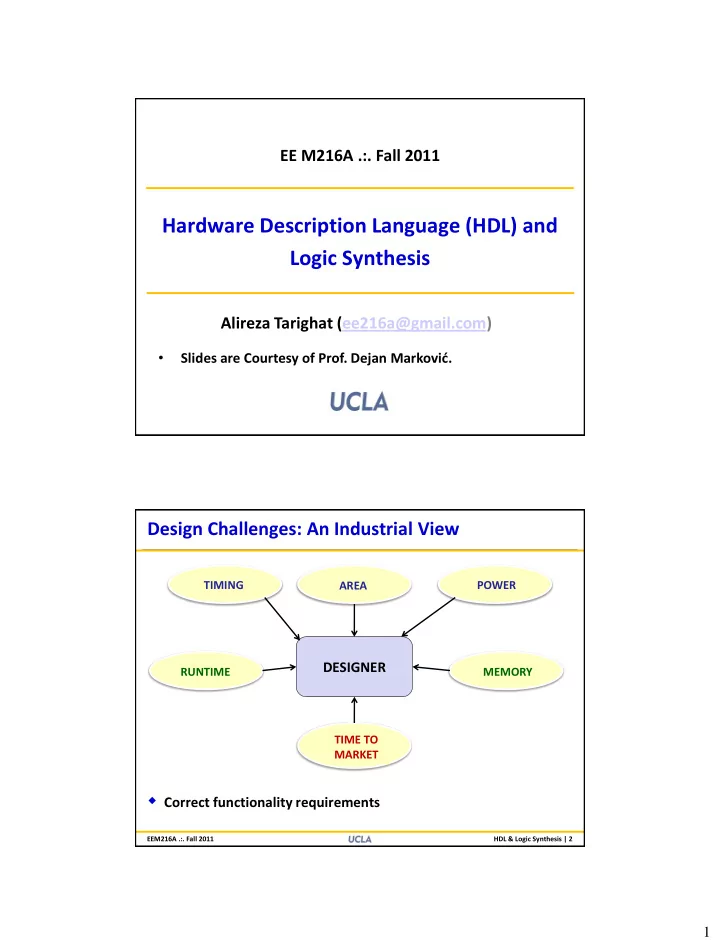
Design Challenges: An Industrial View

 Correct functionality requirements

DESIGNER

TIMING AREA POWER RUNTIME MEMORY TIME TO MARKET

EEM216A .:. Fall 2011 HDL & Logic Synthesis | 2

slide-2
SLIDE 2

2

  • D. Markovic / Slide 3

Logic Synthesis

 Synthesis Tool

– Optimizes gate-level implementation for speed/area/power

  • Sizing the gates, inserting gates, etc.

– Does not touch functional behavior (maintains logic equivalency) – Works with any standard cell library (any technology, any foundry) – Decouples logic design from technology/fab/node and standard cell library – Takes in different input formats

  • VHDL
  • Verilog
  • Gate-level netlist

– Takes in different design constraints

  • Simplest one: clock period

EEM216A .:. Fall 2011 HDL & Logic Synthesis | 3

  • D. Markovic / Slide 4

Logic Synthesis

 Design constraints

– Environmental constraints

  • Driver
  • Load (max fanout)

– Define clocks

  • Cycle time
  • Uncertainty (jitter)

– Optimization constraints

  • In and out delay / max transition
  • Max area etc.
  • Clock period vs. area vs. power

– Timing exceptions

  • Multi-cycle, False-path
  • Example Synthesis Tool:

http://www.synopsys.com/Tools/Implementation/RTLSynthesis/DCUltra /Documents/DCUltra-ds.pdf

EEM216A .:. Fall 2011 HDL & Logic Synthesis | 4

slide-3
SLIDE 3

3

  • D. Markovic / Slide 5

Logic Synthesis is Timing-Driven

 This is a generic design used during synthesis

– Internal data-path delay (cycle (and hold) time analysis) – Relationship to in and out paths – Timing exceptions

D Q QB D Q QB FF2 FF3

TOP

A Clk Z

EEM216A .:. Fall 2011 HDL & Logic Synthesis | 5

  • D. Markovic / Slide 6

Timing Constraints

 Clock period: set by define_clock  Input delay: arrival of an external path with respect to a Clk edge  Output delay: timing path from an output port to a register input

  • f an external block

 Input and output delays budget timing for surrounding logic in

general case when the in/out ports are not registered

EEM216A .:. Fall 2011 HDL & Logic Synthesis | 6

slide-4
SLIDE 4

4

  • D. Markovic / Slide 7

Understanding Timing Constraints

 Three important constraints (clock, input, output)

– Blue box = current_design (to be retimed) logic logic logic logic logic Clk “set_input_delay” (affects input logic) “set_output_delay” (affects output logic) “create_clock” (affects internal logic)

(input) (internal) (output)

EEM216A .:. Fall 2011 HDL & Logic Synthesis | 7

  • D. Markovic / Slide 8

Environment: Drivers, Load…

 To simulate realistic inputs, we can set the driving cell using the

external_driver command, to be any cell in the library – This ensures that the input has a finite slew rate

 The load capacitance can be set on the output ports using the

external_pin_cap command

 By default the Encounter RTL Compiler only tries to meet the

timing constraints without optimizing power

 If the max_dynamic_power attribute is set to some value, the

tool tries to meet the timing specs while also optimizing for power in the process

EEM216A .:. Fall 2011 HDL & Logic Synthesis | 8

slide-5
SLIDE 5

5

  • D. Markovic / Slide 9

Example: Automated Adder Synthesis

 Copy the following files to your work directory

/usr/public.2/ee216a/cadence/SOC62/SynLib.v /usr/public.2/ee216a/cadence/SOC62/adder.v /usr/public.2/ee216a/cadence/SOC62/adder.tcl

 The top level synthesis script adder.tcl reads in the HDL file, sets

timing, load and power constraints, and runs synthesis

 To run RTL synthesis type the following command

> rc –files adder.tcl –gui

 The GUI window will show detailed architecture (gate level). Use

report power, report area, report timing commands in the rc command window to get Power, Area and Delay numbers

EEM216A .:. Fall 2011 HDL & Logic Synthesis | 9

  • D. Markovic / Slide 10

set_attribute library /w/apps/apps.16/cadence/gsclib090_v2.9/timing/typical.lib set_attribute hdl_language v2001 read_hdl adder.v read_hdl SynLib.v elaborate adder dc::current_design adder dc::set_time_unit -picoseconds dc::set_load_unit -femtofarads define_clock -name clk -period 1000 -design /designs/adder {/designs/adder/ports_in/clk} dc::set_input_delay 20 -clock clk [all_inputs] dc::set_output_delay 100 -clock clk [all_outputs] set_attribute external_driver [find [find / -libcell DFFX1] -libpin D] {/designs/adder/ports_in/*} set_attribute external_pin_cap 26.5488 {/designs/adder/ports_out/*} set_attribute lp_power_unit mW / set_attribute max_dynamic_power 0.5 /designs/adder

Setup Example: Adder.tcl (1/2)

Define lib Read HDL Elaborate Set timing Set env. Opt.

EEM216A .:. Fall 2011 HDL & Logic Synthesis | 10

slide-6
SLIDE 6

6

  • D. Markovic / Slide 11

Setup Example: Adder.tcl (2/2)

 How does synthesis work?

synthesize -to_mapped -effort high report area > adder_area.rpt report power > adder_power.rpt report timing > adder_timing.rpt report clocks > adder_clocks.rpt write_encounter design adder -basename adder -lef [format "%s %s %s" /usr/public.2/ee216a/cadence/SOC62/gpdk090_9lm.lef /w/apps/apps.16/cadence/gsclib090_v2.9/lef/gsclib090_tech.lef /w/apps/apps.16/cadence/gsclib090_v2.9/lef/gsclib090_macro.lef] Synthesis Reports

EEM216A .:. Fall 2011 HDL & Logic Synthesis | 11

  • D. Markovic / Slide 12

Example Clock, In and Out Delay [Synopsys]

create_clock –name “Clk” –period $Tclk set_input_delay 0.5 set_output_delay [expr $Tclk – 0.5 + $wire_margin] ;# wire_margin = 0.2

 Define clock, input and output delay  Work with expressions and variables

EEM216A .:. Fall 2011 HDL & Logic Synthesis | 12

slide-7
SLIDE 7

7

  • D. Markovic / Slide 13

Adder.tcl

 The adder.tcl file sets constraints & optimization parameters

EEM216A .:. Fall 2011 HDL & Logic Synthesis | 13

  • D. Markovic / Slide 14

Pre- and Post-Layout Clock

create_clock -p 30 -n MCLK Clk set_clock_uncertainty 0.5 MCLK set_clock_transition 0.25 MCLK set_clock_latency -source 4 MCLK set_clock_latency 2 MCLK create_clock -p 30 -n MCLK Clk set_clock_uncertainty 0.1 MCLK set_clock_latency -source 4 MCLK set_propagated_clock MCLK

pre-layout post-layout

latency uncertainty transition [ jitter 0.1 + skew 0.4 ] ideal clock

Courtesy: Synopsys

EEM216A .:. Fall 2011 HDL & Logic Synthesis | 14

slide-8
SLIDE 8

8

  • D. Markovic / Slide 15

Synthesis Results: Fast Adder

 Adder synthesized to meet

timing constraint of 550 ps

 Input is registered from a FF

– Clk-Q delay = 157 ps – Setup time = 82 ps

 Effective adder delay = 311 ps  Timing constraints are

stringent, tool synthesizes a carry look ahead type of adder

 Synthesis reports

– Area = 1035 mm2 – Energy (active) = 0.2145 fJ – Power (leak) = 0.005 mW

EEM216A .:. Fall 2011 HDL & Logic Synthesis | 15

  • D. Markovic / Slide 16

Synthesis Results: Slow Adder

 Adder delay = 757 ps  Structure is somewhat like

carry ripple topology

 Area = 548 mm2 (half of

previous)

 Energy (active) = 0.13 fJ

– Nearly ½ of previous design – Expected since VDD was the same, Eactive depends only on Csw, which was halved with the area being halved…

 Power (leak) = 0.002 mW

– Also reduced due to reduced area

EEM216A .:. Fall 2011 HDL & Logic Synthesis | 16

slide-9
SLIDE 9

9

  • D. Markovic / Slide 17

Synthesis Results

 Energy-delay tradeoff plot obtained from synthesis

– Keep timing constraint, move down the energy axis (left plot) – Resulting energy-area should be below reference curve (right plot)

200 400 600 800 14 16 18 20 22 24 26

Delay (ps) Energy per Opertaion (fJ)

(311,24) (361,16) (757,15) 400 600 800 1000 1200 14 16 18 20 22 24 26

Area (mm2) Energy per Opertaion (fJ)

(1035,24) (813,16) (548,15)

EEM216A .:. Fall 2011 HDL & Logic Synthesis | 17

  • D. Markovic / Slide 18

High-Level Design Issues

 You may think design is a straightforward

logical process – Start with the idea of what you need to build – And then build it

 Real design is not like that

– Think you have an idea of what to build – Through the design process you figure out what you really want to build – Need to validate idea early in the process

 What you build depends on the

implementation capabilities and constraints – Implementation issues will change the specification Need a language that helps with the real (interactive) design process

Specification Implemen mentation Verification

EEM216A .:. Fall 2011 HDL & Logic Synthesis | 18