Figure 1: Go ogle image of Ro y al Observ atory . The - - PDF document

figure 1 go ogle image of ro y al observ atory the h shap
SMART_READER_LITE
LIVE PREVIEW

Figure 1: Go ogle image of Ro y al Observ atory . The - - PDF document

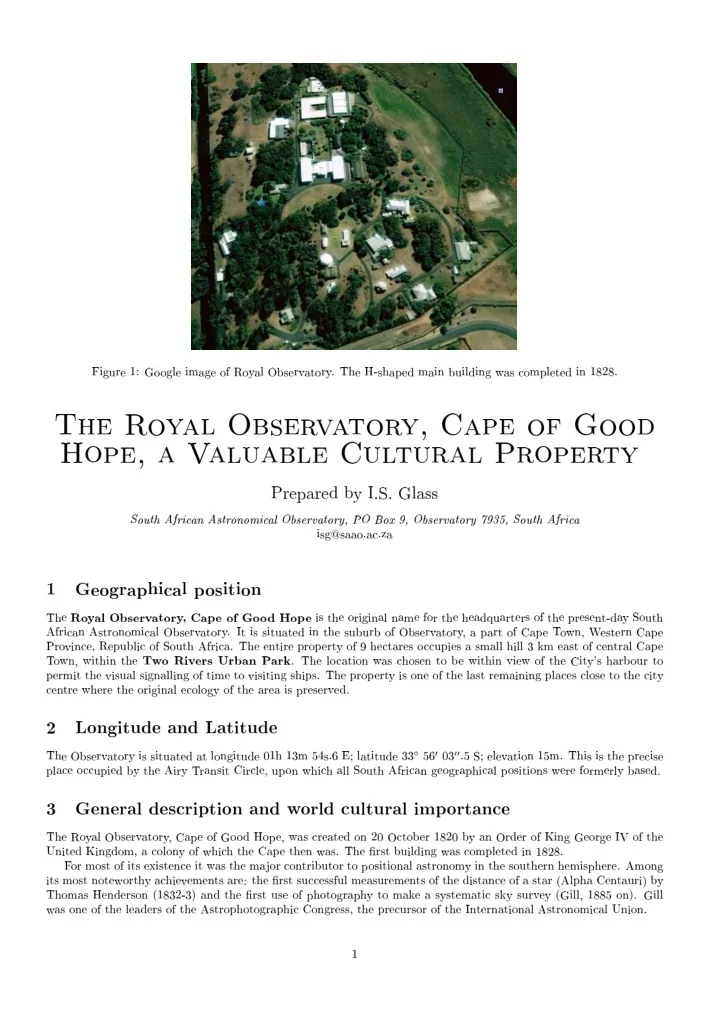
Figure 1: Go ogle image of Ro y al Observ atory . The H-shap ed main building w as completed in 1828. The R o y al Obser v a tor y, Cape of Good Hope, a V aluable Cul tural Pr oper ty Prepared b y I.S.


slide-1
SLIDE 1 Figure 1: Go
  • gle
image
  • f
Ro y al Observ atory . The H-shap ed main building w as completed in 1828. The R
  • y
al Obser v a tor y, Cape
  • f
Good Hope, a V aluable Cul tural Pr
  • per
ty Prepared b y I.S. Glass South Afric an Astr
  • nomic
al Observatory, PO Box 9, Observatory 7935, South Afric a isg@saao.ac.za 1 Geographical p
  • sition
The Ro y al Observ atory , Cap e
  • f
Go
  • d
Hop e is the
  • riginal
name for the headquarters
  • f
the presen t-da y South African Astronomical Observ atory . It is situated in the suburb
  • f
Observ atory , a part
  • f
Cap e T
  • wn,
W estern Cap e Pro vince, Republic
  • f
South Africa. The en tire prop ert y
  • f
9 hectares
  • ccupies
a small hill 3 km east
  • f
cen tral Cap e T
  • wn,
within the Tw
  • Riv
ers Urban P ark. The lo cation w as c hosen to b e within view
  • f
the Cit y's harb
  • ur
to p ermit the visual signalling
  • f
time to visiting ships. The prop ert y is
  • ne
  • f
the last remaining places close to the cit y cen tre where the
  • riginal
ecology
  • f
the area is preserv ed. 2 Longitude and Latitude The Observ atory is situated at longitude 01h 13m 54s.6 E; latitude 33
  • 56
03 00 .5 S; elev ation 15m. This is the precise place
  • ccupied
b y the Airy T ransit Circle, up
  • n
whic h all South African geographical p
  • sitions
w ere formerly based. 3 General description and w
  • rld
cultural imp
  • rtance
The Ro y al Observ atory , Cap e
  • f
Go
  • d
Hop e, w as created
  • n
20 Octob er 1820 b y an Order
  • f
King George IV
  • f
the United Kingdom, a colon y
  • f
whic h the Cap e then w as. The rst building w as completed in 1828. F
  • r
most
  • f
its existence it w as the ma jor con tributor to p
  • sitional
astronom y in the southern hemisphere. Among its most notew
  • rth
y ac hiev emen ts are: the rst successful measuremen ts
  • f
the distance
  • f
a star (Alpha Cen tauri) b y Thomas Henderson (1832-3) and the rst use
  • f
photograph y to mak e a systematic sky surv ey (Gill, 1885
  • n).
Gill w as
  • ne
  • f
the leaders
  • f
the Astrophotographic Congress, the precursor
  • f
the In ternational Astronomical Union. 1
slide-2
SLIDE 2 4 P artial in v en tory
  • f
extan t items 4.1 Buildings
  • The
main building
  • f
the Observ atory (see Fig. 1) w as completed in 1828. The cen tral part comprised
  • bserving
c ham b ers for a transit telescop e and a m ural circle as w ell as an en trance hall and t w
  • small
computing ro
  • ms.
The w est wing comprised quarters for the Astronomer and the east for t w
  • assistan
ts. It w as designed b y the noted na v al arc hitect John Rennie, Chief Engineer to the Admiralt y .
  • Other
early structures include the south meridian mark for the m ural circle (ca 1828) and a dome running
  • n
cannon balls dating from 1849 (for the 7-inc h Merz telescop e).
  • The
18-inc h dome (former heliometer
  • bserv
atory), 1888.
  • The
McClean (Victoria) dome
  • f
1897; an early w
  • rk
b y the in ternationally famous arc hitect Herb ert Bak er. 4.2 Some mo v able artefacts surviving
  • A
rep eating transit b y Dollond, describ ed in a publication
  • f
1820. (used b y the rst astronomer b efore the completion
  • f
the main building).
  • 7-inc
h telescop e b y Merz (1849). Used for T ransit
  • f
V en us 1882. Used also b y R T A Innes, the disco v erer
  • f
Pro xima Cen, for double star w
  • rk.
  • A
sp eculum mirror b y W Hersc hel (1811).
  • Time
signal pistol 1833.
  • Regulator
clo c ks b y Molyneux, Hardy , Den t and Rieer. The Hardy clo c k, whic h dates from the 1820s
  • r
sligh tly earlier, w as in the T ransit Ro
  • m
and w as used b y Henderson in his Alpha Cen w
  • rk;
the Molyneux clo c ks (one eac h sidereal and mean) date from a similar time.
  • Ross
lens used b y Gill for his ep
  • c
h-making photograph y
  • f
Great Comet
  • f
1882
  • Large
Dallmey er p
  • rtrait
lens used for Cap e Photographic Durc hm usterung { the rst photographic sky surv ey
  • Ey
epiece and lens
  • f
Airy T ransit circle (installed 1854).
  • \Kew
P attern" Heliograph b y Dallmey er (1878).
  • 6-inc
h Grubb telescop e (1882).
  • Astrographic
telescop e (Grubb, 1889).
  • McClean
(Victoria) telescop e (Grubb, 1897).
  • Gill
transit circle (1905), the precursor
  • f
all mo dern transit circles.
  • 18-inc
h telescop e (1955)
  • n
Heliometer moun t b y Repsold (1885). In addition, the library , whic h is the National Library
  • f
Astronom y , is
  • ne
  • f
the most comprehensiv e astronomical libraries in the w
  • rld,
b
  • th
for an tique and con temp
  • rary
material. 5 Brief surv ey
  • f
the history
  • f
the site and its uses In pre-colonial times the prop ert y w as probably used for grazing b y the indigenous San pastoralists. Later, but b efore it w as acquired for the Observ atory , the area w as farmland, though ro c ky , treeless and windsw ept. It nev ertheless supp
  • rted
a remark able v ariet y
  • f
seasonal grasses and bulbs. It is underlaid b y greyw ac k e, quartzitic limestone and shale. Although it is the habitat
  • f
man y in teresting
  • ra
and fauna, it is particularly noted for b eing the last remaining natural habitat
  • f
a rare Iris Mor ae a aristata and the northern limit
  • f
the W estern Leopard T
  • ad
Bufo p antherinus, an endangered sp ecies. F rom c a 1820 the prop ert y has b een in use as an
  • bserv
atory . In 1971, it b ecame part
  • f
the South African Astronomical Observ atory . No longer barren,
  • v
er the nearly t w
  • cen
turies
  • f
its existence the site has b een plan ted extensiv ely with shrubs and trees to act as windbreaks. 2
slide-3
SLIDE 3 Figure 2: Photograph
  • f
Ro y al Observ atory c a. 1842. 6 Authen ticit y and in tegrit y W e are fortunate in ha ving a n um b er
  • f
photographs
  • f
the Observ atory dating from 1842 (See Fig. 2). These are the
  • ldest
photographs tak en in South African and the
  • ldest
  • f
an y
  • bserv
atory an ywhere (excepting JFW Hersc hel's photograph
  • f
his father's 48-inc h telescop e). Man y
  • f
the buildings
  • n
the site are
  • riginal
structures. The Main Building, commenced in 1825 and completed in 1828, is still extan t and has b een mo died
  • nly
marginally . Tw
  • copp
er domes, sho wn in the 1842 photograph, w ere remo v ed in 1883 and the cen tral lan tern structure w as remo v ed in 1961. The Ro y al Observ atory , as a living institution, has ev
  • lv
ed con tin uously since its foundation. The
  • riginal
instru- men ts, consisting
  • f
a transit and a m ural circle, w ere lo cated in the Main Building. By 1855, these had b een replaced b y a transit circle designed b y Airy . In 1849 a 7-inc h Merz telescop e with dome w as added. A magnetic
  • bserv
atory , comprising sev eral buildings, w as established in 1841 but none
  • f
these surviv e to da y . Still within the 19th cen tury , a photo-heliograph designed b y de la Rue w as installed in 1876. During the regime
  • f
Da vid Gill,
  • ne
  • f
the greatest astronomers
  • f
the 19th cen tury , activit y
  • n
the site reac hed its zenith. Numerous buildings from Gill's time are extan t, including the Astrographic dome (1888), the Heliometer dome (1888), the McClean dome (1895) and the Gill T ransit Circle (1905). The 20th cen tury sa w the New Oces (c a 1920), the WWI I Optical W
  • rkshop
(no w lecture theatre), the Ly
  • t
coronagraph (1958) and the T ec hnical Building (c a 1988). Numerous
  • ther
small buildings ha v e come and gone during this p erio d, including the F ranklin-Adams telescop e (ca 1909), the 40-inc h (Elizab eth) T elescop e (1964) and the Astrolab e Hut (ca 1960s). 7 Cultural and sym b
  • lic
dimension
  • f
the site The Ro y al Observ atory w as the rst ma jor scien tic institution to b e erected
  • n
the con tinen t
  • f
Africa, so far as is kno wn. F
  • r
m uc h
  • f
the 19th cen tury it
  • ccupied
an imp
  • rtan
t p
  • sition
in the Cap e Colonial hierarc h y , His
  • r
Her Ma jest y's Astronomer b eing called up
  • n
to giv e advice and to serv e
  • n
the b
  • ards
  • f
cultural and educational institutions. T
  • the
general public it w as kno wn as the supplier
  • f
time services,
  • p
erating a no
  • nda
y cannon (as it still do es) and time balls at v arious places in the Cap e Colon y . It w as also the rep
  • sitory
  • f
standard w eigh ts and measures for the colon y . The w eather records are the longest-running in South Africa. T
  • da
y it forms the headquarters
  • f
the South African Astronomical Observ atory , where astronomers ha v e their
  • ces,
data reductions are carried
  • ut
and instrumen ts are constructed. The curren t
  • bserv
ational activities
  • f
the SAA O are cen tred in Sutherland, ab
  • ut
400kms in to the in terior. 8 Do cumen tation and Arc hiv es All phases
  • f
the existence
  • f
the Ro y al Observ atory are w ell-do cumen ted. Large amoun ts
  • f
material exist in the follo wing arc hiv es: Hydrographic Oce
  • f
the Ro y al Na vy (UK), Ro y al Green wic h Observ atory Arc hiv es (no w in Cam bridge Univ ersit y Library), the South African Go v ernmen t Arc hiv es and,
  • f
course, the SAA O Arc hiv es, k ept
  • n
the Ro y al Observ atory site. 3
slide-4
SLIDE 4 9 Presen t site managemen t The prop ert y is
  • wned
at presen t b y the National Researc h F
  • undation
(NRF), the um brella agency
  • f
whic h the SAA O and a n um b er
  • f
  • ther
scien tic institutes form part. It is used exclusiv ely for astronomical purp
  • ses.
Protection: The prop ert y is cen tral to the Tw
  • Riv
ers Urban P ark, a conserv ation area established b y the Cit y
  • f
Cap e T
  • wn.
It is b
  • rdered
to the East and North b y w etlands. As suc h, it is protected from encroac hmen t. 9.1 State
  • f
conserv ation
  • f
buildings, instrumen ts and arc hiv es Most
  • f
the buildings are regularly main tained but certain
  • f
those not in use for curren t astronomical pro jects require restoration. In particular, the Gill Rev ersible T ransit Circle building
  • f
iron and steel is in p
  • r
condition. The arc hiv es and retired instrumen ts are generally w ell-protected from en vironmen tal dammage. 9.2 Restoration and/or main tenance
  • f
the site and instrumen ts Certain
  • f
the
  • ld
instrumen ts ha v e recen tly b een restored. These include the Merz 7-inc h telescop e and the de la Rue photoheliograph. A m useum in the former McClean lab
  • ratory
con tains a selection
  • f
the smaller an tique instrumen ts no longer in use, ranging from a Dollond Rep eating T ransit used b y F allo ws to the photometry equipmen t
  • f
A.W.J. Cousins. 10 Buer zone The Ro y al Observ atory site is partly ank ed b y preserv ed w etlands and the lo w er parts
  • f
the site itself are sub ject to
  • ccasional
  • ding,
making them unsuitable for dev elopmen t. 10.1 Con text and en vironmen t, landscap e The site is no longer dark and rural. Bey
  • nd
the b
  • undaries
  • f
the Tw
  • Riv
ers Urban P ark it is surrounded b y freew a ys and ma jor roads,
  • ce
buildings etc. 10.2 Arc haeological/historical/heritage researc h The Ro y al Observ atory is w ell do cumen ted historically in b
  • ks
b y Gill and W arner and b y man y articles in b
  • ks
and journals. Researc h
  • n
historical matters b y v arious in terested parties is fairly con tin uous. There is a k een in terest in the history
  • f
the site and recen tly an indep enden t \F riends
  • f
the Observ atory" group has b een
  • rganised,
with restoration
  • f
  • ld
instrumen ts and domes as a ma jor theme. An application to the South African National Heritage Agency is curren tly in progress. If appro v ed it w
  • uld
b e the rst SA cultural so designated for its scien tic researc h history . 11 Main threats
  • r
p
  • ten
tial threats to the site The main threat to the Ro y al Observ atory site lies in the ev er-increasing pressure
  • n
  • p
en urban land from real-estate dev elop ers. 12 En vironmen tal study Curren tly , an Observatory Baseline Information Study has b een commissioned to b etter analyse the natural and urban en vironmen t
  • f
the site and b etter c haracterise its unique prop erties, with a view to preserving them. 13 Outreac h F
  • r
man y decades there has b een a public
  • utreac
h programme. Op en nigh ts are held mon thly
  • r
more
  • ften,
in whic h mem b ers
  • f
the public are giv en free
  • f
c harge an in tro duction to the Observ atory , a lecture
  • n
an astronomical topic and sky-viewing
  • pp
  • rtunities.
In addition, man y sc ho
  • l
and
  • ther
groups tour the establishmen t during the da ytime. 4