for Speech Synthesis and Sensor Data Augmentation Deep Generative - - PowerPoint PPT Presentation

for speech synthesis and sensor data augmentation
SMART_READER_LITE
LIVE PREVIEW

for Speech Synthesis and Sensor Data Augmentation Deep Generative - - PowerPoint PPT Presentation

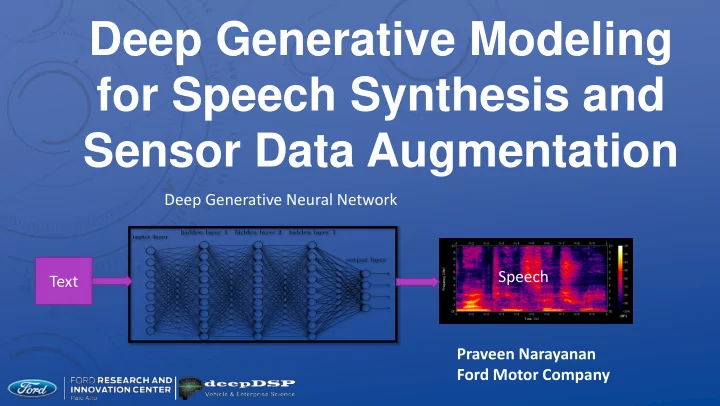
Deep Generative Modeling for Speech Synthesis and Sensor Data Augmentation Deep Generative Neural Network Speech Text Praveen Narayanan Ford Motor Company PROJECT DESCRIPTION Use of DNNs increasingly prevalent as a solution for many data


slide-1
SLIDE 1

Deep Generative Modeling for Speech Synthesis and Sensor Data Augmentation

Praveen Narayanan Ford Motor Company Speech Text Deep Generative Neural Network
slide-2
SLIDE 2

PROJECT DESCRIPTION

  • Use of DNNs increasingly prevalent as a solution for many data intensive applications
  • Key bottleneck – requires large amounts of data with rich feature sets

=> Can we produce synthetic, realistic data?

  • This work aims to leverage state of the art DNN approaches to produce synthetic data that are real world

representative

  • Deep Generative modeling:

−A new research approach using DNN, came into vogue in the last three years −Examples: VAE, GAN, PixelRNN, Wavenet

  • VAE – Variational Autoencoder: Maximizing a variational objective bound + reparametrization
  • GAN – Generative Adversarial Nets: Adversarial learning with a discriminator
  • Some application areas of generative models:
  • Data augmentation in missing data problems – e.g. when labels are missing or bad
  • Generating samples from high dimensional pdfs – e.g. producing rich feature sets
  • Synthetic data generation for simulation – e.g. reinforced learning in a simulated environment

2

slide-3
SLIDE 3

TECHNICAL SCOPE

  • Text to speech problem
  • Given text, convert to speech
  • Use to train ASR
  • Produce speech from text with custom attributes

Examples: Male vs female speech (voice conversion) Accented speech: English in different accents Multilanguage

  • Sensor data augmentation
  • Effecting transformations on data

− Rotations on point clouds − Generating data in adverse weather conditions

3

Hello Do you speak Mandarin ? Mandarin Parrot Accent Nǐ huì shuō pǔtōnghuà ma

slide-4
SLIDE 4

SCOPE OF THIS TALK

  • Very brief introduction to generative models (GANs, VAEs, autoregressive

models)

  • Describe the text to speech problem (TTS)
  • High level overview of “Tacotron” – a quasi end to end TTS system from

google

  • Speech feature processing
  • Different types of features used in speech signal processing
  • Describe the CBHG network and our implementation
  • Originally proposed in the context of NMT
  • Used in Tacotron
  • Voice conversion using VAEs
  • Conditional variational autoencoders to transform images
slide-5
SLIDE 5

GENERATIVE MODELING “TOOLS”

  • Generative Adversarial Networks (GANs)
  • Variational Autoencoders (VAEs)
  • Autoregressive models
  • RNNs

−Vanilla RNNs −Gated: LSTM, GRU, possibly bidirectional −Seq2seq + attention

  • Dilated convolutions

−Wavenet, Bytenet, PixelRNN, PixelCNN

DRAW PixelRNN pix2pix [Goodfellow; Kingma and Welling; Rezende and Mohamed; Van den Oord et al]

slide-6
SLIDE 6

VARIATIONAL AUTOENCODER RESOURCES

Vanilla VAE

  • Kingma and Welling
  • Rezende and Mohamed

Semi Supervised VAE (SSL+conditioning, etc.)

  • Kingma et. al

Related

  • DRAW (Gregor et al)
  • IAF/Variational Normalizing flows (Kingma, Mohamed)

Blogs and helpers

  • Tutorial on VAEs (Doersch)
  • Brian Keng’s blog (http://bjlkeng.github.io/)
  • Shakir Mohamed’s blog (http://blog.shakirm.com/)
  • Ian Goodfellow’s book (http://www.deeplearningbook.org/)
slide-7
SLIDE 7

TEXT TO SPEECH

  • Given a text sequence, produce a speech sequence using DNNs
  • Historical approach:
  • Concatenative TTS (concatenate speech segments)
  • Parametric TTS

−HMMs −DNNs

  • Recent developments
  • Treat as seq2seq problem a la NMT
  • Two current approaches
  • RNNs
  • Autoregressive CNNs (Wavenet/Bytenet/PixelRNN)

(Zen et al)

slide-8
SLIDE 8

CURRENT BLEEDING EDGE LANDSCAPE

  • Last 2 years (!)
  • Baidu DeepVoice series (2016, 2017, 2018)
  • Tacotron series (2017+)
  • DeepVoice, Tacotron are seq2seq models with text in => waveform out

−Seq2seq + attention (Bahdanau style)

  • Wavenet series [not relevant, but very instructive]

−Wavenet 1: fast training, slow generation −Wavenet 2: (a brilliancy) – two developments (100X over wavenet)

1) Inverse Autoregressive Flow – fast inference 2) Probability Density “Distillation” (as against estimation)

  • cooperative training during inference to match PDF of trained wavenet
slide-9
SLIDE 9

DNN WORKFLOW

  • Tacotron, Baidu Deepvoice
  • Google (2017), Tacotron (2016, 2017)
  • Seq2seq+attention RNN trained end to end

Speech Features Text DNN Speech Text to Speech spectrogram hello Seq2seq Attention RNN waveform Speech Deep Generative Neural Network

slide-10
SLIDE 10

TEXT VS PHONEME FEATURES

hello RNN h/eh/l/ow Text sequence Phoneme sequence RNN Speech Earlier models hello RNN Text sequence Speech frames Speech Tacotron Phoneme (‘token’/segment) > text Text=>phoneme needs another DNN Not totally “end-to-end”

slide-11
SLIDE 11

SEQ2SEQ+ATTENTION

  • Originally proposed in NMT context (Bahdanau, Cho et. al.)

I am not a small black cat je ne suis pas un petit chat noir Variable word length Word ordering different Attention weights Input and output words

slide-12
SLIDE 12

TACOTRON: SEQ2SEQ+ATTENTION

Processed text sequence Output mel frames Sophisticated architecture

Built on top of Bahdanau Preprocessing of text Postprocessing of output ‘mel’ frames

Text Tacotron Mel Spectrogram

Training: <text/mel> pairs

slide-13
SLIDE 13

AUDIO FEATURES FOR SPEECH DNNS

  • Main theme: Synthesize voice using generative modeling (VAEs/GANs)
  • Sub-theme: Feature generation for audio critical for audio processing
  • Audio representations:
  • Raw waveforms: uncompressed , 1D, amplitude vs time – 16 kHz
  • Linear spectrograms: 2D, frequency bins vs time (1025 bins)
  • Mel spectrograms: 2D, compressed log-scale representation (80 bins)
  • Compressed (mel) representations
  • Easier to train neural network
  • Lossy
  • Need compression but also need to keep sufficient number of features
slide-14
SLIDE 14

MOTIVATION

Text DNN Speech Features ? Speech DNN Speech Features ? Speech Speech STFT Speech Features Text to Speech Speech to transformed speech Power & mel spectrogram Raw Audio

slide-15
SLIDE 15

MEL FEATURES

  • Order of magnitude compression beneficial to train DNNs
  • Linear spectrograms: 1025 bins
  • Mel: 80 bins
  • Energy is mostly contained in a smaller set of bins in linear spectrogram
  • Creating mel features
  • Low frequencies matter – closely spaced filters
  • Higher frequencies less important – larger spacing

𝑁 = 1125 ln(1 + 𝑔 700) Linearly spaced bins in mel scale Bins closely spaced at lower frequencies (Kishore Prahllad, CMU)

slide-16
SLIDE 16

AUDIO PROCESSING WORKFLOW

Audio Linear Spectrogram Feature Generation VAE Network Mel Spectrogram Mel Spectrogram Training Speech data Mel Spectrogram Mel Spectrogram PostNet Linear Spectrogram Audio Postprocessing To recover audio Linear Mel 80 1025

slide-17
SLIDE 17

POST PROCESSING TO RECOVER AUDIO

  • Use of Griffin-Lim procedure to convert from linear spectrogram to waveform

Conv FilterBank Highway Mel 80 bins 1025 bins BiLSTM Processed frames 80 bins Linear PostNet Griffin Lim Audio Need to use a postprocessing DNN To recover audio waveform

slide-18
SLIDE 18

CBHG/POSTNET

  • Originally, in Tacotron (adapted from Lee et. al.)
  • “Fully Character-Level Neural Machine Translation without Explicit

Segmentation”

  • Tacotron: text=>phoneme bypassed to allow text=>speech
  • Used in 2 places:
  • Encoder: Text=>text features
  • Postprocessor net
  • Mel spectrogram => linear spectrogram (=>audio)

(Tacotron)

slide-19
SLIDE 19

CBHG DESCRIPTION

  • Conv+FilterBank+Highway+GRU
  • Take convolutions of sizes (1,3,5,7, etc.) to account for words of varying size
  • Pad accordingly to create stacks of equal length
  • Max pool to create segment embeddings

Pool (stride=1) convolutions (Lee et al)

slide-20
SLIDE 20

CBHG DESCRIPTION

  • Send to highway layers (improves training deep nets – Srivastava)
  • Bi-directional GRU or LSTM

GRU GRU

slide-21
SLIDE 21

HIGHWAY LAYERS OVERVIEW

  • Improves upon residual connections
  • Residual:
  • 𝑧 = 𝑔 𝑦 + 𝑦
  • Highway motivation: use fraction of input
  • 𝑧 = 𝑑. 𝑔 𝑦 + 1 − 𝑑 . 𝑦
  • Now make ‘c’ a learned metric
  • 𝑧 = 𝑑 𝑦 𝑔 𝑦 + 1 − 𝑑 𝑦

. 𝑦

  • Make c(x) lie between 0 and 1 by passing through sigmoid unit
  • Finally, use a stack of highway layers. E.g. y1(x), y2(y1), y3(y2), y4(y3)

Srivastava et al

slide-22
SLIDE 22

SPECTROGRAM RECONSTRUCTIONS

  • Use filter sizes of 1, 3, 5 in CBHG
  • Use bi-LSTM
  • Highway layer stack of 4
  • Input: 80 bin mel frames with seq length 44
  • Output: 1025 bin linear frames with seq length 44
  • PyTorch
  • Librosa
slide-23
SLIDE 23

SAMPLES

“ground truth” “reconstructed”

slide-24
SLIDE 24

SAMPLES

Ground truth Reconstruction

slide-25
SLIDE 25

GENERATIVE MODELING WITH VARIATIONAL AUTOENCODERS

DESIDERATA

slide-26
SLIDE 26

GENERATIVE MODELING WITH VARIATIONAL AUTOENCODERS

  • Variational Inference fashioned into DNN (Kingma and Welling; Rezende and Mohamed)

Latent Reconstruction Input

slide-27
SLIDE 27

PROPERTIES OF VAE

  • Feed input data and encode representations in reduced dimensional space
  • Reconstruct input data from reduced dimensional representation
  • Compression
  • Generate new data by sampling from latent space

Encoder Input Reconstruction Decoder Latent Layer

Training

Latent Layer Decoder Generation

Inference Sample N(0,I)

slide-28
SLIDE 28

RECONSTRUCTIONS

Ground Truth Reconstruction Original Image: 560 pixels Reconstructed from 20 latent variables 28X image compression advantage

slide-29
SLIDE 29

GENERATION

Faces and poses that did not exist!

slide-30
SLIDE 30

APPLICATIONS

SPEECH ENCODINGS

slide-31
SLIDE 31

SPEECH ENCODINGS USING VAES

  • Encode utterances from several speakers
  • Store encodings
  • Generate synthetic speech by sampling from VAE
  • Tried with simple utterances “hello”, “cat”, “stop” from speech commands dataset
  • Samples to be used in ASR to train speech commands

Learn

Speaker 1 “hello” Speaker 2 “hello” Speaker 3 “hello”

Generate Z

Unique speaker “hello”

Train ASR

slide-32
SLIDE 32

WORKFLOW

  • Input: Spectrogram
  • Convert audio signals to spectrogram
  • Output: spectrogram, converted to audio by Griffin Lim reconstruction
  • Librosa used to manipulate audio

Spectrogram Audio VAE Spectrogram Griffin Lim Audio

slide-33
SLIDE 33

NETWORK ARCHITECTURE

  • Input spectrogram: 1025x44 image (NxF)
  • Audio signals invariant only in time axis
  • Take full connections in y axis
  • First layer: take 1xF convolutions

F N N x1

slide-34
SLIDE 34

NETWORK ARCHITECTURE

  • Encoder/Decoder: Convolution/Deconvolution
  • Use strides for downsampling
  • Multiple channels for filterbanks
  • Filter sizes dx1 operating on Nx1 inputs (times #filter banks=n)

Spectrogram nxNx1 Strided Conv Full Conn Strided Conv Full Conn

Z

Strided Deconv Full Conn Spectrogram

Encoder Decoder

N (0,1) Audio Griffin Lim Audio

𝜈 𝜏 𝜗 𝑎 = 𝜈 + 𝜗𝜏

slide-35
SLIDE 35

AUDIO SAMPLES

Utterance: “Cat”

slide-36
SLIDE 36

CVAE – ROTATED IMAGES WITH POSE AS LABEL

  • Give input image + label
  • Produce rotated image
  • Label==angle
  • One hot encoding
slide-37
SLIDE 37

RECONSTRUCTIONS

Ground Truth Rotations Reconstructed Rotations

slide-38
SLIDE 38

RECONSTRUCTIONS

slide-39
SLIDE 39

TEST ROTATIONS

Need larger Training set Images produced By data not in Training set

slide-40
SLIDE 40

CONCLUSIONS

  • Speech features:
  • Tacotron’s CBHG network is a necessary prelude to other operations
  • Speech transformations
  • Custom convolutional VAE architecture
  • Improving samples and architecture ongoing
  • LIDAR
  • Conditional VAEs/GANs for point cloud transformations
slide-41
SLIDE 41

UNFINISHED WORK

  • VAE: seq2seq implementations
  • Replace encoder/decoder with recurrent forms
  • Conditioning to produce custom attributes
  • Can we do speech transformations with real TTS applications
  • What about voice to voice conversion applications?
  • GAN formulations for losses
  • Investigate scenarios where GAN losses would be beneficial
slide-42
SLIDE 42

MOTIVATION – VAEGAN

  • MSE loss used in VAE
  • 𝑀 = 𝑦𝑒𝑏𝑢𝑏 − 𝑦𝑠𝑓𝑑𝑝𝑜 2
  • Replace with GAN
  • L= L_{GAN}

Data Encoder z Decoder (Generator) Recon Data 0/1 GAN D BProp Autoencoding Beyond Pixels

slide-43
SLIDE 43

EXAMPLES

Truth GAN loss recon VAE (MSE) loss recon (Ground truth not shown)

slide-44
SLIDE 44

USING GANS AS LOSS FUNCTIONS

  • So far, we have used L1 or L2 losses
  • We find that L2 losses reconstruct poorly
  • Can we use GANs as loss functions?

L2 L1 GAN Ground Truth

slide-45
SLIDE 45

SEQ2SEQ VAE

  • Improving upon vanilla vae with recurrent model

LSTM Encoder Z LSTM Decoder Mel in Reconstruction Mel out Sketch-RNN

slide-46
SLIDE 46

SEQ2SEQ VAE

Ground Truth Reconstruction Simple network (LSTM)

slide-47
SLIDE 47

SUPPLEMENTARY SLIDES

slide-48
SLIDE 48

FIGURE 1

Conv FilterBank Highway Mel 80 bins 1025 bins BiLSTM Processed frames 80 bins Linear CBHG Griffin Lim Audio

slide-49
SLIDE 49

GAN LOSS ARCHITECTURE

slide-50
SLIDE 50

FIGURE 2: EXISTING FRAMEWORK FOR LOSSES

CBHG fake real L1 or L2 loss Backprop Mel (real) Linear (fake)

slide-51
SLIDE 51

FIGURE 3: PROPOSED FRAMEWORK WITH GAN LOSSES

CBHG fake real Learned GAN loss Backprop

slide-52
SLIDE 52

FIGURE 5: GAN DISCRIMINATOR DESIGN

FC in Y direction Linear Spectrogram Reduced Linear Spectrogram Reduced Linear Spectrogram 1D conv in X direction Channels y direction Conv output Channels Y direction

slide-53
SLIDE 53

FIGURE 4: OVERVIEW OF SYSTEM ARCHITECTURE WITH GAN LOSSES

CBHG GAN Discriminator False Fake (linear) Backprop Discriminator GAN Discriminator True Real Real (mel)