SLIDE 1
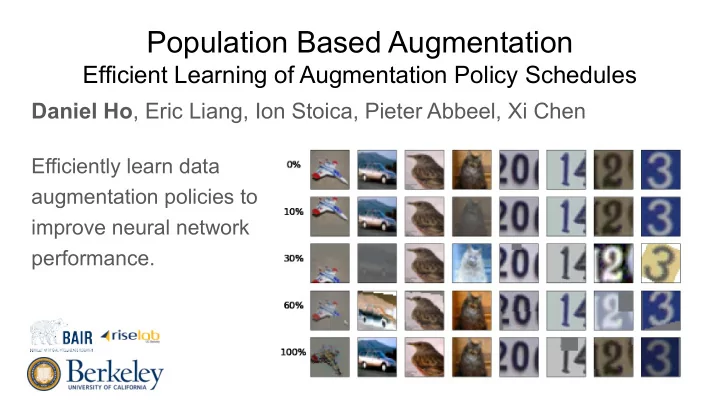
Population Based Augmentation
Efficient Learning of Augmentation Policy Schedules
Efficiently learn data augmentation policies to improve neural network performance.
Daniel Ho, Eric Liang, Ion Stoica, Pieter Abbeel, Xi Chen
SLIDE 2
Data Augmentation
Most models only use basic data augmentation strategies.
SLIDE 3 Augmentation with AutoAugment
Source: AutoAugment
Learns operations to apply with certain probability and magnitude.
SLIDE 4
What’s the catch?
AutoAugment is too computationally expensive to learn. Our algorithm, PBA, uses 1000x less compute.
SLIDE 5
Population Based Augmentation (PBA)
PBA learns CIFAR augmentation policy in 5 GPU hours. AutoAugment learns in 5,000 GPU hours.
CIFAR-10
SLIDE 6 How is the augmentation schedule learned?
Hyperparameter search using a mix of evolutionary algorithms and random search to discover adaptative augmentation policy schedule quickly.
Source: Population Based Training
SLIDE 7
Learned Augmentation Policy Schedules
Effect of Population Based Augmentation applied to images showing stronger augmentations as training progresses.
SLIDE 8
Thank you!
Population Based Augmentation Daniel Ho, Eric Liang, Ion Stoica, Pieter Abbeel, Xi Chen Poster: Pacific Ballroom #134 Code: https://github.com/arcelien/pba Contact: Daniel Ho (daniel.ho at berkeley.edu)