
SLIDE 1
Determinism and Volition in Antiquity
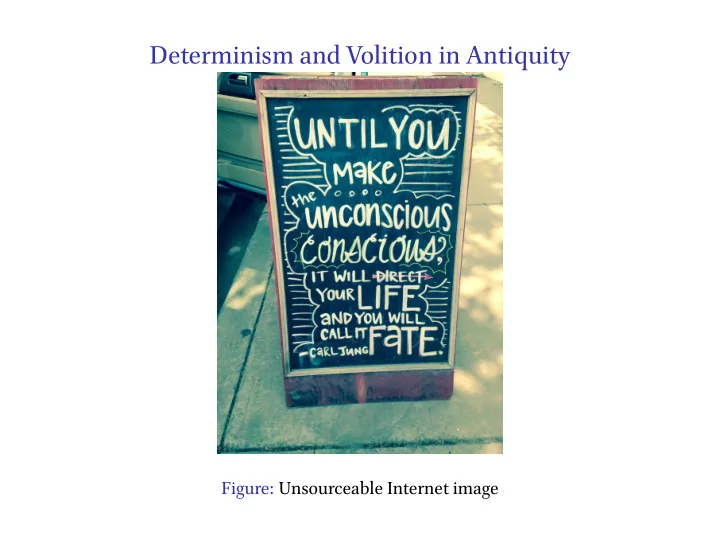
Figure: Unsourceable Internet image
Determinism and Volition in Antiquity Figure: Unsourceable Internet - - PowerPoint PPT Presentation
Determinism and Volition in Antiquity Figure: Unsourceable Internet image Free Will? Figure: The Matrix (YouTube link) Figure: Oliver Sacks (YouTube link) mere appearance Leucippus and Democritus: Atomism (See Edmunds, Necessity, Chance,
Figure: Unsourceable Internet image
Figure: The Matrix (YouTube link) Figure: Oliver Sacks (YouTube link)
▶ Strict materialism ▶ All is atoms and void ▶ Atoms differ in shape, size, and mass ▶ The universe is in constant flux, i.e. atoms move in the void ▶ Objects are either temporary couplings of atoms (like joining like) or
mere appearance
▶ All events are caused by necessity (a whirl); there is no chance ▶ Humans have no power to influence events
(See Edmunds, “Necessity, Chance, and Freedom in the Early Atomists”)
▶ One can only act according to one’s beliefs ▶ One can only believe according to one’s knowledge
→ All act to the best of their knowledge; no one does wrong willingly
▶ The perfect instance of each concept resides in the abstract world of
Forms
▶ Deliberation can bring one closer to these Forms, and thus to virtue ▶ It is also possible misguidedly to corrupt one’s beliefs and thus
change one’s nature for the worse
▶ The heavenly bodies move by necessity out of desire for the
Unmoved Mover
▶ Sublunary organisms are also affected by this final causality: they
strive to partake of the eternal and the divine, translating into an attempt to reach and maintain their highest point of development (and, given failure in the latter, reproduction) (See Dudley, “The Fate of Providence and Plato’s World Soul in Aristotle”)
▶ Animal motion is self-governed, caused by imagination through
desire
▶ Choice is desire moderated by deliberation and moral character;
moral character is influenced by habituation and can be altered with difficulty (See Müller, “Was Aristotle an Ethical Determinist?”)
▶ Atomic motion is determined by gravity and collisions ▶ A minimal, random sideways swerve saves us from determinism ▶ Pleasure motivates action; evil results from a mistaken belief about
what brings pleasure
▶ Reason can influence belief
(See O’Keefe, “Action and Responsibility”)
It were better to follow the myths about the gods than to become a slave to the ‘destiny’ of the natural philosophers: for the former suggests a hope of placating the gods by worship, whereas the latter involves a necessity that knows no placation. (Epicurus, qtd. in Greene, “Fate and Providence,” 333–334)
→ Cf. Neo’s reasoning in The Matrix!
▶ Substance monism: there is only one substance, namely Reason/God ▶ Materialist universe: spirit is just a subtle kind of matter ▶ Two principles: the active (fire, air) and the passive (water, earth) ▶ No chance ▶ All events, cosmic and human, form a single chain of causation ▶ Stoic ethics: to live according to nature, align yourself with fate
What must be, must be; but man, by his insight, may will to do what must be done, and so may act in harmony with nature; or, again, he may resist. The result, considered externally, will be the same in either case, for man cannot overrule Nature, or Fate; but by willing coöperation, by making its law his law, he can find happiness, or by resignation he can at least find peace. (Greene, “Fate and Providence,” 340–341)
▶ One’s own sense of ethics plays no role (contrast Epicureans) ▶ Is nature to be understood as descriptive (triggering inaction) or
prescriptive (triggering action)? Should Stoics retreat from politics
▶ Stoics like Balbus claimed that the world was designed for the good
▶ If there is evil, how can it proceed from a Nature that is good? ▶ Divination is pointless if all is fated ▶ Lazy argument: what’s the point in calling a doctor? (Response:
co-fatedness)
Laius, childless, is told (Delphi) any son will kill him Laius exposes his son Oedipus, intending to kill him and thwart the prophecy Oedipus survives and grows up without knowing his parents Oedipus is told (Delphi) he will kill his father and marry his mother Oedipus tries to thwart the prophecy by travelling to what he thinks is not his birthplace Oedipus kills his father and marries his mother
Figure: Tom Lehrer (GEMA-blocked YouTube link)
▶ Laius, childless, is told (Delphi) any son will kill him ▶ Laius exposes his son Oedipus, intending to kill him and thwart the
prophecy
▶ Oedipus survives and grows up without knowing his parents ▶ Oedipus is told (Delphi) he will kill his father and marry his mother ▶ Oedipus tries to thwart the prophecy by travelling to what he thinks
is not his birthplace
▶ Oedipus kills his father and marries his mother
Figure: Tom Lehrer (GEMA-blocked YouTube link)
▶ Adversity is not important ▶ Adversity serves punishment or education ▶ Fate and Providence are separate entities, the former amoral ▶ Compatibilism; see overleaf
(Greene, “Fate and Providence,” 345–346, 349; cf. Frede, “Stoic Determinism,” 186–192)
▶ Active principle pneuma in complex organisms gives rise to a
semi-autonomous microcosm
▶ Two kinds of cause
▶ Complete/principal cause (inner cause, one’s nature) ▶ Antecedent/proximate/auxiliary cause (external/efficient cause) ▶ → Cylinder (Chrysippus) / bribe (Frede)
▶ A person’s actions are fully predictable if you fully know her nature,
but they are not therefore inexorable; one’s nature can be improved
▶ Pneuma is not a preexisting, omniscient entity; it is interwoven with
the world, and different parts of it constitute our nature. This salvages personal responsibility!
The need to treat human beings as autonomous beings is due to human ignorance of the world order at large. (Frede, “Stoic Determinism,” 204)
→ cf. Oliver Sacks!
▶ A tendency to believe in the capability laboriously to alter one’s
character rather than to have full freedom in individual choices (Plato, Aristotle, Epicurus)
▶ Fundamental cosmic principles effect a degree of determinism
▶ Atomists: strict causal chain ▶ Aristotle: the Unmoved Mover ▶ Stoics: substance monism with absolute predictibility ▶ Epicurus: atomism with a causal chain tempered by a swerve
Figure: Strudwick, “A Golden Thread” (public domain / WMC)
Figure: The Three Fates (public domain / Hans Vischer)
▶ Clotho (“spinner”) spins the thread of life ▶ Lachesis (“allotter”) measures the thread of life and determines its
length
▶ Atropos (“inexorable”) cuts the thread of life and chooses the
manner of death
d’Hoine, Peter, and Gerd van Riel, eds. Fate, Providence and Moral Responsibility in Ancient, Medieval and Early Modern Thought: Studies in Honour of Carlos Steel. Leuven: Leuven University Press, 2014. Dudley, John. “The Fate of Providence and Plato’s World Soul in Aristotle.” In d’Hoine and Riel, Fate, Providence and Moral Responsibility in Ancient, Medieval and Early Modern Thought, 59–73. Edmunds, Lowell. “Necessity, Chance, and Freedom in the Early Atomists.” Phoenix 26, no. 4, 342–357. Frede, Dorothea. “Stoic Determinism.” In The Cambridge Companion to the Stoics, edited by Brad Inwood, 179–205. Cambridge: Cambridge University Press, 2003. Greene, William Chase. “Fate and Providence.” In Moira: Fate, Good, and Evil in Greek Thought, 331–398. Cambridge, MA: Harvard University Press, 1944. New York and Evanston: Harper, 1963.
Müller, Jörn. “Was Aristotle an Ethical Determinist?: Reflections on his Theory of Action and Voluntariness.” In d’Hoine and Riel, Fate, Providence and Moral Responsibility in Ancient, Medieval and Early Modern Thought, 75–99. O’Keefe, Tim. “Action and Responsibility.” In The Cambridge Companion to Epicureanism, edited by James Warren, 142–157. Cambridge: Cambridge University Press, 2009.