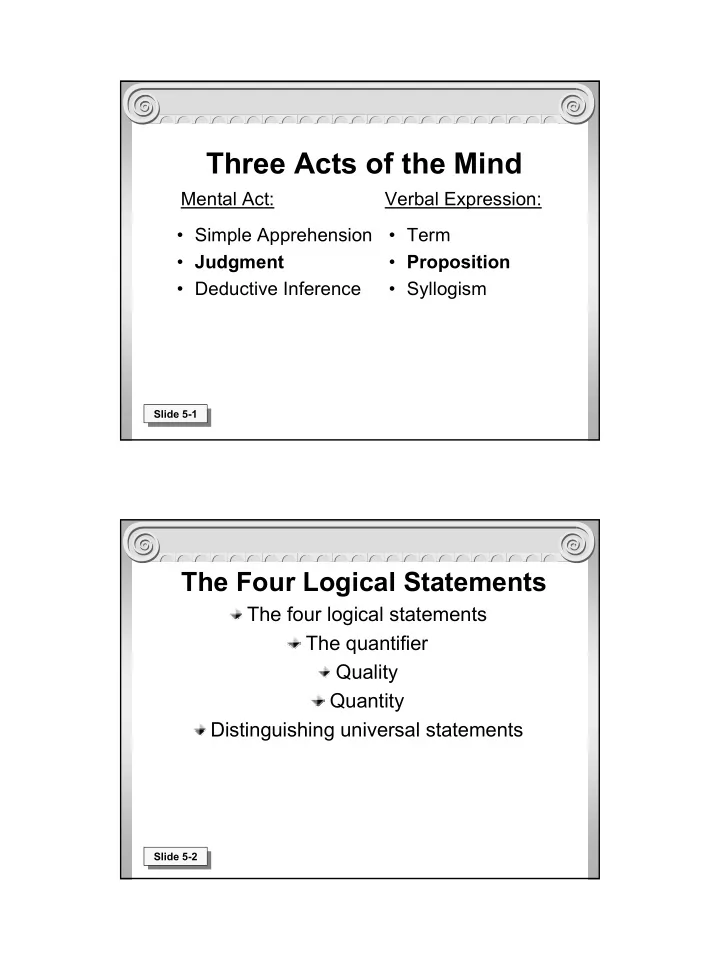
Three Acts of the Mind Mental Act: Verbal Expression: Simple - - PDF document

three acts of the mind
SMART_READER_LITE
LIVE PREVIEW

Three Acts of the Mind Mental Act: Verbal Expression: Simple - - PDF document

Three Acts of the Mind Mental Act: Verbal Expression: Simple Apprehension Term Judgment Proposition Deductive Inference Syllogism Slide 5-1 The Four Logical Statements The four logical statements The quantifier


slide-1
SLIDE 1

1

Three Acts of the Mind

  • Simple Apprehension
  • Judgment
  • Deductive Inference
  • Term
  • Proposition
  • Syllogism

Mental Act: Verbal Expression:

Slide 5-1

The Four Logical Statements

The four logical statements The quantifier Quality Quantity Distinguishing universal statements

Slide 5-2

slide-2
SLIDE 2

2

Judgment is the act by which the intellect unites by affirming, or separates by denying.

Slide 5-3

The classification of propositions

Slide 5-4

slide-3
SLIDE 3

3

The Four Statements of Logic:

A: All S is P I: Some S is P E: No S is P O: Some S is not P

Slide 5-5

affirmo

The A statement affirms something about all of S, namely, P. All S is P

Slide 5-6

slide-4
SLIDE 4

4

Examples of A Statements

All men are mortal All cars are fast All boys are rude All girls are pretty

Slide 5-7

affirmo

The I statement affirms something about some S’s, namely P. Some S is P

Slide 5-8

slide-5
SLIDE 5

5

Examples of I Statements

Some men are mortal Some cars are fast Some boys are rude Some girls are pretty

Slide 5-9

nego

The E statement denies something about all S, namely P. No S is P

Slide 5-10

slide-6
SLIDE 6

6

Examples of E Statements

No men are mortal No cars are fast No boys are rude No girls are pretty

Slide 5-11

nego

The O statement denies something about some S’s, namely P. Some S is not P

Slide 5-12

slide-7
SLIDE 7

7

Examples of O Statements

Some men are not mortal Some cars are not fast Some boys are not rude Some girls are not pretty

Slide 5-13

The Four Elements of a Proposition

Quantifier Subject-term Predicate-term Copula

Slide 5-14

slide-8
SLIDE 8

8

The Four Kinds of Quantifier

All Some No Some … not

Slide 5-15

The Quality of a Proposition

affirmative negative

Slide 5-16

slide-9
SLIDE 9

9

Affirmative Propositions

A: All men are mortal I: Some men are happy

Slide 5-17

Negative Propositions

E: No men are gods O: Some men are not happy

Slide 5-18

slide-10
SLIDE 10

10

The Quantity of Propositions

Universal Particular

Slide 5-19

Universal Propositions

A: All men are mortal E: No men are gods

Slide 5-20

slide-11
SLIDE 11

11

Quantity and Quality of Quantity and Quality of the Four Categorical the Four Categorical Statements Statements

Quality Affirmative Negative Universal A E Quantity Particular I O

Slide 5-21

Particular Propositions

I: Some men are happy O: Some men are not happy

Slide 5-22

slide-12
SLIDE 12

12

Quantity and Quality of Quantity and Quality of the Four Categorical the Four Categorical Statements Statements

Quality Affirmative Negative Universal A E Quantity Particular I O

Slide 5-23

The general rule is that, in statements that do not contain a quantifier, all is intended unless some is clearly indicated.

Slide 5-24

Distinguishing Universal Statements

slide-13
SLIDE 13

13

Distinguishing Universal Statements

Frogs are ugly = All frogs are ugly BUT Men are setting sail = Some men are setting sail

Slide 5-25

Terms in which the subject is an individual are universal Socrates is a man

Slide 5-26

slide-14
SLIDE 14

14

The Four Logical Statements

The four logical statements The quantifier Quality Quantity Distinguishing universal statements

Slide 5-27