
SLIDE 1
Advancing Towards New Frontiers Singapore Test Services
1
Scanning Electron Microscope (SEM) equipped with Energy-dispersive X-ray (EDX) Detector
SEM – typical magnification range used : 35 – 10,000X
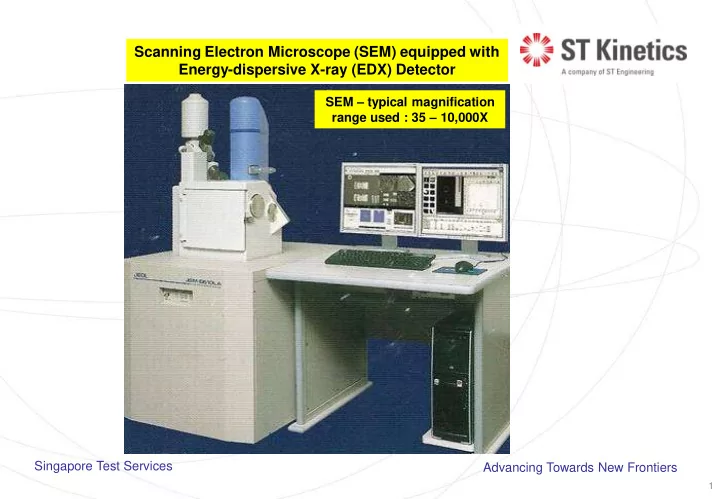
Energy-dispersive X-ray (EDX) Detector SEM typical magnification - - PowerPoint PPT Presentation
Scanning Electron Microscope (SEM) equipped with Energy-dispersive X-ray (EDX) Detector SEM typical magnification range used : 35 10,000X Singapore Test Services Advancing Towards New Frontiers 1 Ductile Fracture Features Singapore
Advancing Towards New Frontiers Singapore Test Services
1
SEM – typical magnification range used : 35 – 10,000X
Advancing Towards New Frontiers Singapore Test Services
2
Advancing Towards New Frontiers Singapore Test Services
3
Advancing Towards New Frontiers Singapore Test Services
4
Advancing Towards New Frontiers Singapore Test Services
5
Advancing Towards New Frontiers Singapore Test Services
6
Cu-Zn alloy – Brass Fe-C-Cr-Mn alloy – Low Alloy Steel Wear debris for material identification
Advancing Towards New Frontiers Singapore Test Services
7
Clean, normal surface region Cracked, contaminated surface region Surface with cracks and contamination
Advancing Towards New Frontiers Singapore Test Services
8
Positive Material Identification Drillings for “Wet’ Analysis Arc-spark Spectroscopy
Advancing Towards New Frontiers Singapore Test Services
9
Advancing Towards New Frontiers Singapore Test Services
10
Advancing Towards New Frontiers Singapore Test Services
11
Advancing Towards New Frontiers Singapore Test Services
12
Advancing Towards New Frontiers Singapore Test Services
13
Impact Testing Hardness Testing
Advancing Towards New Frontiers Singapore Test Services
14
Advancing Towards New Frontiers Singapore Test Services
15
Advancing Towards New Frontiers Singapore Test Services
16
Optical Microscope
Automatic Grinder/Polisher Cut-off Machine Mounted specimens
Advancing Towards New Frontiers Singapore Test Services
17
As-received bolt sample After sectioning longitudinally After mounting, grinding & polishing After etching
Advancing Towards New Frontiers Singapore Test Services
18
Crest Root Threads
Advancing Towards New Frontiers Singapore Test Services
19
Microindentation Hardness Testing
Advancing Towards New Frontiers Singapore Test Services
20
Advancing Towards New Frontiers Singapore Test Services
21
Little or no deformation Significant deformation
Advancing Towards New Frontiers Singapore Test Services
22
Advancing Towards New Frontiers Singapore Test Services
23
Advancing Towards New Frontiers Singapore Test Services
24
Advancing Towards New Frontiers Singapore Test Services
25
Advancing Towards New Frontiers Singapore Test Services
26