Chinatown Planning and Rezoning Study Preliminary Report to the - - PowerPoint PPT Presentation

chinatown planning and rezoning study
SMART_READER_LITE
LIVE PREVIEW

Chinatown Planning and Rezoning Study Preliminary Report to the - - PowerPoint PPT Presentation

Chinatown Planning and Rezoning Study Preliminary Report to the Chinatown Working Group TASK I REVIEW & ANALYSIS Pratt Center / Collective Partnership May 6, 2013 INITIAL ASSESSMENT Shared Goals 1. Create a Special Zoning District 2.

slide-1
SLIDE 1

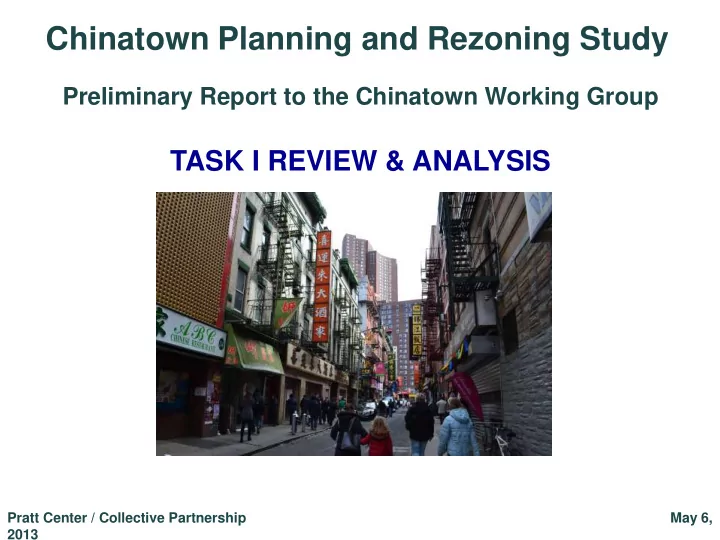
Chinatown Planning and Rezoning Study

Preliminary Report to the Chinatown Working Group

TASK I REVIEW & ANALYSIS

Pratt Center / Collective Partnership May 6, 2013

slide-2
SLIDE 2

INITIAL ASSESSMENT

Pratt Center / Collective Partnership May 6, 2013 Preliminary Report to the Chinatown Working Group

  • 1. Create a Special Zoning District
  • 2. Maintain affordability
  • 3. Promote local job development
  • 4. Support and protect existing

residents and small businesses

  • 5. Preserve Chinatown’s historic

urban fabric

  • 6. Support a contemporary

immigrant community

  • 7. Strengthen existing support

networks

Shared Goals

slide-3
SLIDE 3

APPROACH

  • CAPZ: Culture & Historic Preservation, Affordability, Zoning
  • Economic Development
  • Are citywide, require broad advocacy and involvement
  • Apply uniquely to a local issue, could be pursued within the community

working with partners

  • Can be incorporated in a Special District
  • Need further discussion to reach agreement

DETAILED CONSIDERATION OF CWG RECOMMENDATIONS Identify recommendations that:

Pratt Center / Collective Partnership May 6, 2013 Preliminary Report to the Chinatown Working Group

slide-4
SLIDE 4
  • Parks, Open Space and Recreation
  • Parking, Transportation, Circulation, Security
  • Education and Schools
  • Immigrant Affairs and Social Services
  • Are citywide, require broad advocacy and involvement.
  • Apply uniquely to a local issue, could be pursued within the community

working with partners.

  • Can be incorporated in CAPZ and ED strategies, specifically as elements of

a Special District.

CONSIDERATION OF APPROVED PROPOSED ACTION PLANS Identify recommendations that:

APPROACH

Pratt Center / Collective Partnership May 6, 2013 Preliminary Report to the Chinatown Working Group

slide-5
SLIDE 5

AFFORDABILITY

  • Long-term goal: AMI is a figure that comes from the federal government to

help determine the true cost of housing, to deliver housing subsidies for projects, and to determine rents as a portion of income.

  • May be possible to utilize “income bands” within AMI that more accurately

represent a local AMI.

CWG Recommendation Considerations

Define a local Area Median Income (AMI) that reflects the demographic of Chinatown

Pratt Center / Collective Partnership May 6, 2013 Preliminary Report to the Chinatown Working Group

slide-6
SLIDE 6
  • The real issue is enforcement of regulations.
  • Review subsidized programs, such as Mitchell-Lama.
  • Coordinate with Zoning. Anti-harassment provisions could be included in a

Special District. Examine Clinton Special District and Greenpoint- Williamsburg Rezoning.

CWG Recommendation Considerations

Preserve the existing rent regulated stock in Chinatown and its surrounding areas

AFFORDABILITY

Pratt Center / Collective Partnership May 6, 2013 Preliminary Report to the Chinatown Working Group

slide-7
SLIDE 7
  • Some city programs may be appropriate (subject to federal, state, and city

affordability terms and open to lottery)

  • Consider Mutual Housing Associations. Examine Cooper Square Mutual

Housing Association, Lower East Side Peoples Mutual Housing Association and Limited Equity co-ops.

  • Review other HPD and New York State programs that yield units for
  • wnership.

CWG Recommendation Considerations

Create opportunities for affordable homeownership

AFFORDABILITY

Pratt Center / Collective Partnership May 6, 2013 Preliminary Report to the Chinatown Working Group

slide-8
SLIDE 8
  • Encourage use of 421-a incentive program to build affordable housing,

targeted to several different income levels.

  • Encourage Low Income Housing Tax Credits incentive program to build

affordable housing, targeted to several different income levels.

  • Define an Inclusionary Zoning program that incentivizes the creation of

affordable housing units. Mandate affordable housing when buildings are built to maximum height.

  • Call for the development of 100% truly affordable housing at local AMI on

New York City Housing Authority (NYCHA) property, and for ULURP review

  • f any redevelopment of NYCHA property.
  • Determine if other expired housing programs may be revived to serve

Chinatown (i.e. Mitchell-Lama, Homesteading).

CWG Recommendations

Create more affordable rental housing units

AFFORDABILITY

Pratt Center / Collective Partnership May 6, 2013 Preliminary Report to the Chinatown Working Group

slide-9
SLIDE 9
  • 421-a Program (20% of the units for families earning 60% of AMI): Seek

long-term option of increasing 20% affordability level.

  • Low Income Housing Tax Credit program (20% of units for families earning

50% or less of MFI): Adjusting income levels may not be under the control

  • f the city, since the money comes from the federal government.
  • Inclusionary Zoning: Join with other groups to advocate for a mandatory IZ

program as in other cities, to guarantee that affordable units are built.

  • NYCHA infill development: Community Service Society is leading an effort

to slow down the projects and determine whether they comply with the law. Councilmember Mendez is calling for same. CWG could join coalition.

  • Explore potential for development of affordable micro-studio apartments.

Considerations

Create more affordable rental housing units

AFFORDABILITY

Pratt Center / Collective Partnership May 6, 2013 Preliminary Report to the Chinatown Working Group

slide-10
SLIDE 10

CULTURE & HISTORIC PRESERVATION

  • Height restrictions
  • Transfer of air rights
  • ‘Percent for Art’
  • Legalized signage, street set-ups, storefront display practices
  • Protection for buildings of special interest of significance
  • Chinatown visual and performing arts center
  • Culturally distinct activities and businesses like open air markets
  • Chinatown Culture and Historic Preservation Subdistrict Fund
  • Support for Two Bridges Chinatown/Little Italy National Register district and Bowery

National Register district.

  • Education of local landlords on the benefits of landmarking and National Register

listing, (e.g. tax credits for preservation and rehabilitation).

CWG Recommendations

Create a Special Chinatown Cultural and Historic Preservation Subdistrict (except Division Street and East Broadway)

Pratt Center / Collective Partnership May 6, 2013 Preliminary Report to the Chinatown Working Group

slide-11
SLIDE 11
  • Coordinate with Zoning: Incorporate some of the above in a Chinatown

Special District (e.g. Cultural Use Bonus and Air Rights Transfer. Reference Theatre Subdistrict of Midtown Special District)

  • Reconcile desire for preserving the low-rise character of the neighborhood

with the need for increased density to support the creation of affordable housing

  • Consider tradeoffs associated with local landmarking: protections vs.

restrictions

  • Establishment and operation of performing arts center will require strong

community partnerships

Create a Special Chinatown Cultural and Historic Preservation Subdistrict (except Division Street and East Broadway)

Considerations

CULTURE & HISTORIC PRESERVATION

Pratt Center / Collective Partnership May 6, 2013 Preliminary Report to the Chinatown Working Group

slide-12
SLIDE 12
  • Coordinate with Economic Development
  • Coordinate with Zoning and Affordability. Explore potential for development
  • f affordable micro-studio apartments.

CWG Recommendation CWG Recommendation Considerations Considerations

Explore alternative methods beyond rent regulation/rent stabilization for retaining current residents and attracting new immigrants and temporary housing for recent immigrants

Explore City Support for Local Small Businesses

CULTURE & HISTORIC PRESERVATION

Pratt Center / Collective Partnership May 6, 2013 Preliminary Report to the Chinatown Working Group

slide-13
SLIDE 13

ECONOMIC DEVELOPMENT

  • Training and oversight for cooperative and collaborative retail ventures
  • Access to capital for investment in business improvements. EDC – Chinatown Initiative

linked to Asian Banks

  • Advice and assistance to business owners on business strategy, market research and

marketing, better business practices, employee wages and benefits, compliance.

  • Education (business owners and employees) on cleanliness, customer relations,

compliance issues and civic responsibilities.

  • Request banks to invest in Chinatown through the Community Reinvestment Act

(Feb. 11 Rev)

  • Use Community Benefit Agreements to support small business entrepreneurs

(Nov. 11 Rev)

BUSINESS ASSISTANCE PROGRAMS

CWG Recommendation

Through City, State and Federal legislation and with mandatory Community Benefit Agreements for relocation or development of colleges and universities as well as corporations within the Chinatown area, incentivize:

Pratt Center / Collective Partnership May 6, 2013 Preliminary Report to the Chinatown Working Group

slide-14
SLIDE 14
  • Need local partner/delivery mechanism for all business assistance programs.
  • Advising, educating and increasing English activities could be supported through

business and trade associations as well as local non-profits.

  • Most schools and companies moving into area can likely do so as-of-right and

therefore won’t need CBAs.

  • Community Benefits Agreements can take years to negotiate and can be hard to

enforce.

  • An EDC program restricted to the Asian community may run up against public

contracting issues

  • Need to develop a productive dialogue with local banks (not only Chinese-owned

banks) re fulfilling CRA obligations.

BUSINESS ASSISTANCE PROGRAMS (Continued)

Increase use of English in businesses Strengthen and professionalize business and trade associations

Considerations

ECONOMIC DEVELOPMENT

Pratt Center / Collective Partnership May 6, 2013 Preliminary Report to the Chinatown Working Group

slide-15
SLIDE 15
  • Extend presence of sidewalk cafes and entertainment.
  • Create Sidewalk Vending Regulations for Chinatown (part of CAPZ).
  • Incorporate wider sidewalk standards in Special Zoning/Purpose Districts

for new building/developments where vending or public plaza space might be allowed.

  • Investigate pedestrian ONLY sidewalk plaza spaces with small retail,

business etc.

  • Utilize Lower Park area on Allen and Pike Street for some cultural/business

vending.

  • Cultural/Historic Preservation as an Economic enhancement: Utilize

signage, sidewalk plaques, compass or directional markets to highlight areas and way-finding to cultural landmarks.

STREETSCAPES, PEDESTRIAN ACCESS AND STREET VENDING CWG Recommendations

ECONOMIC DEVELOPMENT

Pratt Center / Collective Partnership May 6, 2013 Preliminary Report to the Chinatown Working Group

slide-16
SLIDE 16
  • Conflicting opinions on increasing sidewalk cafes.
  • Conflicting opinions on accommodation of street vendors.
  • Need specific provision for enforcement of new vendor regulations.

Coordinate with CAPZ.

  • Vendors need to organize, perhaps with Street Vendors Project, to ensure

better compliance and meeting of larger Chinatown economic development goals.

  • Traffic issues may be aggravated by increased plaza and pedestrian only
  • areas. Coordinate with Parking, Transportation, Circulation and Security PAP
  • Coordinate with Culture and Historic Preservation recommendations.
  • May be addressed in a Special District

STREETSCAPES, PEDESTRIAN ACCESS AND STREET VENDING Considerations

ECONOMIC DEVELOPMENT

Pratt Center / Collective Partnership May 6, 2013 Preliminary Report to the Chinatown Working Group

slide-17
SLIDE 17
  • Experiment with time-of-day closings. Start with Pell, Doyers and Mosco
  • Streets. If successful, proceed to some combination of Bayard, Elizabeth,

Mott and Mulberry Street. Minimize the inconvenience to businesses. Design closings with emergency access in mind.

  • Change Verrazano-Narrows Bridge toll structure so that trucks do not use

Canal Street to get from Long Island to New Jersey. (Feb. 11 Rev.)

  • Replace parking spaces lost through closure of municipal parking lot at

Police Plaza. (Feb. 11 Rev.)

  • Developers should be mandated to provide affordable parking. (Feb. 11

Rev)

STREETSCAPES, PEDESTRIAN ACCESS AND STREET VENDING CWG Recommendations

ECONOMIC DEVELOPMENT

Pratt Center / Collective Partnership May 6, 2013 Preliminary Report to the Chinatown Working Group

slide-18
SLIDE 18
  • Street closings should be coordinated with vendor representatives and be

part of a larger marketing strategy to draw customers to Chinatown.

  • Closing of Elizabeth Street would impact the 5th Police Precinct.
  • Merchants may have difficulty deciding to be part of a street closing

program without a BID or block association.

  • Changing the toll structure of the Verrazano-Narrows Bridge is a citywide

and regional issue. Will likely need to be coordinated with other advocacy efforts.

  • Conflict between attraction of regional shoppers with cars and a congested

Manhattan location with limited parking.

  • Need to accommodate bus and van transportation services in appropriate

locations.

STREETSCAPES, PEDESTRIAN ACCESS AND STREET VENDING Considerations

ECONOMIC DEVELOPMENT

Pratt Center / Collective Partnership May 6, 2013 Preliminary Report to the Chinatown Working Group

slide-19
SLIDE 19
  • Coordinate with Zoning.
  • Design standards should be both flexible, to accommodate the unique

character of Chinatown (as some of the PAPs suggest) and perhaps designed for all of Chinatown, rather than specific parts.

  • Provide for limited mixed-use development, with a flexible live/work

composition that could support more permanently affordable residential units.

  • Establish identifiable design standards.

FOCUS AREAS CWG Recommendation

Special Purpose District #1: Canal to Worth Street, Baxter to Bowery

Considerations

ECONOMIC DEVELOPMENT

Pratt Center / Collective Partnership May 6, 2013 Preliminary Report to the Chinatown Working Group

slide-20
SLIDE 20
  • Coordinate with Zoning
  • Design standards should be both flexible, to accommodate the unique

character of Chinatown (as some of the PAPs suggest) and perhaps designed for all of Chinatown, rather than specific parts.

  • Provide for limited development
  • Retain characteristics of a Commercial Zone
  • Recognize historic and cultural context
  • Establish identifiable design standards
  • Streetscape improvements

FOCUS AREAS CWG Recommendation Considerations

Special Purpose District #2: Division and East Broadway, Bowery to Pike

ECONOMIC DEVELOPMENT

Pratt Center / Collective Partnership May 6, 2013 Preliminary Report to the Chinatown Working Group

slide-21
SLIDE 21
  • Modify existing use groups but preserve light manufacturing opportunities.
  • Include anti-displacement criteria
  • Create space for business incubators and cooperatives
  • Re-purpose garment industry skills
  • Reinvent light manufacturing
  • Investigate manufacturing cooperatives
  • Develop Training Centers
  • Incentivize educational, cultural, financial institution and community

facilities investment in Chinatown facilities.

  • Upzone blocks bordered by Canal, Walker, Lafayette and Baxter

FOCUS AREAS CWG Recommendation

Special Purpose - Economic Opportunity District: Grand to Walker St., Lafayette to Baxter

ECONOMIC DEVELOPMENT

Pratt Center / Collective Partnership May 6, 2013 Preliminary Report to the Chinatown Working Group

slide-22
SLIDE 22
  • Coordinate with Zoning where applicable.
  • Research examples in New York and other cities that have capitalized on

incubators, and repurpose for light industries to preserve and grow manufacturing jobs.

  • PAP does not specify zoning for blocks bordered by Canal, Walker,

Lafayette and Baxter.

FOCUS AREAS

Special Purpose - Economic Opportunity District: Grand to Walker St., Lafayette to Baxter

Considerations

ECONOMIC DEVELOPMENT

Pratt Center / Collective Partnership May 6, 2013 Preliminary Report to the Chinatown Working Group

slide-23
SLIDE 23
  • Apply a Chinatown Special Permit in five areas in Chinatown where lots, or

groupings of lots, have less than 20% coverage. Potential for development

  • f multi-purpose signature properties.
  • Coordinate with Zoning. Could be considered in a Special District.
  • Give careful consideration to the impact on uses that currently constitute

the 20% coverage.

FOCUS AREAS CWG Recommendation

Chinatown Special Permit

Considerations

ECONOMIC DEVELOPMENT

Pratt Center / Collective Partnership May 6, 2013 Preliminary Report to the Chinatown Working Group

slide-24
SLIDE 24

ZONING

  • Restrictions of Special Districts and re-zonings in areas adjacent to

Chinatown are pushing development interests to look at Chinatown since there are no current restrictions there.

  • Gentrification is taking place in all the neighborhoods surrounding

Chinatown.

  • There is a great deal to be learned from positive and negative experiences
  • f Special Districts in other Chinatowns.
  • Chinatown’s unique characteristics make it a good candidate for a Special

District incorporating selected provisions from existing NYC Special Districts and other Chinatown Special Districts.

  • NYC Chinatown is the only major North American Chinatown without major

zoning protection.

CWG Issue: Considerations

NEED FOR A SPECIAL DISTRICT

Pratt Center / Collective Partnership May 6, 2013 Preliminary Report to the Chinatown Working Group

slide-25
SLIDE 25
  • DCP is reluctant to include the Clinton anti-harassment provisions in new

Special Districts. However, the Chinatown Special District would need to combine provisions of Local Law 7 (anti-harassment) with Clinton Special District anti-harassment, demolition and alterations regulations, as the regulations differ.

  • Successful provisions in Chinatown Special Districts in other cities can

serve as models.

FUNDAMENTALS OF A SPECIAL DISTRICT CWG Recommendation Considerations

Affordable Housing: Develop strong anti-harassment and anti-demolition provisions (cf. Clinton Preservation District)

ZONING

Pratt Center / Collective Partnership May 6, 2013 Preliminary Report to the Chinatown Working Group

slide-26
SLIDE 26
  • Need to define cultural uses and decide if they can be both generators and receivers of

bonuses and air rights transfers. Are some community facilities cultural uses?

  • Need to examine how much unused FAR currently exists and if it would generate

adequate returns to satisfy owners of the generator buildings/lots.

  • In new development cultural uses could be bonused or required.
  • Should the bonus for cultural use apply throughout the entire Chinatown study area or
  • nly on undeveloped land in a Chinatown Cultural Subdistrict or campus?
  • Bonuses or air rights transfer for cultural uses might result in non-contextual,

development relating to density height, bulk etc. in the receiver locations.

  • Allowing bonuses and air rights transfer for cultural uses or community facilities might

compete with bonuses and air rights transfer for affordable housing.

FUNDAMENTALS OF A SPECIAL DISTRICT CWG Recommendation Considerations

C&HP: Cultural Use Bonus and Air Rights Transfer (cf. Theatre Subdistrict of Midtown Special District)

ZONING

Pratt Center / Collective Partnership May 6, 2013 Preliminary Report to the Chinatown Working Group

slide-27
SLIDE 27
  • Streetscape; Building form; Transparency; Signage to emphasize cultural and

language diversity.

  • Special District provisions could be flexible preservation and aesthetic tools.
  • The Special District could require height limits and maintenance of the street wall.
  • Special District regulations could allow (but not necessarily proscribe) signage and

building form and urban design elements that emphasize Chinese cultural diversity.

  • Signage on buildings, businesses and all street signs should be in Chinese and (if

appropriate) also in English.

  • The Special District streetscape regulations could require illumination of the street

and sidewalk and storefront transparency.

  • The Special District would need to address pedestrian congestion on sidewalks

without prohibiting open display of products by stores and vendors.

FUNDAMENTALS OF A SPECIAL DISTRICT CWG Recommendation Considerations

C & HP: Aesthetic controls in special preservation subdistrict

ZONING

Pratt Center / Collective Partnership May 6, 2013 Preliminary Report to the Chinatown Working Group

slide-28
SLIDE 28
  • Uneven distribution of open space in Chinatown and its surrounding areas. Many older

buildings do not meet current zoning open space requirements, while other areas have more open space than required. New development could help address this imbalance.

  • A Special District could provide more flexibility in the design and siting of open space.
  • Shading should be considered in the siting, design and height of new development.
  • Special District streetscape provisions can require or incentivize culturally specific

treatment of open space.

  • How will the new Open Space and Park developments along East River Park and in

the Seward Park Urban Renewal area affect open space needs and access?

  • NYC2030 proposes more accessible open space and parks. This may serve as an

argument to provide more accessible and appropriate open space.

  • Some of the recommendations of the Parks and Open Space PAP can be integrated

into the Special District Zoning language.

FUNDAMENTALS OF A SPECIAL DISTRICT Considerations

OPEN SPACE REQUIREMENTS

ZONING

Pratt Center / Collective Partnership May 6, 2013 Preliminary Report to the Chinatown Working Group

slide-29
SLIDE 29
  • Need to agree on a definition of what is vacant and what is underdeveloped (soft sites)
  • Can be addressed ina Special District, but the following questions need to be decided:
  • Should cultural uses and affordable housing be bonused or required?
  • Should all developments in these areas qualify for air rights from the preservation

core or cultural and/or affordable housing bonuses?

  • Should new development be restricted to mixed-use or should single use be

permitted?

  • Should new development be required to be contextual with height, use and bulk

limitations with Special District controls beyond the underlying zoning?

  • The treatment of undeveloped areas may depend on whether they are in public or private
  • wnership. Certain requirements may be feasible with public ownership, whereas

incentives may be needed with private ownership.

CWG Recommendation Considerations

Explore development opportunities in undeveloped areas

ZONING

Pratt Center / Collective Partnership May 6, 2013 Preliminary Report to the Chinatown Working Group

slide-30
SLIDE 30
  • Although many Chinatown Special Districts and zoning in other cities such

as San Francisco either prohibit or require special permits for certain uses, the identification of “certain chain stores/chain hotels” may be difficult in NYC.

  • It might be advisable to consider size or use restrictions as these are

measures already used in NYC. All stores and hotels over that size or in that use group would require a special permit.

CWG Recommendation Considerations

Require certain chain stores/chain hotels to obtain a special permit which would require community review to

  • perate in the community

ZONING

Pratt Center / Collective Partnership May 6, 2013 Preliminary Report to the Chinatown Working Group

slide-31
SLIDE 31
  • A preservation core boundary needs to be defined and unused FAR needs to be

calculated.

  • TDR could provide preservation incentives for landowners in the core as well as

development incentives for the creation of affordable housing and cultural uses.

  • A downzoning in the preservation subdistrict could eliminate unused FAR that could

have been transferred.

  • Need to specify what kinds of uses are eligible, so they do not conflict/compete with

each other i.e. affordable housing vs. cultural facilities.

  • The transfer of development rights from the preservation core could result in out-of-

scale buildings in receiver areas and could encourage demolition and displacement of existing residents and businesses.

  • There may be legal constraints related to proximity of generators to receiver sites.

CWG Recommendation Considerations

District-wide Transfer of Development Rights to Preserve Character of Preservation Core

ZONING

Pratt Center / Collective Partnership May 6, 2013 Preliminary Report to the Chinatown Working Group

slide-32
SLIDE 32
  • The affordable unit or cultural space bonus or requirement could also be

made as payment into a Construction and Building Maintenance Fund for

  • ff-site preservation of existing or construction of new affordable housing.
  • Need to define where the funds could be applied. Limited to a subdistrict or

within the larger study area boundary.

  • Need to determine how the fund could be administered and by whom.

CWG Recommendation Considerations

Construction and Building Maintenance Fund

ZONING

Pratt Center / Collective Partnership May 6, 2013 Preliminary Report to the Chinatown Working Group

slide-33
SLIDE 33
  • Designation of the exact boundary of the Preservation Core Sub-district (s) is primary. Also to identify exactly

what elements of the sub-district the zoning is seeking to preserve (height, density, bulk, use, aesthetics, etc.)

  • Need to consider how it will interface with other possible subdistricts.
  • Successful elements from other Chinatown Special Districts could be adapted.
  • Special District provisions or contextual downzoning without strong anti-harassment and demolition

provisions could result in “in place” gentrification with landlords using rehabilitation to displace existing tenants.

  • Air rights transfer profits could be used to preserve existing affordable housing and small business in the

core.

  • Limited strategies for preserving small businesses. Special District size and use restrictions should be

considered.

  • What kind of mixed- use, by building, lot or sub-district is appropriate? For example, requiring a commercial
  • r cultural use on the ground floors?
  • A Special District could allow for alternative building standards (small units), congregate housing, and

alternative ownership models that focus on low income residents.

MECHANICS OF THE DISTRICT: ZONING GOALS AND STRATEGIES CWG Recommendation Considerations

Preservation Core Sub-district: Medium-density residential and mixed-use zoning

ZONING

Pratt Center / Collective Partnership May 6, 2013 Preliminary Report to the Chinatown Working Group

slide-34
SLIDE 34
  • What uses are desired in a mixed-use development? Should the underlying zoning be an existing

mixed use designation or a newly defined Special District mixed-use text?

  • Need to identify the commercial, service and manufacturing uses currently existing on or near these

undeveloped areas, and determine if they might desire to expand.

  • Identify new economic development activities that could be incorporated into new developments thus

deterring demolition, redesign and displacement of Class B and C offices or manufacturing uses.

  • Tie Special District use of bonus or transfer of development rights to employment /training of local

workers.

  • A Special District could establish a new class of Inclusionary Zoning for private development on

publicly-owned land requiring 50-100 % affordable housing using a local AMI. However, DCP, HPD and NYCHA will be very reluctant to do this.

  • For private land, the Special District could require more than 20% affordable housing on and/or off site

using a local AMI. However, DCP and HPD will be reluctant.

MECHANICS OF THE DISTRICT: ZONING GOALS AND STRATEGIES CWG Recommendation Considerations

Undeveloped Areas (e.g. Parking Lots): Higher density mixed- use manufacturing zoning that encourages affordable housing

ZONING

Pratt Center / Collective Partnership May 6, 2013 Preliminary Report to the Chinatown Working Group

slide-35
SLIDE 35

CONSIDERATIONS OF APPROVED PROPOSED ACTION PLANS

  • Allow for the East River Waterfront redevelopment to include more open green space

and free recreational spaces.

  • Identify additional city-owned sites/streets that can be converted into viable open/park

spaces for public use.

  • Allocate capital funding to renovate all of the Allen and Pike Street Malls, from Houston

Street to South Street, and expedite capital improvements to James Madison Park.

  • Convert underutilized DPR buildings in parks into public facilities, including community

centers.

  • Create rooftop community gardens.
  • Green existing streets and sidewalks.
  • Protect and preserve Green Thumb community gardens.
  • Protect public parks and open spaces against private uses, which exclude moderate

and low-income users. Ensure that any private partners such as vendors and recreational facilities on public land are accessible to all residents.

Parks, Open Space and Recreation

Pratt Center / Collective Partnership May 6, 2013 Preliminary Report to the Chinatown Working Group

Recommendations that may be incorporated in a Special District

slide-36
SLIDE 36

CONSIDERATIONS OF APPROVED PROPOSED ACTION PLANS

Parks, Open Space and Recreation

Pratt Center / Collective Partnership May 6, 2013 Preliminary Report to the Chinatown Working Group

Considerations

  • Coordinate with Zoning (Fundamentals of a Special District)
  • DOT has a number of initiatives that make use of public space (streets / sidewalks) for

pedestrian use, including the Complete Streets Program on Division St. and Delancey St., and the Public Plaza program.

  • Hester Street Collaborative and AAFE are working on adaptive reuse of buildings in

three parks in the area, including the Allen St. Mall, Sarah D. Roosevelt Park and Seward Park.

  • NYC DCP’s recently approved Zone Green Text Amendment permits the construction
  • f green roofs.
  • DPR ‘s new Greenstreets Infrastructure program, in partnership with DEP, aims to not
  • nly green streets but also address storm water capture.
slide-37
SLIDE 37
  • Redesign pedestrian / vehicular rights of way and provide protected pedestrian

crossings at Manhattan Bridge, Brooklyn Bridge.

  • Designs are needed that would create enforceable, adequate pedestrian rights-of-way

in sidewalks.

  • Redesign Chatham Square. Follow-up on CB3 Chatham Square Taskforce

recommendations from the City as well as the Community on the best way to fix the traffic flow and increase pedestrian safety in the Chatham Square area.

  • Plan for a central transportation portal/hub for Chinatown. Create more organic

connections between major vehicular entry points, buses and subways and identify a suitable location.

  • Investigate underground parking including an area just for interstate and tourist buses.
  • Re-establish municipal parking. Provide above or below ground parking with better intra

Chinatown and Government Center local transit opportunities.

Parking, Transportation, Circulation, Security

CONSIDERATIONS OF APPROVED PROPOSED ACTION PLANS

Pratt Center / Collective Partnership May 6, 2013 Preliminary Report to the Chinatown Working Group

Recommendations that may be incorporated in a Special District

slide-38
SLIDE 38

CONSIDERATIONS OF APPROVED PROPOSED ACTION PLANS

Pratt Center / Collective Partnership May 6, 2013 Preliminary Report to the Chinatown Working Group

Considerations

  • Design of sidewalks and streetscapes should consider Economic Development, Open

Space and Cultural needs.

  • Consider vehicular and pedestrian circulation in and around Chatham Square in

coordination with Zoning and Economic Development. Also relate to Parks, Open Space and Recreation PAP.

  • Consider measures that reduce auto access rather than encourage it. Place additional

emphasis on improving subway access and bus service and upgrading subway stations.

  • The Special District could consider the location and design of a central

transportation/portal hub.

Parking, Transportation, Circulation, Security

slide-39
SLIDE 39
  • Protect buildings that house schools and centers from demolition, gentrification and
  • vershadowing (from new construction).
  • Ensure adequate school space for the existing community and any future growth in the

community (though not inviting overbuilding of the area).

  • Provide year-round safe havens, safe corridors, after school facilities and gathering

places for teenagers with adequate and well-trained staff.

  • Establish a central directory of services in the neighborhood on after-school programs,

tutoring, cultural activities and other information for parents, young people and schools. House this information in local libraries so that the information is accessible to all.

  • Prioritize traffic and park safety as it affects pedestrian students and seniors.

Education and Schools

CONSIDERATIONS OF APPROVED PROPOSED ACTION PLANS

Pratt Center / Collective Partnership May 6, 2013 Preliminary Report to the Chinatown Working Group

Recommendations that may be incorporated in a Special District

slide-40
SLIDE 40

CONSIDERATIONS OF APPROVED PROPOSED ACTION PLANS

Pratt Center / Collective Partnership May 6, 2013 Preliminary Report to the Chinatown Working Group

Considerations

  • Protection of schools and centers can be incentivized through Special District Zoning;

by allowing Community Facilities to Transfer Development Rights or receive Culture or Preservation Bonuses from other development. Use of a height cap or special permit where new development is near certain community facilities would prevent shading.

  • Require a special permit for any demolition or reuse of existing schools or community

facilities.

  • Require or bonus provision of school space in all new residential and mixed-use

development rezonings that put utilization rates in the community above 100%.

  • A Community Center or Campus that might function as a one stop information and

assistance location or as a community meeting space or youth center could be included in the goals for a Special District, funded through bonuses received through a Cultural Fund or community benefit requirements in new development.

  • Traffic and park safety could be addressed through streetscape design criteria in a

Special District. Coordinate with Transportation recommendations

Education and Schools

slide-41
SLIDE 41
  • Increase the amount of affordable, decent community space for programming. Increase

access to parks and other outdoor spaces for community programs.

  • Conduct a bilingual public education campaign to educate workers about their rights

through activities such as workshops, conferences, and literature dissemination.

  • Through regulations or incentives, negotiate that a minimum percentage of workers

hired in new development contracts be local residents (such as Chatham Square rezoning).

Immigrant Affairs and Social Services

CONSIDERATIONS OF APPROVED PROPOSED ACTION PLANS

Pratt Center / Collective Partnership May 6, 2013 Preliminary Report to the Chinatown Working Group

Recommendations that may be incorporated in a Special District Considerations

  • Coordinate with Education and Schools. Workshops and conferences could take place

in a Community Information Center, funded through development bonuses. Assess how Parks are being used. Increase community accessibility and programming.

  • Potential Special District requirement or Community Benefits Agreements to hire local

workers.

slide-42
SLIDE 42

CONSIDERATION OF DRAFT STUDY AREAS AND BOUNDARIES

  • Final study areas and boundaries to be determined through TASK II research.
  • Different strategies / subdistrics might be required for different parts of the study area.

Pratt Center / Collective Partnership May 6, 2013 Preliminary Report to the Chinatown Working Group

slide-43
SLIDE 43

NEXT STEPS

  • Need to reconcile desire for preserving the low-rise character of the

neighborhood with the need for increased density to support the creation of affordable housing.

  • Debate on focus of economic development and potential imbalance between

tourism-based businesses and those serving local resident needs.

  • Lack of consensus on the permitting of sidewalk cafes and street vendors.
  • Disagreements on proposed Chinatown Special Permit for development on lots

with less than 20% coverage.

  • Different opinions on the availability of high quality commercial space.

Outstanding Issues

Pratt Center / Collective Partnership May 6, 2013 Preliminary Report to the Chinatown Working Group

slide-44
SLIDE 44

NEXT STEPS

Conduct additional research as determined in Task I Continue working on Task II Preparation for June 3 Town Hall Meeting

Pratt Center / Collective Partnership May 6, 2013 Preliminary Report to the Chinatown Working Group