Promoting Healthy Built & Work Environments in Chinatown: - - PowerPoint PPT Presentation

promoting healthy built amp work environments in chinatown
SMART_READER_LITE
LIVE PREVIEW

Promoting Healthy Built & Work Environments in Chinatown: - - PowerPoint PPT Presentation

Promoting Healthy Built & Work Environments in Chinatown: Presentations on the Chinatown Restaurant Worker Health Project & Pedestrian Safety and Environmental Health Conditions in Chinatown Shaw San Liu, Chinese Progressive


slide-1
SLIDE 1

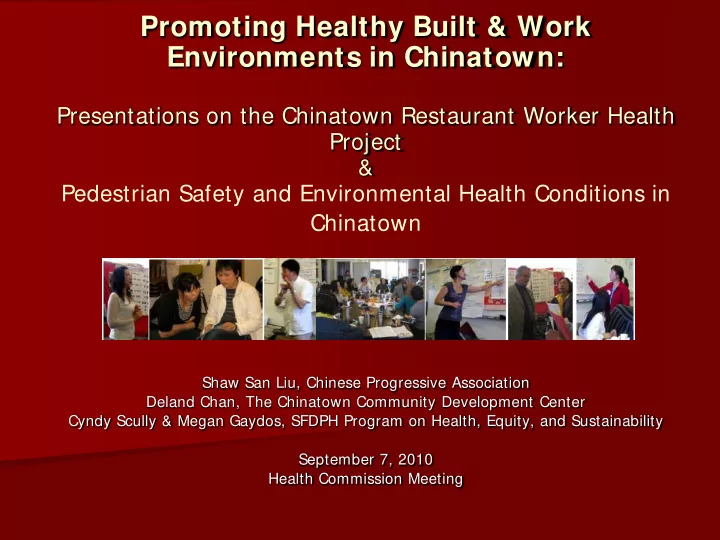
Promoting Healthy Built & Work Environments in Chinatown:

Presentations on the Chinatown Restaurant Worker Health Project & Pedestrian Safety and Environmental Health Conditions in Chinatown

Shaw San Liu, Chinese Progressive Association Deland Chan, The Chinatown Community Development Center Cyndy Scully & Megan Gaydos, SFDPH Program on Health, Equity, and Sustainability September 7, 2010 Health Commission Meeting

slide-2
SLIDE 2

Presentation Overview

 Overview of PHES  Chinatown Restaurant Worker Health

Project: Summary & Key Findings

 Chinatown Pedestrian Needs Assessment

Pedestrian Safety and Environmental Health Conditions in Chinatown

slide-3
SLIDE 3

Program on Health, Equity, & Sustainability www.sfphes.org

Work Environment Water Program Health Disparities Educ. Healthy Housing SF Food Systems Urban Place & Health PHES

slide-4
SLIDE 4

Chinatown Restaurant Worker Health (RWH) Project

Organizational Partners

Chinese Progressive Association’s Staff & Worker Organizing Committee

SF Dept of Public Health

UCB School of Public Health

UCB Labor Occupational Health Program

UCSF School of Occupational and Environmental Medicine

slide-5
SLIDE 5

Worker-administered community survey (n= 433)

SFDPH-administered observational checklist (n= 106)

Focus groups and interviews

Evaluation

Committees: Coordinating, Restaurant Worker Leadership, Survey/Data, Evaluation, Publications, Policy

From Minkler, et al. AJIM 2010 Apr; 53(4):361-71.

About the Chinatown RWH Project

slide-6
SLIDE 6

Observational Checklist (n= 106)

Labor Laws Posters displayed¹ YES

SF Minimum Wage 30% SF Paid Sick Leave 24% Worker’s Comp Info 15%

Hazards Observed YES

Cooks wearing long-sleeved shirts or cook jackets 10% Range tops overcrowded with cookware 70% Sufficient quality non-slip mats 48% Floors are dry, not wet and greasy 38% Proper storage of knives 13% Adequate ventilation 63% Adequate lighting 72% Fully stocked first aid kits4 18% Slicing, grinders and food processors guards5 18%

4 Only 19 of the 106 restaurants

(18%) had a fully stocked first aid kit at time of observation. Of the remaining restaurants, 13 did not have any first aid kit and 74 only had bands aids.

5 Only 4 of the 22 restaurants with a

slicer, grinder, and/or food processor had a protective guard. This item was not applicable to 79%

  • f restaurants (n= 84).
slide-7
SLIDE 7

Worker Survey (n= 433)

Who hasn’t been yelled at by their boss? It happens every day, but people probably

  • nly reported it if

it made them cry. We used to call our boss Crazy Dog because he lost his temper so much.

Females more likely to work “front of the house”

64% not receive job training

40% experience cuts

48% experience burns

14% experience falls

22% experience pain caused or worsened by work

< 1% report injury to workers comp

2% received medical care

 54% pay out of pocket for med. care  38% enrolled in Medi-Cal  28% enrolled in Healthy SF  3% receive employer-based health ins.  42% yelled at by supervisor, coworker, or

customer

slide-8
SLIDE 8

RWH Project Key Findings

Many workers experience wage theft

Preventable occupational hazards and “Low Road” practices common

High unemployment & immigration fuel fear

  • f confronting employer, losing job

Very unlikely that problems are unique to Chinatown

“High Road” practices better for employees’ health, well-being and retention, decrease public taxpayer burden, prevents “race to the bottom”

Increased labor law enforcement, worker awareness and protections, and interagency collaboration needed

slide-9
SLIDE 9

Outcomes & Next Steps

Documentation of conditions faced

↑ capacity of worker leaders

↑ collaboration between org. partners

CPA develops Low Wage Worker Bill of Rights and launches Progressive Worker Alliance

DPH & OLSE using Director’s Hearings to hold abusive employers accountable

DPH & LOHP exploring inspector engagement; DPH, OLSE & DIR exploring collaborations

Disseminating findings (peer-reviewed journals, presentations, outreach to employers, OSHA, and labor agencies, etc)

 Report Launch

  • Sept. 17th * 11:30 AM

1042 Grant Ave, 4th Fl

Mar & Campos to introduce wage theft

  • rdinance

DPH increasing focus on health impacts of low wage work

Worker centers identifying “High Road” and “Low Road” practices & employers

slide-10
SLIDE 10

Safe Sustainable Streets as an

Environmental, Health & Social Justice Issue

Chinatown has the Highest Traffic Volume Density of any San Francisco Neighborhood.

The Pedestrian Collision Rate is 3 times higher than the City Average.

78% of the households live within 150 meters of a truck route and ½ of the Pedestrian Fatalities involved a truck

Only 17% of households own cars, but Chinatown residents are disproportionately impacted by traffic.

Chinatown residents are predominately low income, elderly and monolingual

slide-11
SLIDE 11

Pedestrian Safety Needs Assessment

 Funding/Collaboration  Methods

– Identification of Study Area – Survey Interviews – Scorecard – Pedestrian & Bicycle Counts – PEQI – Community Outreach – Ranked Priority Areas – Recommendations

slide-12
SLIDE 12

Pedestrian Environmental Quality Index (PEQI)

 PEQI quantifies street and

intersection factors empirically known to affect people’s travel behaviors

 Intersections in Chinatown

lack basic pedestrian amenities and engineering countermeasures

 Poor pedestrian street

conditions exists on Broadway, Stockton Street, and Sacramento Street.

slide-13
SLIDE 13

Survey Interviews/Community Forum

 Community Feedback – Longer pedestrian countdown signals at the signalized intersections. – Sidewalks narrow and congested due to merchandise encroachment. – Need more crosswalk treatments, additional signs and lights embedded in the pavement. – The majority of perceived dangerous intersections are located along Stockton and Powell Streets.

slide-14
SLIDE 14

Key Findings/Outcomes

Stockton Street has the highest traffic volume, highest pedestrian volumes, most pedestrian collisions and worse PEQI street segment scores. Ranked Priority Area List 1) Stockton Street Corridor 2) Broadway Corridor 3) Columbus Avenue Corridor 4) Kearny Street Corridor 5) Powell Street Corridor 6) Grant Avenue Corridor 7) Mason and Washington Intersection 8) Montgomery and Clay Intersection

slide-15
SLIDE 15

Recommendations /Next Steps

– Ensure high volume roads are signalized and add crosswalk scrambles at the Stockton and Broadway intersection. – Reroute or reduce the amount

  • f trucks that pass through

Chinatown and also add additional truck route signs. – Encourage transportation improvements that reduce traffic volume and speed, such as bulb outs and curb extensions – Create safer intersection crossings by having shorter crossing distances and increased crossing speed

 Publicize report,

community outreach and education, and involve city agencies.

SFDPH’s Recommendations CCDC’s Next Steps

slide-16
SLIDE 16

Acknowledgements

RWH Project

Funders and I nstitutional Support:

  • National Institute of Occupational Safety and Health
  • The California Endowment
  • The Occupational Health Internship Program (OHIP)

Coordinating & Steering Committees

  • CPA Staff: Fei Ye Chen, Gordon Mar, Shaw San Liu, Alex Tom
  • CPA Leaders: Li Li Shuang, Bing Shu Zhu, Li Zhen He, Michelle

Xiong, Rong Wen Lan, Hu Li Long, Christy Wu, Pei Yu Huang

  • UCB SPH: Meredith Minkler, Charlotte Chang, Alicia Salvatore
  • UCSF Occ/Env Medicine: Niklas Krause
  • LOHP: Pam Tau Lee & Robin Baker
  • SFDPH PHES: Rajiv Bhatia, Megan Gaydos, Alvaro Morales

Additional Supporters

  • Interpretation: Cecilia Wong
  • UCB, SFDPH, & OHIP Interns: Angela Ni, Kallista Bley, Sunhye

Bai, Jennie Lu, Natalie Gee, Qi Ting Zhao, Henning Chu, Alex Cooper, Elizabeth Hom, Margaret Lee

  • SFDPH Inspectors: Amelia Castelli, Jacki Greenwood, Pamela

Hollis, Terrence Hong, Richard Lee, Mohammed Malhi, Eric Mar, Timothy Ng, Lisa O’Malley, Imelda Reyes, Alicia Saam, Calvin Tom, Kenny Wong, Karen Yu

CCDC Pedestrian Safety Needs Assessment

Funders and I nstitutional Support:

  • Funding for this project was provided by a grant

from the California Office of Traffic Safety through the Business, Transportation and Housing Agency through the San Francisco Department of Public Health, Traffic Safety Group.

Coordinating & Steering Committees

  • CCDC Staff: Deland Chan, Tan Chow, Cathie

Lam, Cindy Wu

  • SFDPH PHES: Cyndy Scully, Stephanie Cowles,

Rajiv Bhatia

Additional Supporters

  • CCDC Transportation Interns and Volunteers:

Daniel Martinez Bean, Abigail Shull, Sandra Wong, Greg Wong

  • Chinatown Transportation Research &

Improvement Project (TRIP): Wil Din, Harvey Louie
slide-17
SLIDE 17

For More Information…

 Come to September 17th

Restaurant Worker Report Release!!!

 Reports available at:

www.sfphes.org

 Contact us:

shawsan@cpasf.org dechan@chinatowncdc.org Megan.gaydos@sfdph.org Cyndy.comerford@sfdph.org