Were official!!! Founding Members (Board of Directors): Olca - - PowerPoint PPT Presentation

we re official
SMART_READER_LITE
LIVE PREVIEW

Were official!!! Founding Members (Board of Directors): Olca - - PowerPoint PPT Presentation

PBPS and AJCC 8th Ed Update for USCAP 2016 5/10/2016 Pancreatobiliary Pathology Society Pancreatobiliary Pathology Society Were official!!! Founding Members (Board of Directors): Olca Basturk Wendy Frankel Grace Kim David


slide-1
SLIDE 1

PBPS and AJCC 8th Ed Update for USCAP 2016 5/10/2016 1

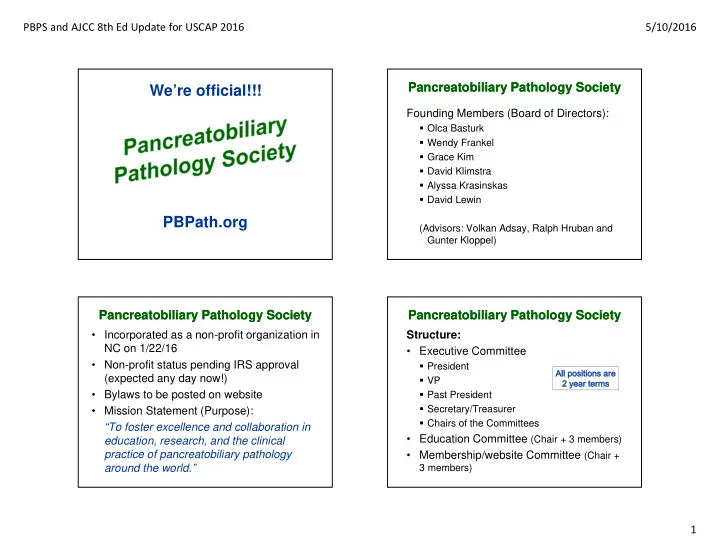
We’re official!!! PBPath.org

Pancreatobiliary Pathology Society Pancreatobiliary Pathology Society

Founding Members (Board of Directors):

  • Olca Basturk
  • Wendy Frankel
  • Grace Kim
  • David Klimstra
  • Alyssa Krasinskas
  • David Lewin

(Advisors: Volkan Adsay, Ralph Hruban and Gunter Kloppel)

Pancreatobiliary Pathology Society Pancreatobiliary Pathology Society

  • Incorporated as a non-profit organization in

NC on 1/22/16

  • Non-profit status pending IRS approval

(expected any day now!)

  • Bylaws to be posted on website
  • Mission Statement (Purpose):

“To foster excellence and collaboration in education, research, and the clinical practice of pancreatobiliary pathology around the world.”

Pancreatobiliary Pathology Society Pancreatobiliary Pathology Society

Structure:

  • Executive Committee
  • President
  • VP
  • Past President
  • Secretary/Treasurer
  • Chairs of the Committees
  • Education Committee (Chair + 3 members)
  • Membership/website Committee (Chair +

3 members)

slide-2
SLIDE 2

PBPS and AJCC 8th Ed Update for USCAP 2016 5/10/2016 2

Pancreatobiliary Pathology Society Pancreatobiliary Pathology Society

Inaugural Committee Members:

  • Executive Committee
  • President = Volkan Adsay
  • VP = Alyssa Krasinskas
  • Secretary/Treasurer = David Lewin
  • Education Committee:
  • Olca Basturk (Chair); David Klimstra, Stefano

Larosa, KT Jang (1 year)

  • Membership/Website Committee:
  • Grace Kim (Chair); Wendy Frankel, Nobu

Ohike, Benoit Terres (1 year)

Pancreatobiliary Pathology Society Pancreatobiliary Pathology Society

Education Committee (Olca)

  • Possible activities include educational

sessions at USCAP and other meetings

  • SOP pending

Pancreatobiliary Pathology Society Pancreatobiliary Pathology Society

Membership/Website Committee (Grace)

  • We have a website! PBPath.org
  • We have an on-line membership application
  • Member dues:

Regular Members = $50 / year Junior Members = Free

  • SOP Pending

Pancreatobiliary Pathology Society Pancreatobiliary Pathology Society

Money! (David L)

  • We have an EIN#
  • We have a bank account
  • In process of creating a PayPal account
  • Will be able to pay dues online via PayPal

as soon as our non-profit status gets approved - Keep checking the website!

slide-3
SLIDE 3

PBPS and AJCC 8th Ed Update for USCAP 2016 5/10/2016 3

Pancreatobiliary Pathology Society Pancreatobiliary Pathology Society

Pending Items:

  • Create a logo: Plan to hold a contest or look into

crowd sourcing

  • Inquire if we can become a USCAP Companion

Society

  • Inquire about PBPath as a topic or USCAP

Evening Subspecialty Session

  • Our annual business meeting will continue to be

held at USCAP, but the format is subject to change

  • Our annual Executive Committee Meeting will

also be held during USCAP

Pancreatobiliary Pathology Society Pancreatobiliary Pathology Society

  • A few words from our 1st President!...

Volkan Adsay

We’re official!!! PBPath.org

Disclaimer

The decisions for AJCC 8th edition has not been finalized. This material was for the sole purpose of the March 14, 2016 Pancreatobiliary Pathology Society Luncheon Discussion.

slide-4
SLIDE 4

PBPS and AJCC 8th Ed Update for USCAP 2016 5/10/2016 4

New AJCC 8th Ed Cancer Staging Updates

  • Mid‐2016 release
  • Effective January 1, 2017
  • PB Sites (DRAFTS!)

– Pancreas Exocrine, Pancreas Endocrine – Ampulla – Gallbladder – Intrahepatic bile ducts – Perihilar bile ducts – Distal bile duct

Pancreas – Exocrine: Summary of Changes

Change Details of Change T1 T1 subcategorized into T1a, T1b and T1c based on size. Rationale: Size‐based categorization of small invasive tumors that have been characterized as ‘minimally invasive,’ and have better outcome T2 and T3 Based on size of invasive tumor; extrapancreatic extension is no longer part of the definition. Rationale: Size‐based definitions are more objective as it is difficult to determine extrapancreatic extension. These definitions show better correlation with survival. T4 T4 is now based on involvement of arteries; resectability has been removed from the definition. Rationale: Resectability is subjective and the T category is better defined by extent of invasion. N Node positive disease N1 has been subdivided into N1 and N2, based on number of positive lymph nodes. Rationale: Better prognostic stratification is provided based on number of positive lymph nodes.

Pancreas – Exocrine: New T

T Category T Criteria TX Primary tumor cannot be assessed T0 No evidence of primary tumor Tis Carcinoma in situ

This includes high grade pancreatic intraepithelial neoplasia (PanIn‐3), intraductal papillary mucinous neoplasm with high‐grade dysplasia and mucinous cystic neoplasm with high‐grade dysplasia

T1 ≤ 2 cm T1a ≤ 0.5 cm T1b > 0.5 cm and < 1 cm T1c 1‐2 cm T2 > 2 cm and ≤ 4 cm T3 > 4 cm T4 Tumor involves celiac axis, superior mesenteric artery and/or common hepatic artery, irrespective of size

Pancreas – Exocrine: New N

N Category N Criteria NX Regional lymph nodes cannot be assessed N0 No regional lymph node metastases N1 Metastasis in 1 to 3 regional lymph nodes N2 Metastasis in ≥ 4 regional lymph nodes

slide-5
SLIDE 5

PBPS and AJCC 8th Ed Update for USCAP 2016 5/10/2016 5

Pancreas – PanNET: Summary of Changes

Change Details of Change New Chapter This staging system was included in the Exocrine and Endocrine Pancreas chapters in previous editions Anatomic Stage and Prognostic Groups Pancreatic neuroendocrine tumors are now staged using a TNM staging system that is predominantly based on size, with elimination of the criterion of peripancreatic soft tissue invasion. Definition of Primary Tumor (T) The Tis distinction has been eliminated M1a, M1b, M1c

Pancreas – PanNET: New T

T Category T Criteria TX Primary tumor cannot be assessed T1 Limited to the pancreas*, <2 cm T2 Limited to the pancreas*, 2‐4 cm T3 Limited to the pancreas*, >4 cm, OR invading duodenum or bile duct T4 Tumor invading adjacent organs (stomach, spleen, colon, adrenal gland) or the wall of large vessels (celiac axis or the superior mesenteric artery)

Multiple tumors should be designated as such (the largest tumor should be used to assign T category): If the number of tumors is known, use T (#), e.g. pT3 (4)N0M0. If the number of tumors is unavailable or too numerous, use m suffix, T(m), e.g. pT3(m)N0M0 * Limited to the pancreas means there is no invasion of adjacent organs (stomach, spleen, colon, adrenal gland) or the wall of large vessels (celiac axis or the superior mesenteric artery). Extension of tumor into peripancreatic adipose tissue is NOT a basis for staging.

≤ 2cm for PDAC

Pancreas – PanNET: New N

N Category N Criteria TX Regional lymph nodes cannot be assessed N0 No regional lymph node involvement N1 Regional lymph node involvement M Category M Criteria M0 No distant metastasis M1 Distant metastases M1a Metastasis confined to liver M1b Metastases in at least one extrahepatic site (e.g. lung, ovary, non‐ regional lymph node, peritoneum, bone) M1c Both (hepatic and extrahepatic metastases)

Pancreas – PanNET: New M

Ampulla: Summary of Changes

Change Details of Change T1 T1 tumors have been subdivided into T1a and T1b: T1a Tumor limited to ampulla of Vater or sphincter of Oddi, and T1b Tumor invades beyond the sphincter of Oddi (perisphincteric invasion) and/or into the duodenal submucosa T2 The T2 definition has been revised to define T2 as invasion into the muscularis propria of the duodenum T3 T3 tumors have been subdivided into T3a and T3b. T3a Tumor directly invades pancreas (up to 0.5 cm) T3b Tumor extends more than 0.5 cm into the pancreas; or Extends into peripancreatic or periduodenal tissue or duodenal serosa but without involvement of the celiac axis or the superior mesenteric artery T4 The T4 definition has been revised to be consistent with the staging system for exocrine pancreas: Tumor with vascular involvement of the superior mesenteric artery or celiac axis, or portal venous involvement that cannot be reconstructed (consistent with pancreas staging) N1 1‐3 positive regional lymph nodes N2 Metastasis to ≥ 4 regional lymph nodes
slide-6
SLIDE 6

PBPS and AJCC 8th Ed Update for USCAP 2016 5/10/2016 6

Ampulla: New T

T Category T Criteria TX Primary tumor cannot be assessed T0 No evidence of primary tumor Tis Carcinoma in situ T1 Tumor limited to ampulla of Vater or sphincter of Oddi or tumor invades beyond the sphincter of Oddi (perisphincteric invasion) and/or into the duodenal submucosa T1a Tumor limited to ampulla of Vater or sphincter of Oddi T1b Tumor invades beyond the sphincter of Oddi (perisphincteric invasion) and/or into the duodenal submucosa T2 Tumor invades into the muscularis propria of the duodenum T3 Tumor directly invades pancreas (up to 0.5 cm), or tumor extends more than 0.5 cm into the pancreas; or extends into peripancreatic or periduodenal tissue or duodenal serosa without involvement of the celiac axis or the superior mesenteric artery T3a Tumor directly invades pancreas (up to 0.5 cm) T3b Tumor extends more than 0.5 cm into the pancreas; or extends into peripancreatic tissue or duodenal serosa without involvement of the celiac axis or the superior mesenteric artery T4 Tumor involves celiac axis, superior mesenteric artery and/or common hepatic artery irrespective of size

Ampulla: New N

N Category N Criteria NX Regional lymph nodes cannot be assessed N0 No regional lymph node metastasis N1 Metastasis to 1‐3 regional lymph nodes N2 Metastasis to ≥4 regional lymph nodes

Gallbladder: Summary of Changes

Change Details of Change T category T2 disease is now subdivided into two groups: T2 tumors on the peritoneal side (T2a) and those on the hepatic side (T2b) of the gallbladder N category Changed from location‐based definitions to number‐ based N category assessment. N categories have been revised to define N1 as 1‐3 positive nodes and N2 > 4 positive nodes The recommendation that ≥ 6 nodes should harvested and evaluated has been added.

Gallbladder: New T

T Category T Criteria TX Primary tumor cannot be assessed T0 No evidence of primary tumor Tis Carcinoma in situ T1 Tumor invades lamina propria or muscular layer T1a Tumor invades lamina propria T1b Tumor invades muscular layer T2 Tumor invades perimuscular connective tissue on the peritoneal side, without involvement of the serosa (visceral peritoneum) Or tumor invades perimuscular connective tissue on the hepatic side; no extension into liver T2a Tumor invades perimuscular connective tissue on the peritoneal side, without involvement of the serosa (visceral peritoneum) T2b Tumor invades perimuscular connective tissue on the hepatic side; no extension into liver T3 Tumor perforates the serosa (visceral peritoneum) and/or directly invades the liver and/or one other adjacent organ or structure, such as the stomach, duodenum, colon, pancreas, omentum, or extrahepatic bile ducts T4 Tumor invades main portal vein or hepatic artery or invades two or more extrahepatic organs or structures

slide-7
SLIDE 7

PBPS and AJCC 8th Ed Update for USCAP 2016 5/10/2016 7

Gallbladder: New N

N Category N Criteria NX Regional lymph nodes cannot be assessed N0 No regional lymph node metastasis N1 Metastases to 1‐3 regional lymph nodes N2 Metastases to > 4 regional lymph nodes

Intrahepatic Bile Duct: Summary of Changes

Change Details of Change T1 The T1 tumor category is revised to account for the prognostic impact of tumor size (T1a, ≤5 cm vs. T1b, >5cm) T2 The T2 tumor category is modified to reflect the equivalent prognostic value of vascular invasion and tumor multifocality T4 The AJCC 7th Ed. T4 tumor category describing the tumor growth pattern is eliminated from staging, but remains recommended for data collection

Intrahepatic Bile Duct: New T

T Category T Criteria TX Primary tumor cannot be assessed T0 No evidence of primary tumor Tis Carcinoma in situ (intraductal tumor) T1 Solitary tumor without vascular invasion < 5 cm or > 5 cm T1a Solitary tumor ≤ 5 cm without vascular invasion T1b Solitary tumor > 5 cm without vascular invasion T2 Solitary tumor with intrahepatic vascular invasion or multiple tumors, with or without vascular invasion T3 Tumor perforating the visceral peritoneum T4 Tumor involving local extrahepatic structures by direct invasion

Intrahepatic Bile Duct: New N

N Category N Criteria NX Regional lymph nodes cannot be assessed N0 No regional lymph node metastasis N1 Regional lymph node metastasis present

slide-8
SLIDE 8

PBPS and AJCC 8th Ed Update for USCAP 2016 5/10/2016 8

Perihilar Bile Ducts: Summary of Changes

Change Details of Change T4 Bilateral second‐order biliary radical invasion (Bismuth‐Corlette type IV) has been removed from T4 category N N category has been reclassified based on number of positive nodes to N1 (1‐3 positive nodes) and N2 (≥ 4 positive nodes) Stage IIIB The stage group for T4 tumors has been changed from stage IVA to stage IIIB Stage IIIC and IVA N1 category has been changed from stage IIIB to IIIC, and N2 category is classified as stage IVA

Perihilar Bile Ducts: New T

T Category T Criteria TX Primary tumor cannot be assessed T0 No evidence of primary tumor Tis Carcinoma in situ T1 Tumor confined to the bile duct, with extension up to the muscle layer or fibrous tissue T2 Tumor invades beyond the wall of the bile duct to surrounding adipose tissue, Or tumor invades adjacent hepatic parenchyma T2a Tumor invades beyond the wall of the bile duct to surrounding adipose tissue T2b Tumor invades adjacent hepatic parenchyma T3 Tumor invades unilateral branches of the portal vein or hepatic artery T4 Tumor invades main portal vein or its branches bilaterally; or the common hepatic artery; or unilateral second‐order biliary radicals with contralateral portal vein or hepatic artery involvement

Perihilar Bile Ducts: New N

N Category N Criteria NX Regional lymph nodes cannot be assessed N0 No regional lymph node metastasis N1 1‐3 positive lymph nodes typically involving hilar, cystic duct, common bile duct, hepatic artery, posterior pancreatoduodenal, and portal vein lymph nodes N2 ≥ 4 positive lymph nodes from above‐stated sites

Distal Bile Duct: Summary of Changes

Change Details of Change Tis The definition of Tis has been expanded to include high‐grade biliary intraepithelial neoplasia (BilIn‐3). High‐grade dysplasia (BilIn‐3), a noninvasive neoplastic process, is synonymous with carcinoma in situ at this site T1, T2, T3 T category definitions have been revised based on measured depth of invasion (<5mm, 5‐12 mm, >12 mm). The descriptive extent of invasion should also still be reported. The depth of tumor invasion is better at predicting patient outcomes than the descriptive extent of tumor invasion. N1, N2 N groupings have been expanded (N1, 1‐3 positive lymph nodes; N2, 4 or more positive lymph nodes). The number of involved lymph nodes appears to be useful in predicting patient outcomes. Histology The histologic type high‐grade neuroendocrine carcinoma has been added for consistency with other gastrointestinal and hepatobiliary neuroendocrine carcinoma designations. Large cell and small cell neuroendocrine carcinomas fall under this subtype. Histology The histologic types have been updated to match current World Health Organization terminology.

slide-9
SLIDE 9

PBPS and AJCC 8th Ed Update for USCAP 2016 5/10/2016 9

Distal Bile Duct: New T

T Category T Criteria TX Primary tumor cannot be assessed Tis "Carcinoma in situ"/high grade dysplasia T1 Invades bile duct wall with a depth of < 5 mm T2 Invades bile duct wall with a depth of 5 ‐ 12 mm T3 Invades bile duct wall with a depth of > 12 mm T4 Tumor involves celiac axis, superior mesenteric artery and/or common hepatic artery

Distal Bile Duct: New N

N Category N Criteria NX Regional lymph nodes cannot be assessed N0 No regional lymph node metastasis N1 Metastasis in 1‐3 regional lymph nodes N2 Metastasis in 4 or more regional lymph nodes