Supplemental Material Figure S-1: Diagram of the apparatus used to - - PDF document

supplemental material figure s 1 diagram of the apparatus
SMART_READER_LITE
LIVE PREVIEW

Supplemental Material Figure S-1: Diagram of the apparatus used to - - PDF document

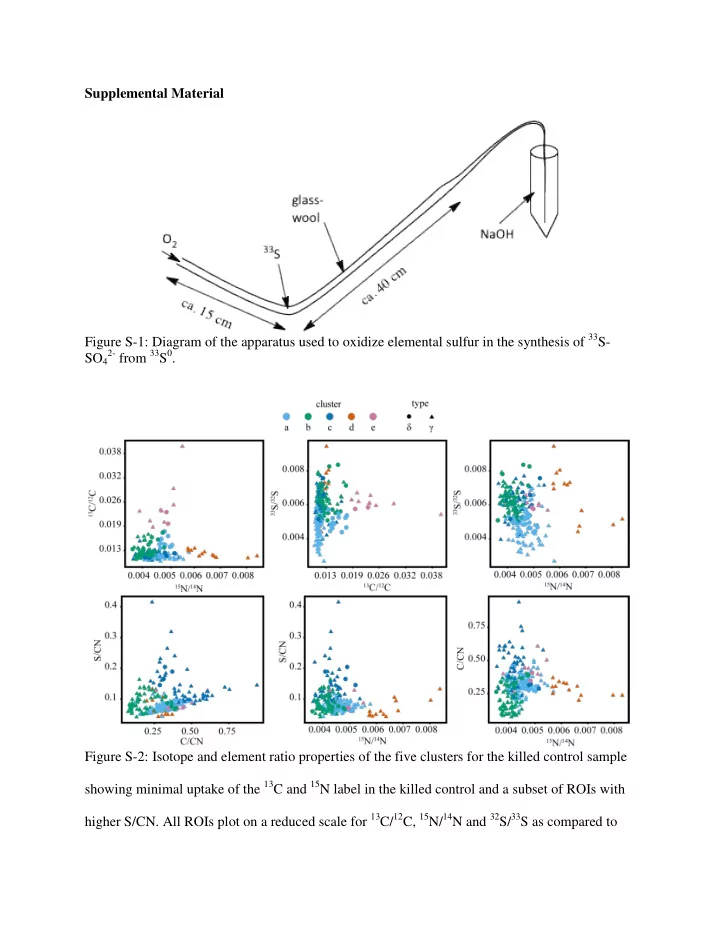
Supplemental Material Figure S-1: Diagram of the apparatus used to oxidize elemental sulfur in the synthesis of 33 S- 2- from 33 S 0 . SO 4 Figure S-2: Isotope and element ratio properties of the five clusters for the killed control sample showing


slide-1
SLIDE 1

Supplemental Material Figure S-1: Diagram of the apparatus used to oxidize elemental sulfur in the synthesis of 33S- SO4

2- from 33S0.

Figure S-2: Isotope and element ratio properties of the five clusters for the killed control sample showing minimal uptake of the 13C and 15N label in the killed control and a subset of ROIs with higher S/CN. All ROIs plot on a reduced scale for 13C/12C, 15N/14N and 32S/33S as compared to

slide-2
SLIDE 2

the live, labeled experiments. The killed control did not result in the affiliation of isotope phenotypes from clusters ‘a’ – ‘e’ with Gammaproteobacteria (‘g’) or Deltaproteobacteria (‘d’) as observed in the labeled substrate incubations. Figure S-3: Isotope and element ratio properties of the five clusters for the unlabeled control

  • sample. All ROIs plot within one standard deviation of the calculated natural abundance value

resulting in a reduced scale for 13C/12C, 15N/14N and 32S/33S ratios as compared to the live, labeled experiments. The unlabeled control did not result in the affiliation of isotope phenotypes from clusters ‘a’ – ‘e’ with Gammaproteobacteria (‘g’) or Deltaproteobacteria (‘d’) as observed in the labeled substrate incubations.

slide-3
SLIDE 3

Figure S-4: Comparison of FISH and NanoSIMS cluster analysis for multiple images from 2, 7 and 10 days of incubation. FISH experiments (1st and 3rd panels) were performed with probes for

slide-4
SLIDE 4

Deltaproteobacteria (purple) and Gammaproteobacteria (green). Clusters ‘a’, ‘b’ and ‘c’ are primarily affiliated with filamentous Gammaproteobacteria. Cluster ‘d’ is primarily affiliated with clusters of coccoid Gammaproteobacteria. Cluster ‘e’ is primarily affiliated with Deltaproteobacteria.