Structural Health Monitoring Remote Sensing Technologies for - - PowerPoint PPT Presentation

structural health monitoring remote sensing technologies
SMART_READER_LITE
LIVE PREVIEW

Structural Health Monitoring Remote Sensing Technologies for - - PowerPoint PPT Presentation

9/7/2010 SHM General Concepts Project Concept Techniques Remote Sensing In-Progress Structural Health Monitoring Remote Sensing Technologies for Detecting Bridge Deterioration and Condition Assessment Ensuring structural integrity and


slide-1
SLIDE 1

9/7/2010 1 Remote Sensing Technologies for Detecting Bridge Deterioration and Condition Assessment Tess Ahlborn, Ph.D., P.E.

with Devin Harris, Colin Brooks, Arthur Endsley, Darrin Evans, Renee Oats, Khatereh Vaghefi, Larry Sutter, Bob Shuchman, Joe Burns, and Chris Roussi

Mi hi T h l i l U i it Mi hi T h l i l U i it Michigan Technological University Michigan Technological University

August 18, 2010 NDT/NDE for Highway Bridges – SMT 2010

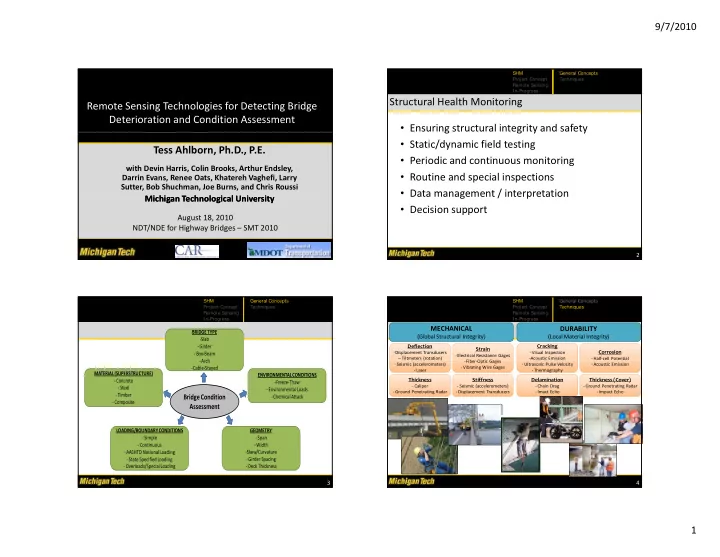
Structural Health Monitoring

  • Ensuring structural integrity and safety

SHM Project Concept Remote Sensing In-Progress General Concepts Techniques

g g y y

  • Static/dynamic field testing
  • Periodic and continuous monitoring
  • Routine and special inspections
  • Data management / interpretation

Data management / interpretation

  • Decision support

2

BRIDGE TYPE ‐Slab ‐Girder ‐Box‐Beam Arch

SHM Project Concept Remote Sensing In-Progress General Concepts Techniques

ENVIRONMENTAL CONDITIONS ‐Freeze‐Thaw ‐Environmental Loads ‐Chemical Attack ‐Arch ‐Cable‐Stayed MATERIAL (SUPERSTRUCTURE) ‐Concrete ‐Steel ‐Timber ‐Composite

Bridge Condition Assessment

3

LOADING/BOUNDARY CONDITIONS ‐Simple ‐Continuous ‐AASHTO Notional Loading ‐State Specified Loading ‐Overloads/Special Loading GEOMETRY ‐Span ‐Width ‐Skew/Curvature ‐Girder Spacing ‐Deck Thickness Cracking ‐ Visual Inspection ‐Acoustic Emission Corrosion ‐ Half‐cell Potential

DURABILITY

(Local Material Integrity)

Strain

‐Electrical Resistance Gages Fib O ti G

Deflection

‐Displacement Transducers ‐‐ Tiltmeters (rotation)

MECHANICAL

(Global Structural Integrity)

SHM Project Concept Remote Sensing In-Progress General Concepts Techniques ‐ Ultrasonic Pulse Velocity ‐ Thermography

Thickness (Cover)

‐ Ground Penetrating Radar ‐ Impact Echo

Delamination

‐ Chain Drag ‐ Imact Echo ‐ Acoustic Emission ‐Fiber‐Optic Gages ‐ Vibrating Wire Gages

Stiffness

‐ Seismic (accelerometers) ‐ Displacement Transducers

Thickness

‐ Caliper ‐ Ground Penetrating Radar ( ) ‐ Seismic (accelerometers) ‐ Laser

4

slide-2
SLIDE 2

9/7/2010 2 Structural Health Monitoring

  • Traditional Inspection Techniques

SHM Project Concept Remote Sensing In-Progress General Concepts Techniques

– Visual, chain drag, half‐cell potential, accelerometers

  • Advanced Monitoring Techniques

– GPR, impact echo, fiber optics, thermal IR, ultrasonic – Wireless remote monitoring

  • Remote Sensing: Non contact data collection
  • Remote Sensing: Non‐contact data collection

– “the collection of data about an object, area, or phenomenon from a distance with a device that is not in contact with the object.”

5

Top 10 Priorities / Challenges

  • Scour/Settlement – The group agreed

that scour is a project within itself and beyond the scope of this project

  • Decks ‐ delamination/spalling, one
  • f the largest influences on public

i f d di i

SHM Project Concept Remote Sensing In-Progress Priorities Goals Concept

beyond the scope of this project. However, settlement is something that should be considered.

  • Corrosion damage of prestressed

concrete beams is a serious concern, especially with end deterioration, section loss, and strand damage.

  • Steel beam section loss is also a

serious concern often most serious at perceptions of road condition.

  • Decks – map cracking and other

material related distresses.

  • Expansion joint failure – expansion

joint damage can be an indicator of water and other damage that can lead to further problems.

  • Chloride ingress – if DOTs had a

better way of estimating the 6 serious concern, often most serious at the end of the beams and base of columns.

  • Vibration can be an indication of other

concerns with the bridge.

  • Large cracking is an indication of

structural damage. better way of estimating the chloride level, deck replacements would be scheduled differently.

  • Length of bridge – the typical bridge

shortens over time ‐ a location item and length change concern.

Project Goals

– Establish remotely sensed bridge condition “signature”

  • Assess the potential for commercial remote sensors to be used to assess

SHM Project Concept Remote Sensing In-Progress Priorities Goals Concept

Assess the potential for commercial remote sensors to be used to assess bridge condition and performance

  • No lane closures, no traffic disruption, no contact with bridge

– Provide bridge inspectors with data to enhance inspection processes

  • Provide condition monitoring between required inspections

Create the framework for a decision support system to

7

– Create the framework for a decision support system to prioritize needs

  • Correlate on‐site, in‐situ, and stand‐off sensors with conventional

assessment methods, historic bridge information, and bridge standards and requirements

USDOT Project Concept

) ln(

si i i

L L X − = Period 0 Bridge Management System Data Structural Health Monitoring Model Maintenance Records Meteorological Data

( ) ( )

r d e r R e r k s

r r k j kR j

′ ′ ≈

′ ⋅ −

ˆ 2 2

4 , ρ π

SHM Project Concept Remote Sensing In-Progress Priorities Goals Concept

DSS: algorithms & interface Trouble Spot 2 Trouble Spot 1

DSS BRIDGE

TIME

Period 0 (Baseline) Period 1 Meteorological Data Bridge Health Indicators Transportation officials utilize dynamic Bridge Health Signature to evaluate changing condition Periodic assessments enhanced with remote sensing as trouble spots are identified Decision Support System

8

MANAGEMENT TEAM

On Site and In Situ Sensors BRIDGE Data Collection Relay

Period X (Current) Bridge Health Signature Damage Location

slide-3
SLIDE 3

9/7/2010 3

Electro‐Optical Imagery

Definition: Any digital

satellite platform

SHM Project Concept Remote Sensing In-Progress

Definition: Any digital photography in the optical, thermal infrared, and near infrared parts of the spectrum collected from an aerial, satellite, or other platform Proposed Application: Mapping Proposed Application: Mapping bridge features; 3D models; characterizing deck surface (spalling, cracks)

9

Speckle Photography and Speckle Pattern Interferometry

Definition: Speckle patterns are high‐contrast, fine‐scale, granular

SHM Project Concept Remote Sensing In-Progress

patterns produced by light reflected from optically rough surfaces. Proposed Application: Interferometry of speckle patterns produces fringes from which deformations or displacement gradients (strain) can be inferred.

Difference of the two speckle patterns Speckle pattern of undeformed surface Speckle pattern of deformed surface

10

Synthetic Aperture Radar (SAR) and Interferometric SAR (InSAR) Definition: SAR collection uses multiple radar (electromagnetic [radio] wave reflections) returns from small(er) antennae to simulate one

SHM Project Concept Remote Sensing In-Progress

wave reflections) returns from small(er) antennae to simulate one radar measurement from a single, large antenna; increases effective resolution. Proposed Application: Bridge dynamics, vibration, and strain; bridge stiffness; bridge settlement

InSAR elevation data 11

Synthetic Aperture Radar (SAR) and Interferometric SAR (InSAR) Definition: SAR collection uses multiple radar (electromagnetic [radio] wave reflections) returns from small(er) antennae to simulate one

SHM Project Concept Remote Sensing In-Progress

wave reflections) returns from small(er) antennae to simulate one radar measurement from a single, large antenna; increases effective resolution. Proposed Application: Bridge dynamics, vibration, and strain; bridge stiffness; bridge settlement

InSAR elevation data Example of InSAR used for infrastructure mapping 12

slide-4
SLIDE 4

9/7/2010 4

Ground‐Penetrating Radar (GPR)

Definition: Depth sounding by radio waves emitted over a wide f b d ith ti l i di t l

SHM Project Concept Remote Sensing In-Progress

frequency band either continuously or in discrete pulses as an antenna sweeps the ground. Proposed Application: Characterization of deck subsurface; detection of delaminations, voids, etc.

13

LiDAR / Laser Scanning

Definition: 3D mapping (scanning) of f bj t b ti i th

Digital elevation model

SHM Project Concept Remote Sensing In-Progress

surfaces or objects by timing the reflection of millions of laser pulses. Proposed Application: 3D modeling; detecting bridge displacement; measuring size and shape

  • f features

Infrastructure mapping pp g

14

GPS/Geodetic Measurement

Definition: Use of precision measurements of position to determine movement over time

SHM Project Concept Remote Sensing In-Progress

determine movement over time Proposed Application: Absolute displacement measurements of structural elements; measuring bridge length

15

GPS/Geodetic Measurement

Definition: Use of precision measurements of position to determine movement over time

SHM Project Concept Remote Sensing In-Progress

determine movement over time Proposed Application: Absolute displacement measurements of structural elements; measuring bridge length

From Roberts (2005): Lateral bridge movement detected by GPS 16

slide-5
SLIDE 5

9/7/2010 5

Infrared Thermography and Spectroscopy

Definition: Images collected in thermal infrared spectrum from which features are identified by their size/shape (thermography)

SHM Project Concept Remote Sensing In-Progress

which features are identified by their size/shape (thermography)

  • r their spectral content (spectroscopy)

Proposed Application: Locating delaminations and other subsurface defects

From Kanada Hot Spots at World Trade Center 17

Commercial Sensor Evaluation

SHM Project Concept Remote Sensing In-Progress Commercial Sensor Evaluation Decision Support System Field Demo

Location “Top 10” Priorities/Challenges Deck Surface Map cracking, Scaling, Spalling, Delaminations (thru surface cracks), Expansion Joint External Issues Deck Subsurface Scaling, Spalling, Delaminations , Expansion Joint Internal Issues, Corrosion, Chloride Ingress Girder Surface Structural Steel and Structural Concrete Cracking, Paint Condition, Steel or Concrete Section Loss 18 Girder Subsurface Structural Concrete Cracking, Concrete Section Loss, Chloride Ingress, Prestress Strand Breakage Global Metric Bridge Length, Settlement, Transverse Movement, Vibration, Surface Roughness

Location Challenges Indicator Desired Measurement Sensitivity / Rating Spectra 3‐D photogrammetry EO airborne & satellite imagery inteferometry LiDAR thermal IR acoustic digital image correlation

Girder

Steel structural cracking Surface Cracks < 0.1 mm (.004"), hairline X X X X X X X concrete structural cracking Surface Cracks .1 mm (.004") X X X X X X X

Girder Surface

steel section loss loss/change in x‐sect area % thickness of web or flange X X X X Paint paint condition amount of missing paint ( X % ) X X concrete section loss loss/change in x‐sect area %volume per foot X X X X X

Girder Subsurface

concrete structural cracking internal cracks (e.g. box beam) approx 0.8 mm (1/32") X concrete section loss loss/change in x‐sect area %volume per foot X X prestress strand breakage loss/change in x‐sect area wire that 2 mm (0.08") in diameter

  • r strand 9.5 mm (3/8") diameter

X Corrosion Corrosion rate (resistivity) 5 to 20 kΩ‐cm X choride Ingress Choride content through the depth 0.4 to 1.0 % Chloride by mass of cement X

19

choride Ingress the depth cement X

Global Metrics

Bridge Length Change in bridge length Accuracy to 30 mm (0.1ft) (smaller) X X X X Bridge Settlement Vertical movement of bridge approximately 6 mm to 12 mm (1/4" to 1/2") X X X X Bridge Movement Transverse directions approximately 6 mm to 12 mm (1/4" to 1/2") X X X X Surface roughness Surface roughness Change over time X X X X X Vibration Vibration .5 ‐20 Hz, amplitutde? X X

X = potential for technology to meet measurement needs; 0 = little or no potential

Commercial Sensor Evaluation

  • Performance metrics for each technology

SHM Project Concept Remote Sensing In-Progress Commercial Sensor Evaluation Decision Support System Field Demo

– Commercial availability – Sensitivity of measurement – Cost – Ease of pre‐collection prep E f d t ll ti

20

– Ease of data collection – Complexity of analysis – Stand‐off distance rating

slide-6
SLIDE 6

9/7/2010 6 Decision Support System Integration

On Site Sensors

GPRbridge deck condition

In Situ Sensors

Strain gagesmeasure stress

Standoff Sensors

EO imagerydeck/approach condition

SHM Project Concept Remote Sensing In-Progress Commercial Sensor Evaluation Decision Support System Field Demo

Spectrometerbridge deck condition Spectrometercorrosion Doppler radarvibration Radar interferometrydeflection Strain gagesmeasure stress Accelerometersvibration Displacement Transducersdeflection Differential GPS bridge movement EO imagerydeck/approach condition Radar imageryvibration Radar interferometrydeflection

Historical Bridge‐ Specific Bridge Standards and Decision Support System

Data analysis Integration algorithms

21 Specific Information Standards and Requirements Integrated Bridge Assessment

BRIDGE SIGNATURE

CONTROLLED LABORATORY MEASUREMENTS On Site Sensor Response to Bridge Components of Varying Configuration and Condition Development of Anomaly Detection

Decision Support Integration

Example GPRbridge deck condition Spectrometerbridge deck

In‐Progress

SHM Project Concept Remote Sensing In-Progress Commercial Sensor Evaluation Decision Support System Field Demo

FIELD MEASUREMENTS On Site Sensor Response to Representative Bridge Components of Varying Configuration and Condition Algorithm

Integration Sensor Selection and Deployment

condition Spectrometercorrosion Doppler radarvibration Radar interferometrydeflection

22

Field Demonstration

Acknowledgements

  • USDOT – Research and Innovative Technology

Administration

– Commercial Remote Sensing and Spatial Information Program Manager: Caesar Singh – Cooperative Agreement #DTOS59‐10‐H‐00001

  • Project Partners

– Michigan Department of Transportation Michigan Tech Transportation Institute – Michigan Tech Transportation Institute – Michigan Tech Research Institute – Center for Automotive Research

  • Technical Advisory Council

23 23

Thank You

www.mtti.mtu.edu/bridgecondition/

24

Tess Ahlborn, Ph.D., P.E. tess@mtu.edu