Public Abstract Structural Health-Monitoring System for Develop a - - PowerPoint PPT Presentation

public abstract
SMART_READER_LITE
LIVE PREVIEW

Public Abstract Structural Health-Monitoring System for Develop a - - PowerPoint PPT Presentation

Integration of Self-Sustained Wireless Public Abstract Structural Health-Monitoring System for Develop a self-sustained Integrated Structural Health Highway Bridges Monitoring (ISHM) system with remote sensing capability by Holds


slide-1
SLIDE 1

Integration of Self-Sustained Wireless Structural Health-Monitoring System for Highway Bridges

by Chung C. Fu & Yunfeng Zhang (UMD) Fuh-Gwo Yuan (NCSU) and Ed Y. Zhou (URS) Sponsored by

USDOT/RITA

To The Transportation Research Board 91st Annual Meeting

January 22, 2012, Washington, D.C.

Public Abstract

  • Develop a self-sustained Integrated Structural Health

Monitoring (ISHM) system with remote sensing capability

  • Holds promise of system scalability and autonomousness

in remote monitoring large complex highway infrastructures.

  • Particularly suited for fatigue condition assessment of

highway steel bridges

  • With a potential to extend to evaluate other types of

bridge damages, such as breaks and corrosion of steel strands of pre-stressed concrete bridges.

DISCLAIMER: The views, opinions, findings and conclusions reflected in this presentation are the responsibility of the authors

  • nly and do not represent the official policy or position of the USDOT/RITA, or any State or other entity

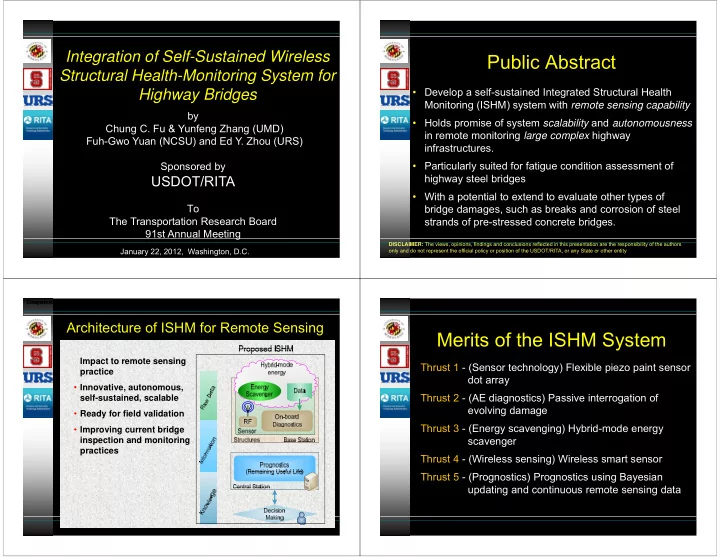
Architecture of ISHM for Remote Sensing

Comparison of current state-of-art SHM technology and proposed ISHM system Comparison of current state-of-art SHM technology and proposed ISHM system Comparison of current state-of-art SHM technology and proposed ISHM system Comparison of current state-of-art SHM technology and proposed ISHM system

Impact to remote sensing practice

  • Innovative, autonomous,

self-sustained, scalable

  • Ready for field validation
  • Improving current bridge

inspection and monitoring practices

Merits of the ISHM System

Thrust 1 - (Sensor technology) Flexible piezo paint sensor dot array Thrust 2 - (AE diagnostics) Passive interrogation of evolving damage Thrust 3 - (Energy scavenging) Hybrid-mode energy scavenger Thrust 4 - (Wireless sensing) Wireless smart sensor Thrust 5 - (Prognostics) Prognostics using Bayesian updating and continuous remote sensing data

slide-2
SLIDE 2

∆σ is secondary stress due to LL induced local distortion. Depending on detailing of primary /secondary connections.

Distortion Induced Fatigue

Tension Tension Tension Tension Tension Tension

Project Planning and Preliminaries

  • Deliverables:
  • Formed Technical Advisory

Committee (TAC) and conduct kick-off meeting.

  • Determined baseline field

test procedure

  • Established and updating

project web site

  • Conducted baseline field

test and finite element analysis on pre-selected bridges

Table 1.1: Potential Failure Maps

(Global/local FE approach to identify hot spots) Global Local Potential Failure Map through FEM Analysis

Thrust 1: Piezo Paint AE sensor

Advantages:

  • Tunable bandwidth
  • Reconfigurable sensor dots
  • Conformable to complex geometry or

curved surface

  • Application to large area
  • Low profile
  • Low cost

Piezo Paint AE Sensor Deliverables

  • Deliverables:
  • Design, fabricate and characterize piezo paint AE

sensor and measure the performance

Flexible piezoelectric paint sensor tested in the UMD laboratory

  • Piezo. Paint

Sensor

  • piezo. paint AE

sensor Preamplifier & filter

slide-3
SLIDE 3

Piezoelectric Paint AE Sensor with Broad Bandwidth

  • Piezo paint AE sensors have non-resonance characteristics in general.
  • All signals will be received with more or less equal sensitivity over a wide

range of frequency.

  • High fidelity signal measurement because of its wideband feature enables

advanced waveform-based signal interpretation for structural damage detection

200 400 600 800 1000 10 100 1000 Amplitude Phase

Frequency (kHz) Impedance Amplitude (kOhms)

  • 90
  • 45

45 90

Phase (deg)

200 400 600 800 1000 10 100 1000 Amplitude Phase

Frequency (kHz) Impedance Amplitude (kOhms)

  • 90
  • 45

45 90

Phase (deg) PZT patch with a 0.2-mm thickness Piezoelectric paint with 45% volume fraction of PZT powder, 0.63-mm thickness

AE signal detected when fatigue crack

  • pened

Piezo paint AE sensor Steel orthortropic deck specimen under fatigue testing

Fatigue test of Steel Orthotropic Deck

11

Field Tests of Piezo Paint AE Sensor on Two Steel Bridges in Korea

Voltage (V)

Field Test of Piezo Paint AE Sensor on a Railway Bridge

Existing fatigue crack Piezo Paint AE sensor

20 40 60 80 100 120

  • 0.2
  • 0.1

0.1 0.2 Amplitude (Volt) T ime (s)

AE signal collected by piezo paint AE sensor

slide-4
SLIDE 4

Current AE Analysis (Signal-based)

Conventional signal-based approach:

  • AE parameter analysis
  • AE activity analysis
  • AE frequency analysis

Need physics-based approach!

Thrust 2: Time-Reversal (T-R) Method for AE Source Identification

  • Develop and evaluate TR method for continual passive

damage interrogation

Paint sensors

t

t

Time-reversal

  • Amplitude
  • Phase
  • Waveform

Waveform based approach: Reconstructing

  • Crack location
  • Crack characterization

Transient wave theory

AE initiation AE wave propagation T-R wave back-propagation Refocus back to damage

Preliminary Verification of T-R Method

Actual location: (-76,-46) mm Estimated location: (-80,-40) mm 1.6% error in 420420mm plate

  • C. L. Chen and F. G. Yuan, “Impact Source Identification of Isotropic Plate Structures using

Time-Reversal Method: Theoretical Study,” Smart Materials and Structures, Vol. 19, 105028, 2010.

Preliminary Verification of Impulse Characterization

Effect of number of sensors Effect of Noise

  • C. L. Chen and F. G. Yuan, “Impact Source Identification of Isotropic Plate Structures using

Time-Reversal Method: Theoretical Study” Smart Materials and Structures, Vol. 19, 105028, 2010.

slide-5
SLIDE 5

Thrust 3: Hybrid-mode energy scavenger & Thrust 4: Wireless smart sensor

  • Deliverables:
  • Develop and experimentally evaluate wireless smart

sensor and hybrid-mode energy harvester

  • Implement passive damage interrogation T-R

algorithm in the wireless smart sensor on

Miniature Wind Turbine system developed by NCSU to harvest wind energy Tested and predicted output voltage versus resistive load A compact modularized high speed wireless sensor platform developed by NCSU researchers.

Planning on Detecting Cracks

  • n Long-Span Bridge

Fatigue Cracks AE Sensors Signal Paths Sensors

Rotor Resistive load Generator
  • Mini. Wind

Turbines

Large Rigid Solar Panels

Sensor Attachments Wireless Data link

Base Station

(mains powered)

Central Station

3G Network

Thrust 5: Prognostics using Bayesian Updating

  • Deliverables:
  • Integrate and validate AE sensors with

wireless smart sensor and hybrid-mode energy harvester

  • Develop and conduct field

implementation/validation of commercial- ready ISHM system with remote sensing capability

  • Recommend strategy to incorporate remote

sensing and prognosis into BMS

0.005 0.01 0.015 0.02 0.025 0.03 0. 0.2 0.4 0.6 0.8 1 1.2 Crack Length (m) Probability Density Prior σmsm=1X10⁻⁴ σmsm=2X10⁻⁴

Benefits and the Potential Impact

  • A cost-effective remote infrastructure sensing/monitoring

system

  • Expected to be commercialized and incorporated into the

nation’s infrastructure system

  • Improved performance will benefit both the DOTs and

general public in ensuring the safety and lowering the maintenance costs

  • Technology transfer and commercialization of the new

technologies developed in this project.

slide-6
SLIDE 6

Thanks!