Statistical Literacy: An Introduction 20-21 Sept 2019 V1 V1 - - PDF document

statistical literacy an introduction 20 21 sept 2019
SMART_READER_LITE
LIVE PREVIEW

Statistical Literacy: An Introduction 20-21 Sept 2019 V1 V1 - - PDF document

Statistical Literacy: An Introduction 20-21 Sept 2019 V1 V1 Schield: 2019 NNN Palomar Workshop 1 Schield: 2019 NNN Palomar Workshop 2 Statistical Literacy: What are Statistics? An Introduction Statistics: Traditional): numerical


slide-1
SLIDE 1

Statistical Literacy: An Introduction 20-21 Sept 2019 2019-Schield-NNN-Palomar-Slides.pdf 1

Schield: 2019 NNN Palomar Workshop

V1 1

by Milo Schield, NNN VP NNN Workshop Palomar CC Sept 20-21, 2019

www.StatLit.org/pdf/ 2019-Schield-NNN-Palomar-Slides.pdf

Statistical Literacy: An Introduction

Schield: 2019 NNN Palomar Workshop

V1

Statistics:

  • Traditional): numerical properties of samples
  • (Stat Lit): numbers in context (in reality)

Signs of context: time, place and units

  • 7.7 billion is a number.
  • 7.7 billion people on earth today* is a statistic.

* Sept, 2019.

2

What are Statistics?

Schield: 2019 NNN Palomar Workshop

V1

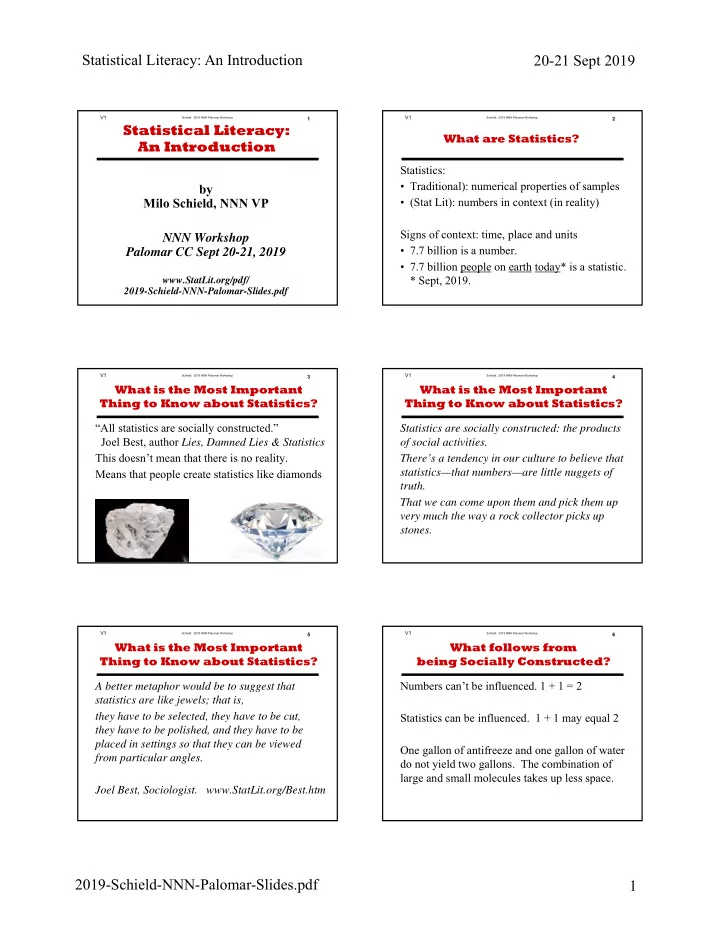
“All statistics are socially constructed.” Joel Best, author Lies, Damned Lies & Statistics This doesn’t mean that there is no reality. Means that people create statistics like diamonds

3

What is the Most Important Thing to Know about Statistics?

Schield: 2019 NNN Palomar Workshop

V1

Statistics are socially constructed: the products

  • f social activities.

There’s a tendency in our culture to believe that statistics—that numbers—are little nuggets of truth. That we can come upon them and pick them up very much the way a rock collector picks up stones.

4

What is the Most Important Thing to Know about Statistics?

Schield: 2019 NNN Palomar Workshop

V1

A better metaphor would be to suggest that statistics are like jewels; that is, they have to be selected, they have to be cut, they have to be polished, and they have to be placed in settings so that they can be viewed from particular angles. Joel Best, Sociologist. www.StatLit.org/Best.htm

5

What is the Most Important Thing to Know about Statistics?

Schield: 2019 NNN Palomar Workshop

V1

Numbers can’t be influenced. 1 + 1 = 2 Statistics can be influenced. 1 + 1 may equal 2 One gallon of antifreeze and one gallon of water do not yield two gallons. The combination of large and small molecules takes up less space.

6

What follows from being Socially Constructed?

slide-2
SLIDE 2

Statistical Literacy: An Introduction 20-21 Sept 2019 2019-Schield-NNN-Palomar-Slides.pdf 2

Schield: 2019 NNN Palomar Workshop

V1

Association is Not Causation.

7

Critical Thinking Inferences

G E N E R A L IZ A T IO N F ro m S

  • m

e to A ll F ro m G ro u p to S u b je ct S P E C IF IC A T IO N F ro m P re s en t to P as t. F ro m E ffec t to C au se F ro m P as t to F u tu re. F ro m A c t to E ffe c t

O B S E R V A B L E S

E X P L A N A T IO N P R E D IC T IO N

Schield: 2019 NNN Palomar Workshop

V1

This statement is ambiguous. It can mean: 1 Association is not sufficient to prove causation 2 Association provides no evidence for causation. Teachers may intend #1; students often hear #2. A better statement would be: Association is typically evidence of causation somewhere.

8

Association is not causation

Schield: 2019 NNN Palomar Workshop

V1

Statistical association: an observable connection.

Association:

  • Height is associated with age in children
  • Obesity is correlated with (related to) diabetes.

Prediction:

  • Graduating from high school predicts success in life.

9

A-B-C Words: A = Association

Schield: 2019 NNN Palomar Workshop

V1

Causation: Lightning caused (resulted in) the fire. Insomnia is a side effect. Sufficient: The more X you do, the more Y you will get. Prevent, stop, end, start, kill, produce, cure, avoid, ban, quit, block, ward off, stave off, cancel, hinder, or eliminate.6 Contra-factual: Those who do X will get more Y than if they had not done X.

Schield and Raymond (2009). www.StatLit.org/pdf/2009SchieldRaymondASA.pdf

10

A-B-C Words: C = Causation

Schield: 2019 NNN Palomar Workshop

V1

Between words describe association but imply causation

Verbs: Red wine cuts cancer risk. TV ups kids’ risk of flunking. Gene X increases health risk. Smoking raises asthma risk. Connectors: Nuts linked to cancer. Trauma tied to heart disease. Contributor Diet contributes to diabetes. Age is factor in infertility Nouns: Spinach is asthma protector. Bad water is a killer. Logicals: Anxiety increased due to (because of) high stake testing

  • *Compare: People who take antidepressants have fewer migraines

Asthma attacks more likely for smokers than non-smokers. *Covariation: As teacher pay increases, student scores increase. The more hours worked, the more likely a promotion

*Manipulation is possible, and treatment and outcome are repeatable.

11

A-B-C Words: B = Between

Schield: 2019 NNN Palomar Workshop

V1

Of the 2,000 news headlines analyzed6, 71% involved A, B or C. Of those headlines involving A, B or C,

  • 86% were "between" claims,
  • 11% sufficiency, 3% causation, 3% association.
  • 6. Schield and Raymond (2009).

12

A-B-C Words: Distribution in Headlines

slide-3
SLIDE 3

Statistical Literacy: An Introduction 20-21 Sept 2019 2019-Schield-NNN-Palomar-Slides.pdf 3

Schield: 2019 NNN Palomar Workshop

V1

2nd hunter: No, it’s not hopeless.

13

Prediction: Its hopeless! This bear is faster than we are I don’t have to outrun the bear. I just have to outrun you!

Schield: 2019 NNN Palomar Workshop

V1

Protestants more likely to suicide than Catholics?

  • No. Reverse was true here. Catholics more likely.

14

Specification: Cross-Level Inference

Suicide Rate, German Provinces 1500s

Suicides per 100,000 population

50 100 150 200 250 20 40 60 80 100

Percentage of Province who are Protestants

Schield: 2019 NNN Palomar Workshop

V1

.

15

Statistical Studies: A New Kind of Argument!

Schield: 2019 NNN Palomar Workshop

V1

.

16

Statistical Literacy Studies Statistics in Arguments

Schield: 2019 NNN Palomar Workshop

V1

Statistics are influenced by C = Confounding: By related factors. A = Assembly: By definitions and presentation. R = Randomness: By uncertainty or chance E = Error: By mistakes or bias. Assembly is the etcetera category.

17

Take C.A.R.E Four Influences on Statistics

Schield: 2019 NNN Palomar Workshop

V1

A father and his children were on a subway. The children were out of control: jumping on seats, yelling, and throwing things. The father did nothing. He slumped forward looking down at the floor, his head between his hands. Finally an unhappy onlooker called on the father to take control of his kids.

18

Confounding Without Statistics

slide-4
SLIDE 4

Statistical Literacy: An Introduction 20-21 Sept 2019 2019-Schield-NNN-Palomar-Slides.pdf 4

Schield: 2019 NNN Palomar Workshop

V1

The father looked up sadly and said: We just left the hospital where their mom died. Immediately the negative judgments were transformed into pity for this family.

19

Confounding Without Statistics The onlookers were confused – confounded – by a confounder: the death of the kids’ mom.

Schield: 2019 NNN Palomar Workshop

V1

Adults who shave their faces tend to be taller than Adults who shave their legs.

20

Statistical Influences: Confounding #1 People that read home and fashion magazines are more likely to get pregnant than people that read car and sport magazines.

Schield: 2019 NNN Palomar Workshop

V1

.

21

Assembly Fueled Brexit? Gross vs. Net (50%):

Schield: 2019 NNN Palomar Workshop

V1

Claims about college students: Administration: 80% of are ‘satisfied’. Students: 70% are not ‘satisfied’.

22

Statistical Influences : Assembly #1 Same data: Happy (30%), OK (50%), Unhappy (20%)

  • Q. Who is correct?
  • A. Both are. Different definitions of ‘satisfied’.
Schield: 2019 NNN Palomar Workshop

V1

Two claims about groups living with AIDS:

  • 1. More blacks than whites.
  • 2. More whites than blacks.

23

Statistical Influences : Assembly #2

Schield: 2019 NNN Palomar Workshop

V1

.

24

Assembly: Presentation

slide-5
SLIDE 5

Statistical Literacy: An Introduction 20-21 Sept 2019 2019-Schield-NNN-Palomar-Slides.pdf 5

Schield: 2019 NNN Palomar Workshop

V1

Sport Illustrated Curse Those featured as best by Sports Illustrated seem cursed! They don’t do as well the next year. Why not?

25

Stat Influences : Randomness Being the best one year is often coincidence.

Schield: 2019 NNN Palomar Workshop

V1

How was data collected? C: What factors not taken into account? A: How were things counted, measured, grouped? R: How small is the group? E: Are subjects telling the truth? Often we don’t know! We are ignorant! We are not omniscient. The solution? Think hypothetically! Plausible?

26

Statistical Literacy deals with Ignorance

Schield: 2019 NNN Palomar Workshop

V1

Deals with statistics in arguments. Much of today’s ‘fake news’ involves the use or misuse of statistics in arguments. Students need statistical literacy in order to understand and evaluate the claims being made. Statistical literacy is a new discipline. Welcome aboard.

27

Statistical Literacy is Quantitative Rhetoric

Schield: 2019 NNN Palomar Workshop

V1

Two-group comparisons:

  • Women live longer than men

Two-factor covariation: ordinal & quantitative

  • The more height, the more weight
  • As height increases, weight increases
  • As height increases by x, weight increases by y
  • For every additional x in X, Y increases by y.

28

Associations: Two Kinds

Schield: 2019 NNN Palomar Workshop

V1

Two-factor covariation:

  • As weight increases, height increases
  • For every additional pound, height increases

by a fifth of an inch. Two interpretations:

  • Snapshot: Change in focus (other people)
  • Movie: Internal change (eat more pizza)

29

Associations: Snapshot vs. Movie

Schield: 2019 NNN Palomar Workshop

V1

Arithmetic (Assembly):

  • Eight is four times two. [Math speak]
  • Eight is four times as much as two. [English]
  • Eight is 300% more than two.
  • Eight is three times more than two.

An exception:

  • 8% is 6% more than 2%? [8% - 2% = 6% ?]
  • 8% is 300% more than 2%. [(8% - 2%)/2%]
  • 8% is 6 percentage points more than 2%.

30

Two-Group Comparisons: Math vs. Ordinary English

slide-6
SLIDE 6

Statistical Literacy: An Introduction 20-21 Sept 2019 2019-Schield-NNN-Palomar-Slides.pdf 6

Schield: 2019 NNN Palomar Workshop

V1

Another exception: Two is four times less than eight. [Sometimes]

  • Ok when the subject cannot go negative:

Revenues, incomes, sizes, weights, prices of houses/groceries,

  • Ambiguous when the values can go negative:

Profits, temperatures, bank balances

31

Two-Group Comparisons: Math vs. Ordinary English

Schield: 2019 NNN Palomar Workshop

V1

.

32

From Comparisons to Ratios: Using Prepositions

Schield: 2019 NNN Palomar Workshop

V1

.

33

.

Schield: 2019 NNN Palomar Workshop

V1

.

34

Prevalence of Named Ratios: nGrams

Schield: 2019 NNN Palomar Workshop

V1

Which kind of percentages are these: part-whole or percent compare?

  • 1. One child's share of the candy.
  • 2. Lifespan 100% longer: US than Swaziland
  • 3. Advertisement: "40% off“
  • 4. Mafia interest rate: 10% per month

35

Two Kinds of Percentages: ‘percent of’ and ‘% more’

Schield: 2019 NNN Palomar Workshop

V1

Of all adults. .

36

Part-Whole Using Pie Charts Valid vs. Invalid

slide-7
SLIDE 7

Statistical Literacy: An Introduction 20-21 Sept 2019 2019-Schield-NNN-Palomar-Slides.pdf 7

Schield: 2019 NNN Palomar Workshop

V1

  • 1. 40% of adults did not vote [for president].

Among adults, 40% did not vote [for President].

  • 2. The percentage of adults who didn’t vote was 40%

The percentage of non-voters among adults was 40%

  • 3. The non-voter rate of|for adults was 40%.

The rate of non-voters among adults was 40%.

  • 4. There is a 40% chance that an adult was a non-voter.

Adults had a 40% chance of not voting.

37

Four Different Grammars:

Percent, Percentage, Rate, Chance

Schield: 2019 NNN Palomar Workshop

V1

  • 1. 60% of adults voted.

The percentage of adults who voted is 60%.

  • 2. 60% of male adults voted.

Percentage of male adults who voted is 60%.

  • 3. 60% of adults who are men voted.

Percentage of adults who are men who voted is 60%. [Convert #3 to #2 first.]

38

Converting:

From Percent to Percentage

Schield: 2019 NNN Palomar Workshop

V1

1. Simple reversal: “The percentage of men who are in the military” versus “the percentage of the military who are men”. 2. Tricky grammar reversal: “The percentage of smokers who are women” versus “The percentage of smokers among women”. 3. Plausible claim, but the inverse is what is needed: “Most CEOs had a pet as a child” versus “Must children who had a pet became CEOs” or “Children who had a pet are more likely to become CEOs”.

39

Confusion of the Inverse: Exchanging Part with Whole

Schield: 2019 NNN Palomar Workshop

V1

  • 1. Study design indicates “control of”
  • 2. Comparisons and ratios indicate “control for”

Control for:

  • 1. Comparisons control for a relevant basis
  • 2. Ratios control for size of group
  • 3. Comparisons of ratios control for both

40

Why teach Grammar? Grammar indicates Control

Schield: 2019 NNN Palomar Workshop

V1

What things block or negate confounders?

  • 1. Large effect size; large arithmetic comparison
  • 2. Study design
  • 3. Ratios
  • 4. Comparison of ratios.
  • 5. Selection and stratification
  • 6. Standardizing

41

Confounding

Schield: 2019 NNN Palomar Workshop

V1

  • 1. Does the association involve an effect size?

If not, then no reason to think it is large

  • 2. Is the effect size material? For example,

a factor of 10 increase in 1 chance in 10,000.

  • 3. Is the effect size statistically significant?
  • 4. Is the effect size large enough to ward off

confounders? A: RR>4, B: RR > 3, C: RR>2, D: RR > 1.5. Schield (2018, ICOTS).

42

#1 Effect Size

slide-8
SLIDE 8

Statistical Literacy: An Introduction 20-21 Sept 2019 2019-Schield-NNN-Palomar-Slides.pdf 8

Schield: 2019 NNN Palomar Workshop

V1

.

43

Controlling Confounding: Control Of

Schield: 2019 NNN Palomar Workshop

V1

.

44

Controlling Confounding: Control For

Schield: 2019 NNN Palomar Workshop

V1

.

45

Control Of/For Ngrams

Schield: 2019 NNN Palomar Workshop

V1

A crude association is an association in which nothing else has been taken into account. More likely to get pregnant: Younger adults

  • that are shorter
  • that don’t shave daily
  • That have longer hair

What one takes into account is an assumption. Teachers should say, “Check your assumptions.”

46

Crude Associations

Schield: 2019 NNN Palomar Workshop

V1

Students need a better understanding of the words and ideas involving statistics in arguments. Statistical Literacy should be taught across the curriculum. Learning this takes time – lots of time Teaching this is not easy, but it is important! Literacy is at least as important as the math!

47

Conclusion

Schield: 2019 NNN Palomar Workshop

V1

Statistical Literacy studies statistics in arguments. Much of today’s ‘fake news’ involves the use or misuse of statistics in arguments. Students need statistical literacy in order to understand and evaluate the claims being made. Students need statistical literacy to become critical thinkers in a complex modern democracy.

48

Statistical Literacy is Quantitative Rhetoric

slide-9
SLIDE 9

Schield: 2019 NNN Palomar Workshop

V1 1

by Milo Schield, NNN VP NNN Workshop Palomar CC Sept 20-21, 2019

www.StatLit.org/pdf/ 2019-Schield-NNN-Palomar-Slides.pdf

Statistical Literacy: An Introduction

slide-10
SLIDE 10

Schield: 2019 NNN Palomar Workshop

V1

Statistics:

  • Traditional): numerical properties of samples
  • (Stat Lit): numbers in context (in reality)

Signs of context: time, place and units

  • 7.7 billion is a number.
  • 7.7 billion people on earth today* is a statistic.

* Sept, 2019.

2

What are Statistics?

slide-11
SLIDE 11

Schield: 2019 NNN Palomar Workshop

V1

“All statistics are socially constructed.” Joel Best, author Lies, Damned Lies & Statistics This doesn’t mean that there is no reality. Means that people create statistics like diamonds

3

What is the Most Important Thing to Know about Statistics?

slide-12
SLIDE 12

Schield: 2019 NNN Palomar Workshop

V1

Statistics are socially constructed: the products

  • f social activities.

There’s a tendency in our culture to believe that statistics—that numbers—are little nuggets of truth. That we can come upon them and pick them up very much the way a rock collector picks up stones.

4

What is the Most Important Thing to Know about Statistics?

slide-13
SLIDE 13

Schield: 2019 NNN Palomar Workshop

V1

A better metaphor would be to suggest that statistics are like jewels; that is, they have to be selected, they have to be cut, they have to be polished, and they have to be placed in settings so that they can be viewed from particular angles. Joel Best, Sociologist. www.StatLit.org/Best.htm

5

What is the Most Important Thing to Know about Statistics?

slide-14
SLIDE 14

Schield: 2019 NNN Palomar Workshop

V1

Numbers can’t be influenced. 1 + 1 = 2 Statistics can be influenced. 1 + 1 may equal 2 One gallon of antifreeze and one gallon of water do not yield two gallons. The combination of large and small molecules takes up less space.

6

What follows from being Socially Constructed?

slide-15
SLIDE 15

Schield: 2019 NNN Palomar Workshop

V1

Association is Not Causation.

7

Critical Thinking Inferences

G E N E R A L IZ A T IO N F ro m S

  • m

e to A ll F ro m G ro u p to S u b je ct S P E C IF IC A T IO N F ro m P res en t to P a st. F ro m E ffec t to C a u se F ro m P as t to F u tu re. F ro m A ct to E ffec t

O B S E R V A B L E S

E X P L A N A T IO N P R E D IC T IO N

slide-16
SLIDE 16

Schield: 2019 NNN Palomar Workshop

V1

This statement is ambiguous. It can mean: 1 Association is not sufficient to prove causation 2 Association provides no evidence for causation. Teachers may intend #1; students often hear #2. A better statement would be: Association is typically evidence of causation somewhere.

8

Association is not causation

slide-17
SLIDE 17

Schield: 2019 NNN Palomar Workshop

V1

Statistical association: an observable connection.

Association:

  • Height is associated with age in children
  • Obesity is correlated with (related to) diabetes.

Prediction:

  • Graduating from high school predicts success in life.

9

A-B-C Words: A = Association

slide-18
SLIDE 18

Schield: 2019 NNN Palomar Workshop

V1

Causation: Lightning caused (resulted in) the fire. Insomnia is a side effect. Sufficient: The more X you do, the more Y you will get. Prevent, stop, end, start, kill, produce, cure, avoid, ban, quit, block, ward off, stave off, cancel, hinder, or eliminate.6 Contra-factual: Those who do X will get more Y than if they had not done X.

Schield and Raymond (2009). www.StatLit.org/pdf/2009SchieldRaymondASA.pdf

10

A-B-C Words: C = Causation

slide-19
SLIDE 19

Schield: 2019 NNN Palomar Workshop

V1

Between words describe association but imply causation

Verbs: Red wine cuts cancer risk. TV ups kids’ risk of flunking. Gene X increases health risk. Smoking raises asthma risk. Connectors: Nuts linked to cancer. Trauma tied to heart disease. Contributor Diet contributes to diabetes. Age is factor in infertility Nouns: Spinach is asthma protector. Bad water is a killer. Logicals: Anxiety increased due to (because of) high stake testing

  • *Compare: People who take antidepressants have fewer migraines

Asthma attacks more likely for smokers than non-smokers. *Covariation: As teacher pay increases, student scores increase. The more hours worked, the more likely a promotion

*Manipulation is possible, and treatment and outcome are repeatable.

11

A-B-C Words: B = Between

slide-20
SLIDE 20

Schield: 2019 NNN Palomar Workshop

V1

Of the 2,000 news headlines analyzed6, 71% involved A, B or C. Of those headlines involving A, B or C,

  • 86% were "between" claims,
  • 11% sufficiency, 3% causation, 3% association.
  • 6. Schield and Raymond (2009).

12

A-B-C Words: Distribution in Headlines

slide-21
SLIDE 21

Schield: 2019 NNN Palomar Workshop

V1

2nd hunter: No, it’s not hopeless.

13

Prediction: Its hopeless! This bear is faster than we are I don’t have to outrun the bear. I just have to outrun you!

slide-22
SLIDE 22

Schield: 2019 NNN Palomar Workshop

V1

Protestants more likely to suicide than Catholics?

  • No. Reverse was true here. Catholics more likely.

14

Specification: Cross-Level Inference

Suicide Rate, German Provinces 1500s

Suicides per 100,000 population

50 100 150 200 250 20 40 60 80 100

Percentage of Province who are Protestants

slide-23
SLIDE 23

Schield: 2019 NNN Palomar Workshop

V1

.

15

Statistical Studies: A New Kind of Argument!

slide-24
SLIDE 24

Schield: 2019 NNN Palomar Workshop

V1

.

16

Statistical Literacy Studies Statistics in Arguments

slide-25
SLIDE 25

Schield: 2019 NNN Palomar Workshop

V1

Statistics are influenced by C = Confounding: By related factors. A = Assembly: By definitions and presentation. R = Randomness: By uncertainty or chance E = Error: By mistakes or bias. Assembly is the etcetera category.

17

Take C.A.R.E Four Influences on Statistics

slide-26
SLIDE 26

Schield: 2019 NNN Palomar Workshop

V1

A father and his children were on a subway. The children were out of control: jumping on seats, yelling, and throwing things. The father did nothing. He slumped forward looking down at the floor, his head between his hands. Finally an unhappy onlooker called on the father to take control of his kids.

18

Confounding Without Statistics

slide-27
SLIDE 27

Schield: 2019 NNN Palomar Workshop

V1

The father looked up sadly and said: We just left the hospital where their mom died. Immediately the negative judgments were transformed into pity for this family.

19

Confounding Without Statistics The onlookers were confused – confounded – by a confounder: the death of the kids’ mom.

slide-28
SLIDE 28

Schield: 2019 NNN Palomar Workshop

V1

Adults who shave their faces tend to be taller than Adults who shave their legs.

20

Statistical Influences: Confounding #1 People that read home and fashion magazines are more likely to get pregnant than people that read car and sport magazines.

slide-29
SLIDE 29

Schield: 2019 NNN Palomar Workshop

V1

.

21

Assembly Fueled Brexit? Gross vs. Net (50%):

slide-30
SLIDE 30

Schield: 2019 NNN Palomar Workshop

V1

Claims about college students: Administration: 80% of are ‘satisfied’. Students: 70% are not ‘satisfied’.

22

Statistical Influences : Assembly #1 Same data: Happy (30%), OK (50%), Unhappy (20%)

  • Q. Who is correct?
  • A. Both are. Different definitions of ‘satisfied’.
slide-31
SLIDE 31

Schield: 2019 NNN Palomar Workshop

V1

Two claims about groups living with AIDS:

  • 1. More blacks than whites.
  • 2. More whites than blacks.

23

Statistical Influences : Assembly #2

slide-32
SLIDE 32

Schield: 2019 NNN Palomar Workshop

V1

.

24

Assembly: Presentation

slide-33
SLIDE 33

Schield: 2019 NNN Palomar Workshop

V1

Sport Illustrated Curse Those featured as best by Sports Illustrated seem cursed! They don’t do as well the next year. Why not?

25

Stat Influences : Randomness Being the best one year is often coincidence.

slide-34
SLIDE 34

Schield: 2019 NNN Palomar Workshop

V1

How was data collected? C: What factors not taken into account? A: How were things counted, measured, grouped? R: How small is the group? E: Are subjects telling the truth? Often we don’t know! We are ignorant! We are not omniscient. The solution? Think hypothetically! Plausible?

26

Statistical Literacy deals with Ignorance

slide-35
SLIDE 35

Schield: 2019 NNN Palomar Workshop

V1

Deals with statistics in arguments. Much of today’s ‘fake news’ involves the use or misuse of statistics in arguments. Students need statistical literacy in order to understand and evaluate the claims being made. Statistical literacy is a new discipline. Welcome aboard.

27

Statistical Literacy is Quantitative Rhetoric

slide-36
SLIDE 36

Schield: 2019 NNN Palomar Workshop

V1

Two-group comparisons:

  • Women live longer than men

Two-factor covariation: ordinal & quantitative

  • The more height, the more weight
  • As height increases, weight increases
  • As height increases by x, weight increases by y
  • For every additional x in X, Y increases by y.

28

Associations: Two Kinds

slide-37
SLIDE 37

Schield: 2019 NNN Palomar Workshop

V1

Two-factor covariation:

  • As weight increases, height increases
  • For every additional pound, height increases

by a fifth of an inch. Two interpretations:

  • Snapshot: Change in focus (other people)
  • Movie: Internal change (eat more pizza)

29

Associations: Snapshot vs. Movie

slide-38
SLIDE 38

Schield: 2019 NNN Palomar Workshop

V1

Arithmetic (Assembly):

  • Eight is four times two. [Math speak]
  • Eight is four times as much as two. [English]
  • Eight is 300% more than two.
  • Eight is three times more than two.

An exception:

  • 8% is 6% more than 2%? [8% - 2% = 6% ?]
  • 8% is 300% more than 2%. [(8% - 2%)/2%]
  • 8% is 6 percentage points more than 2%.

30

Two-Group Comparisons: Math vs. Ordinary English

slide-39
SLIDE 39

Schield: 2019 NNN Palomar Workshop

V1

Another exception: Two is four times less than eight. [Sometimes]

  • Ok when the subject cannot go negative:

Revenues, incomes, sizes, weights, prices of houses/groceries,

  • Ambiguous when the values can go negative:

Profits, temperatures, bank balances

31

Two-Group Comparisons: Math vs. Ordinary English

slide-40
SLIDE 40

Schield: 2019 NNN Palomar Workshop

V1

.

32

From Comparisons to Ratios: Using Prepositions

slide-41
SLIDE 41

Schield: 2019 NNN Palomar Workshop

V1

.

33

.

slide-42
SLIDE 42

Schield: 2019 NNN Palomar Workshop

V1

.

34

Prevalence of Named Ratios: nGrams

slide-43
SLIDE 43

Schield: 2019 NNN Palomar Workshop

V1

Which kind of percentages are these: part-whole or percent compare?

  • 1. One child's share of the candy.
  • 2. Lifespan 100% longer: US than Swaziland
  • 3. Advertisement: "40% off“
  • 4. Mafia interest rate: 10% per month

35

Two Kinds of Percentages: ‘percent of’ and ‘% more’

slide-44
SLIDE 44

Schield: 2019 NNN Palomar Workshop

V1

Of all adults. .

36

Part-Whole Using Pie Charts Valid vs. Invalid

slide-45
SLIDE 45

Schield: 2019 NNN Palomar Workshop

V1

  • 1. 40% of adults did not vote [for president].

Among adults, 40% did not vote [for President].

  • 2. The percentage of adults who didn’t vote was 40%

The percentage of non-voters among adults was 40%

  • 3. The non-voter rate of|for adults was 40%.

The rate of non-voters among adults was 40%.

  • 4. There is a 40% chance that an adult was a non-voter.

Adults had a 40% chance of not voting.

37

Four Different Grammars:

Percent, Percentage, Rate, Chance

slide-46
SLIDE 46

Schield: 2019 NNN Palomar Workshop

V1

  • 1. 60% of adults voted.

The percentage of adults who voted is 60%.

  • 2. 60% of male adults voted.

Percentage of male adults who voted is 60%.

  • 3. 60% of adults who are men voted.

Percentage of adults who are men who voted is 60%. [Convert #3 to #2 first.]

38

Converting:

From Percent to Percentage

slide-47
SLIDE 47

Schield: 2019 NNN Palomar Workshop

V1

1. Simple reversal: “The percentage of men who are in the military” versus “the percentage of the military who are men”. 2. Tricky grammar reversal: “The percentage of smokers who are women” versus “The percentage of smokers among women”. 3. Plausible claim, but the inverse is what is needed: “Most CEOs had a pet as a child” versus “Must children who had a pet became CEOs” or “Children who had a pet are more likely to become CEOs”.

39

Confusion of the Inverse: Exchanging Part with Whole

slide-48
SLIDE 48

Schield: 2019 NNN Palomar Workshop

V1

  • 1. Study design indicates “control of”
  • 2. Comparisons and ratios indicate “control for”

Control for:

  • 1. Comparisons control for a relevant basis
  • 2. Ratios control for size of group
  • 3. Comparisons of ratios control for both

40

Why teach Grammar? Grammar indicates Control

slide-49
SLIDE 49

Schield: 2019 NNN Palomar Workshop

V1

What things block or negate confounders?

  • 1. Large effect size; large arithmetic comparison
  • 2. Study design
  • 3. Ratios
  • 4. Comparison of ratios.
  • 5. Selection and stratification
  • 6. Standardizing

41

Confounding

slide-50
SLIDE 50

Schield: 2019 NNN Palomar Workshop

V1

  • 1. Does the association involve an effect size?

If not, then no reason to think it is large

  • 2. Is the effect size material? For example,

a factor of 10 increase in 1 chance in 10,000.

  • 3. Is the effect size statistically significant?
  • 4. Is the effect size large enough to ward off

confounders? A: RR>4, B: RR > 3, C: RR>2, D: RR > 1.5. Schield (2018, ICOTS).

42

#1 Effect Size

slide-51
SLIDE 51

Schield: 2019 NNN Palomar Workshop

V1

.

43

Controlling Confounding: Control Of

slide-52
SLIDE 52

Schield: 2019 NNN Palomar Workshop

V1

.

44

Controlling Confounding: Control For

slide-53
SLIDE 53

Schield: 2019 NNN Palomar Workshop

V1

.

45

Control Of/For Ngrams

slide-54
SLIDE 54

Schield: 2019 NNN Palomar Workshop

V1

A crude association is an association in which nothing else has been taken into account. More likely to get pregnant: Younger adults

  • that are shorter
  • that don’t shave daily
  • That have longer hair

What one takes into account is an assumption. Teachers should say, “Check your assumptions.”

46

Crude Associations

slide-55
SLIDE 55

Schield: 2019 NNN Palomar Workshop

V1

Students need a better understanding of the words and ideas involving statistics in arguments. Statistical Literacy should be taught across the curriculum. Learning this takes time – lots of time Teaching this is not easy, but it is important! Literacy is at least as important as the math!

47

Conclusion

slide-56
SLIDE 56

Schield: 2019 NNN Palomar Workshop

V1

Statistical Literacy studies statistics in arguments. Much of today’s ‘fake news’ involves the use or misuse of statistics in arguments. Students need statistical literacy in order to understand and evaluate the claims being made. Students need statistical literacy to become critical thinkers in a complex modern democracy.

48

Statistical Literacy is Quantitative Rhetoric