StartV_Start a Volunteering Programme The Train inin ing The way - - PDF document

startv start a volunteering programme the train inin ing
SMART_READER_LITE
LIVE PREVIEW

StartV_Start a Volunteering Programme The Train inin ing The way - - PDF document

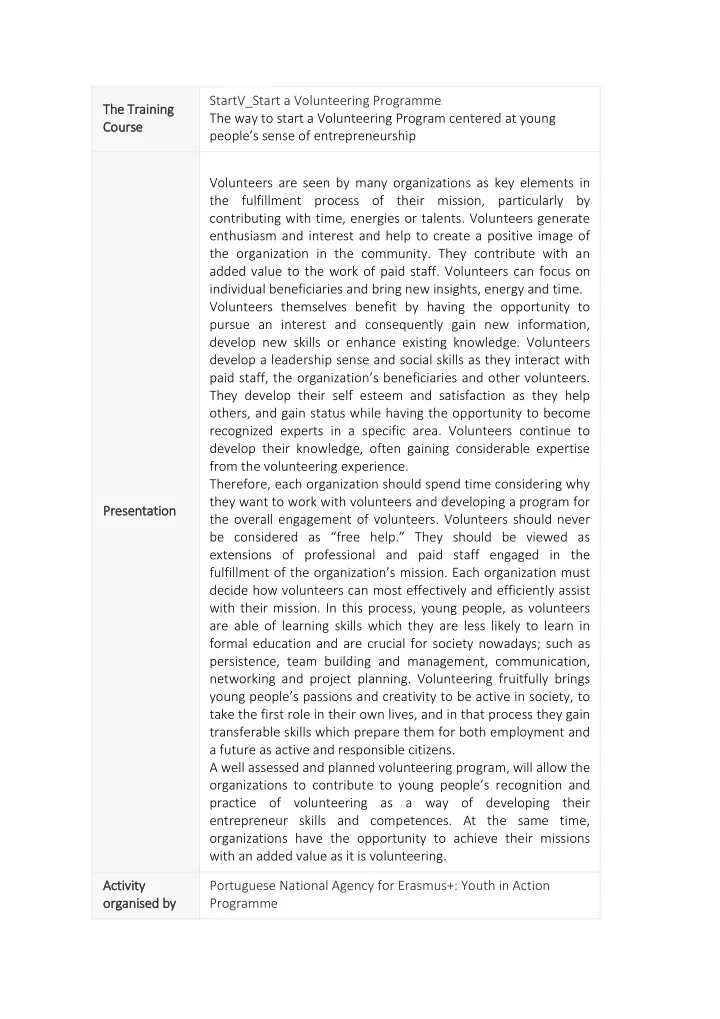
StartV_Start a Volunteering Programme The Train inin ing The way to start a Volunteering Program centered at young Cou ourse peoples sense of entrepreneurship Volunteers are seen by many organizations as key elements in the fulfillment


slide-1
SLIDE 1

The Train inin ing Cou

  • urse

StartV_Start a Volunteering Programme The way to start a Volunteering Program centered at young people’s sense of entrepreneurship Presentati tion

  • n

Volunteers are seen by many organizations as key elements in the fulfillment process of their mission, particularly by contributing with time, energies or talents. Volunteers generate enthusiasm and interest and help to create a positive image of the organization in the community. They contribute with an added value to the work of paid staff. Volunteers can focus on individual beneficiaries and bring new insights, energy and time. Volunteers themselves benefit by having the opportunity to pursue an interest and consequently gain new information, develop new skills or enhance existing knowledge. Volunteers develop a leadership sense and social skills as they interact with paid staff, the organization’s beneficiaries and other volunteers. They develop their self esteem and satisfaction as they help

  • thers, and gain status while having the opportunity to become

recognized experts in a specific area. Volunteers continue to develop their knowledge, often gaining considerable expertise from the volunteering experience. Therefore, each organization should spend time considering why they want to work with volunteers and developing a program for the overall engagement of volunteers. Volunteers should never be considered as “free help.” They should be viewed as extensions of professional and paid staff engaged in the fulfillment of the organization’s mission. Each organization must decide how volunteers can most effectively and efficiently assist with their mission. In this process, young people, as volunteers are able of learning skills which they are less likely to learn in formal education and are crucial for society nowadays; such as persistence, team building and management, communication, networking and project planning. Volunteering fruitfully brings young people’s passions and creativity to be active in society, to take the first role in their own lives, and in that process they gain transferable skills which prepare them for both employment and a future as active and responsible citizens. A well assessed and planned volunteering program, will allow the

  • rganizations to contribute to young people’s recognition and

practice of volunteering as a way of developing their entrepreneur skills and competences. At the same time,

  • rganizations have the opportunity to achieve their missions

with an added value as it is volunteering. Acti tivi vity

  • r
  • rgan

anis ised by by Portuguese National Agency for Erasmus+: Youth in Action Programme

slide-2
SLIDE 2

Su Summar ary This training is aimed to enable youth workers, volunteer managers and other workers from the volunteering field to develop volunteering programs that promote young people’s sense of entrepreneurship and recognize its importance as a quality tool for the achievement of their organization’s mission. Acti tivi vity y date te 9th to 12th of December 2015 Acti tivi vity typ ype Training Course Tar arget t group Youth workers, volunteer coordinators/managers, social workers. For

  • r

par artic ticip ipan ants ts fr from

  • m

YOUTH IN ACTION PROGRAMME COUNTRIES Grou

  • upsiz

ize 25 Venue plac ace, ve venue cou

  • untr

try Faro, Portugal Deta tails ils Why this Training Course?

  • To understand the concept of volunteering in nowadays

society;

  • To recognize volunteering as a way of providing informal

and non-formal learning opportunities;

  • To understand volunteering as a crucial instrument for

developing young people’s entrepreneurship skills;

  • To enable participants to understand and develop a

volunteering program which recognizes the value of youngsters’ entrepreneurship as a vehicle for social change and skills development;

  • To develop skills in planning and preparation of the whole

process of integration and monitoring volunteers through: - Recognition of the importance of preparing and managing volunteering programs;

  • To analyze the integration process of a volunteering

program in an organization;

  • To identify and understand the various stages of a

volunteering program;

  • To develop a volunteering program adapted to different
  • rganizations, according to their characteristics and

particularities;

  • To share tools and resources that will allow participants

to structure their volunteering programs and cooperate after the training course.

slide-3
SLIDE 3

How it will be done? The training course will be based on non-formal learning approaches encouraging the active involvement of participants, giving them space to take an active role, express themselves, share good practice examples and develop a good support network when developing a volunteering programme. The pedagogical process A fundamental flow during the training is based upon:

  • Experiencing: different educational settings, different non

formal education methods (role play, simulation game, work in small groups...)

  • Reflecting: about volunteering, it’s methods and practices in
  • rganizations, on the importance of creating a volunteering

programme to achieve the best results from a volunteering project for the organization and the volunteers themselves.

  • Transferring: to the own reality of participants, in order to

improve ways of implementing volunteering projects.

  • Sharing: different perceptions, current situations and

experiences.

  • Developing: the building capacity of the participants, by giving

them the opportunity to develop a real volunteering programme for their organizations. Participants should be at least 18 years old and should have a good level of English. Workin ing lan languag age English Organ aniz izer Portuguese National Agency for Erasmus+: Youth in Action Programme