Spectrahedra Cynthia Vinzant, North Carolina State University - - PowerPoint PPT Presentation

spectrahedra
SMART_READER_LITE
LIVE PREVIEW

Spectrahedra Cynthia Vinzant, North Carolina State University - - PowerPoint PPT Presentation

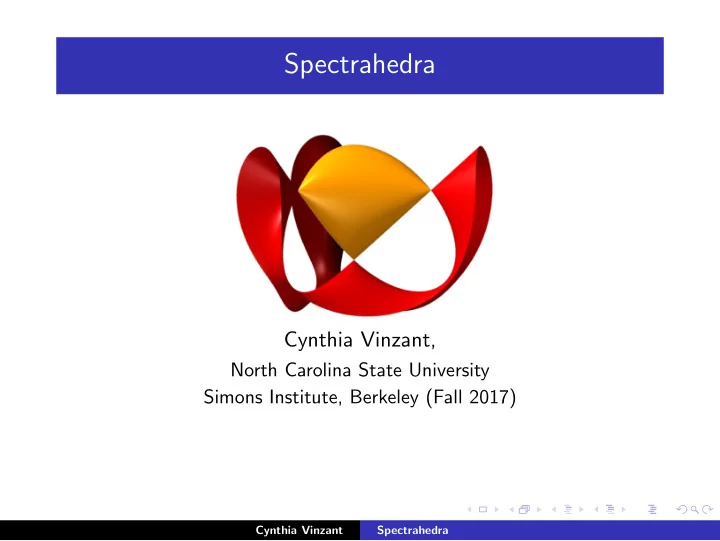
Spectrahedra Cynthia Vinzant, North Carolina State University Simons Institute, Berkeley (Fall 2017) Cynthia Vinzant Spectrahedra Spectrahedra . . . What? Why? Let PSD d denote the convex cone of positive semidefinite matrices in R d d sym .

slide-1
SLIDE 1

Spectrahedra

Cynthia Vinzant,

North Carolina State University Simons Institute, Berkeley (Fall 2017)

Cynthia Vinzant Spectrahedra

slide-2
SLIDE 2

Spectrahedra . . . What? Why?

Let PSDd denote the convex cone of positive semidefinite matrices in Rd×d

sym .

A spectrahedron is the intersection PSDd with an affine linear space L.

Cynthia Vinzant Spectrahedra

slide-3
SLIDE 3

Spectrahedra . . . What? Why?

Let PSDd denote the convex cone of positive semidefinite matrices in Rd×d

sym .

A spectrahedron is the intersection PSDd with an affine linear space L. Writing L = A0 + spanR{A1, . . . , An} identifies L ∩ PSDd with S =

  • x ∈ Rn : A(x) 0
  • where

A(x) = A0 + n

i=1 xiAi.

These are feasible sets of semidefinite programs (extension of linear programming with applications in combinatorial optimization, control, polynomial optimization, quantum information, . . .).

Cynthia Vinzant Spectrahedra

slide-4
SLIDE 4

Some examples

polytope cylinder elliptope

   ℓ1(x) ... ℓ12(x)        1 − x y y 1 + x 1 − z 1 + z       1 x y x 1 z y z 1  

Some differences with polyhedra:

◮ S can have infinitely-many faces ◮ dim(face) + dim(normal cone) not always equal to n.

Cynthia Vinzant Spectrahedra

slide-5
SLIDE 5

Positive semidefinite matrices

A real symmetric matrix A is positive semidefinite if the following equivalent conditions hold:

◮ all eigenvalues of A are ≥ 0 ◮ all diagonal minors of A are ≥ 0 ◮ vTAv ≥ 0 for all v ∈ Rd ◮ there exists B ∈ Rd×k with

A = BBT = (ri, rj)ij =

k

  • i=1

cicT

i

where r1, . . . , rd, c1, . . . , ck are the rows and cols of B

Cynthia Vinzant Spectrahedra

slide-6
SLIDE 6

The convex cone of PSD matrices

The cone of PSD matrices PSDd = conv({xxT : x ∈ Rd}). PSDd is self-dual under the inner product A, B = trace(A · B) : A, B ≥ 0 for all B ∈ PSDd ⇔ A, bbT ≥ 0 for all b ∈ Rd ⇔ bTAb ≥ 0 for all b ∈ Rd ⇔ A ∈ PSDd

Cynthia Vinzant Spectrahedra

slide-7
SLIDE 7

The convex cone of PSD matrices

The cone of PSD matrices PSDd = conv({xxT : x ∈ Rd}). PSDd is self-dual under the inner product A, B = trace(A · B) : A, B ≥ 0 for all B ∈ PSDd ⇔ A, bbT ≥ 0 for all b ∈ Rd ⇔ bTAb ≥ 0 for all b ∈ Rd ⇔ A ∈ PSDd Faces of PSDd have dim r+1

2

  • for r = 0, 1, . . . , d and look like

FL = {A ∈ PSDd : L ⊆ ker(A)}. Ex: for L = span{er+1, . . . , ed}, FL = A

  • : A ∈ PSDr

= PSDr

Cynthia Vinzant Spectrahedra

slide-8
SLIDE 8

Structure of spectrahedra

A spectrahedron S = {x ∈ Rn : A(x) 0} is a convex, basic-closed semi-algebraic set.

A(x, y, z) =     1 − x y y 1 + x 1 − z 1 + z    

↔ Its faces are intersections of faces of PSDd with {A(x) : x ∈ Rn} → characterized by kernels of A(x).

Cynthia Vinzant Spectrahedra

slide-9
SLIDE 9

Spectrahedral Shadows: an interlude

Caution: The projection of spectrahedron may not be a spectrahedron! S = proj(S) = not basic closed ⇒ not a spectrahedron

Cynthia Vinzant Spectrahedra

slide-10
SLIDE 10

Spectrahedral Shadows: an interlude

Caution: The projection of spectrahedron may not be a spectrahedron! S = proj(S) = not basic closed ⇒ not a spectrahedron Caution: The convex dual of spectrahedron may not be a spectrahedron! S =

  • 0.5

S◦ = still not a spectrahedron

Cynthia Vinzant Spectrahedra

slide-11
SLIDE 11

Spectrahedral shadows: an interlude

A spectrahedral shadow is the image of a spectrahedron under linear

  • projection. These are convex semialgebraic sets.

Unlike spectrahedra, the class of spectrahedral shadows is closed under projection, duality, convex hull of unions, . . .

For more, come to “An Afternoon of Real Algebraic Geometry,” MSRI, Friday Sept. 15, 2-6pm.

Cynthia Vinzant Spectrahedra

slide-12
SLIDE 12

Spectrahedral shadows: an interlude

A spectrahedral shadow is the image of a spectrahedron under linear

  • projection. These are convex semialgebraic sets.

Unlike spectrahedra, the class of spectrahedral shadows is closed under projection, duality, convex hull of unions, . . . Helton-Nie Conjecture (2009): Every convex semialgebraic set is a spectrahedral shadow.

For more, come to “An Afternoon of Real Algebraic Geometry,” MSRI, Friday Sept. 15, 2-6pm.

Cynthia Vinzant Spectrahedra

slide-13
SLIDE 13

Spectrahedral shadows: an interlude

A spectrahedral shadow is the image of a spectrahedron under linear

  • projection. These are convex semialgebraic sets.

Unlike spectrahedra, the class of spectrahedral shadows is closed under projection, duality, convex hull of unions, . . . Helton-Nie Conjecture (2009): Every convex semialgebraic set is a spectrahedral shadow. Counterexample by Scheiderer in 2016. Open: What is the smallest dimension of a counterexample?

For more, come to “An Afternoon of Real Algebraic Geometry,” MSRI, Friday Sept. 15, 2-6pm.

Cynthia Vinzant Spectrahedra

slide-14
SLIDE 14

Example: Elliptopes

The d × d elliptope is Ed = {A ∈ PSDd : Aii = 1 for all i} = {d × d correlation matrices} in stats Ed has 2d−1 matrices of rank-one: {xxT : x ∈ {−1, 1}d}, corresponding to cuts in the complete graph Kd.

Cynthia Vinzant Spectrahedra

slide-15
SLIDE 15

Example: Elliptopes

The d × d elliptope is Ed = {A ∈ PSDd : Aii = 1 for all i} = {d × d correlation matrices} in stats Ed has 2d−1 matrices of rank-one: {xxT : x ∈ {−1, 1}d}, corresponding to cuts in the complete graph Kd.

MAXCUT = max

S⊂[d]

  • i∈S,j∈Sc

wij = max

x∈{−1,1}d

  • i,j

wij (1 − xixj) 2 = max

A∈Ed,rk(A)=1

  • i,j

wij (1 − Aij) 2 ≤ max

A∈Ed

  • i,j

wij (1 − Aij) 2 .

Goemans-Williamson use this to give ≈ .87 optimal cuts of graphs.

Cynthia Vinzant Spectrahedra

slide-16
SLIDE 16

Example: Univariate Moments

S = conv{(t, t2, . . . , t2d) : t ∈ R} is a spectrahedron in R2d S =

  • x ∈ R2d : M(x) 0
  • where M(x) = (xi+j−2)1≤i,j≤d+1

Cynthia Vinzant Spectrahedra

slide-17
SLIDE 17

Example: Univariate Moments

S = conv{(t, t2, . . . , t2d) : t ∈ R} is a spectrahedron in R2d S =

  • x ∈ R2d : M(x) 0
  • where M(x) = (xi+j−2)1≤i,j≤d+1
  • Ex. (d=1): conv{(t, t2) : t ∈ R} =
  • (x1, x2) :

1 x1 x1 x2

  • Cynthia Vinzant

Spectrahedra

slide-18
SLIDE 18

Example: Univariate Moments

S = conv{(t, t2, . . . , t2d) : t ∈ R} is a spectrahedron in R2d S =

  • x ∈ R2d : M(x) 0
  • where M(x) = (xi+j−2)1≤i,j≤d+1
  • Ex. (d=1): conv{(t, t2) : t ∈ R} =
  • (x1, x2) :

1 x1 x1 x2

  • Minimization of univariate polynomial of degree ≤ 2d

→Minimization of linear function over S

Cynthia Vinzant Spectrahedra

slide-19
SLIDE 19

Example: Univariate Moments

S = conv{(t, t2, . . . , t2d) : t ∈ R} is a spectrahedron in R2d S =

  • x ∈ R2d : M(x) 0
  • where M(x) = (xi+j−2)1≤i,j≤d+1
  • Ex. (d=1): conv{(t, t2) : t ∈ R} =
  • (x1, x2) :

1 x1 x1 x2

  • Minimization of univariate polynomial of degree ≤ 2d

→Minimization of linear function over S Ex: conv{(t, t2, t3) : t ∈ [−1, 1]} =

  • x ∈ R3 :

1 ± x1 x1 ± x2 x1 ± x2 x2 ± x3

  • Cynthia Vinzant

Spectrahedra

slide-20
SLIDE 20

Extreme Points: Pataki range

S = {x ∈ Rn : A(x) 0}, dim(S) = n, Ai ∈ Rd×d

sym .

If x is an extreme point of S and r is the rank of A(x) then r + 1 2

  • + n ≤

d + 1 2

  • Furthermore if A0, . . . , An are generic, then n ≥

d−r+1

2

  • .

The interval of r ∈ Z+ satisfying both ≤’s is the Pataki range.

Cynthia Vinzant Spectrahedra

slide-21
SLIDE 21

Extreme Points: Pataki range

S = {x ∈ Rn : A(x) 0}, dim(S) = n, Ai ∈ Rd×d

sym .

If x is an extreme point of S and r is the rank of A(x) then r + 1 2

  • + n ≤

d + 1 2

  • Furthermore if A0, . . . , An are generic, then n ≥

d−r+1

2

  • .

The interval of r ∈ Z+ satisfying both ≤’s is the Pataki range. Open: For each d, n, is there a spectrahedron with an extreme point of each rank in the Pataki range?

Cynthia Vinzant Spectrahedra

slide-22
SLIDE 22

Facial structure

Example: d = 3, n = 3 Pataki range: r = 1, 2

Cynthia Vinzant Spectrahedra

slide-23
SLIDE 23

Facial structure

Example: d = 3, n = 3 Pataki range: r = 1, 2

Counting rank-1 matrices: {X : rank(X) ≤ 1} is variety of codim 3 and degree 4 in R3×3

sym .

⇒ 0, 1, 2, 3, 4 or ∞ rank-1 matrices in S (generically 0,2, or 4)

Cynthia Vinzant Spectrahedra

slide-24
SLIDE 24

Facial structure

Example: d = 3, n = 3 Pataki range: r = 1, 2

Counting rank-1 matrices: {X : rank(X) ≤ 1} is variety of codim 3 and degree 4 in R3×3

sym .

⇒ 0, 1, 2, 3, 4 or ∞ rank-1 matrices in S (generically 0,2, or 4) There must be ≥ 1 rank-1 matrix. Why? Topology! If ∂S has no rank-1 matrices, then the map S2 ∼ = ∂S → P2(R) given by x → ker(A(x)) is an embedding. ⇒⇐ (For more see Friedland, Robbin, Sylvester,1984)

Cynthia Vinzant Spectrahedra

slide-25
SLIDE 25

Another connection with topology

Suppose A0 = I and let f (x) = det(A(x)). ⇒ f is hyperbolic, i.e. for every x ∈ Rn, f (tx) ∈ R[t] is real-rooted.

Cynthia Vinzant Spectrahedra

slide-26
SLIDE 26

Another connection with topology

Suppose A0 = I and let f (x) = det(A(x)). ⇒ f is hyperbolic, i.e. for every x ∈ Rn, f (tx) ∈ R[t] is real-rooted. If VR(f ) is smooth, this implies that that VR(f ) ⊂ Pn−1 consists of ⌊d/2⌋ nested spheres.

Cynthia Vinzant Spectrahedra

slide-27
SLIDE 27

Another connection with topology

Suppose A0 = I and let f (x) = det(A(x)). ⇒ f is hyperbolic, i.e. for every x ∈ Rn, f (tx) ∈ R[t] is real-rooted. If VR(f ) is smooth, this implies that that VR(f ) ⊂ Pn−1 consists of ⌊d/2⌋ nested spheres. Open (Generalized Lax Conjecture): Is every hyperbolicity region a spectrahedron?

Cynthia Vinzant Spectrahedra

slide-28
SLIDE 28

Combinatorics of spectrahedra

What is the “f -vector” of a spectrahedron? Extreme points and faces of S come with a lot of discrete data . . . dimension, matrix rank, dimension of normal cone, degree, # number of connected components, Betti #s, . . .

Cynthia Vinzant Spectrahedra

slide-29
SLIDE 29

Combinatorics of spectrahedra

What is the “f -vector” of a spectrahedron? Extreme points and faces of S come with a lot of discrete data . . . dimension, matrix rank, dimension of normal cone, degree, # number of connected components, Betti #s, . . . Very open: What values are possible?

Cynthia Vinzant Spectrahedra