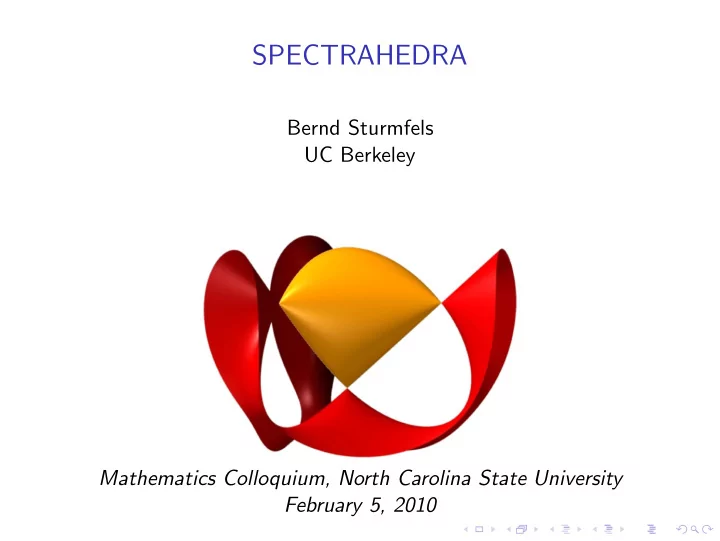
SLIDE 1
SPECTRAHEDRA
Bernd Sturmfels UC Berkeley Mathematics Colloquium, North Carolina State University February 5, 2010
SLIDE 2 Positive Semidefinite Matrices
For a real symmetric n × n-matrix A the following are equivalent:
◮ All n eigenvalues of A are positive real numbers. ◮ All 2n principal minors of A are positive real numbers. ◮ Every non-zero vector x ∈ Rn satisfies xTA · x > 0.
A matrix A is positive definite if it satisfies these properties, and it is positive semidefinite if the following equivalent properties hold:
◮ All n eigenvalues of A are non-negative real numbers. ◮ All 2n principal minors of A are non-negative real numbers. ◮ Every vector x ∈ Rn satisfies xT A · x ≥ 0.
The set of all positive semidefinite n × n-matrices is a convex cone of full dimension n+1
2
- . It is closed and semialgebraic.
The interior of this cone consists of all positive definite matrices.
SLIDE 3
Semidefinite Programming
A spectrahedron is the intersection of the cone of positive semidefinite matrices with an affine-linear space. Its algebraic representation is a linear combination of symmetric matrices A0 + x1A1 + x2A2 + · · · + xmAm 0 (∗) Engineers call this is a linear matrix inequality.
SLIDE 4 Semidefinite Programming
A spectrahedron is the intersection of the cone of positive semidefinite matrices with an affine-linear space. Its algebraic representation is a linear combination of symmetric matrices A0 + x1A1 + x2A2 + · · · + xmAm 0 (∗) Engineers call this is a linear matrix inequality. Semidefinite programming is the computational problem
- f maximizing a linear function over a spectrahedron:
Maximize c1x1 + c2x2 + · · · + cmxm subject to (∗) Example: The smallest eigenvalue of a symmetric matrix A is the solution of the SDP Maximize x subject to A − x · Id 0.
SLIDE 5 Convex Polyhedra
Linear programming is semidefinite programming for diagonal
- matrices. If A0, A1, . . . , Am are diagonal n×n-matrices then
A0 + x1A1 + x2A2 + · · · + xmAm 0 translates into a system of n linear inequalities in the m unknowns.
SLIDE 6 Convex Polyhedra
Linear programming is semidefinite programming for diagonal
- matrices. If A0, A1, . . . , Am are diagonal n×n-matrices then
A0 + x1A1 + x2A2 + · · · + xmAm 0 translates into a system of n linear inequalities in the m unknowns. A spectrahedron defined in this manner is a convex polyhedron:
SLIDE 7
Pictures in Dimension Two
Here is a picture of a spectrahedron for m = 2 and n = 3:
SLIDE 8
Pictures in Dimension Two
Here is a picture of a spectrahedron for m = 2 and n = 3: Duality is important in both optimization and projective geometry:
SLIDE 9 Example: Multifocal Ellipses
Given m points (u1, v1), . . . , (um, vm) in the plane R2, and a radius d > 0, their m-ellipse is the convex algebraic curve
m
- k=1
- (x−uk)2 + (y−vk)2 = d
- .
The 1-ellipse and the 2-ellipse are algebraic curves of degree 2.
SLIDE 10 Example: Multifocal Ellipses
Given m points (u1, v1), . . . , (um, vm) in the plane R2, and a radius d > 0, their m-ellipse is the convex algebraic curve
m
- k=1
- (x−uk)2 + (y−vk)2 = d
- .
The 1-ellipse and the 2-ellipse are algebraic curves of degree 2. The 3-ellipse is an algebraic curve of degree 8:
SLIDE 11
2, 2, 8, 10, 32, ...
The 4-ellipse is an algebraic curve of degree 10: The 5-ellipse is an algebraic curve of degree 32:
SLIDE 12
Concentric Ellipses
What is the algebraic degree of the m-ellipse? How to write its equation? What is the smallest radius d for which the m-ellipse is non-empty? How to compute the Fermat-Weber point?
SLIDE 13 3D View
C =
m
- k=1
- (x−uk)2 + (y−vk)2 ≤ d
- .
SLIDE 14 Ellipses are Spectrahedra
The 3-ellipse with foci (0, 0), (1, 0), (0, 1) has the representation
2 6 6 6 6 6 6 6 6 6 4 d + 3x − 1 y − 1 y y y − 1 d + x − 1 y y y d + x + 1 y − 1 y y y − 1 d − x + 1 y y d + x − 1 y − 1 y y y − 1 d − x − 1 y y y d − x + 1 y − 1 y y y − 1 d − 3x + 1 3 7 7 7 7 7 7 7 7 7 5
The ellipse consists of all points (x, y) where this symmetric 8×8-matrix is positive semidefinite. Its boundary is a curve
SLIDE 15 2, 2, 8, 10, 32, 44, 128, ...
Theorem: The polynomial equation defining the m-ellipse has degree 2m if m is odd and degree 2m− m
m/2
We express this polynomial as the determinant of a symmetric matrix of linear polynomials. Our representation extends to weighted m-ellipses and m-ellipsoids in arbitrary dimensions .....
[J. Nie, P. Parrilo, B.St.: Semidefinite representation of the k-ellipse, in Algorithms in Algebraic Geometry, I.M.A. Volumes in Mathematics and its Applications, 146, Springer, New York, 2008, pp. 117-132]
In other words, m-ellipses and m-ellipsoids are spectrahedra. The problem of finding the Fermat-Weber point is an SDP.
SLIDE 16 2, 2, 8, 10, 32, 44, 128, ...
Theorem: The polynomial equation defining the m-ellipse has degree 2m if m is odd and degree 2m− m
m/2
We express this polynomial as the determinant of a symmetric matrix of linear polynomials. Our representation extends to weighted m-ellipses and m-ellipsoids in arbitrary dimensions .....
[J. Nie, P. Parrilo, B.St.: Semidefinite representation of the k-ellipse, in Algorithms in Algebraic Geometry, I.M.A. Volumes in Mathematics and its Applications, 146, Springer, New York, 2008, pp. 117-132]
In other words, m-ellipses and m-ellipsoids are spectrahedra. The problem of finding the Fermat-Weber point is an SDP. Let’s now look at some spectrahedra in dimension three. Our next picture shows the typical behavior for m = 3 and n = 3.
SLIDE 17
A Spectrahedron and its Dual
SLIDE 18 Non-Linear Convex Hull Computation
Input :
- (t, t2, t3) ∈ R3 : −1 ≤ t ≤ 1
- −1
−0.5 0.5 1 0.5 1 −1 −0.8 −0.6 −0.4 −0.2 0.2 0.4 0.6 0.8 1 y1 y2 y3
SLIDE 19 Non-Linear Convex Hull Computation
Input :
- (t, t2, t3) ∈ R3 : −1 ≤ t ≤ 1
- −1
−0.5 0.5 1 0.5 1 −1 −0.8 −0.6 −0.4 −0.2 0.2 0.4 0.6 0.8 1 y1 y2 y3
The convex hull of the moment curve is a spectrahedron. Output : 1 x x y
x y y z
SLIDE 20
Characterization of Spectrahedra
A convex hypersurface of degree d in Rn is rigid convex if every line passing through its interior meets (the Zariski closure of) that hypersurface in d real points.
Theorem (Helton–Vinnikov (2006))
Every spectrahedron is rigid convex. The converse is true for n = 2.
SLIDE 21
Characterization of Spectrahedra
A convex hypersurface of degree d in Rn is rigid convex if every line passing through its interior meets (the Zariski closure of) that hypersurface in d real points.
Theorem (Helton–Vinnikov (2006))
Every spectrahedron is rigid convex. The converse is true for n = 2. Open problem: Is every compact convex basic semialgebraic set S the projection of a spectrahedron in higher dimensions?
Theorem (Helton–Nie (2008))
The answer is yes if the boundary of S is “sufficiently smooth”.
SLIDE 22 Questions about 3-Dimensional Spectrahedra
What are the edge graphs of spectrahedra in R3? How can one define their combinatorial types? Is there an analogue to Steinitz’ Theorem for polytopes in R3? Consider 3-dimensional spectrahedra whose boundary is an irreducible surface of degree n. Can such a spectrahedron have n+1
3
- isolated singularities in its boundary? How about n = 4?
SLIDE 23
Minimizing Polynomial Functions
Let f (x1, . . . , xm) be a polynomial of even degree 2d. We wish to compute the global minimum x∗ of f (x) on Rm. This optimization problem is equivalent to Maximize λ such that f (x) − λ is non-negative on Rm. This problem is very hard.
SLIDE 24
Minimizing Polynomial Functions
Let f (x1, . . . , xm) be a polynomial of even degree 2d. We wish to compute the global minimum x∗ of f (x) on Rm. This optimization problem is equivalent to Maximize λ such that f (x) − λ is non-negative on Rm. This problem is very hard. The optimal value of the following relaxtion gives a lower bound. Maximize λ such that f (x) − λ is a sum of squares of polynomials. The second problem is much easier. It is a semidefinite program.
SLIDE 25
Minimizing Polynomial Functions
Let f (x1, . . . , xm) be a polynomial of even degree 2d. We wish to compute the global minimum x∗ of f (x) on Rm. This optimization problem is equivalent to Maximize λ such that f (x) − λ is non-negative on Rm. This problem is very hard. The optimal value of the following relaxtion gives a lower bound. Maximize λ such that f (x) − λ is a sum of squares of polynomials. The second problem is much easier. It is a semidefinite program. Empirically, the optimal value of the SDP almost always agrees with the global minimum. In that case, the optimal matrix of the dual SDP has rank one, and the optimal point x∗ can be recovered from this. How to reconcile this with Blekherman’s results?
SLIDE 26 SOS Programming: A Univariate Example
Let m = 1, d = 2 and f (x) = 3x4 + 4x3 − 12x2. Then f (x) − λ =
1
3 2 µ − 6 2 −2µ µ − 6 −λ x2 x 1 Our problem is to find (λ, µ) such that the 3×3-matrix is positive semidefinite and λ is maximal.
SLIDE 27 SOS Programming: A Univariate Example
Let m = 1, d = 2 and f (x) = 3x4 + 4x3 − 12x2. Then f (x) − λ =
1
3 2 µ − 6 2 −2µ µ − 6 −λ x2 x 1 Our problem is to find (λ, µ) such that the 3×3-matrix is positive semidefinite and λ is maximal. The optimal solution of this SDP is (λ∗, µ∗) = (−32, −2). Cholesky factorization reveals the SOS representation f (x) − λ∗ =
√ 3 x − 4 √ 3 ) · (x + 2) 2 + 8 3
2. We see that the global minimum is x∗ = −2. This approach works for many polynomial optimization problems.
SLIDE 28
My Favorite Spectrahedron
Consider the intersection of the cone of 6×6 PSD matrices with the 15-dimensional linear space consisting of all Hankel matrices H = λ400 λ220 λ202 λ310 λ301 λ211 λ220 λ040 λ022 λ130 λ121 λ031 λ202 λ022 λ004 λ112 λ103 λ013 λ310 λ130 λ112 λ220 λ211 λ121 λ301 λ121 λ103 λ211 λ202 λ112 λ211 λ031 λ013 λ121 λ112 λ022 . This is a 15-dimensional spectrahedral cone.
SLIDE 29
My Favorite Spectrahedron
Consider the intersection of the cone of 6×6 PSD matrices with the 15-dimensional linear space consisting of all Hankel matrices H = λ400 λ220 λ202 λ310 λ301 λ211 λ220 λ040 λ022 λ130 λ121 λ031 λ202 λ022 λ004 λ112 λ103 λ013 λ310 λ130 λ112 λ220 λ211 λ121 λ301 λ121 λ103 λ211 λ202 λ112 λ211 λ031 λ013 λ121 λ112 λ022 . This is a 15-dimensional spectrahedral cone. Dual to this intersection is the projection Sym2(Sym2(R3)) → Sym4(R3) taking a 6×6-matrix to the ternary quartic it represents. Its image is a cone whose algebraic boundary is a discriminant of degree 27.
SLIDE 30
Orbitopes
An orbitope is the convex hull of an orbit under a real algebraic representation of a compact Lie group. Primary examples are the groups SO(n) and their products. Orbitopes for their adjoint representations are continuous analogues of permutohedra. Many of these special orbitopes are projections of spectrahedra. A recent paper with Raman Sanyal and Frank Sottile develops the basic theory of orbitopes and has many examples.
SLIDE 31
Orbitopes
An orbitope is the convex hull of an orbit under a real algebraic representation of a compact Lie group. Primary examples are the groups SO(n) and their products. Orbitopes for their adjoint representations are continuous analogues of permutohedra. Many of these special orbitopes are projections of spectrahedra. A recent paper with Raman Sanyal and Frank Sottile develops the basic theory of orbitopes and has many examples. Example: Consider the orbitope of (x+y+z)4 under the SO(3)-action on the space Sym4(R3) of ternary quartics. Quiz: Is this orbitope a spectrahedron?
SLIDE 32 Orbitopes
An orbitope is the convex hull of an orbit under a real algebraic representation of a compact Lie group. Primary examples are the groups SO(n) and their products. Orbitopes for their adjoint representations are continuous analogues of permutohedra. Many of these special orbitopes are projections of spectrahedra. A recent paper with Raman Sanyal and Frank Sottile develops the basic theory of orbitopes and has many examples. Example: Consider the orbitope of (x+y+z)4 under the SO(3)-action on the space Sym4(R3) of ternary quartics. Quiz: Is this orbitope a spectrahedron? Answer: Yes, it is the set of psd Hankel matrices H that satisfy λ400 + λ040 + λ004 + 2λ220 + 2λ202 + 2λ022 = 9.
- Problem. Classify all SO(n)-orbitopes that are spectrahedra.
SLIDE 33 Barvinok-Novik Orbitopes
The SO(2)-orbitope BN4 is the convex hull of the curve θ →
- cos(θ), sin(θ), cos(3θ), sin(3θ)
- ∈ R4.
This is the projection of a 6-dimensional Hermitian spectrahedron:
SLIDE 34 Barvinok-Novik Orbitopes
The SO(2)-orbitope BN4 is the convex hull of the curve θ →
- cos(θ), sin(θ), cos(3θ), sin(3θ)
- ∈ R4.
This is the projection of a 6-dimensional Hermitian spectrahedron: 1 x1 x2 x3 y1 1 x1 x2 y2 y1 1 x1 y3 y2 y1 1 where xj = cj + √−1 · sj, yj = cj − √−1 · sj, under the map (c1, c2, c3, s1, s2, s3) → (c1, c3, s1, s3). Here the unknown cj represents cos(jθ), the unknown sj represents sin(jθ). The curve is cut out by the 2×2-minors of the Toeplitz matrix.
SLIDE 35 Barvinok-Novik Orbitopes
The SO(2)-orbitope BN4 is the convex hull of the curve θ →
- cos(θ), sin(θ), cos(3θ), sin(3θ)
- ∈ R4.
This is the projection of a 6-dimensional Hermitian spectrahedron: 1 x1 x2 x3 y1 1 x1 x2 y2 y1 1 x1 y3 y2 y1 1 where xj = cj + √−1 · sj, yj = cj − √−1 · sj, under the map (c1, c2, c3, s1, s2, s3) → (c1, c3, s1, s3). Here the unknown cj represents cos(jθ), the unknown sj represents sin(jθ). The curve is cut out by the 2×2-minors of the Toeplitz matrix. The faces of BN4 are certain edges and triangles. Its algebraic boundary is the threefold defined by the degree 8 polynomial x2
3y 6 1 − 2x3 1x3y 3 1 y3 + x6 1y 2 3 + 4x3 1 y 3 1 − 6x1x3y 4 1 − 6x4 1y1y3 + 12x2 1 x3y 2 1 y3
− 2x2
3y 3 1 y3 − 2x3 1x3y 2 3 − 3x2 1y 2 1 + 4x3y 3 1 + 4x3 1y3 − 6x1x3y1y3 + x2 3y 2 3 .
SLIDE 36
Conclusion
Spectrahedra and orbitopes deserve to be studied in their own right, independently of their important uses in applications. A true understanding of these convex bodies will require the integration of three different areas of mathematics:
◮ Combinatorial Convexity ◮ Algebraic Geometry ◮ Optimization Theory
Please join us at IPAM in the Fall of 2010 !!